
Give 10 marks answer of shoulder joint
The Shoulder Joint (Glenohumeral Joint)
1. Introduction
2. Articulating Surfaces
| Structure | Description |
|---|---|
| Head of humerus | Large, rounded; covered with hyaline cartilage |
| Glenoid cavity of scapula | Shallow, pear-shaped fossa; faces anterolaterally |
| Glenoid labrum | Fibrocartilaginous ring that deepens the cavity marginally |
3. Capsule and Ligaments
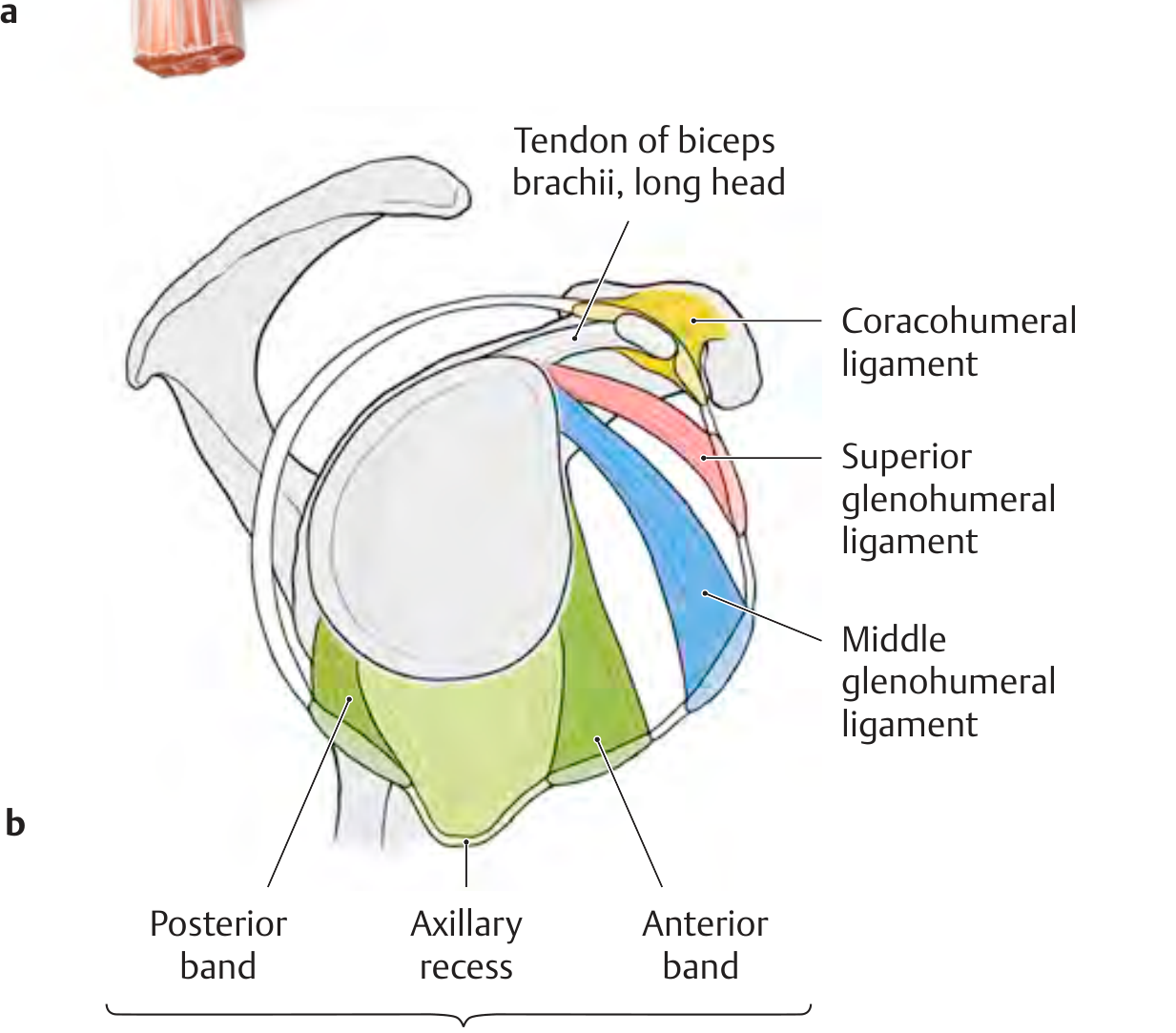
- Superior glenohumeral ligament (SGHL): Runs from the upper glenoid margin to the intertubercular groove and lesser tubercle. Forms the "roof" of the biceps pulley (rotator interval).
- Middle glenohumeral ligament (MGHL): Passes at almost a right angle to the subscapularis tendon from the upper glenoid margin to the anatomic neck of the humerus.
- Inferior glenohumeral ligament (IGHL): The most important stabiliser. Has three parts: anterior band, posterior band, and axillary recess (which hangs as a "hammock" during abduction). Extends from the inferior glenoid margin to the surgical neck of the humerus. This is the primary restraint to anterior-inferior dislocation.
4. Rotator Cuff (Dynamic Stabilisers)
| Muscle | Origin | Insertion | Action |
|---|---|---|---|
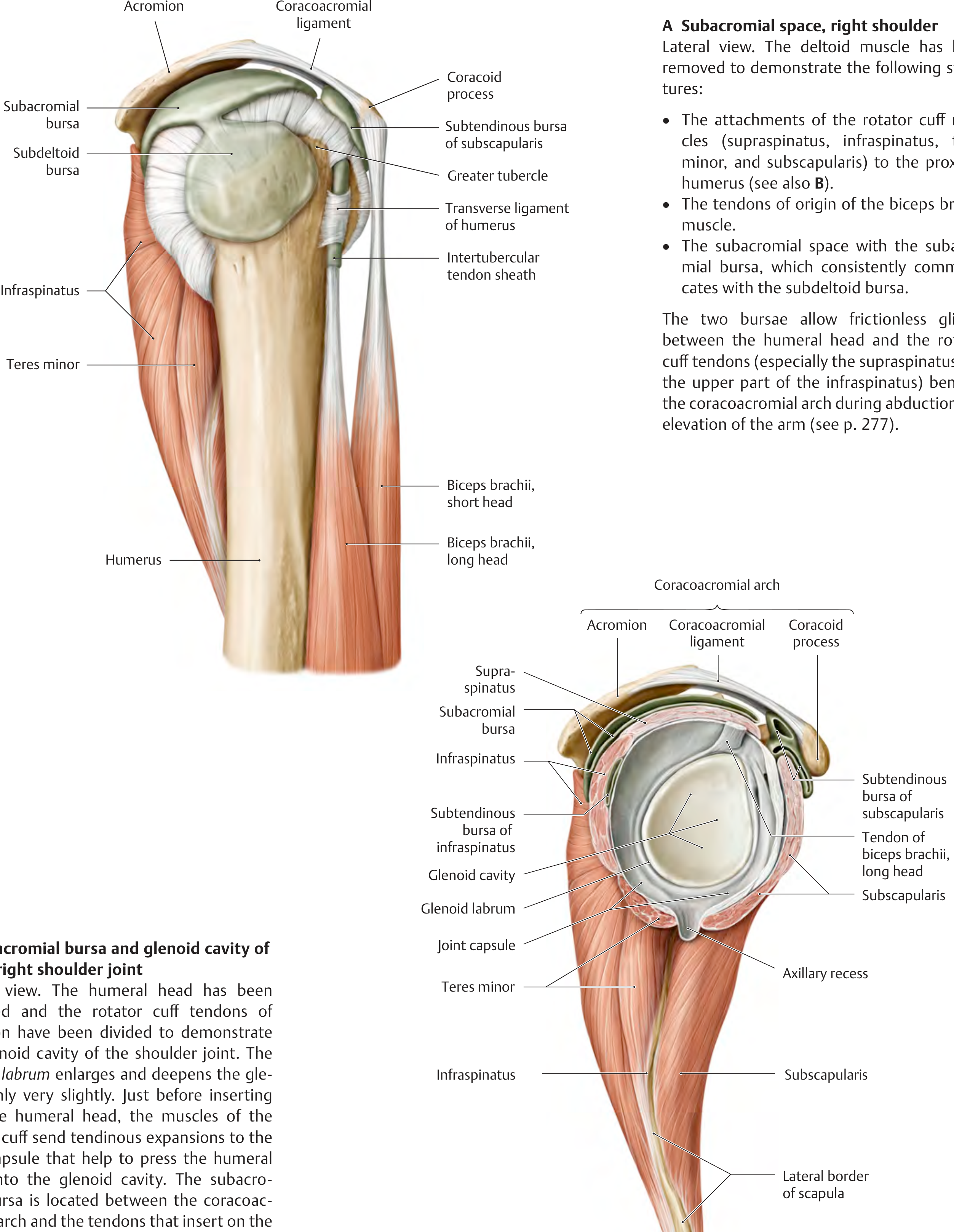
| Supraspinatus | Supraspinous fossa | Greater tubercle (superior facet) | Initiates abduction (first 0-10°); keeps humeral head centred in glenoid |
| Infraspinatus | Infraspinous fossa | Greater tubercle (middle facet) | External rotation |
| Teres minor | Lateral border of scapula | Greater tubercle (inferior facet) | External rotation |
| Subscapularis | Subscapular fossa (anterior scapula) | Lesser tubercle | Internal rotation (sole anterior muscle) |
5. Bursae
- Subacromial bursa - lies between the coracoacromial arch and the rotator cuff tendons; allows frictionless gliding during arm elevation.
- Subdeltoid bursa - between the deltoid and greater tubercle; communicates consistently with the subacromial bursa.
- Subtendinous bursa of subscapularis - between the subscapularis tendon and the scapular neck; may communicate with the joint cavity.
- Subtendinous bursa of infraspinatus - posterior aspect.
6. Intracapsular Structures
- Tendon of the long head of biceps brachii: Arises from the supraglenoid tubercle inside the capsule, passes over the humeral head, and exits through the intertubercular groove where it is held by the transverse humeral ligament. It is a weak stabiliser that assists the rotator cuff.
- Synovial membrane: Lines the capsule and extends as a sleeve around the biceps long head tendon, forming the intertubercular tendon sheath.
7. Movements and Muscles Responsible
| Movement | Range | Prime Movers |
|---|---|---|
| Flexion | 0-180° | Anterior deltoid, pectoralis major (clavicular), coracobrachialis, biceps brachii |
| Extension | 0-60° | Posterior deltoid, latissimus dorsi, teres major |
| Abduction | 0-180° | Supraspinatus (first 10-15°), middle deltoid; requires scapular rotation for full elevation |
| Adduction | - | Pectoralis major, latissimus dorsi, teres major |
| Internal rotation | 0-70° | Subscapularis, pectoralis major, latissimus dorsi, teres major, anterior deltoid |
| External rotation | 0-90° | Infraspinatus, teres minor, posterior deltoid |
| Circumduction | Full arc | Combination of above |
8. Nerve Supply
- Axillary nerve (C5, C6) - primary supply
- Suprascapular nerve (C5, C6) - posterosuperior capsule
- Musculocutaneous nerve (C5, C6, C7) - anterior capsule (small branch)
- Lateral pectoral nerve - anterosuperior capsule
9. Blood Supply
- Anterior and posterior circumflex humeral arteries (branches of the axillary artery) - form an anastomotic ring around the surgical neck
- Suprascapular artery (from thyrocervical trunk)
- Subscapular artery (from axillary artery)
10. Clinical Correlations
- Anterior dislocation (95% of cases) - the humeral head is forced anteroinferiorly, typically rupturing the anterior capsule/IGHL. The Hill-Sachs lesion (posterosuperior humeral head impaction defect) and Bankart lesion (avulsion of the anteroinferior glenoid labrum) are characteristic MRI findings.
- Axillary nerve injury is the most common neurological complication.
- Supraspinatus tendon is involved in 95% of complete tears.
- Subacromial impingement is caused by mechanical contact between the calcified or degenerate supraspinatus tendon and the coracoacromial arch during abduction.
- Progressive contracture and fibrosis of the joint capsule, especially the IGHL and rotator interval, leading to loss of external rotation and abduction.
- Detachment of the glenoid labrum and IGHL from the anteroinferior glenoid rim, causing recurrent anterior instability. Treated by arthroscopic Bankart repair with anchor sutures.
Knee joint
The Knee Joint
1. Introduction
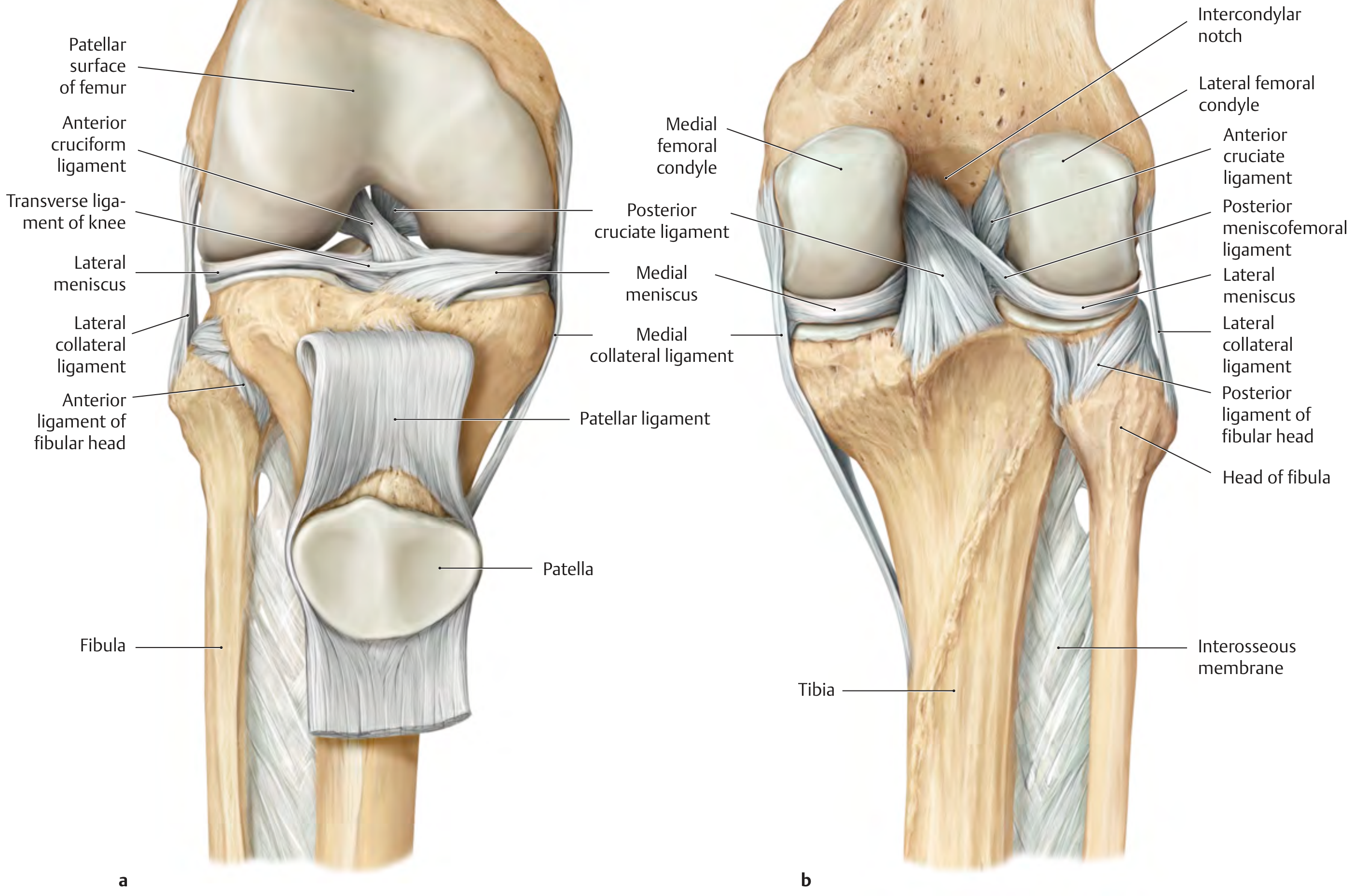
- Tibiofemoral joint - between the femoral condyles and tibial condyles; weight-bearing.
- Patellofemoral joint - between the patella and the patellar (trochlear) surface of the femur; redirects the pull of the quadriceps anteriorly over the knee.
2. Articulating Surfaces
| Bone | Articular Surface |
|---|---|
| Femur | Two condyles (medial and lateral) + patellar (trochlear) surface anteriorly |
| Tibia | Superior surfaces of medial and lateral condyles (tibial plateau) |
| Patella | Posterior articular surface (divided by a vertical ridge) |
3. Menisci
| Feature | Medial Meniscus | Lateral Meniscus |
|---|---|---|
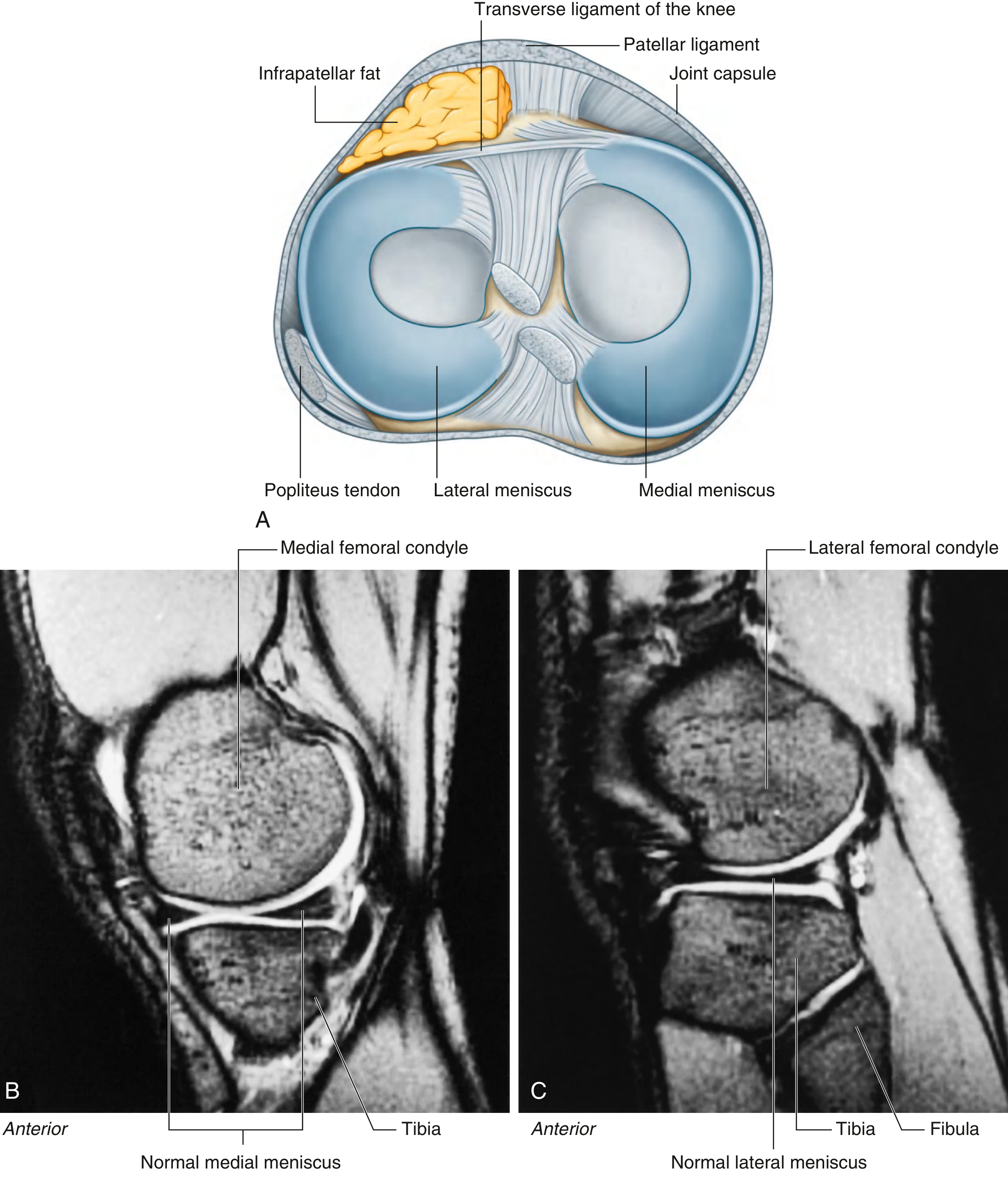
| Shape | C-shaped (larger, wider posteriorly) | Nearly circular (O-shaped) |
| Attachment | Firmly attached to joint capsule and tibial (medial) collateral ligament | Not attached to capsule or LCL; connected to popliteus tendon |
| Mobility | Less mobile | More mobile |
| Injury risk | Higher (less mobile - commonly torn) | Lower |
4. Articular Capsule
- Anteriorly: Deficient in midline, replaced by the patella and patellar ligament. Reinforced by the quadriceps expansion and patellar retinacula.
- Posteriorly: Reinforced by the oblique popliteal ligament (expansion of semimembranosus) and arcuate popliteal ligament.
- The cruciate ligaments lie within the fibrous capsule but outside the synovial cavity (they are intracapsular but extrasynovial).
5. Ligaments
A. Cruciate Ligaments (Intrinsic - inside the capsule)
| Ligament | Tibial Attachment | Femoral Attachment | Function |
|---|---|---|---|
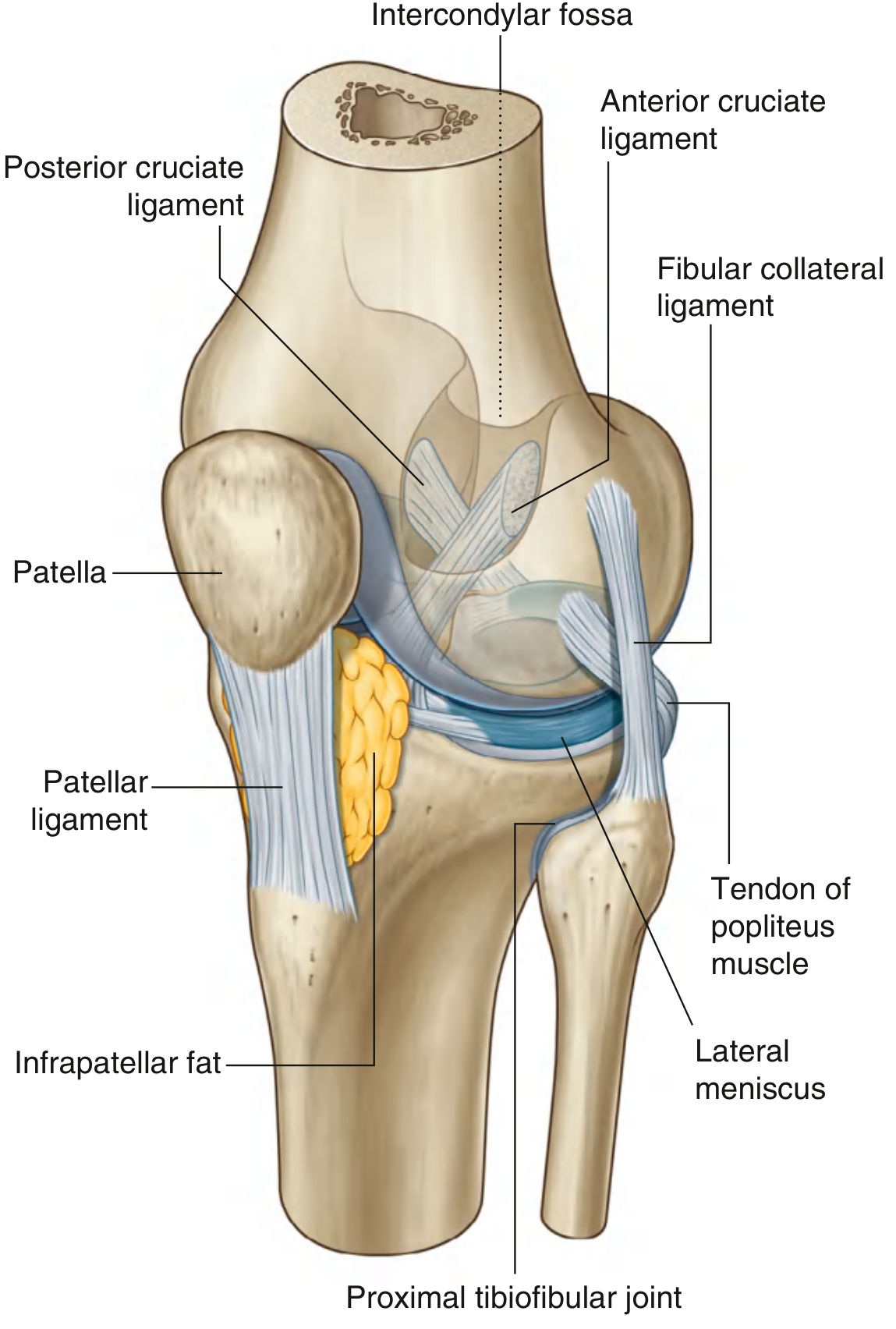
| ACL (Anterior Cruciate) | Anterior intercondylar area | Medial surface of lateral femoral condyle (posterior intercondylar notch) | Prevents anterior displacement of tibia on femur; limits hyperextension |
| PCL (Posterior Cruciate) | Posterior intercondylar area | Lateral surface of medial femoral condyle | Prevents posterior displacement of tibia; stronger and thicker than ACL |
B. Collateral Ligaments (Extrinsic)
| Ligament | Origin | Insertion | Function |
|---|---|---|---|
| MCL (Tibial collateral) | Medial femoral epicondyle | Medial surface of upper tibia (~7-8 cm below tibial plateau) | Resists valgus stress; stabilises in coronal plane |
| LCL (Fibular collateral) | Lateral femoral epicondyle | Head of fibula | Resists varus stress |
C. Patellar Ligament
D. Other Ligaments
- Transverse ligament of knee: Connects the anterior horns of both menisci.
- Oblique popliteal ligament: Posterior capsule reinforcement.
- Arcuate popliteal ligament: Y-shaped, reinforces posterolateral capsule.
6. Synovial Membrane and Bursae
| Bursa | Location | Communication with joint |
|---|---|---|
| Suprapatellar bursa | Between distal femur and quadriceps tendon | Always communicates (clinically an extension of the joint) |
| Prepatellar bursa (subcutaneous) | Over the patella | No |
| Infrapatellar bursa (deep) | Between patellar ligament and upper tibia | No |
| Infrapatellar bursa (subcutaneous) | Over tibial tuberosity | No |
| Popliteal (Baker's) cyst | Medial popliteal fossa - fusion of semimembranosus + gastrocnemius bursa | Secondary communication in disease states |
7. Movements and Muscles Responsible
| Movement | Range | Prime Movers |
|---|---|---|
| Flexion | 0-135° (active); 160° (passive) | Hamstrings (biceps femoris, semitendinosus, semimembranosus), gastrocnemius, popliteus, sartorius, gracilis |
| Extension | 0° (full extension) | Quadriceps femoris (rectus femoris, vastus medialis, lateralis, intermedius) |
| Medial rotation (tibia on femur, knee flexed) | ~10° | Popliteus, semitendinosus, semimembranosus, sartorius, gracilis |
| Lateral rotation (tibia on femur, knee flexed) | ~30° | Biceps femoris |
8. Locking Mechanism
- The broad, flat inferior femoral condyle surfaces come into contact with the tibial plateau - maximising joint congruence.
- Because the medial femoral condyle has a longer articular surface, the femur undergoes medial rotation on the tibia during the last few degrees of extension.
- This tightens all ligaments (especially the collateral and cruciate ligaments), locking the joint in a "close-packed" position.
- This passive stability reduces quadriceps energy expenditure during prolonged standing.
9. Blood Supply
- Femoral artery - descending genicular artery
- Popliteal artery - 5 genicular branches (superior medial, superior lateral, middle, inferior medial, inferior lateral genicular arteries)
- Anterior tibial artery - anterior tibial recurrent artery
- Lateral circumflex femoral artery - descending branch
- Circumflex fibular artery
10. Nerve Supply
| Nerve | Origin | Region supplied |
|---|---|---|
| Femoral nerve | L2-L4 | Anterior and medial capsule (via branches to vastus muscles) |
| Obturator nerve | L2-L4 | Medial capsule (posterior branch) |
| Common peroneal (fibular) nerve | L4-S2 | Lateral and posterolateral capsule |
| Tibial nerve | L4-S3 | Posterior capsule |
| Saphenous nerve | L3-L4 (femoral branch) | Medial and anteromedial capsule |
11. Clinical Correlations
- Most common serious knee ligament injury, especially in sports involving pivoting/cutting.
- Positive anterior drawer test and Lachman test. MRI is the investigation of choice.
- Managed arthroscopically with patellar tendon or hamstring graft reconstruction.
- Simultaneous injury to the ACL + MCL + medial meniscus following a valgus force with external rotation (e.g., tackled from the side in football).
- Medial meniscus is more commonly injured due to its firm capsular attachment limiting mobility.
- Patterns: vertical, horizontal, or bucket-handle tear (longitudinal tear where the inner fragment displaces into the intercondylar notch, causing locking).
- MRI is the modality of choice; arthroscopic repair/meniscectomy for treatment.
- "Dashboard injury" - posterior force on the proximal tibia with the knee flexed (e.g., car accident). Positive posterior drawer test.
- A synovial-fluid-filled cyst in the medial popliteal fossa, often secondary to rheumatoid arthritis or osteoarthritis. Formed by fusion of the semimembranosus and gastrocnemius bursae, which communicates with the joint under elevated intra-articular pressure.
- Inflammation of the subcutaneous prepatellar bursa from repeated kneeling (e.g., carpet layers, domestic workers).
Brachial plexsus
The Brachial Plexus
1. Introduction and Definition
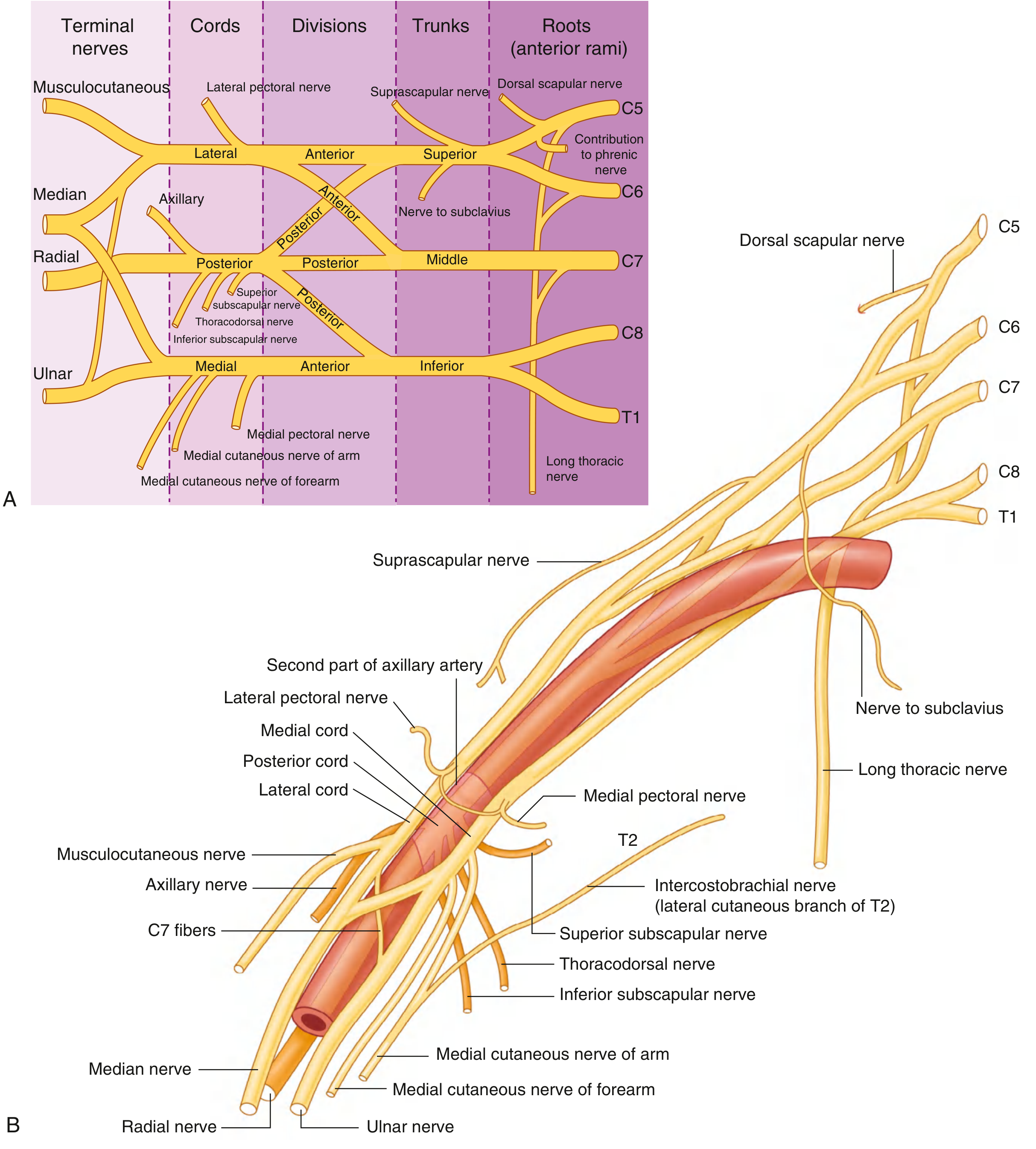
2. Components: The Five Parts
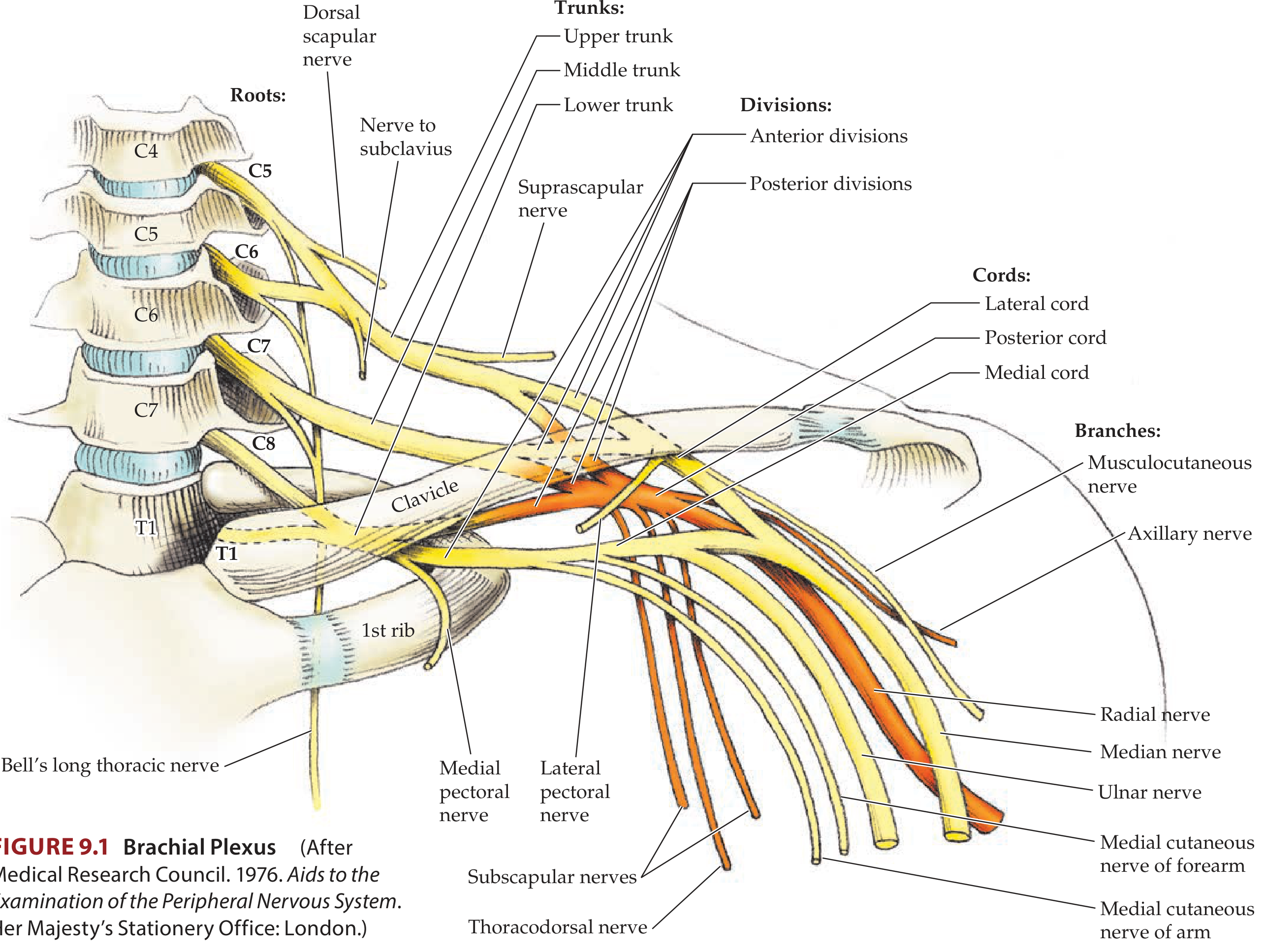
A. Roots (5)
- Each root receives gray rami communicantes from the cervical sympathetic trunk (postganglionic sympathetic fibers for peripheral distribution).
- A small contribution from C4 is common (prefixed plexus); T2 contribution can occur (postfixed plexus).
| Nerve | Root | Muscle(s) |
|---|---|---|
| Dorsal scapular nerve | C5 | Rhomboid major, rhomboid minor |
| Long thoracic nerve (nerve of Bell) | C5, C6, C7 | Serratus anterior |
| Contribution to phrenic nerve | C5 | Diaphragm |
B. Trunks (3)
| Trunk | Formation | Position |
|---|---|---|
| Superior (Upper) | C5 + C6 unite | Superior |
| Middle | C7 alone | Middle |
| Inferior (Lower) | C8 + T1 unite | Lies on rib I, behind subclavian artery |
| Nerve | Trunk | Muscle(s) |
|---|---|---|
| Suprascapular nerve | Superior trunk | Supraspinatus, infraspinatus |
| Nerve to subclavius | Superior trunk | Subclavius |
C. Divisions (6)
- Anterior divisions supply anterior (flexor) compartments.
- Posterior divisions supply posterior (extensor) compartments.
D. Cords (3)
| Cord | Formation | Spinal levels | Position to axillary artery |
|---|---|---|---|
| Lateral cord | Anterior divisions of superior + middle trunks | C5, C6, C7 | Lateral |
| Medial cord | Anterior division of inferior trunk | C8, T1 | Medial |
| Posterior cord | All three posterior divisions | C5-T1 | Posterior |
E. Terminal Branches (Nerves of the Upper Limb)
3. Branches from Each Cord
Lateral Cord (C5-C7) branches:
| Nerve | Innervation |
|---|---|
| Lateral pectoral nerve | Pectoralis major (+ minor via communication with medial pectoral) |
| Musculocutaneous nerve | All anterior arm muscles (biceps brachii, brachialis, coracobrachialis); sensation - lateral forearm |
| Lateral root of median nerve | (joins with medial root to form median nerve) |
Medial Cord (C8-T1) branches:
| Nerve | Innervation |
|---|---|
| Medial pectoral nerve | Pectoralis major and minor |
| Medial cutaneous nerve of arm | Skin on medial arm |
| Medial cutaneous nerve of forearm | Skin on medial forearm |
| Medial root of median nerve | (joins lateral root) |
| Ulnar nerve | Majority of intrinsic hand muscles + 1.5 flexor muscles forearm; sensation - medial 1.5 fingers |
Posterior Cord (C5-T1) branches:
| Nerve | Innervation |
|---|---|
| Superior subscapular nerve | Subscapularis |
| Thoracodorsal nerve | Latissimus dorsi |
| Inferior subscapular nerve | Subscapularis + teres major |
| Axillary nerve | Deltoid, teres minor; sensation - "regimental badge" area of shoulder |
| Radial nerve | All posterior compartment muscles of arm and forearm (triceps, brachioradialis, all extensors of wrist/fingers/thumb); sensation - posterior arm, forearm, dorsum of lateral hand |
4. Summary Table: All Branches
| Origin | Nerve | Root value | Motor | Sensory |
|---|---|---|---|---|
| Root C5 | Dorsal scapular | C5 | Rhomboids | - |
| Roots C5-C7 | Long thoracic | C5-C7 | Serratus anterior | - |
| Superior trunk | Suprascapular | C5, C6 | Supraspinatus, infraspinatus | - |
| Superior trunk | Nerve to subclavius | C5, C6 | Subclavius | - |
| Lateral cord | Lateral pectoral | C5-C7 | Pec. major | - |
| Lateral cord | Musculocutaneous | C5-C7 | Ant. arm muscles | Lateral forearm |
| Medial cord | Medial pectoral | C8, T1 | Pec. major & minor | - |
| Medial cord | Medial cut. nerve of arm | C8, T1 | - | Medial arm |
| Medial cord | Medial cut. nerve of forearm | C8, T1 | - | Medial forearm |
| Medial + lateral cords | Median nerve | C5-T1 | Anterior forearm (most), thenar muscles, lateral 2 lumbricals | Lateral 3.5 digits (palm) |
| Medial cord | Ulnar nerve | C8, T1 | Intrinsic hand, medial forearm flexors | Medial 1.5 digits |
| Posterior cord | Superior subscapular | C5, C6 | Subscapularis | - |
| Posterior cord | Thoracodorsal | C6-C8 | Latissimus dorsi | - |
| Posterior cord | Inferior subscapular | C5, C6 | Subscapularis, teres major | - |
| Posterior cord | Axillary nerve | C5, C6 | Deltoid, teres minor | Lateral shoulder |
| Posterior cord | Radial nerve | C5-T1 | All posterior arm/forearm | Posterior arm, forearm, dorsolateral hand |
5. Relations
- Supraclavicular part (roots + trunks): lies in the posterior triangle of the neck, between the anterior and middle scalene muscles. The plexus is related to the subclavian artery (inferiorly) and the subclavian vein (anterior to the artery but not in the plexus sheath).
- Infraclavicular part (cords + branches): lies in the axilla, surrounding the axillary artery. The three cords are named relative to the second part of the axillary artery.
- The plexus lies within a fascial sheath continuous with the prevertebral fascia - the basis for interscalene and axillary nerve blocks in regional anaesthesia.
6. Clinical Correlations
A. Erb's Palsy (Upper Plexus Injury - C5, C6)
- Cause: Forcible separation of head from shoulder (difficult delivery, motorcycle accident).
- Lesion: Superior trunk or C5-C6 roots.
- Muscles paralysed: Deltoid, supraspinatus, infraspinatus, biceps, brachialis, brachioradialis.
- Deformity: "Waiter's tip" (porter's tip) position - arm hangs adducted, internally rotated, elbow extended, forearm pronated, wrist flexed.
- Most common brachial plexus injury; best prognosis.
B. Klumpke's Palsy (Lower Plexus Injury - C8, T1)
- Cause: Upward traction on the arm (grabbing a branch during a fall), thoracic outlet syndrome, Pancoast tumour.
- Lesion: Inferior trunk or C8-T1 roots.
- Muscles paralysed: Intrinsic hand muscles (interossei, lumbricals, thenar, hypothenar), long flexors of fingers.
- Deformity: "Claw hand" - hyperextension at MCPs, flexion at IPJs, wasted hand.
- Associated finding: Horner's syndrome (ptosis, miosis, anhidrosis) if T1 is damaged proximal to the sympathetic trunk - poor prognosis sign.
C. Total Plexus Palsy (C5-T1)
- Complete flail, insensate upper extremity. Worst prognosis.
- Seen in high-velocity road traffic accidents (motorcyclists).
D. Thoracic Outlet Syndrome
- Compression of the lower trunk (C8-T1) between the clavicle and first rib, or by a cervical rib.
- Symptoms worsen with arm elevation and external rotation.
E. Parsonage-Turner Syndrome (Brachial Neuritis)
- Idiopathic inflammatory brachial plexopathy. Sudden onset severe shoulder pain followed by weakness and wasting of upper limb muscles. Most recover in 6-12 weeks.
F. Pancoast Tumour
- Apical lung carcinoma invading the lower brachial plexus (C8-T1), causing lower plexus signs + Horner's syndrome ± hoarseness (recurrent laryngeal nerve).
G. Long Thoracic Nerve Palsy
- Injury to C5-C7 roots (surgical procedures, trauma, radical mastectomy).
- Serratus anterior paralysis → "winging of the scapula" (medial border of scapula lifts away from thoracic wall, especially during forward arm elevation).
Create a detailed diagram showing brachial plexus nerve injuries and clinical presentations
A detailed medical educational diagram titled "Brachial Plexus Nerve Injuries & Clinical Presentations" with a clean white background and professional anatomical style. Left side: A complete brachial plexus schematic showing: - 5 roots labeled C5, C6, C7, C8, T1 (color-coded: C5-C6 in orange, C7 in green, C8-T1 in purple) - 3 trunks: Upper trunk (C5+C6), Middle trunk (C7), Lower trunk (C8+T1) - Anterior and posterior divisions - 3 cords: Lateral cord, Posterior cord, Medial cord - Terminal branches: Musculocutaneous, Axillary, Radial, Median, Ulnar nerves - Clavicle drawn as a horizontal bar separating supraclavicular and infraclavicular parts Center-right: Three injury syndrome panels with colored boxes: PANEL 1 (Orange box - Upper Plexus): "ERB'S PALSY (C5-C6)" - Cause: Forced separation of head and shoulder, difficult birth - Muscles affected: Deltoid, supraspinatus, biceps, brachialis, brachioradialis - Deformity: Arm adducted, internally rotated, elbow extended, forearm pronated = "Waiter's Tip" - Small silhouette showing the waiter's tip arm position - Reflexes lost: Biceps, brachioradialis - Sensory loss: Lateral arm and forearm PANEL 2 (Purple box - Lower Plexus): "KLUMPKE'S PALSY (C8-T1)" - Cause: Upward arm traction, Pancoast tumor, thoracic outlet syndrome - Muscles affected: All intrinsic hand muscles, finger flexors - Deformity: Claw hand - MCP hyperextension, IP flexion, wasted hand - Small silhouette showing claw hand - Horner's syndrome (ptosis, miosis, anhidrosis) if T1 proximal lesion - Sensory loss: Medial forearm and hand (ulnar border) PANEL 3 (Red box - Total Plexus): "TOTAL PLEXUS PALSY (C5-T1)" - Cause: High-velocity trauma, motorcycle accidents - Complete flail, insensate upper extremity - Worst prognosis Bottom row: Additional clinical boxes: - "Long Thoracic Nerve (C5-C7)" → Serratus anterior paralysis → Winged Scapula - "Thoracic Outlet Syndrome" → Lower trunk compression between clavicle and rib 1 / cervical rib - "Parsonage-Turner Syndrome" → Idiopathic inflammatory brachial neuritis, sudden shoulder pain + weakness Color legend in corner: Orange=C5-C6, Green=C7, Purple=C8-T1 Title in bold dark blue at top, clean grid layout, arrows connecting injury sites on the plexus to corresponding clinical panel boxes