
cranial bone anatomy
I'll read the medical library skill first, then search for cranial bone anatomy content.
Reading File
Now let me search the library for cranial bone anatomy content in parallel:
Finding Sources
Finding Sources
Good hits. Let me read the Netter's Atlas section on cranial bones, plus the forensic medicine skull anatomy section, in parallel:
Reading File
Reading File
Finding Sources
Good content found. Let me now fetch the key Netter's cranial base images and also read more from the Netter's Atlas for the full cranial vault content:
Reading File
Loading Image
Loading Image
Excellent images retrieved. Now let me fetch the calvaria image and the lateral skull view, and also read the beginning of the Netter's block for the vault/calvaria labels:
Loading Image
Loading Image
Reading File
I now have excellent Netter's Atlas images and detailed anatomical content. Let me fetch two more key images - the anterior skull view and the lateral colored view - to complete the picture:
Loading Image
Loading Image
I now have comprehensive Netter's Atlas images and detailed textbook content. Let me compile the full answer:
Cranial Bone Anatomy
The skull is divided into two functional parts: the neurocranium (braincase) and the viscerocranium (facial skeleton). The neurocranium itself has two components: the calvaria (vault/roof) and the cranial base (floor).
1. The 8 Bones of the Neurocranium
| Bone | Count | Location |
|---|---|---|
| Frontal | 1 | Forehead, roof of orbits |
| Parietal | 2 (paired) | Lateral walls and roof |
| Temporal | 2 (paired) | Lateral walls, contains ear structures |
| Occipital | 1 | Posterior and floor |
| Sphenoid | 1 | Central base, "keystone" bone |
| Ethmoid | 1 | Anterior base, nasal septum |
2. The Calvaria (Skullcap)
The calvaria is the dome-shaped roof formed by parts of the frontal, parietal, and occipital bones. Its internal surface shows characteristic grooves and features visible in the inferior view image below.
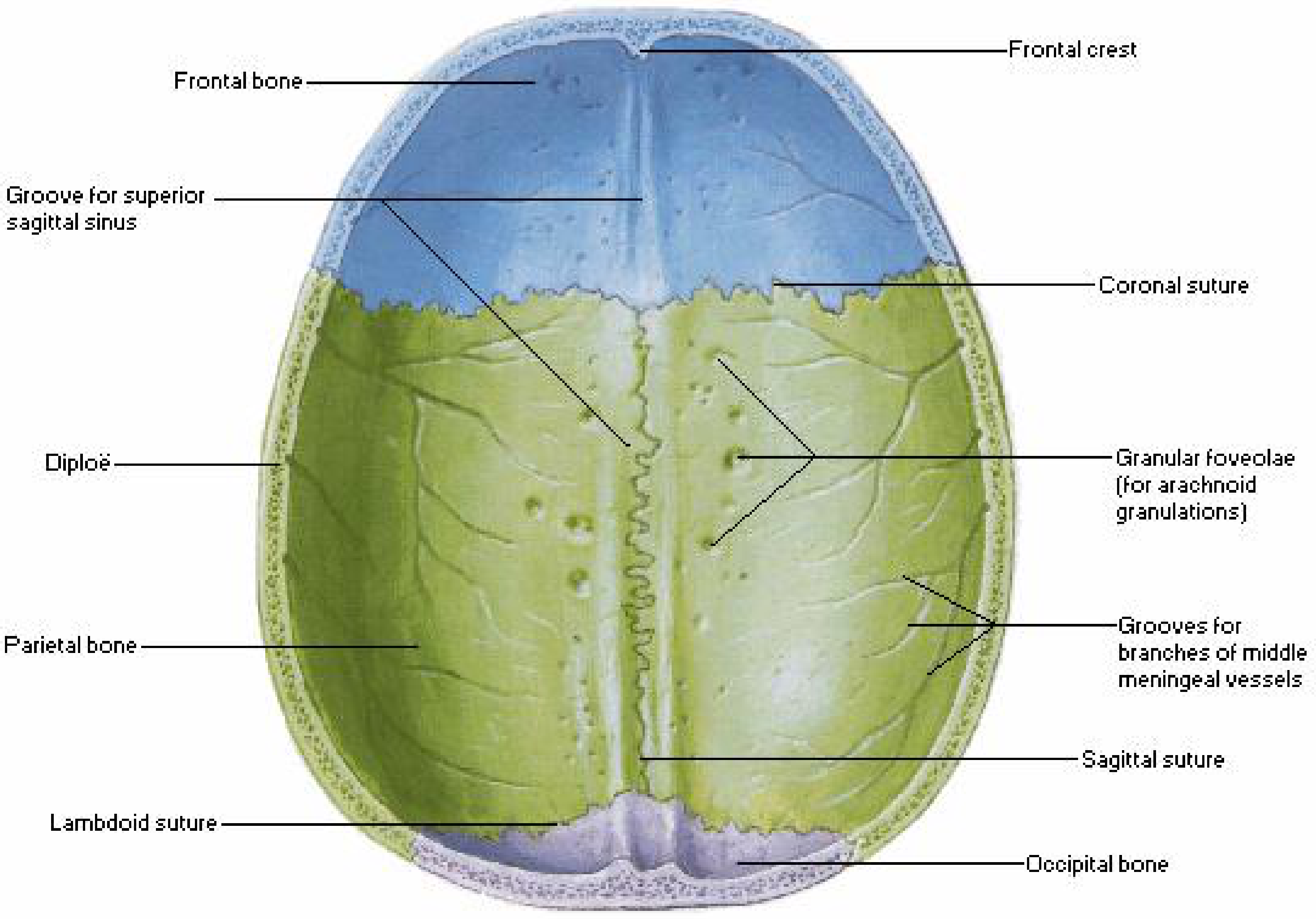
Key features of the calvaria:
- Frontal crest - midline ridge on internal surface of frontal bone; attachment point for the falx cerebri
- Groove for the superior sagittal sinus - midline groove running front-to-back, deepening posteriorly
- Granular foveolae - small pits for arachnoid granulations (CSF reabsorption)
- Grooves for middle meningeal vessels - arborizing grooves on parietal bone inner surface
- Coronal suture - between frontal and parietal bones
- Sagittal suture - between the two parietal bones (midline)
- Lambdoid suture - between parietal bones and occipital bone
Bone structure: The skull bones have two compact tables (outer table ~twice as thick as inner) separated by diploe (cancellous bone with marrow). Diploe begins forming at ~4 years of age. The thinnest region is the temporal bone (~4 mm); the occipital bone at midline can reach ≥15 mm. Frontal and parietal bones average 6-10 mm. - P.C. Dikshit Forensic Medicine, p. 193
3. Anterior View of the Skull
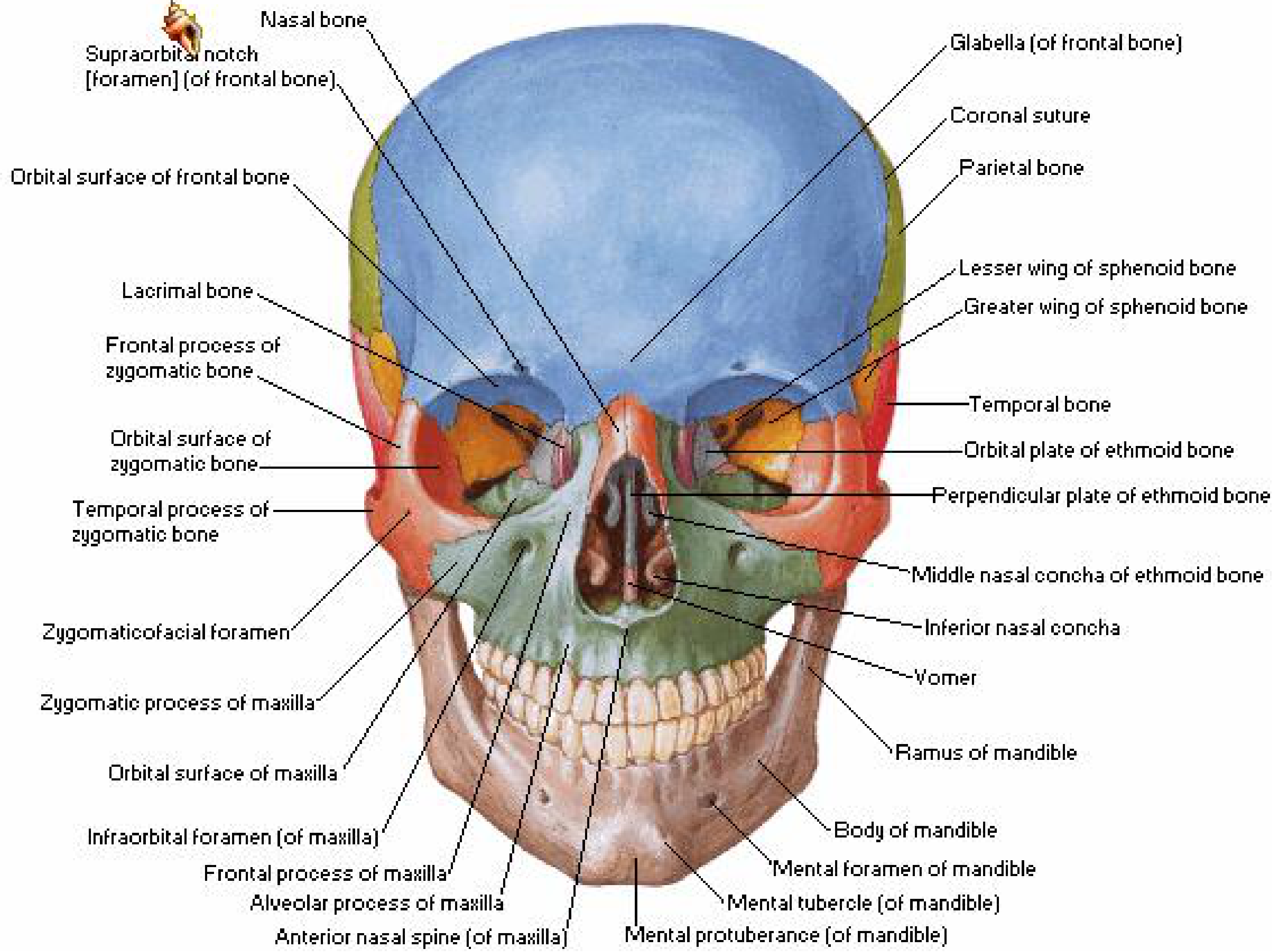
Notable anterior landmarks:
- Glabella - smooth midline prominence of frontal bone between the superciliary arches
- Supraorbital notch/foramen - transmits supraorbital nerve and vessels
- Infraorbital foramen - transmits infraorbital nerve (branch of V2)
- Mental foramen - transmits mental nerve (branch of V3), on mandible
4. Cranial Base - Superior (Internal) View
The cranial base is divided into three cranial fossae:
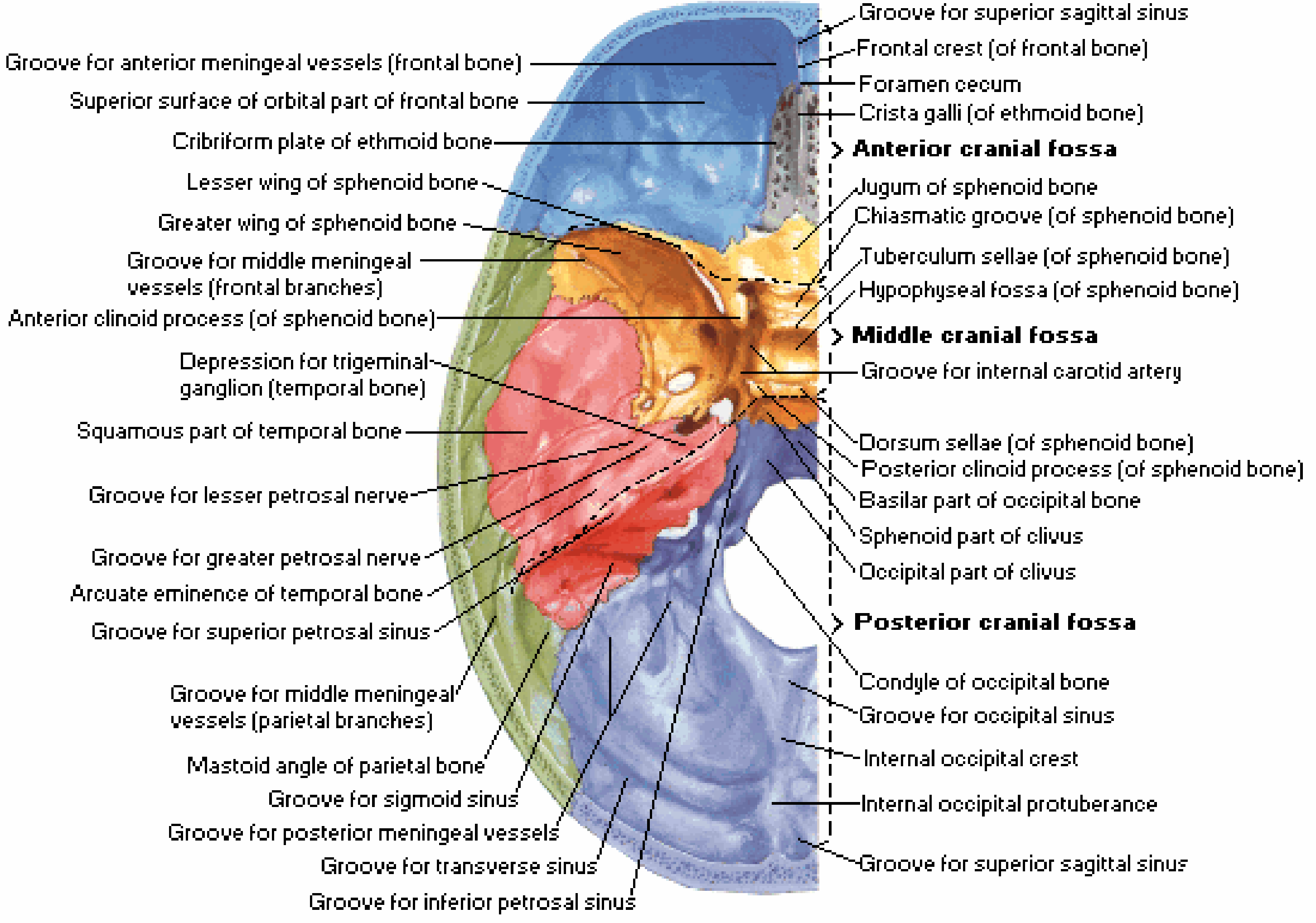
Anterior Cranial Fossa
- Formed by: orbital part of frontal bone, cribriform plate of ethmoid, lesser wing + jugum of sphenoid
- Key features: crista galli (ethmoid), cribriform plate (olfactory nerve bundles CN I pass through), foramen cecum, anterior clinoid process
Middle Cranial Fossa
- Formed by: greater wing of sphenoid + squamous and petrous parts of temporal bone
- Key features: hypophyseal fossa (sella turcica), optic canal (CN II, ophthalmic artery), superior orbital fissure, foramen rotundum (V2), foramen ovale (V3), foramen spinosum (middle meningeal artery), foramen lacerum, carotid sulcus
Posterior Cranial Fossa
- Formed by: occipital bone (basilar, squamous, lateral parts), petrous part of temporal bone
- Key features: foramen magnum (medulla, vertebral arteries, CN XI spinal roots), internal acoustic meatus (CN VII, VIII), jugular foramen (CN IX, X, XI; sigmoid + inferior petrosal sinus), hypoglossal canal (CN XII), internal occipital protuberance
5. Foramina and Their Transmissions
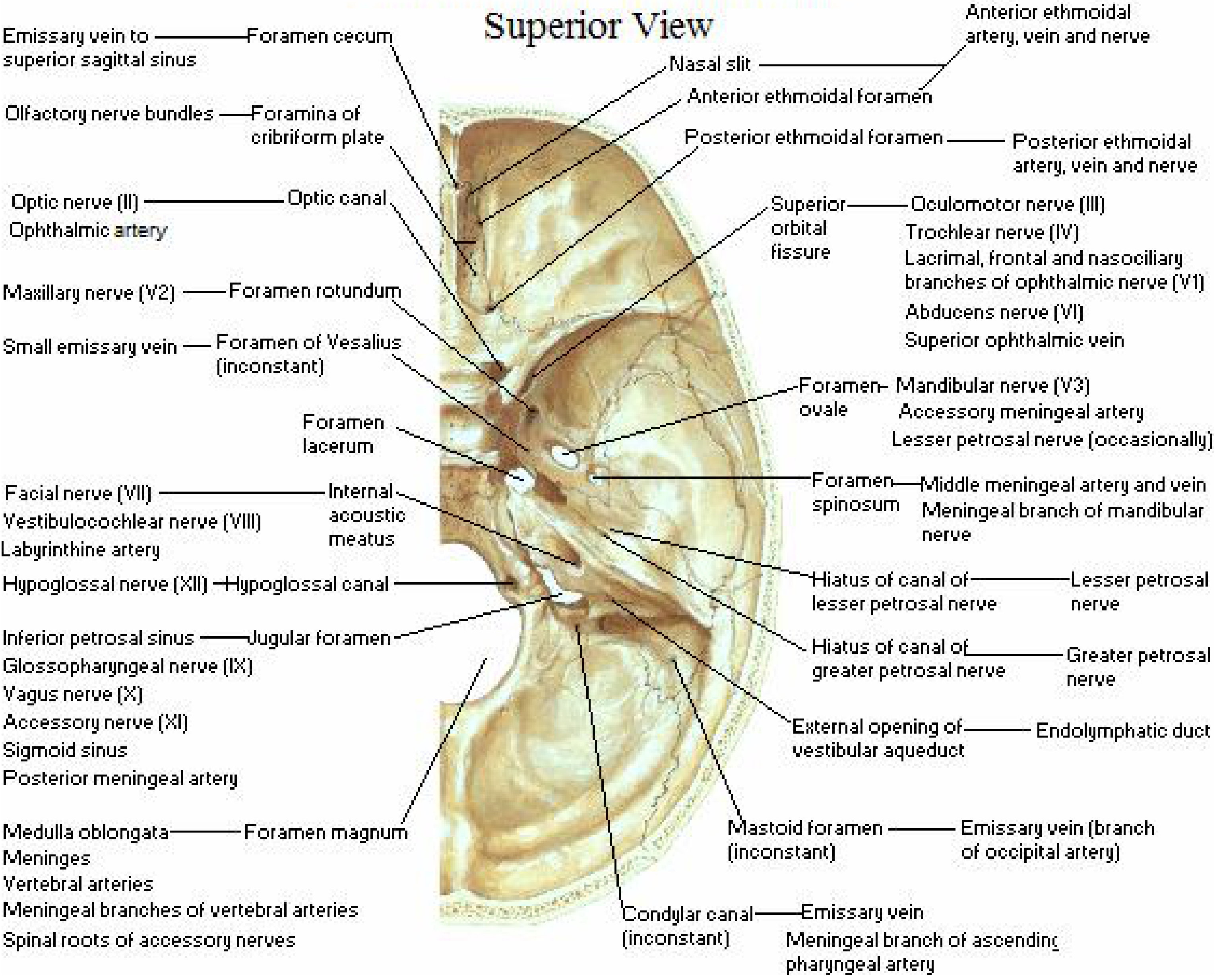
| Foramen | Bone | Contents |
|---|---|---|
| Foramen cecum | Frontal/ethmoid | Emissary vein to superior sagittal sinus |
| Cribriform plate foramina | Ethmoid | CN I (olfactory nerve bundles) |
| Optic canal | Sphenoid | CN II, ophthalmic artery |
| Superior orbital fissure | Sphenoid | CN III, IV, V1, VI; superior ophthalmic vein |
| Foramen rotundum | Sphenoid | CN V2 (maxillary nerve) |
| Foramen ovale | Sphenoid | CN V3 (mandibular nerve), accessory meningeal artery |
| Foramen spinosum | Sphenoid | Middle meningeal artery and vein |
| Foramen lacerum | Sphenoid/temporal | Filled with cartilage in life; internal carotid artery passes over it |
| Internal acoustic meatus | Temporal | CN VII, CN VIII, labyrinthine artery |
| Jugular foramen | Temporal/occipital | CN IX, X, XI; sigmoid sinus → internal jugular vein; inferior petrosal sinus |
| Hypoglossal canal | Occipital | CN XII |
| Foramen magnum | Occipital | Medulla oblongata, vertebral arteries, CN XI spinal roots, meninges |
| Condylar canal | Occipital | Emissary vein (inconstant) |
| Mastoid foramen | Temporal | Emissary vein (inconstant) |
6. Individual Bone Highlights
Frontal Bone
- Forms the forehead, roof of orbits, and part of anterior cranial floor
- Contains the frontal sinuses (paired, separated by intersinus septum)
- Glabella = smooth area between superciliary arches
Parietal Bones (paired)
- Form the upper sides and roof of the skull
- Strong areas: sagittal ridge; thin areas: parieto-temporal zone
- Inner surface: superior sagittal sinus groove and meningeal vessel grooves
Temporal Bone
- Most complex skull bone; has 4 parts: squamous, petrous, tympanic, mastoid
- Petrous part = hardest bone in body; contains inner ear structures
- Mastoid process = posterior projection (attachment for sternocleidomastoid)
- Styloid process = slender projection below external acoustic meatus
- The thinnest bone of the calvaria (~4 mm)
Occipital Bone
- Has 4 parts: squamous, 2 condylar (lateral), basilar
- Foramen magnum is the largest foramen
- External occipital protuberance (inion) = posterior midline palpable landmark
- Occipital condyles articulate with atlas (C1) - atlanto-occipital joint
- Thickest skull bone at midline (≥15 mm)
Sphenoid Bone
- Often called the "keystone" - articulates with all other cranial bones
- Has a body (containing sphenoidal sinuses), 2 lesser wings, 2 greater wings, 2 pterygoid processes
- Sella turcica (Turkish saddle) = houses the pituitary gland
- Pterygoid processes project inferiorly - lateral and medial plates
Ethmoid Bone
- Lightest cranial bone; highly aerated
- Cribriform plate = horizontal plate in anterior cranial floor (CN I passes through)
- Crista galli = superior midline projection (falx cerebri attachment)
- Perpendicular plate = upper part of nasal septum
- Contains the ethmoid air cells (ethmoidal sinuses)
7. Cranial Sutures
| Suture | Bones Joined | Clinical Note |
|---|---|---|
| Coronal | Frontal + Parietals | Lies in coronal plane |
| Sagittal | Parietal + Parietal | Midline, AP direction |
| Lambdoid | Parietals + Occipital | Lambda-shaped |
| Squamosal | Temporal + Parietal | Weakest area of lateral skull |
| Metopic | Frontal halves | Usually fuses by age 2 |
The pterion is where the frontal, parietal, temporal, and sphenoid bones meet - the thinnest and most vulnerable area of the lateral skull. The anterior branch of the middle meningeal artery runs deep to it; fractures here can cause epidural hematoma.
The bregma is the junction of the coronal and sagittal sutures (site of the anterior fontanelle in infants). The lambda is the junction of the sagittal and lambdoid sutures (posterior fontanelle site).
Sources: Netter's Atlas of Human Anatomy (ISBN 9780323547048); P.C. Dikshit Textbook of Forensic Medicine and Toxicology (ISBN 9788188867967)
This is a shared conversation. Sign in to Orris to start your own chat.