
Somnambulism and nightmares, conceptual understanding
Reading File
Now let me search the medical library for somnambulism and nightmares in parallel.
Finding Sources
Finding Sources
Excellent finds. Now let me read the most comprehensive sources in parallel.
Reading File
Reading File
Reading File
Now let me read the nightmare and sleep terror sections, and also the Kaplan & Sadock nightmare disorder section:
Reading File
Reading File
Reading File
I have all the core content needed. Let me now fetch the sleep terror diagram and search for a relevant image:
Loading Image
Finding Sources
I now have comprehensive content from multiple authoritative neurology and psychiatry textbooks. Let me compose the full answer.
Somnambulism (Sleepwalking) and Nightmares - Conceptual Understanding
These two phenomena are both parasomnias - abnormal behaviors occurring during sleep - but they are fundamentally different in their sleep-stage origin, phenomenology, and clinical significance.
What Are Parasomnias?
Parasomnias are unusual behaviors that occur during either REM or non-REM sleep. They are classified based on the sleep stage from which they arise, which is the single most important conceptual dividing line:
- NREM parasomnias: somnambulism, sleep terrors, confusional arousals, enuresis
- REM parasomnias: nightmare disorder, REM Sleep Behavior Disorder (RBD)
SOMNAMBULISM (Sleepwalking)
Definition and Classification
Somnambulism is an NREM parasomnia characterized by complex motor behaviors - ranging from sitting up in bed to walking around - arising out of slow-wave (Stage N3) sleep.
Sleep Stage and Timing
- Occurs during Stage N3 (slow-wave/deep NREM) sleep
- Arises predominantly in the first one-third of the night, when N3 sleep is most concentrated
- A popular belief is that sleepwalkers are "acting out dreams" - this is false. Sleep lab observations confirm somnambulism occurs during the period when dreaming is least likely
- Episodes generally last less than 10 minutes
Epidemiology
- Common in children aged 5-12 years (approximately 15% have at least one episode)
- Only ~1% of adults sleepwalk regularly
- Strong familial component - 1 in 5 sleepwalkers has a family history
- Children typically outgrow it as N3 sleep decreases in late adolescence
- Adult-onset somnambulism is unusual and may suggest psychiatric illness or drug intoxication
- Lifetime prevalence in U.S. adults has been estimated at 29%
Behavioral Features
- Eyes are typically open - the person is guided by vision and may avoid familiar objects
- Behavior ranges from simply sitting up, to walking, turning on lights, performing familiar acts
- Repetitive behaviors (muttering, pushing against a wall, turning a doorknob) may occur
- If spoken to, the person usually does not respond
- May be led back to bed, or will return when told
- Amnesia for the event the following morning is characteristic
Precipitating Factors
Conditions that deepen slow-wave sleep worsen somnambulism:
- Sleep deprivation / fatigue
- Febrile illness
- Sedative medications (note: alcohol's role is debated and probably not significant)
- Sleep apnea (arousal trigger)
- Stress
Violence and Medico-legal Aspects
- Violent or frenzied behavior is rare in children but more frequent in adults
- Self-injury, homicidal episodes during sleepwalking have been reported
- Organized, planned sequential criminal activity during sleepwalking is considered very unlikely
- Amnesia for the violent act is characteristic
Differentiation from Other Conditions
- Complex partial seizures / epileptic automatisms: distinguished by normal polysomnography; seizure shows ictal EEG changes
- Fugue states: prolonged, purposeful travel; no amnesia on return
- REM Sleep Behavior Disorder (RBD): occurs in REM sleep; person is acting on their dream sensorium and appears unaware of the actual environment (unlike a sleepwalker who avoids familiar furniture)
EEG During Episodes
Even while walking, the EEG continues to show slow delta waves of N3 sleep for the first minute or two, gradually transitioning toward a wakefulness pattern - a fascinating hybrid state.
Treatment
- Children: primarily safety measures (lock doors/windows, remove dangerous objects, sleep on ground floor). Parents should be reassured; it is not a psychiatric disorder.
- Adults: clonazepam 0.5-1.0 mg at bedtime is the drug of choice
- Some respond to clonazepam + phenytoin combination, or flurazepam
- Tricyclic antidepressants reduce N3 sleep and can be effective
- Treat underlying sleep apnea if present
Sleep Terrors (Pavor Nocturnus)
Sleep terrors are closely related to somnambulism and often co-occur. They deserve mention as the "frightening subtype" of NREM parasomnias.
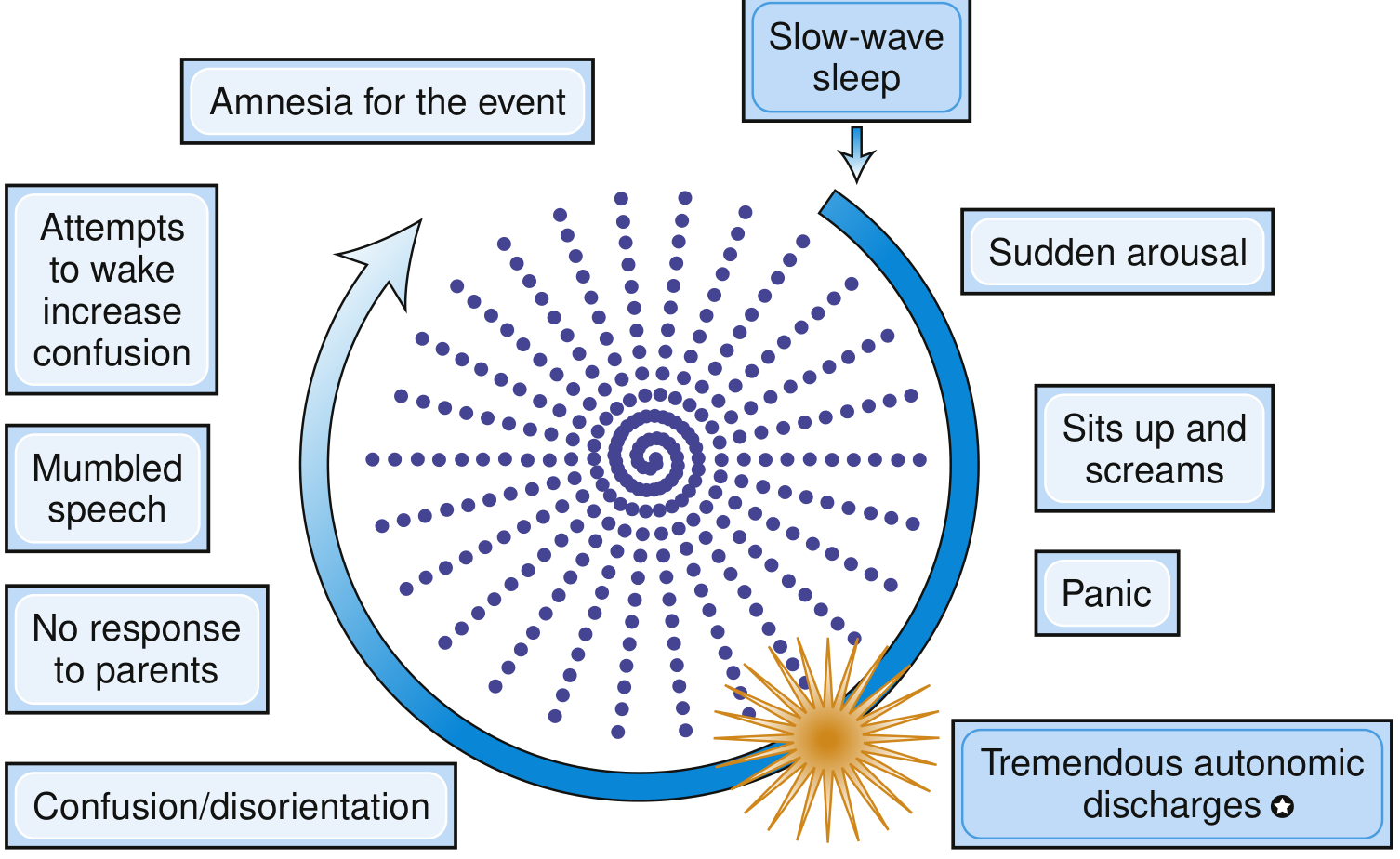
Fig. 101.62 - Sleep terrors: sudden arousal from slow-wave sleep (Bradley and Daroff's Neurology in Clinical Practice)
As shown in the diagram above, sleep terrors involve:
- Sudden arousal from slow-wave sleep
- Sitting up and screaming, panic, tremendous autonomic discharge (tachycardia, dilated pupils, diaphoresis)
- Mumbled speech, confusion/disorientation
- No response to parents/bystanders - attempts to console or wake may worsen the screaming
- Amnesia for the event next morning
Peak onset is ages 5-7 years. The episode is typically more distressing for the parent than the child (because the child has no memory of it). A recent study found strong association between sleep terrors in adolescents and later development of migraines.
NIGHTMARES
Definition and Classification
Nightmares (also called "dream anxiety attacks") are REM parasomnias - frightening or terrifying dreams that may produce sympathetic activation and awaken the dreamer.
Sleep Stage and Timing
- Occur during REM sleep
- REM predominates in the last third of the night, so nightmares typically occur later in the night
- They evolve from a long, complicated dream that becomes increasingly frightening - not a sudden event
Key Distinguishing Feature from Sleep Terrors
The most important clinical distinction:
| Feature | Nightmare (REM) | Sleep Terror (NREM) |
|---|---|---|
| Sleep stage | REM | N3 (slow-wave) |
| Timing in night | Last 1/3 | First 1/3 |
| Dream recall | Yes - vivid | No/amnesic |
| Autonomic storm | Mild-moderate | Severe |
| Child consolable? | Usually yes after waking | No, inconsolable during |
| Screaming during event | No - person wakes first | Yes - loud piercing scream |
| Behavioral enactment | None (REM atonia intact) | Motor activity common |
Epidemiology
- Common in children ages 3-6 years (prevalence 10-50%)
- Rare in adults (1% or less have frequent nightmares)
- Recurrent nightmares are a hallmark of PTSD (may be literal re-experiences of the traumatic event)
Associations and Risk Factors
- Psychiatric: individuals with schizotypal, borderline, schizoid personality disorders, and schizophrenia are at higher risk
- Medications that provoke nightmares: L-DOPA, beta-adrenergic blockers, withdrawal from REM-suppressant medications
- Drug/alcohol abuse is associated
- "Thin boundaries" personality (Hartmann, 1998) - open, trusting, creative/artistic individuals may be more vulnerable
Vicious Cycle
Frequent nightmares create a "fear of sleeping" insomnia - the person is afraid to go to sleep. This insomnia causes sleep deprivation, which in turn intensifies and increases nightmares, creating a self-perpetuating cycle.
Psychoanalytic Perspective
In Freudian theory, the nightmare represents a failure of the dream process - normally dreams disguise emotionally charged content symbolically to protect sleep; when this "censorship" fails, raw frightening content breaks through and disrupts sleep.
Treatment
- Behavioral: cognitive therapy, stimulus control therapy, lucid dream therapy, sleep hygiene
- Pharmacological:
- Prazosin (central alpha-1 receptor antagonist): growing evidence for PTSD-related nightmares - increases total sleep time and REM time, reduces trauma-related nightmares and distressed awakenings
- Benzodiazepines (BZDs) and non-BZD receptor agonists (BZRAs) are sometimes used
- L-DOPA and beta-blocker adjustments if medication-induced
REM Sleep Behavior Disorder (RBD) - For Contrast
Worth understanding alongside nightmares because it is also a REM parasomnia but mechanistically opposite:
- In normal REM sleep, the dreamer is immobilized by atonia (hyperpolarization of alpha and gamma motor neurons)
- In RBD, this atonia fails - the person literally enacts their dreams (punching, kicking, running)
- Unlike a sleepwalker (who navigates familiar furniture calmly), the RBD patient acts on their dream sensorium and is unaware of the real environment - they may dive through a window thinking it is a lake
- Strongly associated with synucleinopathies (Parkinson's disease, Lewy body dementia, MSA) - RBD may precede the neurodegeneration by years
- Treatment: clonazepam
Conceptual Summary Table
| Feature | Somnambulism | Sleep Terror | Nightmare | RBD |
|---|---|---|---|---|
| Sleep stage | NREM N3 | NREM N3 | REM | REM |
| Timing | First 1/3 night | First 1/3 night | Last 1/3 night | Last 1/3 night |
| Motor activity | Yes (walking) | Yes (sitting, thrashing) | No (atonia intact) | Yes (enacting dream) |
| Dream recall | No | No | Yes | Yes (upon waking) |
| Autonomic arousal | Mild-moderate | Severe | Mild-moderate | Variable |
| Amnesia | Yes | Yes | No | No |
| Peak age | 5-12 years | 5-7 years | 3-6 years | Middle-older age |
| Treatment | Clonazepam, safety | Safety, benzodiazepines | Prazosin, CBT | Clonazepam |
| Key association | Familial, fatigue | Familial, migraine | PTSD | Parkinson's/synucleinopathy |
Sources:
- Adams and Victor's Principles of Neurology, 12th Edition, Ch. 5 (Somnambulism and Sleep Automatism)
- Bradley and Daroff's Neurology in Clinical Practice (Sleepwalking, Sleep Terrors)
- Eric Kandel's Principles of Neural Science, 6th Ed. (Non-REM Parasomnias, REM sleep behavior disorder)
- Kaplan & Sadock's Comprehensive Textbook of Psychiatry (Nightmare Disorder)
This is a shared conversation. Sign in to Orris to start your own chat.