
A complete guide to wernickes encephalopathy and korsakoff’s psychosis
Reading File
Now I'll run parallel searches across headings and paragraphs for both conditions, plus a PubMed search and web search simultaneously.
Finding Sources
Finding Sources
Searching PubMed
"Wernicke encephalopathy"[MeSH Terms] AND "thiamine"[MeSH Terms]
Searching the Web
Wernicke encephalopathy Korsakoff psychosis clinical guide 2024 2025
Now let me read the most comprehensive textbook sections in parallel:
Reading File
Reading File
Reading File
Finding Sources
Excellent. Now let me read the Goldman-Cecil Korsakoff section, Adams & Victor section, and Maudsley treatment dosing in parallel:
Reading File
Reading File
Reading File
Finding Sources
Now let me get the MRI imaging, Robbins pathology section, and Bradley's full WE section for completeness:
Reading File
Reading File
Reading File
Searching Images
Wernicke encephalopathy MRI brain mammillary bodies thalamus
I now have comprehensive data from multiple authoritative sources. Let me compile the complete guide.
Wernicke's Encephalopathy & Korsakoff's Psychosis: A Complete Guide
1. Overview & Historical Context
Wernicke's encephalopathy (WE) and Korsakoff's syndrome (KS) represent two ends of a single disease spectrum — Wernicke-Korsakoff syndrome (WKS) — both caused by thiamine (vitamin B1) deficiency. WE is the acute, potentially reversible phase; KS is the chronic, largely irreversible amnestic state that follows.
- WE was first described by Gayet (French ophthalmologist) in 1875, and independently by Carl Wernicke (German neurologist) in 1881.
- "Korsakoff psychosis" is an older term; modern neurology prefers Korsakoff syndrome or amnesic state, as psychosis is not the dominant feature. — Adams and Victor's Principles of Neurology, 12th ed.
2. Thiamine Biochemistry & Pathophysiology
Thiamine (B1), as thiamine pyrophosphate (TPP), is a critical cofactor in energy metabolism:
- Pyruvate dehydrogenase — entry into the TCA cycle
- α-ketoglutarate dehydrogenase — TCA cycle intermediate step
- Transketolase — pentose phosphate pathway
Deficiency of α-ketoglutarate dehydrogenase activity in astrocytes leads to microglial activation and glutamatergic toxicity, the key mechanism of WE neuronal injury. — Goldman-Cecil Medicine
Because thiamine is required to metabolize glucose, administration of IV glucose before thiamine replacement can precipitate or worsen WE — a critical clinical pitfall. — Maudsley Prescribing Guidelines, 15th ed.
Total body thiamine stores are depleted within 2–3 weeks of inadequate intake.
3. Causes & Risk Factors
Primary Cause
- Chronic alcohol use disorder — the most common cause in Western countries (both reduced dietary intake and impaired intestinal absorption)
Non-alcoholic Causes
| Category | Examples |
|---|---|
| Prolonged vomiting | Hyperemesis gravidarum, cyclical vomiting, chemotherapy |
| Malabsorption | Bariatric surgery (especially gastric bypass), inflammatory bowel disease |
| Refeeding syndromes | Parenteral nutrition without thiamine supplementation |
| Systemic illness | AIDS/HIV, cancer, cachexia |
| Dialysis | Thiamine lost during hemodialysis (33% prevalence of deficiency in symptomatic dialysis patients) — Bradley & Daroff's Neurology |
| Eating disorders | Anorexia nervosa, bulimia nervosa |
| Prolonged fasting | Hunger strikes, extreme diets |
| Digitalis poisoning |
Risk Factors in Alcohol Dependence (Maudsley Guidelines)
- Acute withdrawal
- Malnourishment / low BMI (<18)
- Decompensated liver disease
- Emergency department attendance or acute hospitalization
- Homelessness
- Memory disturbance or peripheral neuropathy
- Previous episode of WE
4. Neuropathology
Affected Brain Regions
WE preferentially affects regions with the highest thiamine-dependent metabolic demand:
- Mammillary bodies (most characteristic; bilaterally affected)
- Periaqueductal gray matter
- Medial thalami (anterior and centromedian nuclei; dorsomedial thalamic nucleus lesions best correlate with memory disturbance in KS)
- Floor of the fourth ventricle
- Superior and inferior colliculi
- Hypothalamus (occasionally)
- Cerebral cortex (rarely, in severe cases)
Microscopic Changes
- Neuronal swelling and microscopic hemorrhages (early)
- Gliosis (later)
- Resolution of necrosis → cystic spaces with hemosiderin-laden macrophages
In Korsakoff syndrome, damage is concentrated in the limbic system: mammillary bodies, amygdala, dorsomedial thalamus, and anterior thalamus. Cortical involvement in KS may relate to direct alcohol neurotoxicity rather than thiamine deficiency per se. — Robbins & Kumar Basic Pathology; Goldman-Cecil Medicine
5. Clinical Presentation
Wernicke's Encephalopathy: Classic Triad
| Feature | Description |
|---|---|
| Mental status changes | Ranges from mild inattention and memory impairment to delirium and coma; often with apathy or abulia |
| Ocular abnormalities | Nystagmus, dysconjugate gaze, horizontal/vertical gaze palsies, ophthalmoplegia |
| Ataxia | Affects legs > arms > trunk; gait ataxia prominent |
⚠️ The full triad is present in only ~30% of cases. Up to 75% of cases are undiagnosed at the time of death (only ~25% detected before death). — Goldman-Cecil Medicine
Additional Features
- Autonomic dysfunction: bradycardia, hypothermia, hypotension (can be life-threatening)
- Papilledema, optic neuropathy
- Seizures, myoclonus
- Peripheral neuropathy
- Signs of chronic alcoholism (gynecomastia, palmar erythema, Dupuytren's contractures, ascites)
Maudsley Guidance: Presume WE in Any Detoxification Patient with ANY of:
- Ataxia
- Hypothermia or hypotension
- Confusion or memory disturbance
- Ophthalmoplegia / nystagmus
- Unconsciousness / coma
6. Korsakoff's Syndrome
Core Features
Korsakoff syndrome develops in up to 80% of patients surviving WE. It is more likely to follow WE in the setting of alcoholism than in pure nutritional deficiency — likely due to synergistic mechanisms including repeated alcohol withdrawal causing glutamate neurotoxicity compounded by thiamine deficiency. — Goldman-Cecil Medicine
Three cardinal features (Adams & Victor):
- Retrograde amnesia — impaired recall of events established before onset
- Anterograde amnesia — inability to form new memories or learn new information
- Impaired temporal localization of past experience
What Is Preserved
- Alertness and attention
- Language comprehension and expression
- Spatial organization
- Procedural (motor) memory
- Immediate recall (digit span) — a measure of registration/attention, not memory encoding
- Social interaction
"Equally important in the definition of the Korsakoff syndrome is this integrity of certain aspects of behavior and mental function." — Adams & Victor's Principles of Neurology
Confabulation
- Momentary confabulation: partial memories inaccurately localized in time, provoked by questions
- Fantastic confabulation: spontaneous elaborate false narratives; more common in the initial confused phase
- Confabulation is not obligate for diagnosis; it typically lessens over time as a compensatory mechanism — Adams & Victor
Neuropsychological Profile
- Anterograde > retrograde amnesia severity
- Remote (early life) memories relatively preserved vs. recent (Ribot's Rule)
- Mild executive dysfunction (frontal lobe involvement)
- Patients are typically unaware of their memory impairment (anosognosia)
7. Neuroimaging
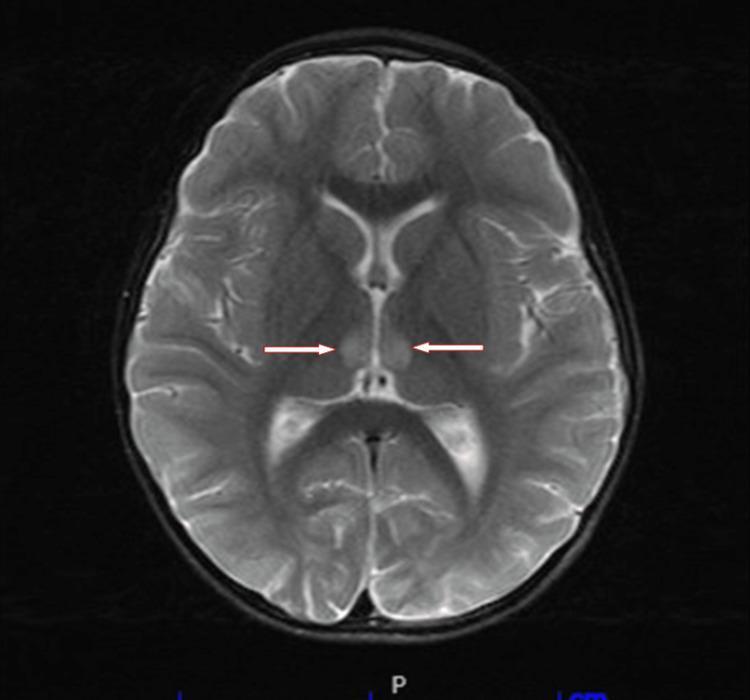
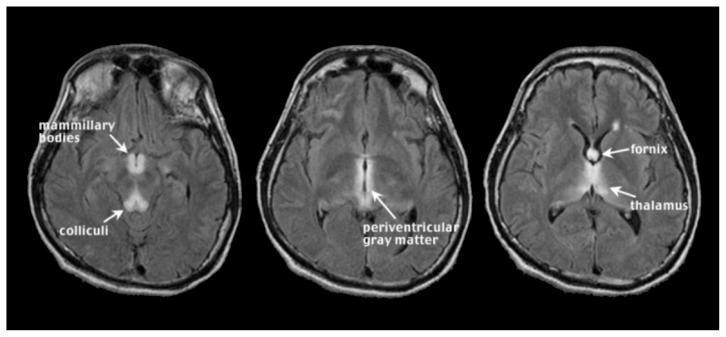
MRI Findings in Acute WE
T2-weighted/FLAIR sequences show bilateral and symmetrical hyperintensities in:
- Mammillary bodies
- Periaqueductal gray matter
- Medial thalami / periventricular regions of the 3rd ventricle
- Floor of the 4th ventricle / pons / medulla
- Basal ganglia (less commonly)
- Cortex (rare; implies severe disease)
Special MRI Findings
- DWI: restricted diffusion (cytotoxic edema); may show vasogenic component (increased ADC)
- Microbleeds on T1/GRE in thalami and mammillary bodies → poor outcome marker
- Contrast enhancement of mammillary bodies: present in ~80% of cases, even before T2 changes are visible — considered highly specific — Grainger & Allison's Diagnostic Radiology
- Periaqueductal contrast enhancement: ~50% of cases
MRI in Chronic Korsakoff Syndrome
- T2 signal changes become less prominent
- Diffuse brain atrophy, most pronounced in the mesencephalon and mammillary bodies
MRI can be normal in symptomatic WE — a normal MRI does not exclude the diagnosis.
8. Laboratory Investigations
| Test | Finding |
|---|---|
| Serum thiamine | Low (<50 nmol/L); may be normal in ~10% |
| RBC transketolase activity | Reduced (most sensitive functional test) |
| Serum lactate & pyruvate | Elevated (disrupted carbohydrate metabolism) |
| MCV, LFTs, GGT | Signs of chronic alcohol use |
| Magnesium | Often deficient; critical to replace (required for thiamine utilization) |
| Sodium | May be low; must be replaced carefully |
9. Diagnosis
WE is a clinical diagnosis — do not wait for labs or MRI before treating.
The Caine criteria (operational diagnostic criteria used in clinical practice) require any 2 of:
- Dietary deficiency
- Oculomotor abnormalities
- Cerebellar dysfunction
- Either altered mental status or mild memory impairment
A presumptive diagnosis should be made in any at-risk patient with even a single feature.
Differential Diagnoses to Consider
- Hepatic encephalopathy
- Delirium tremens (overlapping with acute alcohol withdrawal)
- Meningitis/encephalitis
- Posterior reversible encephalopathy syndrome (PRES)
- Central pontine myelinolysis
- Drug intoxication / overdose
- Stroke (thalamic, brainstem)
10. Treatment
Principle: Treat First, Confirm Later
"In acute settings, especially in ICUs, all patients should receive replenishment with high-dose IV or IM thiamine prior to any glucose administration." — Goldman-Cecil Medicine
Thiamine Replacement Doses
If WE is suspected / confirmed (acute treatment):
- IV or IM thiamine 500–1000 mg/day × 3–5 days — Goldman-Cecil Medicine
- UK NICE / Maudsley Guidelines: IV thiamine (Pabrinex) 2–3 pairs (each pair = 250 mg) three times daily for 3–5 days
Prophylaxis in high-risk patients (e.g., alcohol detoxification):
- Community: IM thiamine 200–300 mg once daily for at least 3 days
- Hospital: IM or IV thiamine 200–300 mg once daily for 3–5 days with daily monitoring
Low-risk drinkers with adequate diet:
- Oral thiamine 300 mg daily during withdrawal
Additional Measures
- Never give IV glucose before thiamine in a thiamine-deficient or at-risk patient
- Replace magnesium (required cofactor for thiamine-dependent enzymes)
- Replace sodium if deficient
- Monitor electrolytes, fluid balance
- Treat nausea/vomiting (metoclopramide 10 mg or prochlorperazine 5 mg)
Response to Treatment
- Nystagmus and ophthalmoplegia resolve first — often within hours of thiamine administration
- Ataxia resolves more slowly (days to weeks)
- Mental status changes — variable; may partially or fully resolve
- Korsakoff syndrome does not respond to thiamine replacement — prevention by early recognition of WE is essential
11. Prevention
- Thiamine supplementation of anyone at risk due to vomiting, starvation, bariatric surgery, dialysis, or malnutrition (>100 mg/day)
- Routine thiamine fortification of foods (e.g., flour, rice) has reduced the population burden
- Universal thiamine before IV dextrose in the emergency department for at-risk patients
- Post-bariatric surgery: lifelong thiamine supplementation is standard of care
12. Prognosis
| Outcome | Data |
|---|---|
| WE untreated mortality | ~90% |
| WE treated mortality | Up to 20% |
| KS following WE | ~80% of WE survivors |
| KS long-term mortality | ~50% of treated patients die within 8 years |
| Cognitive function in KS | Stable (neither progressive nor recovering) |
| Residual deficits | Ataxia and cognitive/memory impairment (partly from alcohol neurotoxicity) |
"Because Korsakoff syndrome does not respond to thiamine replacement, prevention by timely recognition of Wernicke encephalopathy is essential." — Goldman-Cecil Medicine
Recovery from KS
A small proportion (< 20%) achieve partial recovery with prolonged abstinence from alcohol, but full recovery is rare. Prognosis is better in non-alcoholic WKS (e.g., hyperemesis gravidarum).
13. Special Populations
Pregnancy (Hyperemesis Gravidarum)
WE complicating hyperemesis gravidarum is a well-described, systematically reviewed entity. High index of suspicion required; thiamine must be given before IV dextrose. Fetal brain injury is possible if untreated.
Bariatric Surgery
A leading non-alcoholic cause. ASMBS published dedicated clinical guidelines (2025) on prevention, diagnosis and treatment of WE/WKS in bariatric patients.
Renal Failure / Dialysis
Thiamine is water-soluble and dialyzable; patients on renal replacement therapy have high rates of deficiency. A 2024 systematic review (PMID 37838073) documented this in both acute and chronic kidney disease. Routine supplementation is indicated.
HIV/AIDS & Cancer
Cachexia, malabsorption, and poor oral intake create risk. WE can occur without any alcohol history.
14. Comparison: WE vs. KS
| Feature | Wernicke's Encephalopathy | Korsakoff's Syndrome |
|---|---|---|
| Phase | Acute | Chronic |
| Mechanism | Active thiamine deficiency | Structural limbic/thalamic damage |
| Core features | Confusion, ophthalmoplegia, ataxia | Anterograde + retrograde amnesia, confabulation |
| Consciousness | Impaired (delirium → coma) | Preserved (patient is alert) |
| Reversibility | Yes — if treated promptly | Largely irreversible |
| Response to thiamine | Dramatic (oculomotor signs first) | No significant response |
| MRI | Active edema/hemorrhage in mammillary bodies, thalami, periaqueductal | Atrophy of mammillary bodies, mesencephalon |
| Confabulation | Not typical | Present (especially early phase) |
15. Key Takeaways for Clinical Practice
- Diagnose clinically — do not wait for lab confirmation or MRI to start thiamine.
- The full classic triad is present in <30% of cases — treat on suspicion.
- Never administer IV glucose before thiamine in any malnourished or alcohol-dependent patient.
- High-dose IV thiamine (500–1000 mg/day for 3–5 days) is the standard for suspected WE.
- Magnesium replacement is mandatory alongside thiamine.
- Korsakoff syndrome is preventable but not treatable — early WE recognition is the only strategy.
- Non-alcoholic WE is common — think bariatric surgery, hyperemesis, cancer, dialysis.
- Only 25% of WE cases are detected before death — the syndrome is massively under-recognized.
Sources
- Goldman-Cecil Medicine, International Edition
- Adams and Victor's Principles of Neurology, 12th Edition
- Maudsley Prescribing Guidelines in Psychiatry, 15th Edition
- Grainger & Allison's Diagnostic Radiology
- Robbins & Kumar Basic Pathology
- Bradley and Daroff's Neurology in Clinical Practice
- Recent systematic reviews: PMID 37322816 (WE in hyperemesis gravidarum, 2023), PMID 37838073 (WE in kidney disease, 2024), PMID 38306946 (diagnosis and treatment systematic review, 2024)
This is a shared conversation. Sign in to Orris to start your own chat.