
Describe the gross and microscopic features of meningioma with neat, labelled diagram as per Ramdas nayak textbook for 5 marks
meningioma gross microscopic features Ramdas Nayak pathology textbook psammoma bodies whorls
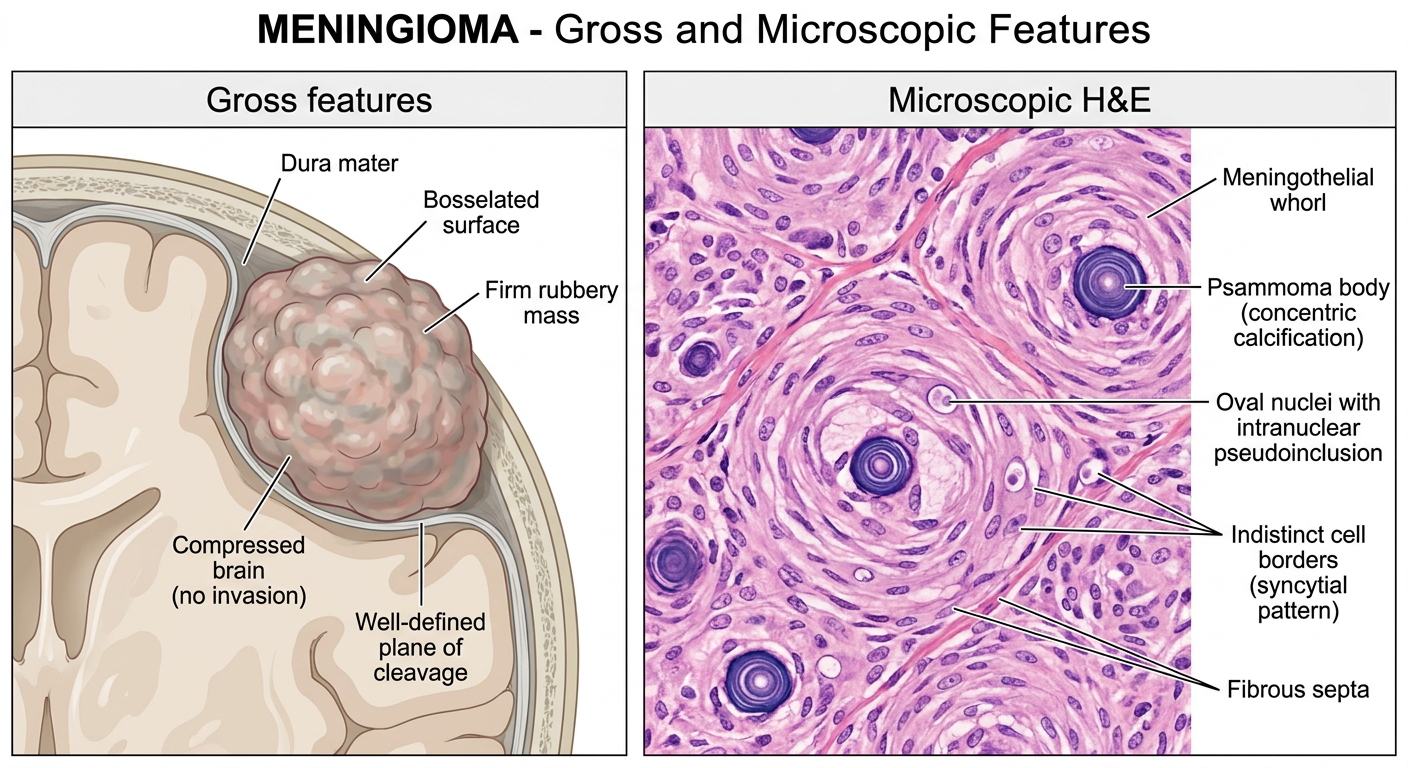
Neat labelled medical diagram of meningioma showing: Left panel (Gross features) - a rounded bosselated dural mass attached to dura mater, compressing but not invading underlying brain tissue, with labels: "Dura mater", "Bosselated surface", "Firm rubbery mass", "Compressed brain (no invasion)", "Well-defined plane of cleavage"; Right panel (Microscopic H&E) - histology showing meningothelial cells arranged in whorls (concentric spirals) with psammoma bodies (concentric calcified rings) in center, intranuclear pseudoinclusions in oval nuclei, labels: "Meningothelial whorl", "Psammoma body (concentric calcification)", "Oval nuclei with intranuclear pseudoinclusion", "Indistinct cell borders (syncytial pattern)", "Fibrous septa". Title at top: "MENINGIOMA - Gross and Microscopic Features". Clean white background, professional medical illustration style, black ink labels with leader lines.
MENINGIOMA - Gross and Microscopic Features
Definition / Introduction
A. GROSS FEATURES
-
Site: Most commonly arise from the parasagittal dura, dural convexity, sphenoid wing, olfactory groove, sella turcica, and foramen magnum.
-
Shape and surface: Rounded, lobulated (bosselated), or multinodular mass firmly attached to the dura.
-
Consistency: Rubbery to firm. May feel finely gritty (sand-like) when psammoma bodies are numerous - the Greek word psammos means "sand," hence the name.
-
En plaque variant: Some tumors grow in a flat, carpet-like (sheet-like) fashion along the dural surface, causing reactive hyperostosis of adjacent bone.
-
Relationship to brain: The tumor compresses the underlying brain but does not invade it - a clear plane of cleavage exists between tumor and brain parenchyma. This is the hallmark that distinguishes WHO Grade I from higher grades.
-
Cut surface: Grey-white or tan, homogeneous. Calcified areas may be visible as white gritty foci.
-
Vascularity: Usually well-vascularized with a meningeal blood supply (a "dural tail" is seen on MRI).
B. MICROSCOPIC FEATURES (H&E)
1. Meningothelial (Syncytial) Type - Most Common
- Lobules of epithelioid cells with indistinct (fuzzy) cell borders - cells appear to blend together (syncytial appearance).
- Nuclei are oval, uniform, with fine chromatin.
- Characteristic intranuclear cytoplasmic pseudoinclusions (invagination of cytoplasm into the nucleus) - appear as clear vacuoles within the nucleus.
2. Whorls
- Tumor cells wrap concentrically around one another in a whorl pattern - this is the diagnostic hallmark.
- These whorls undergo progressive hyalinization and eventually calcify to form psammoma bodies.
3. Psammoma Bodies
- Concentric, laminated calcifications deposited within the center of meningothelial whorls.
- Appear as pink, onion-skin layered spherical bodies on H&E.
- When extremely numerous, the term psammomatous meningioma is used.
4. Fibroblastic Type
- Intersecting fascicles of spindle-shaped cells with abundant collagen deposition between them.
- Less common whorls; psammoma bodies are sparse.
5. Transitional (Mixed) Type
- Shows features of both meningothelial and fibroblastic types.
- Prominent whorls and psammoma bodies - classic appearance.
6. Higher-grade features (WHO Grade 2 and 3)
- Increased mitotic activity, brain invasion, necrosis, prominent nucleoli, and loss of architecture.
DIAGRAM
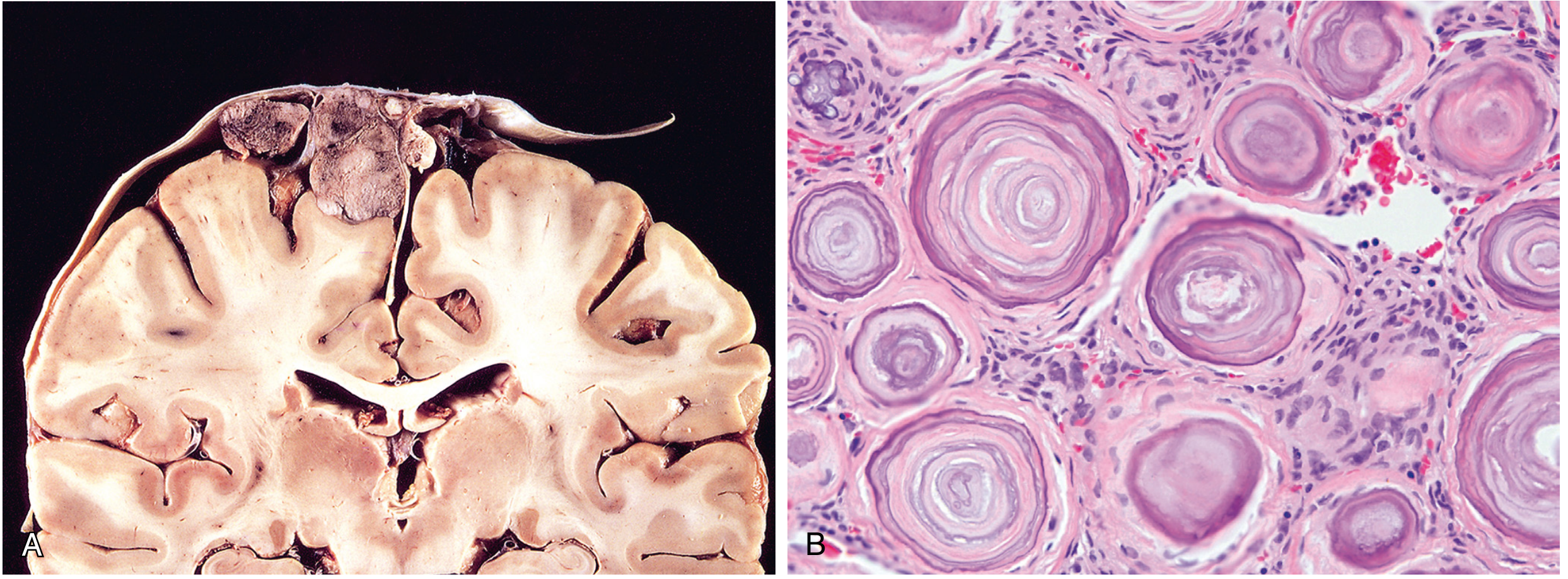
Textbook Image (Robbins & Cotran):
- (A) Gross: Parasagittal multilobular meningioma attached to the dura, compressing the underlying brain.
- (B) Microscopic: Whorled pattern of cell growth with numerous psammoma bodies (concentrically calcified rings).
Summary Table (Memory Aid for Exam)
| Feature | Description |
|---|---|
| Origin | Arachnoid cap cells |
| Gross shape | Rounded, bosselated, dura-attached |
| Consistency | Rubbery to firm / gritty |
| Brain invasion | Absent (compresses, does not invade) - Grade I |
| Key cell | Meningothelial cell - oval nucleus, indistinct borders |
| Hallmark pattern | Concentric whorls |
| Hallmark calcification | Psammoma bodies |
| Nuclear feature | Intranuclear pseudoinclusions |
| Most common subtype | Meningothelial (syncytial) |
- Meningiomas arise from arachnoid cap cells, not neurons or glial cells.
- Gross: bosselated, dura-attached, compresses but does not invade brain, clear plane of cleavage.
- Microscopy: whorls + psammoma bodies + intranuclear pseudoinclusions = the triad.
- Psammoma bodies = calcified whorls = "concentric onion-skin calcifications."
- WHO Grade I = benign; surgical excision is curative in most cases.