

IMG_20260624_125957746.jpg
My child is one month old, this pimple type thing is on her face since 5 days, what it is and how to cure it?
analyse_media
Reading File
Based on the image analysis, this almost certainly looks like neonatal acne - a completely normal and harmless condition in 1-month-old babies. Let me look this up in the medical library to give you complete information.
Searching sources...
Finding Sources
Finding Sources
Reading File
Reading File
Loading Image
Reading File
Here is a full explanation of what your baby has and what to do about it:
Your Baby Most Likely Has Neonatal Acne (Neonatal Cephalic Pustulosis)
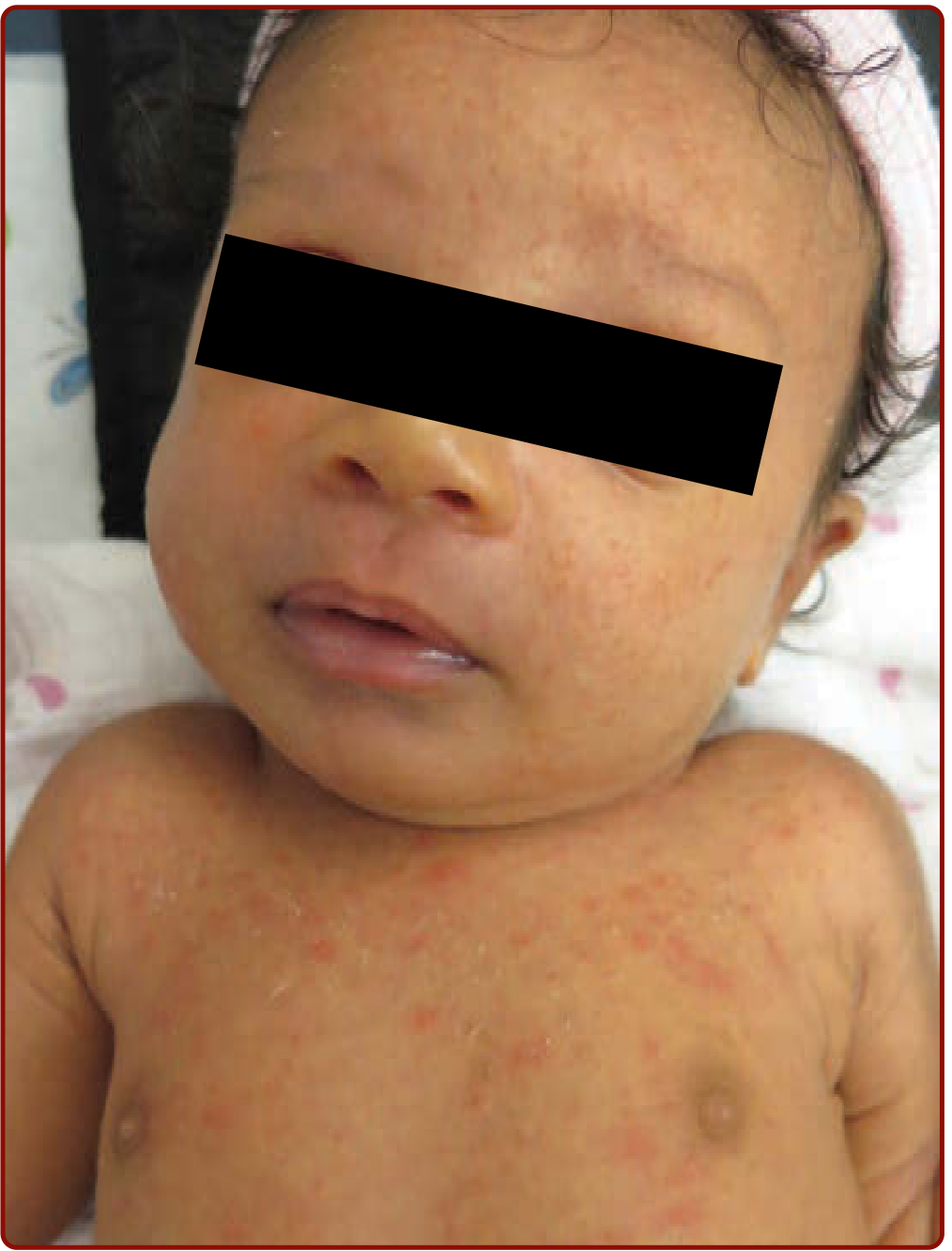
The rash in the photo shows multiple small, red, raised bumps (papules and pustules) on the cheeks and jawline - this matches neonatal acne almost exactly, and the textbook image from Fitzpatrick's Dermatology below looks very similar to your baby's face:
What Is It?
Neonatal acne (also called neonatal cephalic pustulosis) affects more than 20% of healthy newborns - so this is very common and completely normal. It typically appears around 2-4 weeks of age, which matches your baby's timeline exactly.
Why does it happen?
- Maternal hormones passed to the baby before birth stimulate the baby's oil (sebaceous) glands
- A mild inflammatory reaction to a normal skin yeast called Malassezia (which lives on everyone's skin) may also play a role
- Newborns naturally have high sebum (oil) production for the first few months, which contributes to this
Key features that confirm neonatal acne:
- Small red bumps/pimples, no blackheads or deep painful lumps
- Appears on cheeks, forehead, chin, and jawline (exactly as seen in your photo)
- Baby is not bothered - no itching, no fussiness from the rash itself
- No fever
Will It Go Away?
Yes, completely and on its own. As sebum production naturally declines after the first few months, neonatal acne resolves within a few weeks to 3 months with no scarring.
What To Do (and Not Do)
DO:
- Wash the face once daily with warm water or a mild, fragrance-free baby wash
- Gently pat dry - do not rub
- Keep the skin clean and dry
DO NOT:
- Squeeze, pop, or pinch the bumps (this can cause infection or scarring)
- Apply heavy oils, coconut oil, or greasy lotions to the face
- Use adult acne creams (like benzoyl peroxide or salicylic acid) - these are too harsh for newborn skin
- Over-wash the face - once daily is enough
No treatment is needed in most cases. The condition will clear on its own.
If a doctor finds it is more severe or not clearing, a mild topical antifungal cream (ketoconazole 2%) is sometimes used since Malassezia yeast is thought to be a contributing factor. - Dermatology 2-Volume Set 5e, p. 721
See a Doctor If:
- The bumps start oozing yellow fluid, forming crusts, or blistering (signs of bacterial infection)
- Your baby develops a fever or seems unusually unwell
- The rash spreads rapidly beyond the face to large areas of the body
- The rash is still present and worsening after 3 months
Bottom line: This is a harmless, normal newborn skin condition that affects 1 in 5 babies. No special treatment is needed. Just keep the face clean and gently washed, and it will go away on its own within weeks. Please do show it to your pediatrician at your next regular checkup for in-person confirmation.
Can it be because of people kissing baby cheeks or touching their cheeks with them
This is a really common concern for new parents. The short answer is: not directly for neonatal acne, but there are some important points worth knowing.
Searching sources...
Finding Sources
Searching the Web
can kissing baby cause neonatal acne skin irritation newborn
Great question - here is a clear and honest answer:
Kissing Does NOT Cause Neonatal Acne
The root cause of neonatal acne is internal, not external:
- Maternal hormones passed through the placenta or breast milk stimulate the baby's oil glands
- Malassezia yeast (naturally present on all skin, including your baby's) triggers a mild inflammatory response
- These are things happening inside the baby's skin from birth - no amount of avoiding kisses would have prevented it
Kisses, touching, or rubbing cheeks are not the cause of neonatal acne. This would have appeared regardless.
However - Kissing Can Make Existing Irritation Slightly Worse
While kisses don't cause neonatal acne, a few things related to skin contact can aggravate already-sensitive newborn skin:
| What | Why it irritates |
|---|---|
| Stubble/beard rubbing the face | Physical friction irritates delicate skin |
| Lipstick, lip balm, or cosmetics | Chemicals and fragrances can clog tiny pores |
| Saliva staying wet on the skin | Prolonged moisture can cause mild irritation |
| Perfume or cologne on someone's face/neck | Fragrance is a common skin irritant in newborns |
What This Means Practically
- You do not need to stop family from kissing the baby over neonatal acne
- It is a good idea though to ask people not to kiss if they have a cold sore (oral herpes - this is genuinely dangerous for newborns under 3 months)
- If someone with a beard keeps rubbing their face on the baby's cheek, that friction could worsen redness temporarily
- After kisses, a gentle wipe with a soft damp cloth is perfectly fine if the skin looks irritated
The reassuring truth: Your baby's acne is a hormonal, internal process that was going to happen regardless of who held or kissed her. It will clear up on its own. There is no one to blame and nothing that could have been done differently to prevent it.
What other newborn skin conditions look similar to baby acne?
Several newborn skin conditions can look like baby acne. Let me pull up the full medical details and images from dermatology textbooks.
Searching sources...
Finding Sources
Finding Sources
Finding Sources
Finding Sources
Finding Sources
Reading File
Reading File
Reading File
Finding Sources
Finding Sources
Reading File
Reading File
Loading Image
Loading Image
Loading Image
Here is a complete visual guide to all the newborn skin conditions that look similar to baby acne, drawn from Tintinalli's Emergency Medicine, Dermatology 2-Volume Set 5e, and The Harriet Lane Handbook:
Newborn Skin Conditions That Look Like Baby Acne
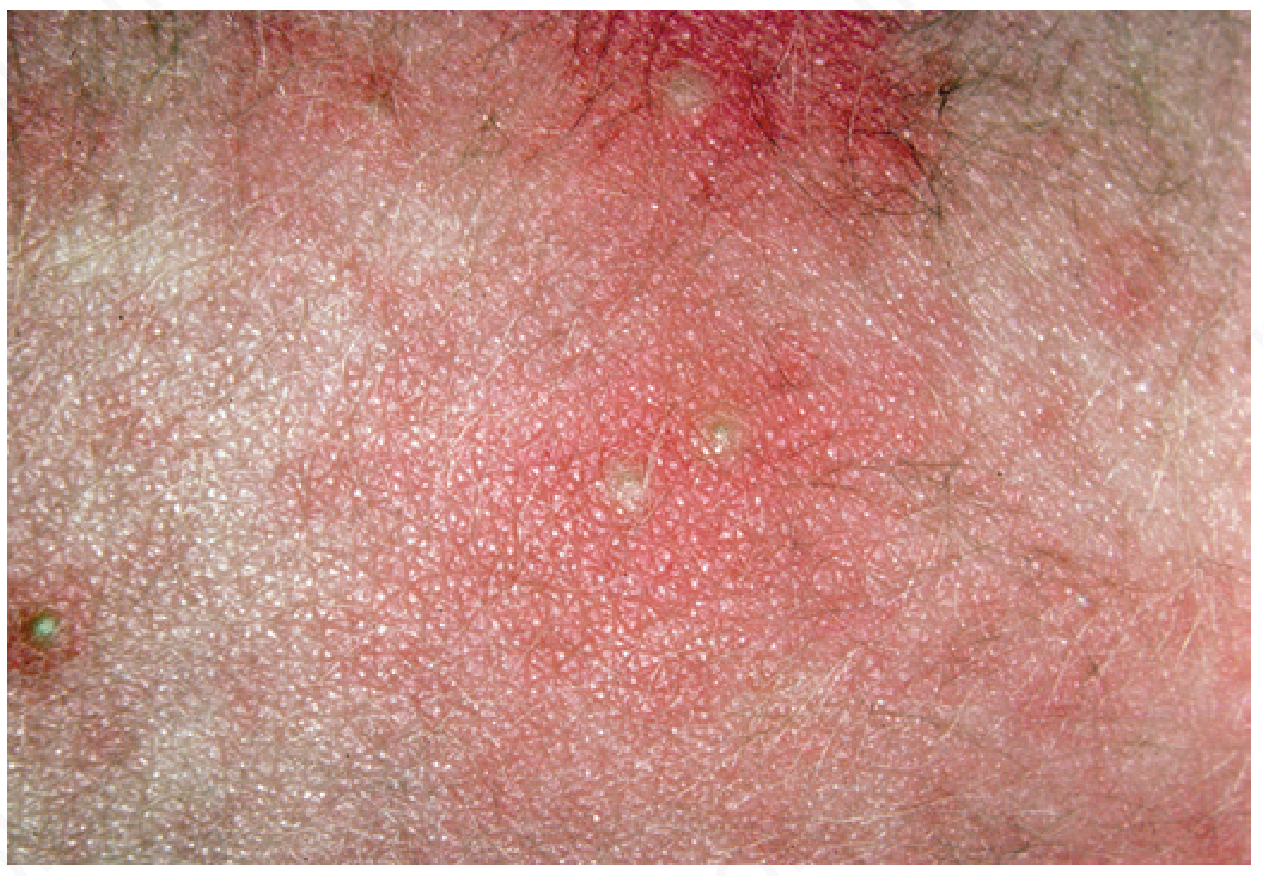
1. Erythema Toxicum Neonatorum (ETN)
The most common newborn rash - affects up to 50% of full-term babies
| Feature | Details |
|---|---|
| Appearance | Large red blotchy patches (2-3 cm) with a small white/yellow pustule in the center |
| Key difference from acne | The RED AREA around each bump is much bigger and more dramatic than acne; looks like a "bulls-eye" |
| Location | Face, trunk, arms and legs - but never palms or soles |
| When | First week of life, usually days 1-3 |
| Duration | Clears in 5-7 days on its own |
| Treatment | None needed - completely harmless |
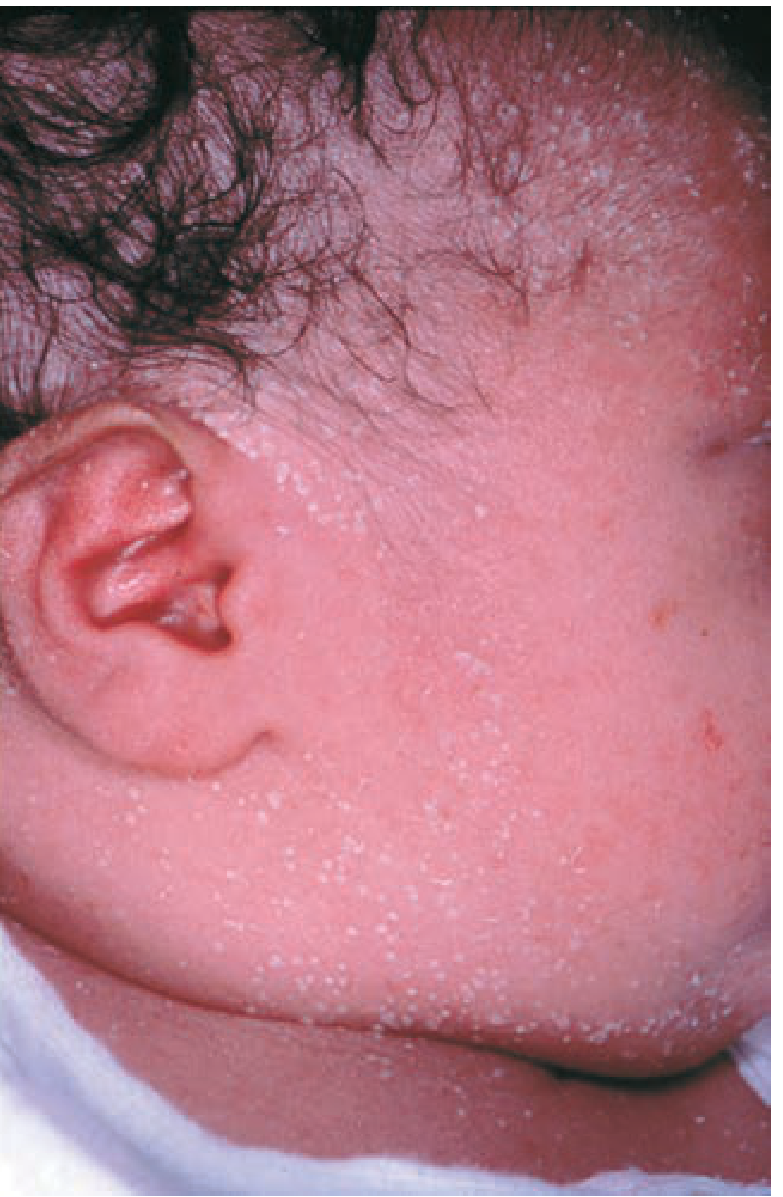
2. Milia
Very common - tiny white bumps, often mistaken for pimples
| Feature | Details |
|---|---|
| Appearance | Tiny (1-3 mm) white or yellowish firm bumps - like small white seeds |
| Key difference from acne | No redness around them; they look like white pinpoints, not inflamed pimples |
| Location | Mostly on the nose and across the cheeks and forehead |
| Cause | Trapped keratin (skin protein) in the pores - not hormonal |
| Treatment | None - disappear on their own within weeks |
3. Miliaria (Heat Rash)
Caused by blocked sweat glands in hot conditions
| Feature | Details |
|---|---|
| Appearance | Tiny red bumps or clear/white blisters, sometimes with small pustules |
| Key difference from acne | Directly linked to overheating - appears after baby is too warm, overdressed, or in an incubator |
| Location | Face, scalp, neck folds, and areas covered by clothing |
| Treatment | Move baby to a cooler environment, remove tight clothing - clears quickly |
4. Transient Neonatal Pustular Melanosis (TNPM)
| Feature | Details |
|---|---|
| Appearance | Small pustules WITHOUT redness around them. When they burst, they leave brown pigmented spots with a ring of scale |
| Key difference from acne | Pustules sit on non-red skin (unlike acne which has surrounding redness); may leave brownish marks that slowly fade over weeks to months |
| Who gets it | More common in darker-skinned babies |
| When | Often present at birth - this is the main clue |
| Treatment | None needed - resolves fully on its own |
5. Sebaceous Hyperplasia
Enlarged oil glands - harmless
| Feature | Details |
|---|---|
| Appearance | Tiny, yellowish-white, pearly bumps - very small and flat-ish |
| Key difference from acne | No inflammation, no redness - they look like tiny pale dots, not pimples |
| Location | Nose and cheeks |
| Cause | Maternal hormones cause the baby's oil glands to temporarily enlarge |
| Treatment | None - disappears in weeks as hormones clear |
Quick Visual Comparison Table
| Condition | Color | Red around it? | When it appears | Goes away in |
|---|---|---|---|---|
| Neonatal acne | Red bumps/pustules | Yes, mild | 2-4 weeks old | 1-3 months |
| Erythema toxicum | White pustule in large red patch | Yes, very prominent | Days 1-7 | 5-7 days |
| Milia | White/yellow, firm | No | Birth | Weeks |
| Miliaria (heat rash) | Red bumps or clear blisters | Yes, mild | When overheated | Hours to days |
| TNPM | Pustules then brown spots | No | At birth | Weeks to months |
| Sebaceous hyperplasia | Yellow-white, flat | No | Birth | Weeks |
When to Worry - See a Doctor If:
All the conditions above are harmless and self-resolving. However, get your baby checked promptly if the bumps:
- Are blistering or oozing yellow/green fluid
- Come with a fever or the baby seems unwell
- Develop honey-colored crusts (suggests bacterial infection/impetigo)
- Appear as grouped fluid-filled blisters (could be neonatal herpes - needs urgent care)
- Are spreading rapidly and the baby is uncomfortable
For your daughter's rash, based on what we saw in the photo, neonatal acne remains the most likely diagnosis - and all of the above conditions are equally harmless and need no treatment. - Harriet Lane Handbook, 23rd ed.
Can contaminated oil result in this
Good question. The short answer is: contaminated or heavy oils don't cause neonatal acne, but they can definitely make it worse - and in rare cases, infected oil could cause a separate skin infection on top.
Searching sources...
Finding Sources
Searching the Web
baby oil on newborn face acne clog pores worsen neonatal skin
Finding Sources
Finding Sources
Finding Sources
Finding Sources
Finding Sources
Finding Sources
Finding Sources
Searching the Web
contaminated oil baby face skin infection neonatal acne aggravate
Here is a clear breakdown of exactly how oil relates to your baby's skin condition:
Can Contaminated Oil Cause or Worsen This?
The direct answer: No, oil did not CAUSE neonatal acne - but yes, applying oil to a newborn's face can make it significantly worse, and contaminated oil carries additional risks.
Why Oil Doesn't Cause Neonatal Acne
Neonatal acne is driven entirely by internal hormonal factors - maternal hormones that were already in the baby's system from before birth. This process starts from the inside, within the baby's own oil glands. No external product causes it. It would have appeared whether or not any oil was ever applied.
How Oil on the Face Makes It Worse
This is the important part. Newborn facial skin is extremely thin and permeable - about 30% thinner than adult skin. When you apply oil to a face that already has active neonatal acne:
| Problem | What happens |
|---|---|
| Pore occlusion | Oil sits on the skin and physically blocks the tiny pore openings, trapping sebum and the Malassezia yeast underneath - the exact combination that drives neonatal acne |
| Yeast feeding | Malassezia (the yeast involved in neonatal acne) feeds on fatty acids found in oils. Applying oil to the face literally feeds the yeast causing the inflammation |
| Prolonged moisture | Oil keeps the skin surface moist longer, which encourages more yeast and bacterial growth |
| Irritation | Many traditional oils (mustard oil especially) are known irritants for newborn skin and can damage the skin barrier |
This is why dermatologists specifically advise: do not apply heavy oils or greasy products to a newborn's face.
The Extra Risk with Contaminated Oil
If the oil itself is contaminated with bacteria (stored in a dirty container, left open, or mixed with anything), it can cause a completely separate problem on top of the acne:
- Bacterial folliculitis - infection of the hair follicles, looks like acne but the pustules are larger and more painful
- Impetigo - bacterial skin infection causing honey-colored crusting
- Staphylococcal skin infection - newborns are especially vulnerable because their immune systems are immature
These infections look different from simple neonatal acne - the pustules tend to be larger, may ooze, may crust over in a yellowish color, and the baby may seem uncomfortable or develop a fever.
A Note on Traditional Practices (Oil Massage)
Many families, particularly in South Asian cultures, routinely massage newborns with oils like mustard oil, coconut oil, or olive oil. Research on newborn skin has found:
- Mustard oil is particularly problematic - it disrupts the newborn skin barrier and increases water loss
- Olive oil also shown to worsen eczema risk in some studies
- Coconut oil is the gentlest of the commonly used oils, but still should be kept off an acne-affected face
- Body massage with gentle oil is generally fine - the face should be kept oil-free
What to Do Right Now
- Stop applying any oil to her face - this is the most important step
- If you have been applying oil to the face, gently clean it off with warm water and a soft cloth once daily
- Keep the face dry and clean - water only, or a very mild fragrance-free baby wash
- Continue body massage if you wish, just keep it below the neck
- If the bumps worsen after stopping the oil, or you see any crusting/oozing, see a pediatrician
The good news is that once oil is removed from the face, neonatal acne typically starts improving noticeably within a week or two, on top of the natural resolution that was already going to happen.
Bacterial folliculitis
Bacterial folliculitis is an infection of the hair follicles, most commonly caused by Staphylococcus aureus. Let me pull up the full medical details and images.
Searching sources...
Finding Sources
Finding Sources
Reading File
Reading File
Reading File
Loading Image
Finding Sources
Finding Sources
Here is a complete guide to bacterial folliculitis, sourced from Dermatology 2-Volume Set 5e and Fitzpatrick's Dermatology:
Bacterial Folliculitis - Complete Guide
What Is It?
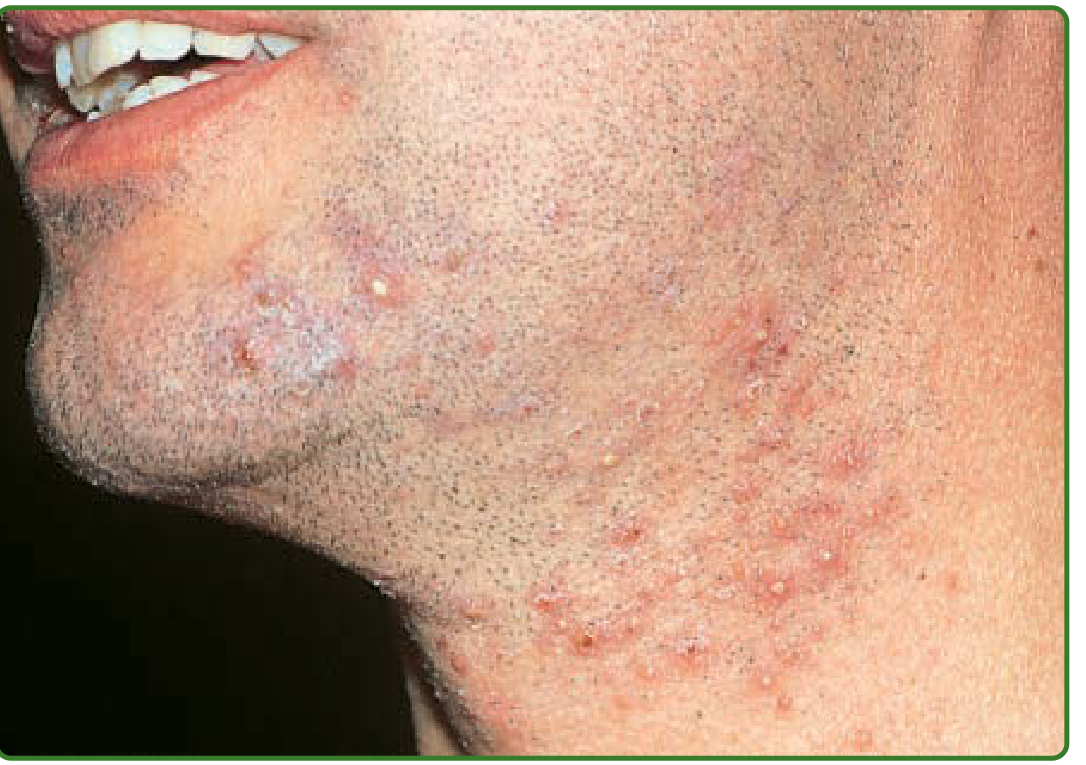
Bacterial folliculitis is an infection of the hair follicle - each individual pore/follicle becomes infected with bacteria. It can be superficial (just the top of the follicle) or deep (involving the whole follicle and surrounding skin).
Causes (Types)
| Type | Organism | Notes |
|---|---|---|
| Staphylococcal (most common) | Staphylococcus aureus | Responsible for vast majority of cases |
| Gram-negative | Various bacteria | Seen in people on long-term antibiotics |
| "Hot tub" folliculitis | Pseudomonas aeruginosa | From poorly chlorinated water |
| Syphilitic | Treponema pallidum | Rare, acne-like appearance |
In newborns specifically, the relevant form is called periporitis staphylogenes - a S. aureus infection of neonates that can appear as a secondary infection on top of miliaria (heat rash) or occluded skin.
Who Gets It - Risk Factors
According to Dermatology 2-Volume Set 5e, predisposing factors include:
- Occlusion - anything blocking the follicle (heavy oils, thick creams)
- Maceration - skin kept too moist for too long
- Hot and humid weather
- Atopic dermatitis (eczema)
- Diabetes mellitus (in adults)
- Shaving, plucking, or waxing hair
In a newborn's case - applying oil to the face directly creates the occlusion + maceration conditions that make folliculitis possible.
What It Looks Like
Superficial folliculitis:
- Small (1-4 mm) pustules - like pimples but each one is centered exactly on a hair follicle/pore
- Red, inflamed base around each pustule
- Lesions are clustered together
- May be slightly itchy or tender to touch
- Heals without scarring if treated
Deep folliculitis (more severe):
- Larger, more painful red bumps
- Central pustule visible
- Bumps may merge together into crusted plaques
- Can progress to a furuncle (boil) - a painful, pus-filled lump - if untreated
How It Differs from Neonatal Acne
This is important for your baby:
| Feature | Neonatal Acne | Bacterial Folliculitis |
|---|---|---|
| Cause | Internal hormones + yeast | External bacteria (S. aureus) |
| Pustule size | Small, uniform | Variable, often larger |
| Tenderness | None - baby unbothered | May cause discomfort/fussiness |
| Associated fever | Never | Possible if spreading |
| Discharge | None | May ooze yellow/green pus |
| Crusting | None | Yellow/honey-colored crusts possible |
| Spreading | Stays on face | Can spread to new areas |
| Response to cleaning | Gradual improvement | Does not improve without antibiotics |
Diagnosis
Usually clinical (by looking at it). If uncertain, a doctor may:
- Take a swab for bacterial culture from one of the pustules
- Do a Gram stain - shows clusters of Gram-positive cocci (S. aureus)
- This is especially useful in newborns where the stakes are higher
Treatment
Localized / mild cases:
- Antibacterial wash with chlorhexidine
- Topical antibiotic: mupirocin 2% ointment or clindamycin applied for 7-10 days
- These are prescription items - a pediatrician/dermatologist must prescribe them for a 1-month-old
Widespread or not improving:
- Oral antibiotics: beta-lactam antibiotics (penicillin family), first-generation cephalosporins, or TMP-SMZ depending on local resistance patterns
- For MRSA (antibiotic-resistant S. aureus): doxycycline, trimethoprim-sulfamethoxazole, or clindamycin
Recurring folliculitis - decolonization:
- Mupirocin ointment to the nostrils (the nose is a common hiding place for S. aureus)
- Chlorhexidine washes for the body
- Disinfect potential contaminated objects
Important for a 1-month-old: Never apply any antibiotic, antiseptic, or medicated product to a newborn without a doctor's prescription. Newborn skin absorbs products differently and systemic absorption of topical medications is much higher than in adults.
How to Tell If Your Baby's Rash Has Become Folliculitis
Watch for these warning signs that suggest it has gone beyond simple neonatal acne and needs a doctor:
- Pustules becoming larger or more painful-looking
- Baby seems fussy or uncomfortable when the area is touched
- Yellow or green discharge from any bumps
- Honey-colored crusting forming on the skin
- Fever (temperature above 38°C / 100.4°F)
- The rash spreading rapidly to new areas
- Any bump growing into a hard, painful lump (possible boil)
If any of the above occur - see a pediatrician the same day. Bacterial skin infections in 1-month-olds can spread quickly and need prompt treatment.
- Dermatology 2-Volume Set 5e, p. 1517 | Fitzpatrick's Dermatology
This is a shared conversation. Sign in to Orris to start your own chat.