
Feed back mechanism
I need a bit more context to give you a useful answer. "Feedback mechanism" spans many domains.
Asking for Preferences
What domain are you asking about?
Reading File
Finding Sources
Searching the Web
feedback mechanism biology physiology positive negative examples
Finding Sources
Reading File
Reading File
Reading File
Searching Images
negative feedback loop homeostasis physiology diagram
Loading Image
Reading File
Here is a comprehensive overview of feedback mechanisms in biology and physiology, drawn from authoritative medical textbooks.
Feedback Mechanisms in Physiology
A feedback mechanism is a regulatory loop in which the output of a system feeds back to influence its own activity. The body uses these loops to maintain homeostasis — a stable internal environment.
Core Components of Any Feedback Loop
Every feedback system requires at least four elements (Medical Physiology):
| Component | Role | Example |
|---|---|---|
| Sensor | Detects the controlled variable | Baroreceptors (blood pressure) |
| Set-point comparator | Compares input to a reference value | Brain medulla / vasomotor centers |
| Integrating center | Generates an error signal | Hypothalamus, pituitary |
| Effector | Acts to correct the deviation | Heart, blood vessels, glands |
Types of Feedback
1. Negative Feedback (most common)
The response opposes the original stimulus, returning the system toward its set-point.
"One of the most common themes in physiology is the negative-feedback mechanism responsible for homeostasis." — Medical Physiology
How it works:
- A vital parameter deviates from the set-point
- Sensors detect the change
- An error signal is generated
- Effectors act in the opposite direction to correct it
Classic example — Baroreceptor reflex (arterial blood pressure):
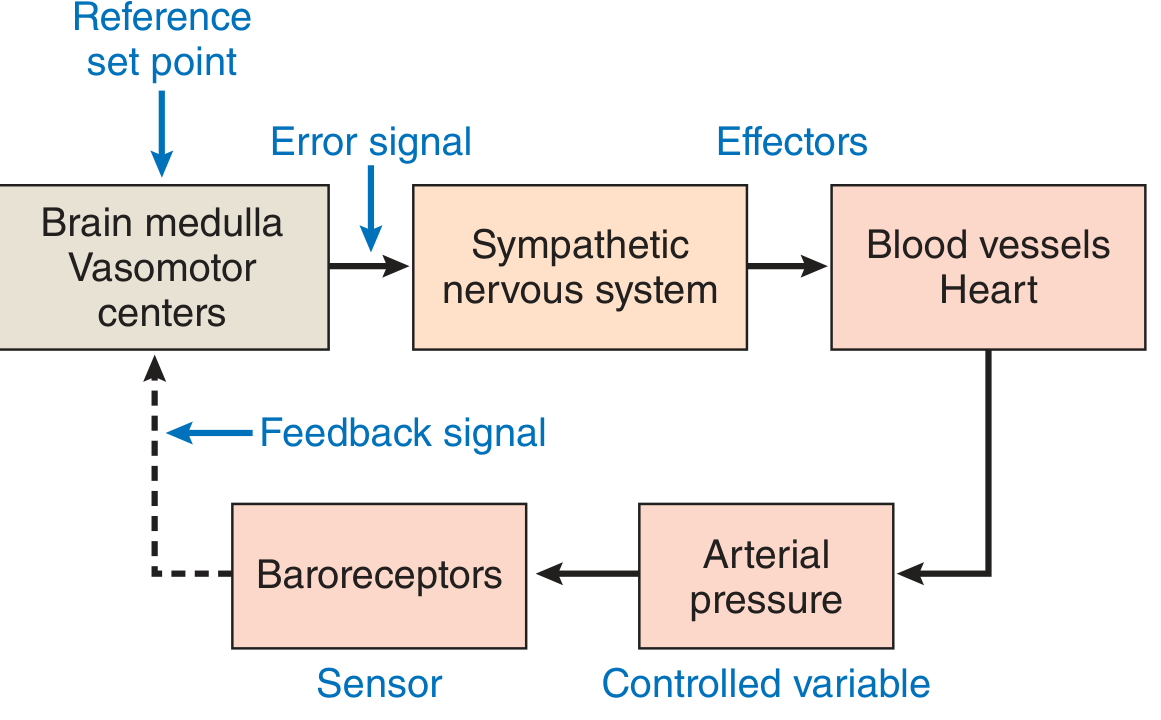
Figure: Negative feedback loop controlling arterial blood pressure. Baroreceptors (sensor) detect elevated pressure → signal the brain medulla → reduce sympathetic output (effector) → vasodilation + reduced heart pumping → pressure returns to normal.
Other key examples:
| Parameter | Sensor | Effector |
|---|---|---|
| Blood glucose ↑ | Pancreatic β-cells | Insulin release → glucose uptake |
| Body temperature ↑ | Hypothalamus | Sweating, vasodilation |
| CO₂ ↑ | Brainstem chemoreceptors | Increased respiratory rate |
| Testosterone ↑ | Hypothalamus/pituitary | ↓ GnRH/LH → ↓ testicular output |
Gain of a feedback system = correction produced ÷ remaining error. The baroreceptor system has a gain of −2 (corrects ~2/3 of the disturbance). Body temperature control has a gain of −33, making it far more powerful.
2. Positive Feedback (less common — amplifies the signal)
The response reinforces the original stimulus, driving the process to completion. It leads to instability unless part of a larger negative feedback system.
"Positive feedback is sometimes known as a 'vicious cycle.'" — Guyton & Hall
Physiologically useful examples:
| Event | Mechanism |
|---|---|
| Blood clotting | Clotting factors activate more clotting factors → rapid plug formation |
| Childbirth (parturition) | Uterine contractions stretch the cervix → more oxytocin released → stronger contractions (Ferguson reflex) |
| Action potential generation | Na⁺ influx → membrane depolarization → more Na⁺ channels open → explosive depolarization |
| LH surge at ovulation | Rising estradiol switches from negative to positive feedback → LH surge → ovulation |
When positive feedback causes disease:
- Hemorrhagic shock: blood loss → ↓ cardiac output → ↓ coronary flow → weaker heart → further ↓ output (vicious cycle → death if blood loss >2 L)
- Acute MI: atherosclerotic plaque rupture → clot formation → arterial occlusion
Hierarchy and Redundancy
The body rarely relies on a single feedback loop. Systems are organized hierarchically:
- Hypothalamus → controls anterior pituitary → controls adrenal cortex → releases cortisol → controls blood glucose
And redundantly — the more vital the parameter, the more backup systems exist. Blood glucose, for instance, is regulated by insulin, glucagon, epinephrine, cortisol, and growth hormone simultaneously.
Feed-Forward Control (bonus concept)
A related mechanism where the body anticipates a change before it occurs (rather than reacting after). Example: during rapid voluntary movements, the brain sends pre-programmed motor commands without waiting for sensory feedback. Errors are corrected on the next movement — a form of adaptive (delayed negative) feedback.
Summary Table
| Feature | Negative Feedback | Positive Feedback |
|---|---|---|
| Response direction | Opposes change | Amplifies change |
| Goal | Restore set-point | Drive process to completion |
| Stability | Stabilizing | Destabilizing (unless bounded) |
| Frequency | Very common | Rare, specific contexts |
| Examples | BP, temperature, glucose, hormones | Clotting, childbirth, action potentials, LH surge |
Sources:
- Guyton and Hall Textbook of Medical Physiology — Chapters 1 & 10
- Medical Physiology (Boron & Boulpaep) — Chapter 1
This is a shared conversation. Sign in to Orris to start your own chat.