
Pharmacodynamics
Reading File
The topic "Pharmacodynamics" is broad. Let me clarify what you need before diving in.
Asking for Preferences
What aspect of pharmacodynamics do you need? · What level of detail?
Searching sources...
Finding Sources
Finding Sources
Finding Sources
Reading File
Reading File
Finding Sources
Reading File
Finding Sources
Reading File
I now have excellent source material from Lippincott Illustrated Reviews: Pharmacology. Let me read a bit more to capture the antagonist and drug interaction sections.
Reading File
I now have all the key content needed. Let me compile a comprehensive, exam-ready summary.
Loading Image
Loading Image
Here is a complete, exam-ready overview of Pharmacodynamics, sourced from Lippincott Illustrated Reviews: Pharmacology.
Pharmacodynamics - Exam-Ready Overview
Definition: Pharmacodynamics describes the actions of a drug on the body - what the drug does, and how it does it. (Compare with pharmacokinetics = what the body does to the drug.)
1. Drug-Receptor Basics
Most drugs exert effects by binding to specialized macromolecules called receptors on or inside cells. This binding triggers signal transduction - a cascade of biochemical events that produces the drug's effect.
Key concept: Affinity = the strength with which a drug binds to its receptor (measured by the dissociation constant, Kd). The lower the Kd, the higher the affinity.
Receptor Types & Signal Transduction Mechanisms
| Receptor Type | Mechanism | Speed | Examples |
|---|---|---|---|
| Ligand-gated ion channels (Type I) | Ion flux across membrane | Fastest (milliseconds) | Nicotinic ACh receptor, GABA-A |
| G protein-coupled receptors (Type II) | Activate second messengers (cAMP, IP3/DAG, cGMP) | Seconds-minutes | Adrenergic, muscarinic, opioid |
| Receptor tyrosine kinases (Type III) | Autophosphorylation of tyrosine residues | Minutes-hours | Insulin receptor, growth factors |
| Nuclear receptors / Intracellular (Type IV) | Alter gene transcription | Hours-days (slowest) | Steroid hormones, thyroid hormone |
Second Messengers (high-yield):
- Gs (stimulatory) → adenylyl cyclase ↑ → cAMP ↑ → PKA activated (e.g., β-adrenergic)
- Gi (inhibitory) → adenylyl cyclase ↓ → cAMP ↓ (e.g., M2 muscarinic, opioid)
- Gq → phospholipase C → IP3 + DAG → Ca²⁺ release + PKC (e.g., α1-adrenergic, M1/M3)
2. Dose-Response Relationships
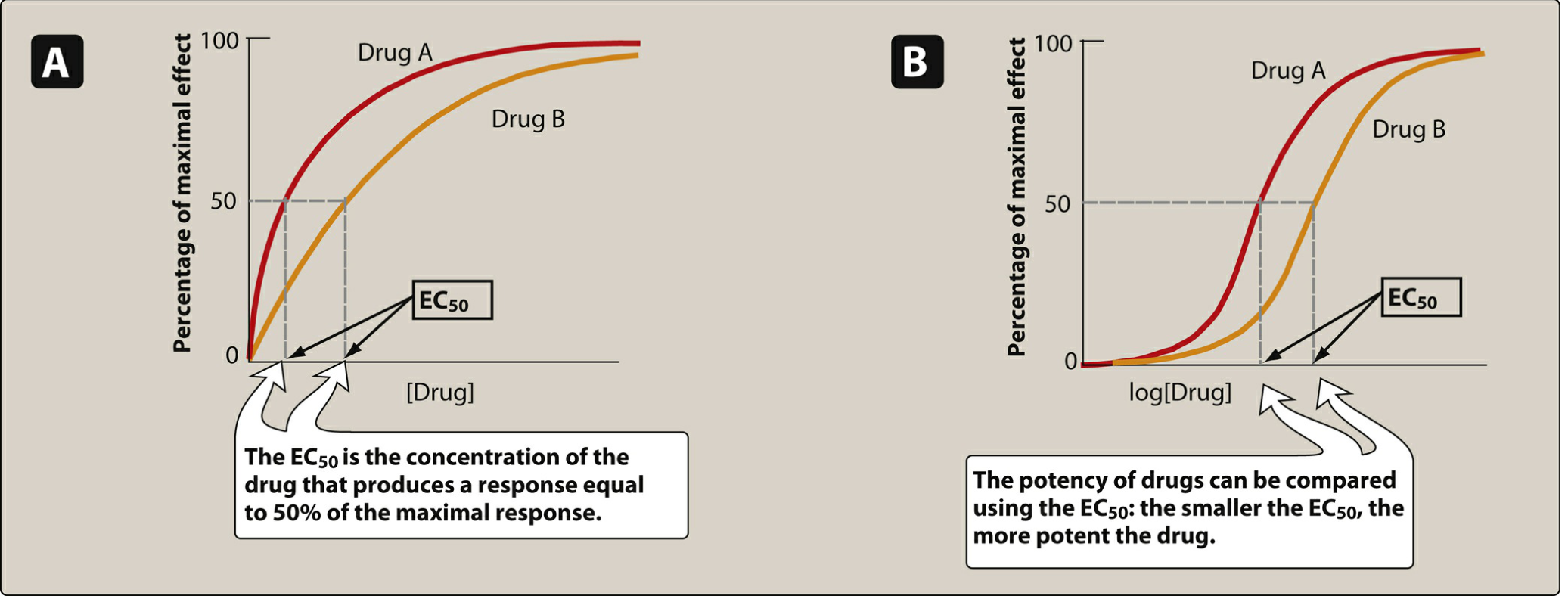
As drug concentration increases, pharmacologic effect increases until all receptors are occupied (maximum effect = Emax).
Potency vs. Efficacy
| Parameter | Definition | Measured By | Key Point |
|---|---|---|---|
| Potency | Amount of drug needed to produce an effect | EC50 (lower = more potent) | Clinically less important than efficacy |
| Efficacy | Maximum effect a drug can produce | Emax | More clinically important |
- Drug A is more potent than Drug B if Drug A has a lower EC50 (its curve is shifted left)
- Two drugs can have equal efficacy (same Emax) but different potency
Therapeutic Index (TI)
$$TI = \frac{TD_{50}}{ED_{50}}$$
- Wide TI = safer drug (e.g., penicillin)
- Narrow TI = careful dosing required (e.g., warfarin, digoxin, lithium, aminoglycosides)
3. Agonists, Partial Agonists & Antagonists
Types of Drug Activity (Intrinsic Activity)
| Type | Intrinsic Activity | Effect | Example |
|---|---|---|---|
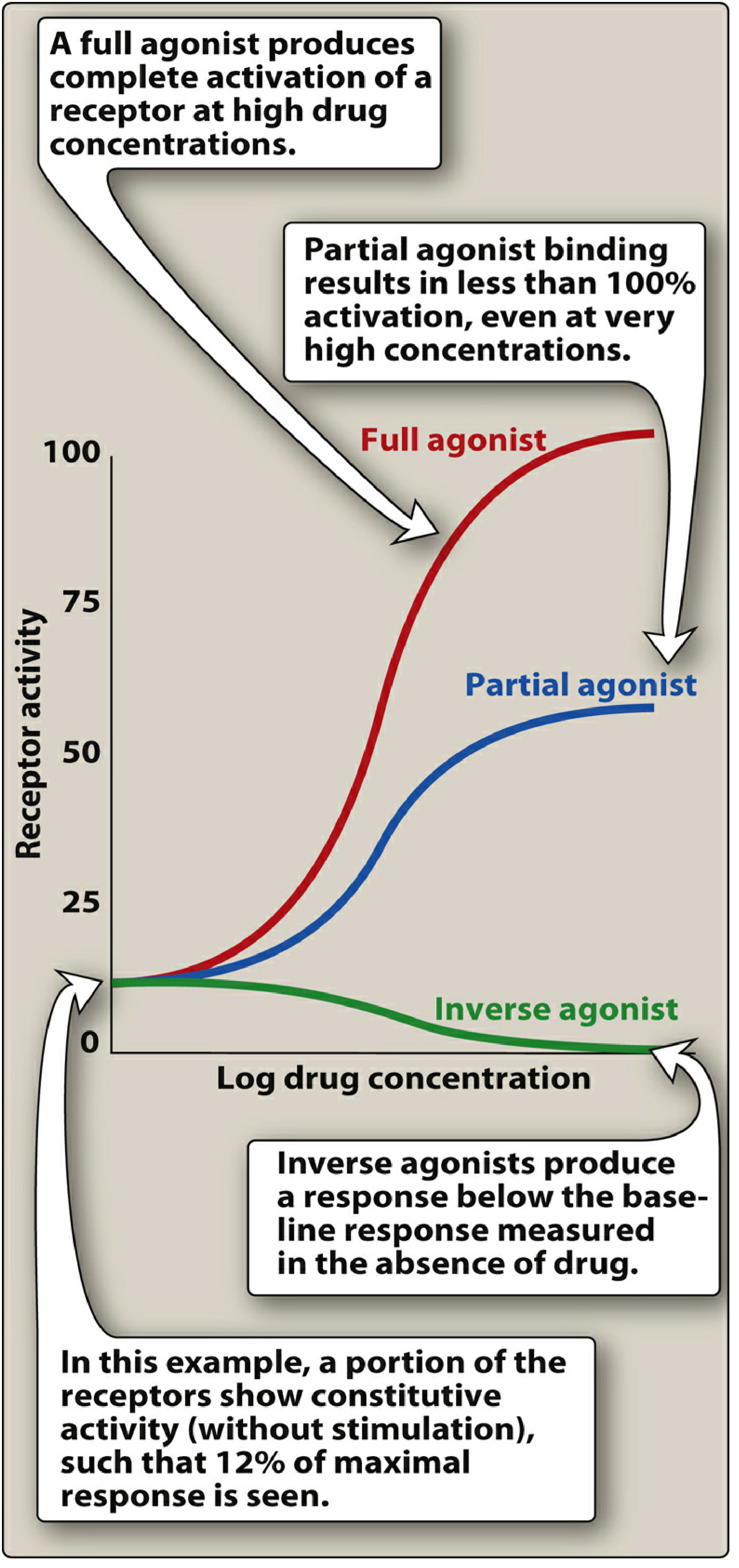
| Full agonist | = 1 | Binds and produces maximal response (same Emax as endogenous ligand) | Morphine (opioid), phenylephrine (α1) |
| Partial agonist | 0 < IA < 1 | Produces sub-maximal response even at 100% receptor occupancy; can act as partial antagonist in the presence of a full agonist | Buprenorphine (opioid), buspirone (5-HT1A) |
| Inverse agonist | < 0 | Produces effect below baseline (reduces constitutive activity) | Some benzodiazepines in certain contexts |
| Competitive antagonist | 0 | Binds reversibly; shifts dose-response curve to the right (↑ EC50); Emax unchanged | Naloxone, atropine, propranolol |
| Non-competitive (irreversible) antagonist | 0 | Binds permanently; ↓ Emax (Emax is reduced); EC50 may not change | Phenoxybenzamine (α-blocker) |
Key exam pearl: Competitive antagonism is surmountable (increasing agonist dose can overcome it). Non-competitive is insurmountable (Emax can never recover).
4. Receptor Regulation
Downregulation (Desensitization)
- Caused by prolonged agonist exposure
- Receptors are phosphorylated → rendered unresponsive
- Receptors may be internalized (removed from cell surface)
- Clinical example: Opioid tolerance - repeated morphine use decreases opioid receptor number and responsiveness, requiring higher doses for same pain relief
Upregulation
- Caused by prolonged antagonist exposure
- More receptors are inserted into the membrane
- Cells become hypersensitive to agonists
- Clinical example: Rebound hypertension when β-blockers are stopped abruptly (upregulated β-receptors → exaggerated catecholamine response)
Tachyphylaxis
- Rapidly developing tolerance after just a few doses (e.g., repeated use of indirect-acting sympathomimetics like amphetamine depletes norepinephrine stores)
5. Drug Interactions (Pharmacodynamic)
| Type | Mechanism | Result | Example |
|---|---|---|---|
| Synergism / Additivity | Both drugs act on same pathway | Effect ≥ sum of individual effects | Alcohol + benzodiazepines (CNS depression) |
| Potentiation | One drug enhances another's effect without having the effect itself | Enhanced effect | Probenecid + penicillin |
| Antagonism | Opposing actions at same or different receptors | Reduced net effect | Naloxone reversing morphine overdose |
6. Special Populations - Altered Pharmacodynamics
- Elderly patients: Decreased β-receptor sensitivity to both agonists and antagonists; increased CNS sensitivity to benzodiazepines and opioids (receptor changes); increased risk of anticholinergic toxicity (↓ ACh synthesis); greater warfarin-induced vitamin K inhibition at same plasma levels
- Calcium channel blockers cause greater BP and HR drops in elderly due to diminished homeostatic reserve
High-Yield Summary Table
| Concept | Key Value/Definition |
|---|---|
| EC50 | Concentration causing 50% maximal effect; measures potency |
| Emax | Maximum effect achievable; measures efficacy |
| Kd | Dissociation constant; inversely related to affinity |
| Full agonist | Intrinsic activity = 1, same Emax as endogenous ligand |
| Partial agonist | Intrinsic activity < 1, can antagonize full agonist |
| Competitive antagonist | Shifts curve right, Emax preserved |
| Non-competitive antagonist | Decreases Emax, curve does not recover with more agonist |
| Downregulation | Prolonged agonist → fewer receptors, tolerance |
| Upregulation | Prolonged antagonist → more receptors, rebound effect |
| Narrow TI drugs | Warfarin, digoxin, lithium, aminoglycosides, phenytoin |
Source: Lippincott Illustrated Reviews: Pharmacology, Chapter 2 - Drug-Receptor Interactions and Pharmacodynamics
This is a shared conversation. Sign in to Orris to start your own chat.