
Ctg
CTG can mean a few things - most commonly cardiotocography (fetal heart rate monitoring in obstetrics), but also cytosine-thymine-guanine (a codon), or something else entirely.
Could you clarify what you're looking for?
Asking for Preferences
What does CTG refer to in your question?
Goiter
Reading File
Searching sources...
Finding Sources
Searching PubMed
goiter thyroid enlargement
Good results. Now let me read the most comprehensive sources in parallel.
Reading File
Reading File
Reading File
Reading File
Finding Sources
I now have excellent, comprehensive information. Let me also fetch the CT scan image to include it.
Loading Image
Here is a thorough overview of Goiter drawn from multiple authoritative medical textbooks.
Goiter
Definition
A goiter is any enlargement of the thyroid gland. In common clinical usage the term most often refers to benign causes - diffuse toxic goiter (Graves' disease), toxic multinodular goiter, or nontoxic multinodular goiter. Malignant thyroid enlargement is usually called a mass or nodule rather than a goiter.
- Goldman-Cecil Medicine, p. 3271
- Current Surgical Therapy 14e, p. 880
Types
| Type | Description |
|---|---|
| Diffuse goiter | Uniform gland enlargement; almost always benign; seen in Graves' disease and congenital hormone synthesis defects |
| Multinodular goiter (MNG) | Multiple nodules, solid or partially cystic (colloid cysts), with areas of fibrosis; may be toxic (hyperthyroid) or nontoxic (euthyroid) |
| Endemic goiter | Occurs in geographic regions of iodine deficiency |
| Retrosternal / intrathoracic goiter | Extension into the chest; can cause superior vena cava syndrome or anterior mediastinal mass |
Causes / Pathogenesis
The most common cause worldwide is iodine deficiency. The pituitary responds to low thyroid hormone by increasing TSH secretion, which drives thyroid enlargement. Other causes include:
- Goitrogens (dietary): bamboo shoots, maize, sweet potatoes
- Genetic factors and dyshormonogenesis (enzyme defects in thyroid hormone synthesis)
- Graves' disease (autoimmune, TSH-receptor stimulation)
- Hashimoto's thyroiditis (autoimmune destruction with compensatory enlargement)
- Drugs: amiodarone (can cause either hypo- or hyperthyroidism depending on iodine status), lithium
- Sporadic: in iodine-sufficient areas, the specific cause is often not identified
The thyroid undergoes cycles of activity and regression, leading to nodule formation - some solid, some cystic.
- Textbook of Family Medicine 9e, p. 315
- Current Surgical Therapy 14e, p. 880
- Gray's Anatomy for Students, p. 7340
Clinical Features
-
Painless neck swelling is the classic presentation - the mass moves upward on swallowing (attached to larynx by pretracheal fascia)
-
Compressive symptoms with large goiters:
- Dyspnea, stridor (inspiratory "crowing" sound from tracheal compression)
- Dysphagia (esophageal compression)
- Hoarseness (pressure on larynx or stretching of recurrent laryngeal nerve)
- Venous congestion / neck discomfort with movement
-
Pemberton's sign: raising both arms above the head causes facial plethora and redness from venous obstruction - a sign of significant substernal extension
-
Tracheal deviation (away from a large unilateral lobe)
-
Hypothyroid symptoms (in large nontoxic MNG): weight gain, bradycardia, lethargy
-
Hyperthyroid symptoms (in toxic MNG or Graves'): palpitations, weight loss, heat intolerance
-
Goldman-Cecil Medicine, p. 3278
-
Current Surgical Therapy 14e, p. 1829
-
Gray's Anatomy for Students, p. 7340-7360
Evaluation
- Thyroid function tests: TSH, free T4, T3 - to identify hypo-, hyper-, or euthyroid state
- Ultrasound: primary imaging for nodule characterization; features raising malignancy risk:
- Hypoechogenicity
- Microcalcifications
- Hypervascularity
- Solid component of complex nodule
- Regional lymphadenopathy
- Fine-needle aspiration (FNA): for any sonographically suspicious nodule
- CT scan (non-contrast): best for assessing tracheal compression, retrosternal extension, airway geometry - contrast is avoided to prevent iodine load precipitating acute hyperthyroidism
- Chest X-ray: tracheal deviation, retrosternal/retrotracheal extension, calcification
- Fiber-optic laryngoscopy: for any patient with voice change or prior neck surgery
- Flow-volume loop: can detect external tracheal compression
- Goldman-Cecil Medicine, p. 3278
- Current Surgical Therapy 14e, p. 1838-1842
CT Imaging Example
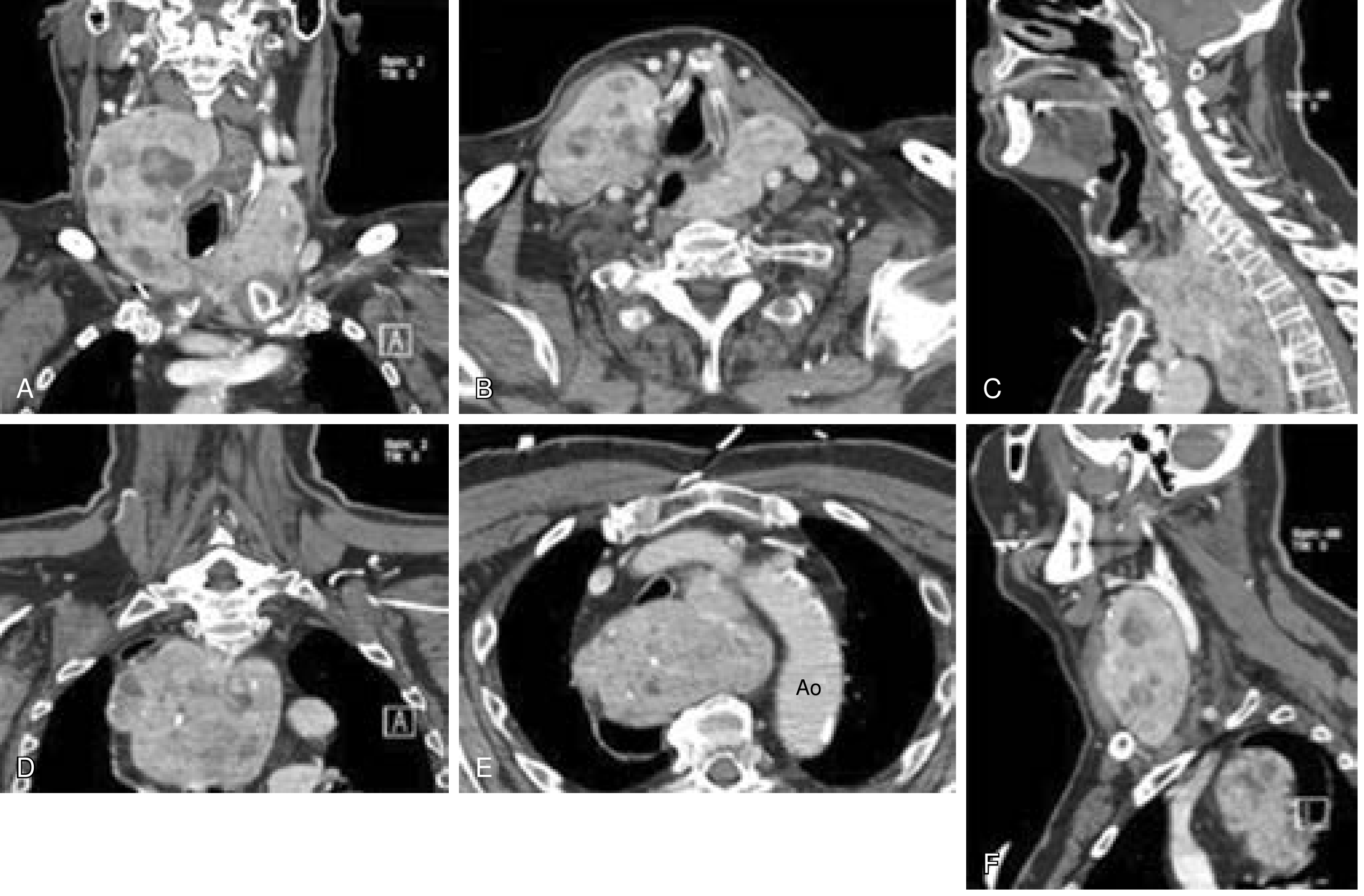
CT of an 82-year-old man with massive bilateral multinodular goiter (A,B), retrosternal left lobe (C,D), extension below the aortic arch (E, Ao = aorta), and displacement of the right common carotid artery (F). Required manubriotomy for safe resection. - Current Surgical Therapy 14e
Treatment
Indications for Intervention
- Local compressive symptoms (choking, dyspnea, dysphagia)
- Partial obstruction of the upper aerodigestive tract
- Substantial substernal extension (even if asymptomatic) - relative indication, as further growth may require more disruptive surgery later
- Cosmesis (rarely the sole indication)
Treatment Modalities
| Modality | Role |
|---|---|
| Total or subtotal thyroidectomy | Definitive treatment for large/compressive goiters |
| Radioactive iodine (RAI) | Reduces goiter size ~40-50%; useful in high-risk surgical patients; can transiently worsen compressive symptoms by causing swelling |
| TSH-suppression with thyroxine | Limited role in established MNG; prospective trials show little benefit; side effects (bone loss, arrhythmias) outweigh benefit especially in elderly |
| Thyroid hormone replacement | Indicated when hypothyroidism is present |
- Current Surgical Therapy 14e, p. 1856-1863
- Goldman-Cecil Medicine, p. 3283
Surgical Complications (Post-Thyroidectomy)
-
Hypocalcemia / tetany: from inadvertent removal or devascularization of parathyroid glands (manifests as tingling in hands, feet, perioral area, and carpopedal spasm)
-
Recurrent laryngeal nerve (RLN) injury: hoarseness, vocal cord paralysis
-
Hemorrhage / hematoma
-
Hypothyroidism: requires lifelong levothyroxine replacement after total thyroidectomy
-
Gray's Anatomy for Students, p. 7368
Key Points at a Glance
- Goiter = thyroid enlargement; most are benign
- Leading global cause = iodine deficiency
- Diffuse goiters are almost always benign; asymmetric/nodular goiters require malignancy workup
- Pemberton's sign flags substernal compression
- Non-contrast CT is the gold standard for airway and mediastinal assessment
- Surgery is the mainstay for compressive or cosmetically significant goiter; TSH suppression has minimal evidence benefit
This is a shared conversation. Sign in to Orris to start your own chat.