
Urea cycle can be connected to tca cycle by what connections?
The urea cycle and TCA cycle are connected through several key metabolic links. Briefly:
- Fumarate - produced in the urea cycle (from argininosuccinate cleavage), enters the TCA cycle directly.
- Aspartate/Oxaloacetate - OAA from TCA is transaminated to aspartate, which donates a nitrogen to the urea cycle.
- α-ketoglutarate - accepts amino groups via transamination, linking nitrogen disposal to TCA.
Searching sources...
Reading File
Finding Sources
Finding Sources
Reading File
Reading File
Reading File
Reading File
Finding Sources
Now I have excellent textbook content. Let me fetch the key diagram image (the Krebs bi-cycle figure).
Loading Image
Loading Image
Excellent! I have all the information and diagrams needed. Here is the complete answer:
Connections Between the Urea Cycle and the TCA Cycle (The "Krebs Bi-Cycle")
The two cycles are so tightly interlocked that the connection is sometimes called the Krebs bi-cycle. There are three main metabolic bridges:
Connection 1 - Fumarate (Urea cycle → TCA cycle)
This is the most direct and famous link.
- In the urea cycle, argininosuccinate lyase cleaves argininosuccinate into arginine + fumarate (cytoplasmic reaction).
- This fumarate is a direct TCA cycle intermediate.
- In the cytosol, fumarate is hydrated by cytoplasmic fumarase → malate → oxidized by cytoplasmic malate dehydrogenase → oxaloacetate.
- This OAA can then either: enter gluconeogenesis, or be transaminated back to aspartate (see Connection 2 below).
Note: Cytoplasmic fumarase and malate dehydrogenase serve the urea cycle connection here; their mitochondrial isoforms function in the TCA cycle proper.
Connection 2 - Aspartate / Oxaloacetate (TCA cycle → Urea cycle)
This is the nitrogen-donating bridge.
- TCA-derived oxaloacetate is transaminated (by aspartate aminotransferase, using glutamate as nitrogen donor) → aspartate + alpha-ketoglutarate.
- This aspartate enters the urea cycle at the argininosuccinate synthetase step, combining with citrulline and donating its -NH₂ group as the second nitrogen of urea.
- The carbon skeleton of aspartate is released back as fumarate (Connection 1), completing the loop.
Connection 3 - alpha-Ketoglutarate / Glutamate (TCA cycle ↔ Nitrogen metabolism)
- alpha-Ketoglutarate (a TCA intermediate) accepts amino groups from amino acid degradation via transamination → glutamate.
- Glutamate is then oxidatively deaminated by glutamate dehydrogenase → releases NH₄⁺, which is the first nitrogen entering the urea cycle (as carbamoyl phosphate via CPS I).
- This links overall amino acid catabolism with TCA carbon flow and urea nitrogen disposal.
Summary Diagram (Krebs Bi-Cycle)
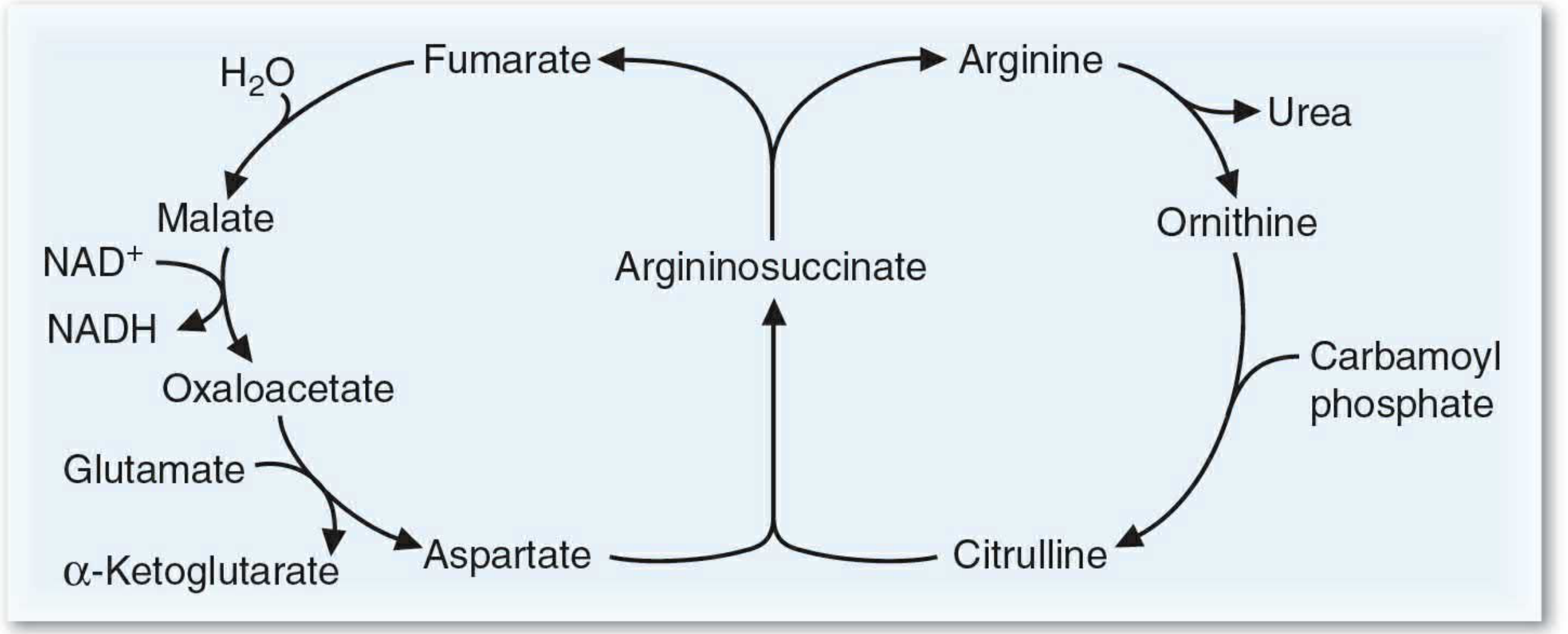
The full urea cycle diagram showing all connections:
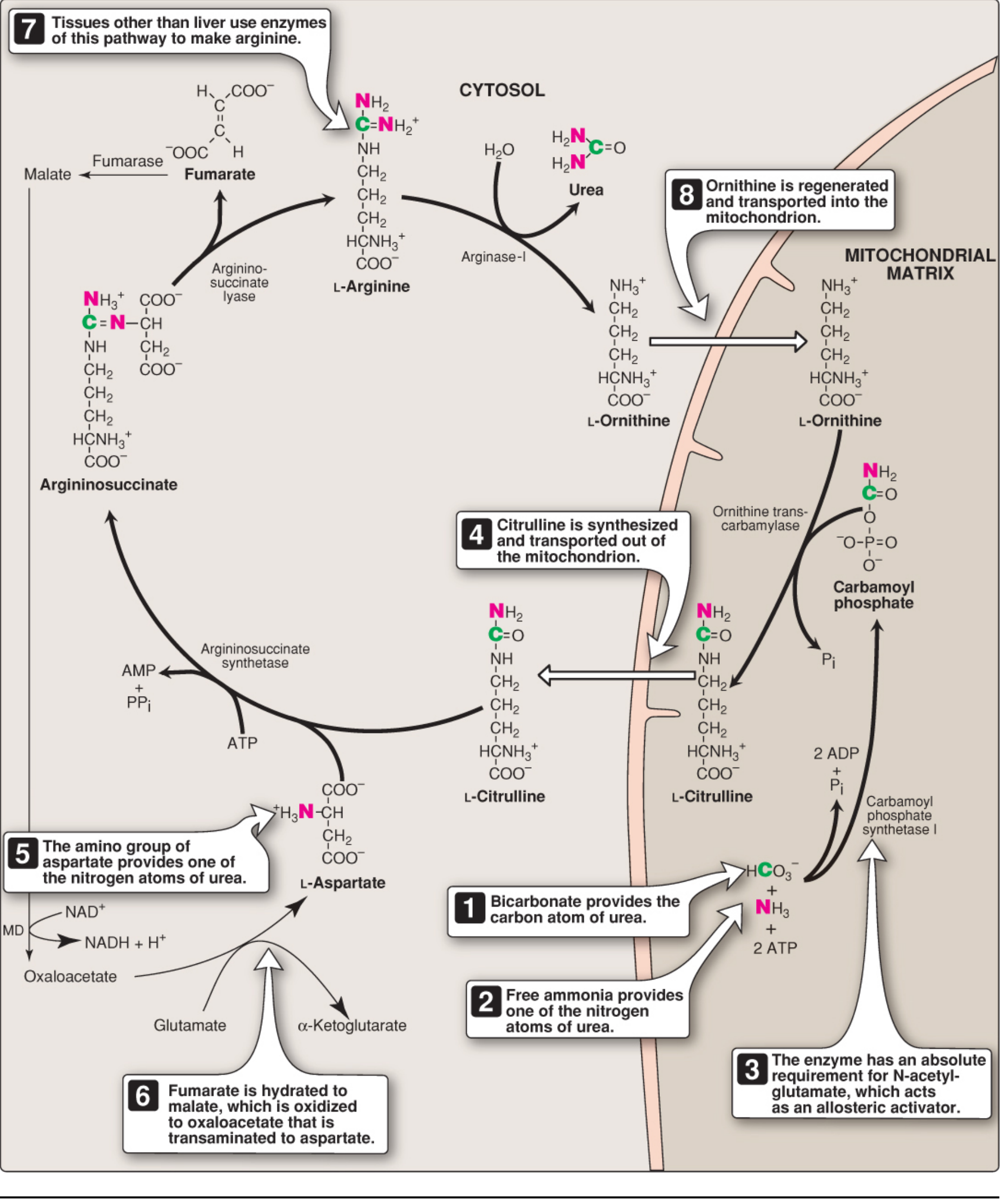
Quick Summary Table
| Connection | Metabolite | Direction | Role |
|---|---|---|---|
| 1 | Fumarate | Urea → TCA | Carbon skeleton recycled from argininosuccinate |
| 2 | Aspartate/OAA | TCA → Urea | Donates 2nd nitrogen to urea cycle |
| 3 | alpha-KG/Glutamate | TCA ↔ Nitrogen pool | Links amino acid catabolism to urea nitrogen |
This elegant cycling means the carbon atoms of aspartate are never lost - they exit as fumarate, get converted back to OAA, and are re-aminated to aspartate repeatedly, acting as a nitrogen carrier that shuttles amino groups into urea without consuming OAA net.
- Basic Medical Biochemistry - A Clinical Approach, 6e, pp. 1322-1323
- Biochemistry, 8th ed Lippincott Illustrated Reviews, pp. 713-714
This is a shared conversation. Sign in to Orris to start your own chat.