
Can you speak in hinglish
Haan bilkul! Main Hinglish mein baat kar sakta hoon. 😄
Toh batao, kya kaam hai aaj? Koi sawaal hai, kuch research karni hai, ya bas timepass karna hai? Main poori tarah ready hoon help karne ke liye! 🙌
Neuroanatomy padhni h
Bahut achha topic choose kiya! Neuroanatomy thodi complex hai, but ek baar samajh aaye toh bahut interesting lagti hai. 🧠
Pehle bata do ki kahan se start karna hai, taaki hum sahi direction mein padh sakein!
Asking for Preferences
Neuroanatomy ka kaunsa topic padhna hai? · Kitne depth mein padhna hai?
Mbbs ka student hu
MBBS level - perfect! Toh hum MBBS syllabus ke according padhenge. 😊
Ek kaam bata do - kaun sa specific topic chahiye?
Asking for Preferences
Neuroanatomy ka kaunsa topic padhna hai?
Brain aur cerebral cortex - bahut important topic hai! Abhi medical library se proper content nikalta hoon. 🧠
Searching sources...
Reading File
Finding Sources
Finding Sources
Finding Sources
Bahut sari books mil gayi! Ab Guyton aur Neuroscience textbook se content padhta hoon - ye MBBS ke liye best hain.
Reading File
Reading File
Bahut accha content mila! Ab ek brain diagram bhi fetch karta hoon aur sab kuch ek saath present karta hoon.
Loading Image
Finding Sources
Bahut accha! Diagram bhi aa gaya. Ab poora ek comprehensive explanation Hinglish mein deta hoon! 🎉
🧠 Brain - Lobes & Cerebral Cortex
Sabse pehle - Basic Structure
Brain ka jo bahar dikhne wala hissa hai - woh Cerebral Cortex hai. Ye sirf 2 to 5 mm thick hai, lekin isme 80 billion se bhi zyada neurons hain! Ye ek얇i si layer hai jo pure cerebrum ki surface ko cover karti hai - jaise ek wrinkled sheet.
Cerebral cortex mein 3 main types of neurons hote hain:
- Granular (Stellate) cells - Short axons, interneurons ka kaam karte hain. Glutamate (excitatory) ya GABA (inhibitory) release karte hain. Sensory areas mein zyada paaye jaate hain.
- Pyramidal cells - Ye bahut bade hote hain, inse hi long fibers nikalte hain jo spinal cord tak jaate hain. Motor cortex mein prominent.
- Fusiform cells - Output fibers dete hain.
Brain ke 4 Main Lobes - Lateral View
Ye diagram dekho - isme saari important structures label ki gayi hain:
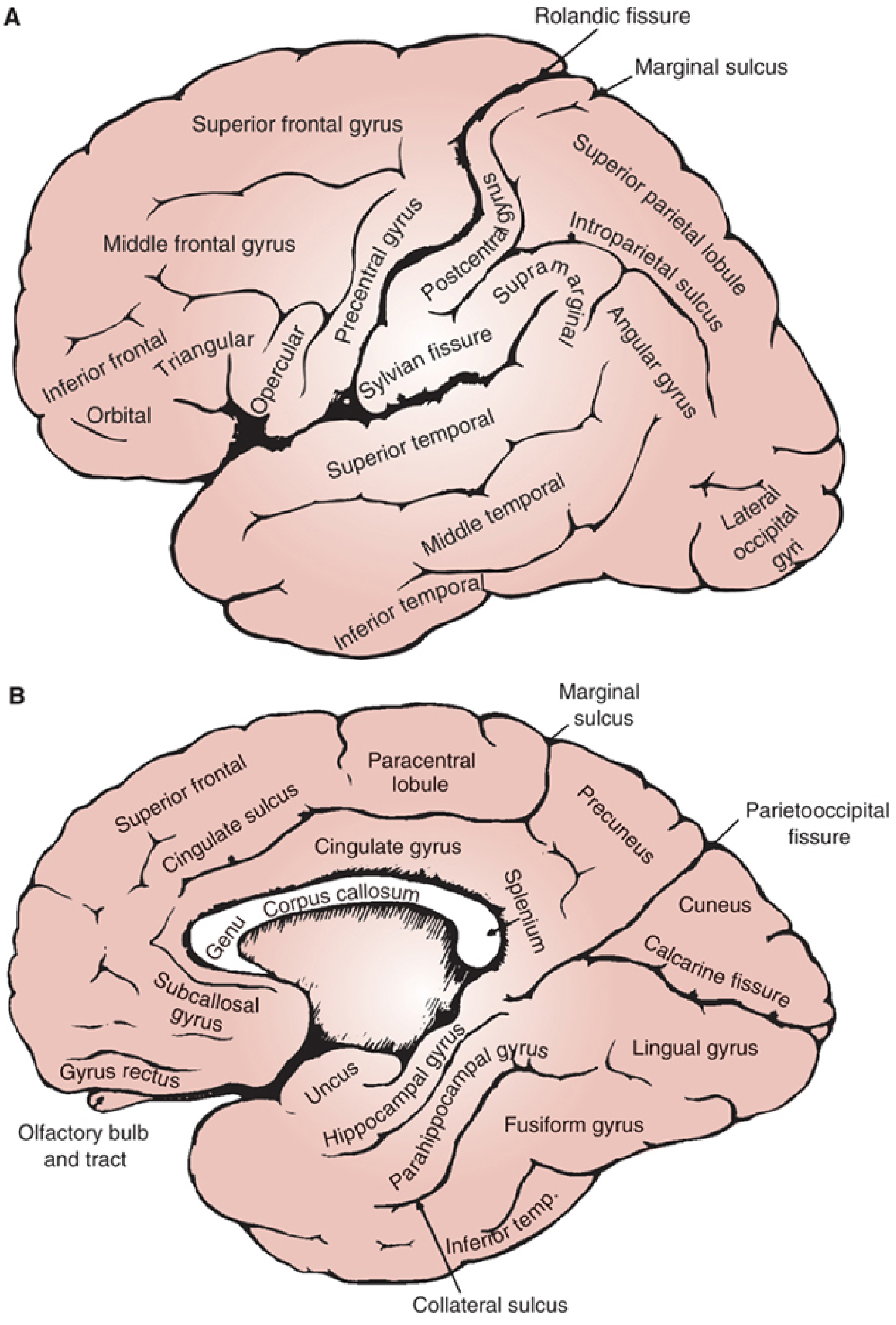
Brain mein do hemispheres hote hain - Left aur Right - jo Longitudinal Fissure se alag hote hain. Inhe Corpus Callosum connect karta hai.
4 Lobes - Ek Ek Karke Samjho
1. 🔵 Frontal Lobe (Aage wala)
- Boundary: Aage se Central Sulcus (Rolandic Fissure) tak
- Gyri: Superior, Middle, aur Inferior frontal gyri
- Important structure: Precentral Gyrus - yahi PRIMARY MOTOR CORTEX hai!
- Yahan se signals nikalke spinal cord jaate hain muscles ko control karne ke liye
- Broca's Area - Left hemisphere mein, inferior frontal gyrus ke triangular + opercular part mein - Speech production ke liye
- Functions: Planning, decision-making, personality, voluntary movement
2. 🟡 Parietal Lobe (Upar-Peeche)
- Boundary: Central Sulcus ke peeche se Parietooccipital fissure tak
- Important structure: Postcentral Gyrus - yahi PRIMARY SOMATOSENSORY CORTEX hai!
- Touch, pain, temperature sense yahan process hoti hai
- Supramarginal gyrus aur Angular gyrus - language processing
- Functions: Sensory processing, spatial awareness
3. 🟢 Temporal Lobe (Neeche wala)
- Boundary: Sylvian Fissure ke neeche
- Gyri: Superior, Middle, aur Inferior temporal gyri
- Heschl's Gyrus (Transverse gyrus) - Superior temporal gyrus ke upar - PRIMARY AUDITORY CORTEX
- Hearing yahan process hoti hai
- Wernicke's Area - Left temporal lobe mein - Speech comprehension ke liye
- Hippocampus - Memory formation (medial temporal lobe mein)
- Functions: Hearing, memory, language understanding
4. 🔴 Occipital Lobe (Peeche wala)
- Boundary: Brain ke bilkul peeche
- Calcarine Fissure - yahan PRIMARY VISUAL CORTEX hai (V1)
- Cuneus aur Lingual gyrus bhi yahan hain
- Functions: Vision processing
Cortex ke 6 Layers - Yaad karne ki trick 🧠
| Layer | Naam | Kya karta hai |
|---|---|---|
| I | Molecular layer | Mostly fibers |
| II | External granular | Intracortical connections |
| III | Pyramidal cell layer | Association fibers (short) |
| IV | Internal granular | Sensory INPUT yahan aata hai |
| V | Large pyramidal | Motor OUTPUT - brainstem/spinal cord |
| VI | Fusiform/Polymorphic | Thalamus ko output |
Trick: "Input = Layer 4, Output = Layer 5 & 6"
Medial Surface ki Important Structures
Diagram ke B part mein dekho:
- Cingulate Gyrus - Emotions, attention (limbic system ka part)
- Paracentral Lobule - Lower limb ka motor + sensory area (precentral + postcentral gyrus ka medial continuation)
- Precuneus - Visual imagery, episodic memory
- Corpus Callosum - Genu (aage), Body, aur Splenium (peeche) - dono hemispheres ko connect karta hai
MBBS Exam ke liye Important Points ✅
- Precentral gyrus = Primary Motor Cortex (Layer V se output)
- Postcentral gyrus = Primary Somatosensory Cortex
- Broca's area = Frontal lobe, LEFT hemisphere - motor speech
- Wernicke's area = Temporal lobe, LEFT hemisphere - speech comprehension
- Heschl's gyrus = Primary Auditory Cortex - superior temporal gyrus
- Calcarine cortex = Primary Visual Cortex - occipital lobe
- Central sulcus = Motor aur Sensory cortex ke beech boundary
- Sylvian fissure = Frontal/Parietal aur Temporal lobe ke beech
Ab kaunsa topic aur padhna hai? Basal ganglia, blood supply, ya cranial nerves? 😊
(Sources: Guyton & Hall Medical Physiology; Localization in Clinical Neurology, 8e)
This is a shared conversation. Sign in to Orris to start your own chat.