
Types of skin graft
Reading File
Skin grafts are transplanted pieces of skin used to cover wounds or defects. The main types are split-thickness grafts (epidermis + part of dermis), full-thickness grafts (epidermis + full dermis), and composite grafts (skin + underlying tissue). They can also be classified as autografts, allografts, xenografts, or synthetic.
Searching sources...
Finding Sources
Finding Sources
Good results. Let me read the most relevant sections and fetch the diagram images in parallel.
Reading File
Reading File
Reading File
Reading File
Excellent content. Now let me read more details and fetch the key diagram images in parallel.
Reading File
Reading File
Loading Image
Loading Image
I now have comprehensive textbook content and excellent diagrams. Let me read the full-thickness graft advantages/disadvantages section and also check the autologous/allograft classification from Fischer's.
Reading File
Reading File
I now have comprehensive information from multiple authoritative textbooks plus excellent diagrams. Here is the full answer:
Types of Skin Graft
A skin graft is tissue transferred from a donor site to a recipient wound without bringing its own blood supply. It depends entirely on the vascularity of the recipient bed for "take" (revascularization). Graft failure occurs from shear forces, haematoma/seroma formation, or infection (notably beta-haemolytic streptococci, staphylococci, and Pseudomonas).
Classification by Donor Source
| Type | Source | Notes |
|---|---|---|
| Autograft | Same individual | Gold standard; no rejection |
| Allograft (homograft) | Another human (cadaveric) | Temporary; eventually rejected |
| Xenograft (heterograft) | Different species (e.g., pig) | Temporary biological dressing |
| Synthetic/dermal substitutes | Manufactured (e.g., Integra, MatriDerm) | Require a well-vascularised bed; usually need a secondary STSG |
Classification by Thickness (Primary Surgical Classification)
The diagram below from Bailey & Love's illustrates the skin layers and the depth at which each graft type is harvested:
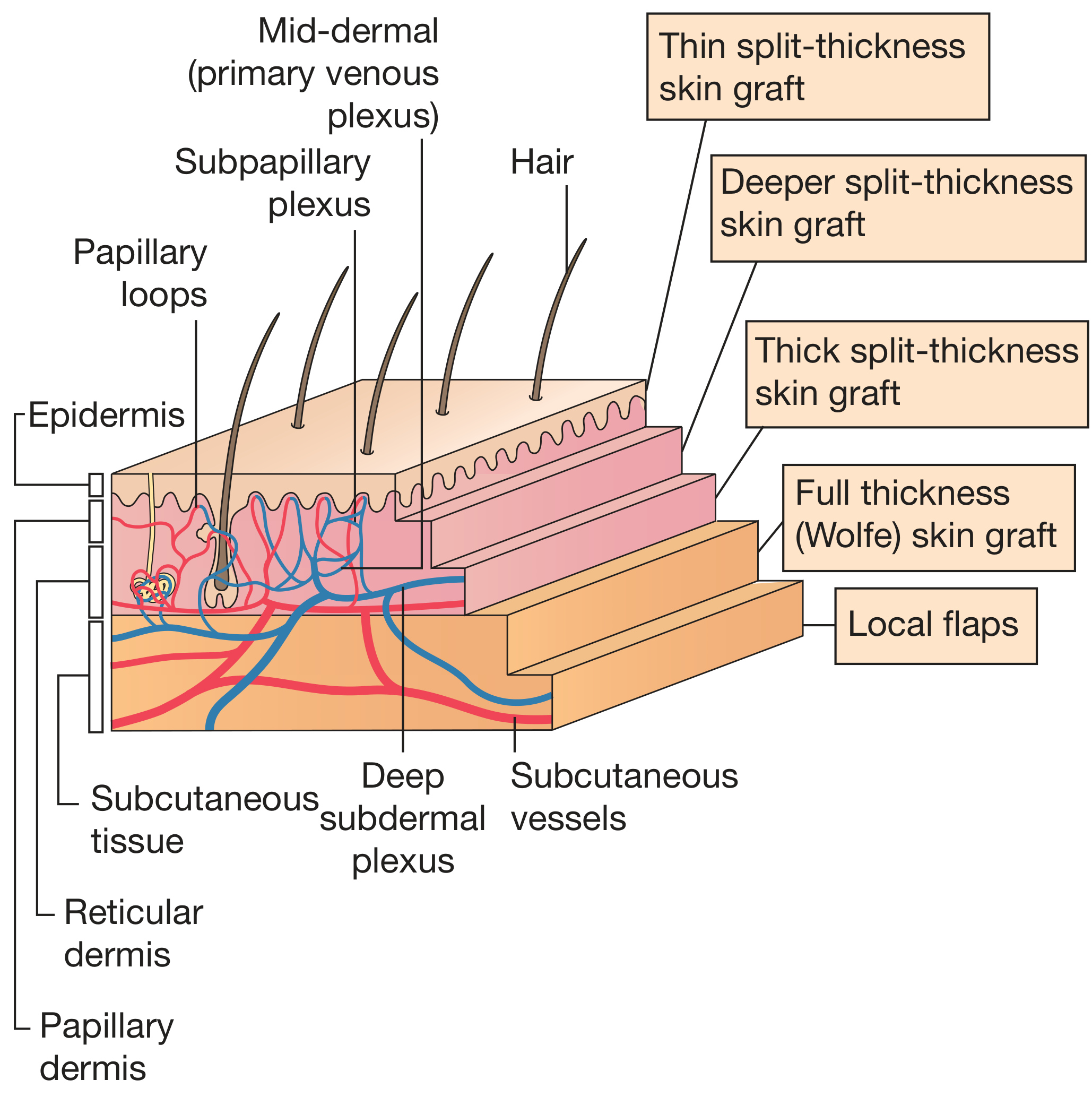
1. Split-Thickness Skin Graft (STSG / Thiersch Graft)
Contains the epidermis + a variable portion of the dermis (not the full dermis). The remaining dermis at the donor site regenerates spontaneously.
Sub-grades by thickness:
| Grade | Thickness |
|---|---|
| Thin | 0.005 - 0.010 inch |
| Medium | ~0.010 - 0.015 inch |
| Thick | >0.015 inch |
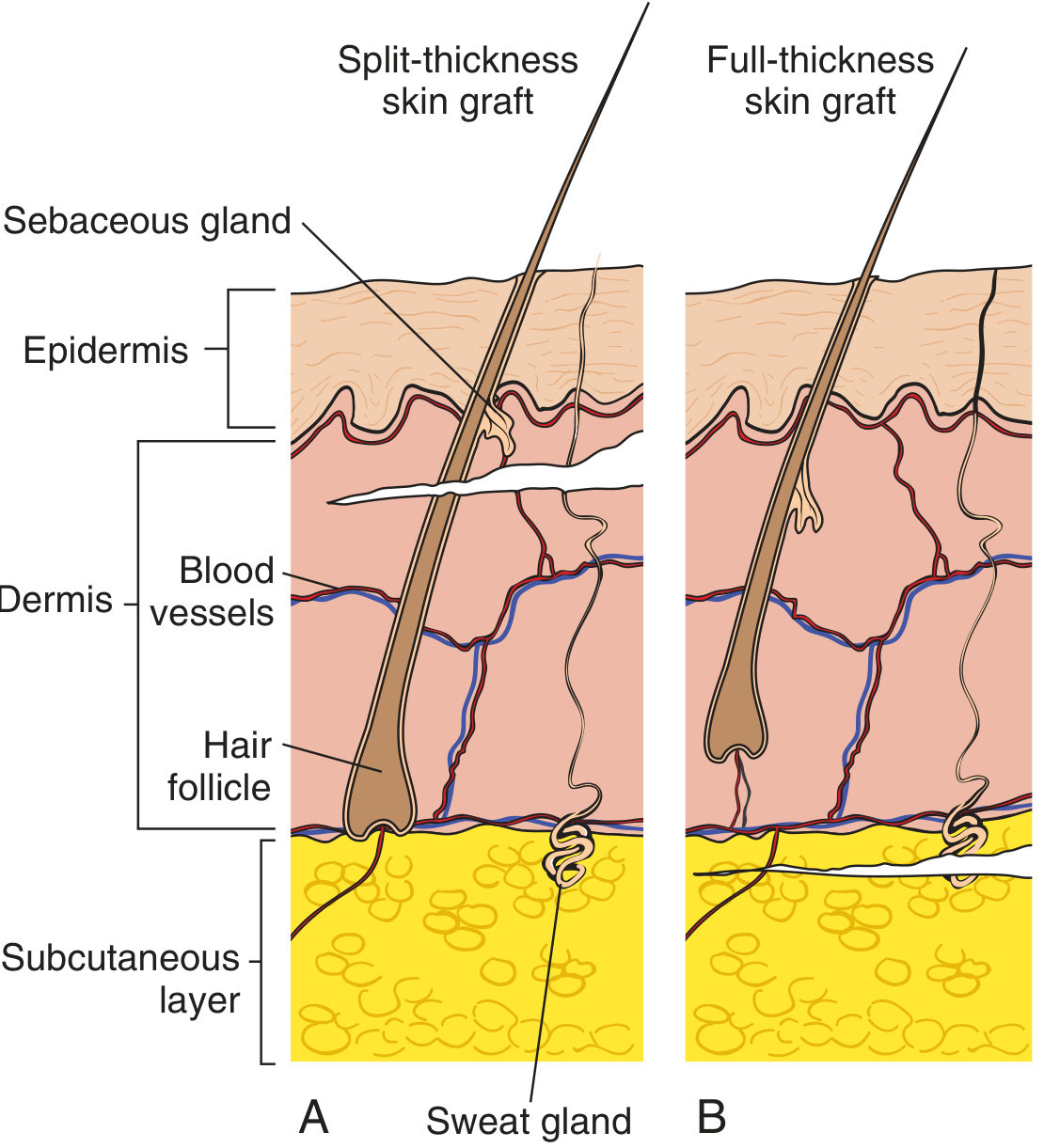
Harvesting: Electric or battery-powered dermatome; commonly from the thigh or scalp. The dermatome is set at 45-60° with even pressure. After harvest, the donor site shows light punctuate bleeding (papillary dermis) - fat lobules should NOT be visible.
Meshing: STSGs can be "meshed" or "pie-crusted" (small slits cut into the graft) to expand coverage by 1.5x to 9x (ratios 1:1.5, 1:2, 1:3, 1:6, 1:9). Meshing allows drainage of blood/serum and improves graft "take" over large defects such as burns.
Advantages:
- Can cover large areas
- Can be meshed for even greater coverage
- Requires less recipient-bed vascularity - better for poorly vascularised wounds
- Donor site heals spontaneously within ~2 weeks
- Thin grafts vascularize quickly
Disadvantages:
- High contraction risk - not ideal over joints
- Poor cosmetic match (color, texture, hair growth)
- Mesh pattern is permanent - avoid cosmetically sensitive areas (face, anterior neck)
- Less durable; prone to friction injury
- Will not grow over bone without periosteum, or cartilage without perichondrium
Preferred for: Large wounds, burns, trauma reconstruction, sites at high risk for tumour recurrence (acts as a "window" to detect recurrence).
2. Full-Thickness Skin Graft (FTSG / Wolfe Graft)
Contains the epidermis + entire dermis. Harvested by sharp scalpel dissection; donor site must be primarily closed (limiting graft size).
Common donor sites: Supraclavicular skin, groin crease, post-auricular region (classic "Wolfe graft" site), inner upper arm - all areas with skin laxity that allow primary closure.
Advantages:
- Excellent color, contour, and texture match
- Minimal secondary contracture (retains dermal elasticity)
- More durable; resists friction and wear
- Can cover bone without periosteum and cartilage without perichondrium
- Better sensation and adnexal function
Disadvantages:
- Limited by donor site size (cannot be meshed)
- Requires excellent recipient bed vascularity (takes the longest to vascularize)
- Time-consuming; technically demanding
- Large donor sites may themselves need STSG coverage
Preferred for: Facial defects, syndactyly release in the hand, small areas over joints (where contracture must be avoided), contracture release after burns.
3. Composite Graft
Contains skin + another tissue type - most commonly skin + cartilage, or skin + fat.
Example: Helical root of the ear harvested as skin-cartilage composite to reconstruct the nasal alar following skin cancer excision. Hair-bearing composite scalp grafts can reconstruct an eyebrow.
Characteristics: Single-stage procedure; good functional and aesthetic results for appropriate defects (<2 cm diameter). Higher risk of graft failure under vascular compromise; limited donor tissue availability.
Comparison Table (from Dermatology 5e)
| Property | FTSG | STSG | Composite |
|---|---|---|---|
| Tissue match | Good to excellent | Poor to fair | Good |
| Nutritional requirements | High | Low | High |
| Vascularity requirement | High | Low | Very high |
| Contraction risk | Low | High | Low |
| Durability | Good to excellent | Fair to good | Fair |
| Sensation | Good | Fair | Fair |
| Adnexal functions | Excellent | Poor | Good |
Graft "Take" - Phases of Revascularization
- Imbibition (0-48 hrs): Graft absorbs plasmatic fluid from the wound bed (passive nutrition)
- Inosculation (2-4 days): Alignment/connection of graft and recipient vessels
- Neovascularization (4-7 days): Ingrowth of new capillaries from the wound bed
Factors that prevent take: shear forces, haematoma, seroma, wound infection (especially beta-haemolytic Streptococcus).
Donor Site Considerations by Graft Type
| Graft | Typical Donor Site | Donor Site Healing |
|---|---|---|
| Thin STSG | Thigh, scalp | Secondary intention (~2 weeks) |
| Thick STSG | Thigh, back | Secondary intention (slower) |
| FTSG | Post-auricular, groin crease, supraclavicular | Primary closure |
| Composite | Ear helical root | May need flap or complex closure |
Sources: Bailey and Love's Short Practice of Surgery 28th Ed., p. 708; Pfenninger and Fowler's Procedures for Primary Care, p. 257-259; Dermatology 2-Volume Set 5e, Table 148.1; Fischer's Mastery of Surgery 8th Ed., p. 7670; Rockwood and Green's Fractures in Adults 10th Ed., p. 732
Can you create a pdf of types of skin grafts
Reading File
Running Command
ls -la /tmp/workspace/ 2>/dev/null || mkdir -p /tmp/workspace && echo "created"
Running Command
mkdir -p /tmp/workspace/skin-graft-pdf && python3 -c "import reportlab; print('reportlab ok')"
Writing File
~/skin-graft-pdf/generate_pdf.py
import urllib.request
import os
from reportlab.lib.pagesizes import A4
from reportlab.lib import colors
from reportlab.lib.units import cm, mm
from reportlab.lib.styles import getSampleStyleSheet, ParagraphStyle
from reportlab.lib.enums import TA_CENTER, TA_LEFT, TA_JUSTIFY
from reportlab.platypus import (
SimpleDocTemplate, Paragraph, Spacer, Table, TableStyle,
HRFlowable, Image, KeepTogether
)
from reportlab.platypus.flowables import HRFlowable
from reportlab.graphics.shapes import Drawing, Rect, String, Line
from reportlab.graphics import renderPDF
OUTPUT = "/tmp/workspace/skin-graft-pdf/Types_of_Skin_Graft.pdf"
# ── Download diagrams ─────────────────────────────────────────────────────────
img_dir = "/tmp/workspace/skin-graft-pdf/imgs"
os.makedirs(img_dir, exist_ok=True)
imgs = {
"anatomy": "https://cdn.orris.care/cdss_images/f959600fd7372d62892ac2eca8898e07c0d5dcfd5f87fa99215a86e92c88e54a.png",
"cross": "https://cdn.orris.care/cdss_images/4ba1b93738d679554068854c6cd0cdf895ef4c3a0df2b509da7aa270b0e4154c.png",
}
for name, url in imgs.items():
path = os.path.join(img_dir, f"{name}.png")
if not os.path.exists(path):
try:
urllib.request.urlretrieve(url, path)
print(f"Downloaded {name}")
except Exception as e:
print(f"Failed {name}: {e}")
# ── Colour palette ────────────────────────────────────────────────────────────
TEAL = colors.HexColor("#1A6B72")
LIGHT_TEAL = colors.HexColor("#E8F5F6")
DARK_TEAL = colors.HexColor("#0D4A50")
GOLD = colors.HexColor("#C8861A")
LIGHT_GOLD = colors.HexColor("#FDF3E0")
GREY_LIGHT = colors.HexColor("#F5F5F5")
GREY_MED = colors.HexColor("#CCCCCC")
DARK_GREY = colors.HexColor("#333333")
WHITE = colors.white
RED_SOFT = colors.HexColor("#C0392B")
GREEN_SOFT = colors.HexColor("#27AE60")
# ── Document setup ────────────────────────────────────────────────────────────
doc = SimpleDocTemplate(
OUTPUT,
pagesize=A4,
leftMargin=2*cm, rightMargin=2*cm,
topMargin=2.5*cm, bottomMargin=2.5*cm,
title="Types of Skin Graft",
author="Orris Medical Reference",
)
W = A4[0] - 4*cm # usable width
# ── Styles ────────────────────────────────────────────────────────────────────
base = getSampleStyleSheet()
def S(name, **kw):
return ParagraphStyle(name, **kw)
title_style = S("Title",
fontName="Helvetica-Bold", fontSize=22, textColor=WHITE,
alignment=TA_CENTER, spaceAfter=4)
subtitle_style = S("Subtitle",
fontName="Helvetica", fontSize=11, textColor=LIGHT_TEAL,
alignment=TA_CENTER, spaceAfter=6)
h1 = S("H1",
fontName="Helvetica-Bold", fontSize=13, textColor=DARK_TEAL,
spaceBefore=14, spaceAfter=4, borderPad=4)
h2 = S("H2",
fontName="Helvetica-Bold", fontSize=11, textColor=TEAL,
spaceBefore=10, spaceAfter=3)
body = S("Body",
fontName="Helvetica", fontSize=9.5, textColor=DARK_GREY,
leading=14, spaceAfter=4, alignment=TA_JUSTIFY)
bullet = S("Bullet",
fontName="Helvetica", fontSize=9.5, textColor=DARK_GREY,
leading=13, leftIndent=12, bulletIndent=0, spaceAfter=2)
note = S("Note",
fontName="Helvetica-Oblique", fontSize=8.5, textColor=colors.HexColor("#666666"),
leading=12, spaceAfter=4, alignment=TA_CENTER)
caption = S("Caption",
fontName="Helvetica-Oblique", fontSize=8, textColor=colors.HexColor("#555555"),
alignment=TA_CENTER, spaceAfter=6)
table_header = S("TH",
fontName="Helvetica-Bold", fontSize=8.5, textColor=WHITE,
alignment=TA_CENTER, leading=11)
table_cell = S("TC",
fontName="Helvetica", fontSize=8.5, textColor=DARK_GREY,
alignment=TA_CENTER, leading=11)
table_cell_l = S("TCL",
fontName="Helvetica", fontSize=8.5, textColor=DARK_GREY,
alignment=TA_LEFT, leading=11)
adv_style = S("Adv",
fontName="Helvetica", fontSize=9, textColor=colors.HexColor("#1A5C1A"),
leading=13, leftIndent=10, spaceAfter=2)
dis_style = S("Dis",
fontName="Helvetica", fontSize=9, textColor=RED_SOFT,
leading=13, leftIndent=10, spaceAfter=2)
# ── Helper flowables ──────────────────────────────────────────────────────────
def hr(color=GREY_MED, thickness=0.5):
return HRFlowable(width="100%", thickness=thickness, color=color, spaceAfter=4, spaceBefore=4)
def section_banner(text, color=TEAL, text_color=WHITE):
"""A coloured banner row acting as a section header."""
t = Table([[Paragraph(text, S("BannerText",
fontName="Helvetica-Bold", fontSize=12, textColor=text_color, leading=14))]],
colWidths=[W])
t.setStyle(TableStyle([
("BACKGROUND", (0,0), (-1,-1), color),
("TOPPADDING", (0,0), (-1,-1), 7),
("BOTTOMPADDING",(0,0), (-1,-1), 7),
("LEFTPADDING", (0,0), (-1,-1), 10),
]))
return t
def info_box(text, bg=LIGHT_TEAL, border=TEAL):
t = Table([[Paragraph(text, S("IB",
fontName="Helvetica", fontSize=9.5, textColor=DARK_GREY, leading=14))]], colWidths=[W])
t.setStyle(TableStyle([
("BACKGROUND", (0,0), (-1,-1), bg),
("BOX", (0,0), (-1,-1), 1, border),
("TOPPADDING", (0,0), (-1,-1), 8),
("BOTTOMPADDING",(0,0), (-1,-1), 8),
("LEFTPADDING", (0,0), (-1,-1), 10),
("RIGHTPADDING", (0,0), (-1,-1), 10),
]))
return t
def two_col_adv_dis(advantages, disadvantages):
"""Side-by-side advantages / disadvantages table."""
adv_items = "\n".join([f"• {a}" for a in advantages])
dis_items = "\n".join([f"• {d}" for d in disadvantages])
adv_p = Paragraph(
"<b><font color='#1A5C1A'>✔ Advantages</font></b><br/>" +
"<br/>".join([f"<font color='#1A5C1A'>• {a}</font>" for a in advantages]),
S("AdvBox", fontName="Helvetica", fontSize=9, textColor=DARK_GREY, leading=13))
dis_p = Paragraph(
"<b><font color='#C0392B'>✘ Disadvantages</font></b><br/>" +
"<br/>".join([f"<font color='#C0392B'>• {d}</font>" for d in disadvantages]),
S("DisBox", fontName="Helvetica", fontSize=9, textColor=DARK_GREY, leading=13))
col = (W - 0.4*cm) / 2
t = Table([[adv_p, dis_p]], colWidths=[col, col], hAlign="LEFT")
t.setStyle(TableStyle([
("BACKGROUND", (0,0), (0,-1), colors.HexColor("#EAF7EA")),
("BACKGROUND", (1,0), (1,-1), colors.HexColor("#FDECEA")),
("BOX", (0,0), (0,-1), 0.5, GREEN_SOFT),
("BOX", (1,0), (1,-1), 0.5, RED_SOFT),
("TOPPADDING", (0,0), (-1,-1), 8),
("BOTTOMPADDING",(0,0), (-1,-1), 8),
("LEFTPADDING", (0,0), (-1,-1), 8),
("RIGHTPADDING", (0,0), (-1,-1), 8),
("VALIGN", (0,0), (-1,-1), "TOP"),
("COLPADDING", (0,0), (-1,-1), 4),
]))
return t
# ── Content builder ───────────────────────────────────────────────────────────
story = []
# ─── Cover banner ─────────────────────────────────────────────────────────────
cover = Table(
[[Paragraph("TYPES OF SKIN GRAFT", title_style)],
[Paragraph("A Comprehensive Surgical Reference", subtitle_style)],
[Paragraph("Sources: Bailey & Love's Surgery 28e | Pfenninger & Fowler's Primary Care | Fischer's Mastery of Surgery | Dermatology 5e", note)]],
colWidths=[W]
)
cover.setStyle(TableStyle([
("BACKGROUND", (0,0), (-1,-1), TEAL),
("TOPPADDING", (0,0), (-1,-1), 12),
("BOTTOMPADDING", (0,0), (-1,-1), 10),
("LEFTPADDING", (0,0), (-1,-1), 14),
("RIGHTPADDING", (0,0), (-1,-1), 14),
]))
story.append(cover)
story.append(Spacer(1, 0.5*cm))
# ─── Definition box ───────────────────────────────────────────────────────────
story.append(info_box(
"<b>Definition:</b> A skin graft is tissue transferred from a donor site to a recipient wound "
"<b>without bringing its own blood supply</b>. It depends entirely on the vascularity of the "
"recipient bed for 'take' (revascularisation). Graft failure occurs from shear forces, "
"haematoma/seroma formation, or infection (notably beta-haemolytic streptococci, staphylococci, Pseudomonas)."
))
story.append(Spacer(1, 0.35*cm))
# ─── Classification by donor source ───────────────────────────────────────────
story.append(section_banner("1. CLASSIFICATION BY DONOR SOURCE"))
story.append(Spacer(1, 0.2*cm))
donor_data = [
[Paragraph("<b>Type</b>", table_header), Paragraph("<b>Source</b>", table_header),
Paragraph("<b>Key Notes</b>", table_header)],
[Paragraph("Autograft", table_cell), Paragraph("Same individual", table_cell_l),
Paragraph("Gold standard — no rejection risk", table_cell_l)],
[Paragraph("Allograft (Homograft)", table_cell), Paragraph("Cadaveric human donor", table_cell_l),
Paragraph("Temporary; eventually rejected by immune system", table_cell_l)],
[Paragraph("Xenograft (Heterograft)", table_cell), Paragraph("Different species (e.g., pig)", table_cell_l),
Paragraph("Temporary biological dressing only", table_cell_l)],
[Paragraph("Synthetic / Dermal Substitute", table_cell), Paragraph("Manufactured (e.g., Integra, MatriDerm, BTM)", table_cell_l),
Paragraph("Requires well-vascularised bed; usually needs secondary STSG", table_cell_l)],
]
col_w = [3.8*cm, 4.5*cm, W - 8.3*cm]
dt = Table(donor_data, colWidths=col_w)
dt.setStyle(TableStyle([
("BACKGROUND", (0,0), (-1,0), TEAL),
("BACKGROUND", (0,1), (-1,1), GREY_LIGHT),
("BACKGROUND", (0,2), (-1,2), WHITE),
("BACKGROUND", (0,3), (-1,3), GREY_LIGHT),
("BACKGROUND", (0,4), (-1,4), WHITE),
("ROWBACKGROUNDS",(0,1), (-1,-1), [GREY_LIGHT, WHITE]),
("BOX", (0,0), (-1,-1), 0.5, GREY_MED),
("INNERGRID", (0,0), (-1,-1), 0.3, GREY_MED),
("TOPPADDING", (0,0), (-1,-1), 5),
("BOTTOMPADDING", (0,0), (-1,-1), 5),
("LEFTPADDING", (0,0), (-1,-1), 6),
("VALIGN", (0,0), (-1,-1), "MIDDLE"),
]))
story.append(dt)
story.append(Spacer(1, 0.4*cm))
# ─── Classification by thickness heading ──────────────────────────────────────
story.append(section_banner("2. CLASSIFICATION BY THICKNESS (PRIMARY SURGICAL CLASSIFICATION)"))
story.append(Spacer(1, 0.2*cm))
# Diagrams
anatomy_path = os.path.join(img_dir, "anatomy.png")
cross_path = os.path.join(img_dir, "cross.png")
if os.path.exists(anatomy_path) and os.path.exists(cross_path):
img1 = Image(anatomy_path, width=8*cm, height=7*cm, kind="proportional")
img2 = Image(cross_path, width=6*cm, height=7*cm, kind="proportional")
cap1 = Paragraph("Fig 1. Skin anatomy and harvesting depths<br/><i>(Bailey & Love's 28e)</i>", caption)
cap2 = Paragraph("Fig 2. STSG vs FTSG cross-section<br/><i>(Pfenninger & Fowler's)</i>", caption)
img_table = Table([[img1, img2]], colWidths=[W*0.55, W*0.45])
cap_table = Table([[cap1, cap2]], colWidths=[W*0.55, W*0.45])
img_table.setStyle(TableStyle([
("VALIGN", (0,0), (-1,-1), "MIDDLE"),
("ALIGN", (0,0), (-1,-1), "CENTER"),
]))
cap_table.setStyle(TableStyle([
("ALIGN", (0,0), (-1,-1), "CENTER"),
]))
story.append(img_table)
story.append(cap_table)
story.append(Spacer(1, 0.3*cm))
# ─── STSG ─────────────────────────────────────────────────────────────────────
story.append(KeepTogether([
section_banner("A. SPLIT-THICKNESS SKIN GRAFT (STSG / Thiersch Graft)", color=DARK_TEAL),
Spacer(1, 0.15*cm),
info_box(
"<b>Composition:</b> Epidermis + a variable portion of dermis (not full dermis). "
"Remaining dermis at donor site regenerates spontaneously.<br/>"
"<b>Harvesting:</b> Electric/battery dermatome at 45-60° with even pressure. "
"Common donor sites: thigh, scalp. Dermatome at 0.2-0.3 mm (0.014-0.016 inch). "
"After harvest, donor site shows light punctuate bleeding (papillary dermis only - "
"fat lobules must NOT be visible).",
bg=LIGHT_TEAL, border=TEAL),
Spacer(1, 0.2*cm),
]))
# Sub-grades
grade_data = [
[Paragraph("<b>Grade</b>", table_header), Paragraph("<b>Thickness</b>", table_header),
Paragraph("<b>Key Property</b>", table_header)],
[Paragraph("Thin", table_cell), Paragraph("0.005 - 0.010 inch", table_cell),
Paragraph("Fastest vascularisation; heals rapidly; poor cosmesis", table_cell_l)],
[Paragraph("Medium", table_cell), Paragraph("0.010 - 0.015 inch", table_cell),
Paragraph("Balance of take rate and cosmetic appearance", table_cell_l)],
[Paragraph("Thick", table_cell), Paragraph("> 0.015 inch", table_cell),
Paragraph("Better cosmesis and wear resistance; slower healing", table_cell_l)],
]
gt = Table(grade_data, colWidths=[3*cm, 4*cm, W - 7*cm])
gt.setStyle(TableStyle([
("BACKGROUND", (0,0), (-1,0), DARK_TEAL),
("ROWBACKGROUNDS",(0,1), (-1,-1), [GREY_LIGHT, WHITE]),
("BOX", (0,0), (-1,-1), 0.5, GREY_MED),
("INNERGRID", (0,0), (-1,-1), 0.3, GREY_MED),
("TOPPADDING", (0,0), (-1,-1), 5),
("BOTTOMPADDING", (0,0), (-1,-1), 5),
("LEFTPADDING", (0,0), (-1,-1), 6),
("VALIGN", (0,0), (-1,-1), "MIDDLE"),
]))
story.append(Paragraph("Sub-grades by thickness:", h2))
story.append(gt)
story.append(Spacer(1, 0.2*cm))
story.append(Paragraph("Meshing:", h2))
story.append(info_box(
"STSGs can be <b>meshed</b> or <b>pie-crusted</b> (small slits cut into the graft) to expand "
"coverage by 1.5x to 9x (ratios 1:1.5, 1:2, 1:3, 1:6, 1:9). Meshing allows drainage of blood/serum "
"and improves graft 'take' over large defects such as burns.",
bg=LIGHT_GOLD, border=GOLD))
story.append(Spacer(1, 0.2*cm))
story.append(two_col_adv_dis(
advantages=[
"Can cover large areas; can be meshed for greater expansion",
"Requires less recipient-bed vascularity",
"Donor site heals by secondary intention (~2 weeks)",
"Thin grafts vascularize quickly",
"Can act as a 'window' for tumour recurrence surveillance",
],
disadvantages=[
"High contraction risk — avoid over joints",
"Poor cosmetic match (colour, texture, hair growth)",
"Mesh pattern permanent — avoid face/anterior neck",
"Less durable; prone to friction injury",
"Will not grow over bone without periosteum",
"Requires a dermatome; operating suite for large grafts",
]
))
story.append(Spacer(1, 0.15*cm))
story.append(Paragraph(
"<b>Best for:</b> Large wounds, burns, trauma reconstruction, high-risk tumour sites.",
S("Pref", fontName="Helvetica-BoldOblique", fontSize=9.5,
textColor=DARK_TEAL, spaceAfter=6)))
story.append(Spacer(1, 0.3*cm))
# ─── FTSG ─────────────────────────────────────────────────────────────────────
story.append(KeepTogether([
section_banner("B. FULL-THICKNESS SKIN GRAFT (FTSG / Wolfe Graft)", color=colors.HexColor("#5B2C6F")),
Spacer(1, 0.15*cm),
info_box(
"<b>Composition:</b> Epidermis + entire dermis. Retains dermal elasticity, minimal contracture. "
"Harvested by sharp scalpel dissection. Donor site must be <b>primarily closed</b>, limiting graft size.<br/>"
"<b>Common donor sites:</b> Post-auricular region (classic Wolfe graft), groin crease, "
"supraclavicular skin, inner upper arm — all areas with sufficient skin laxity.",
bg=colors.HexColor("#F5EEF8"), border=colors.HexColor("#5B2C6F")),
Spacer(1, 0.2*cm),
]))
story.append(two_col_adv_dis(
advantages=[
"Excellent colour, contour and texture match",
"Minimal secondary contracture",
"More durable; resists friction and wear",
"Can cover bone without periosteum",
"Better sensation and adnexal function",
],
disadvantages=[
"Limited by donor site size — cannot be meshed",
"Requires excellent recipient bed vascularity",
"Takes the longest time to vascularize",
"Time-consuming; technically demanding",
"Large donor sites may need STSG coverage",
]
))
story.append(Spacer(1, 0.15*cm))
story.append(Paragraph(
"<b>Best for:</b> Facial defects, syndactyly release (hand), joints (contracture prevention), contracture release post-burns.",
S("Pref2", fontName="Helvetica-BoldOblique", fontSize=9.5,
textColor=colors.HexColor("#5B2C6F"), spaceAfter=6)))
story.append(Spacer(1, 0.3*cm))
# ─── Composite ────────────────────────────────────────────────────────────────
story.append(KeepTogether([
section_banner("C. COMPOSITE GRAFT", color=GOLD),
Spacer(1, 0.15*cm),
info_box(
"<b>Composition:</b> Skin + another tissue type (cartilage, fat, or perichondrium).<br/>"
"<b>Example:</b> Skin-cartilage graft from helical root of ear to reconstruct nasal alar "
"after skin cancer excision. Hair-bearing composite scalp graft to reconstruct eyebrow.<br/>"
"<b>Limitation:</b> Best for defects <b><2 cm</b> in diameter. Higher failure risk under "
"vascular compromise.",
bg=LIGHT_GOLD, border=GOLD),
Spacer(1, 0.2*cm),
]))
story.append(two_col_adv_dis(
advantages=[
"Single-stage procedure",
"Good functional and aesthetic results for small defects",
"Provides structural support (cartilage component)",
"Low contraction risk",
],
disadvantages=[
"Size limited to <2 cm diameter",
"High failure risk under vascular compromise",
"Limited donor tissue availability",
"Increased infection and displacement risk",
"Donor site may need flap or complex closure",
]
))
story.append(Spacer(1, 0.3*cm))
# ─── Perichondrial cutaneous graft ────────────────────────────────────────────
story.append(KeepTogether([
section_banner("D. PERICHONDRIAL CUTANEOUS GRAFT", color=colors.HexColor("#17A589")),
Spacer(1, 0.15*cm),
info_box(
"Contains skin with its underlying perichondrium. "
"<b>Indication:</b> Repair of deep nasal tip and alar defects, especially with exposed cartilage. "
"Thicker than FTSG; contracts less; better chance of survival under vascular compromise.",
bg=colors.HexColor("#E8F8F5"), border=colors.HexColor("#17A589")),
]))
story.append(Spacer(1, 0.4*cm))
# ─── Comparison table ─────────────────────────────────────────────────────────
story.append(section_banner("3. COMPARISON TABLE (Dermatology 5e — Table 148.1)"))
story.append(Spacer(1, 0.2*cm))
headers = ["Property", "FTSG", "STSG", "Composite"]
rows = [
["Tissue match", "Good-Excellent", "Poor-Fair", "Good"],
["Nutritional req.", "High", "Low", "High"],
["Vascularity req.", "High", "Low", "Very High"],
["Contraction risk", "Low", "High", "Low"],
["Durability", "Good-Excellent", "Fair-Good", "Fair"],
["Sensation", "Good", "Fair", "Fair"],
["Adnexal functions", "Excellent", "Poor", "Good"],
]
comp_data = [[Paragraph(f"<b>{h}</b>", table_header) for h in headers]]
for i, row in enumerate(rows):
bg = GREY_LIGHT if i % 2 == 0 else WHITE
comp_data.append([Paragraph(row[j],
table_cell_l if j == 0 else table_cell) for j in range(4)])
cw = [4*cm, (W-4*cm)/3, (W-4*cm)/3, (W-4*cm)/3]
ct = Table(comp_data, colWidths=cw)
ct.setStyle(TableStyle([
("BACKGROUND", (0,0), (-1,0), TEAL),
("ROWBACKGROUNDS",(0,1), (-1,-1), [GREY_LIGHT, WHITE]),
("BOX", (0,0), (-1,-1), 0.5, GREY_MED),
("INNERGRID", (0,0), (-1,-1), 0.3, GREY_MED),
("TOPPADDING", (0,0), (-1,-1), 5),
("BOTTOMPADDING", (0,0), (-1,-1), 5),
("LEFTPADDING", (0,0), (-1,-1), 6),
("VALIGN", (0,0), (-1,-1), "MIDDLE"),
]))
story.append(ct)
story.append(Spacer(1, 0.4*cm))
# ─── Donor site table ─────────────────────────────────────────────────────────
story.append(section_banner("4. DONOR SITE SUMMARY"))
story.append(Spacer(1, 0.2*cm))
ds_data = [
[Paragraph(h, table_header) for h in ["Graft Type", "Typical Donor Sites", "Donor Site Healing"]],
[Paragraph("Thin STSG", table_cell),
Paragraph("Thigh, scalp", table_cell_l),
Paragraph("Secondary intention (~2 weeks)", table_cell_l)],
[Paragraph("Thick STSG", table_cell),
Paragraph("Thigh, back", table_cell_l),
Paragraph("Secondary intention (slower)", table_cell_l)],
[Paragraph("FTSG", table_cell),
Paragraph("Post-auricular, groin crease, supraclavicular", table_cell_l),
Paragraph("Primary closure required", table_cell_l)],
[Paragraph("Composite", table_cell),
Paragraph("Ear helical root, earlobe", table_cell_l),
Paragraph("May need flap or complex closure", table_cell_l)],
]
dst = Table(ds_data, colWidths=[3.5*cm, 7*cm, W - 10.5*cm])
dst.setStyle(TableStyle([
("BACKGROUND", (0,0), (-1,0), TEAL),
("ROWBACKGROUNDS",(0,1), (-1,-1), [GREY_LIGHT, WHITE]),
("BOX", (0,0), (-1,-1), 0.5, GREY_MED),
("INNERGRID", (0,0), (-1,-1), 0.3, GREY_MED),
("TOPPADDING", (0,0), (-1,-1), 5),
("BOTTOMPADDING", (0,0), (-1,-1), 5),
("LEFTPADDING", (0,0), (-1,-1), 6),
("VALIGN", (0,0), (-1,-1), "MIDDLE"),
]))
story.append(dst)
story.append(Spacer(1, 0.4*cm))
# ─── Graft take phases ────────────────────────────────────────────────────────
story.append(section_banner("5. PHASES OF GRAFT 'TAKE' (REVASCULARISATION)"))
story.append(Spacer(1, 0.2*cm))
phase_data = [
[Paragraph(h, table_header) for h in ["Phase", "Timing", "Description"]],
[Paragraph("1. Imbibition", table_cell),
Paragraph("0 - 48 hrs", table_cell),
Paragraph("Graft absorbs plasmatic fluid from wound bed for passive nutrition", table_cell_l)],
[Paragraph("2. Inosculation", table_cell),
Paragraph("2 - 4 days", table_cell),
Paragraph("Alignment and connection of graft and recipient vessels", table_cell_l)],
[Paragraph("3. Neovascularisation", table_cell),
Paragraph("4 - 7 days", table_cell),
Paragraph("Ingrowth of new capillaries from the wound bed", table_cell_l)],
]
pt = Table(phase_data, colWidths=[3.5*cm, 3*cm, W - 6.5*cm])
pt.setStyle(TableStyle([
("BACKGROUND", (0,0), (-1,0), TEAL),
("ROWBACKGROUNDS",(0,1), (-1,-1), [GREY_LIGHT, WHITE]),
("BOX", (0,0), (-1,-1), 0.5, GREY_MED),
("INNERGRID", (0,0), (-1,-1), 0.3, GREY_MED),
("TOPPADDING", (0,0), (-1,-1), 5),
("BOTTOMPADDING", (0,0), (-1,-1), 5),
("LEFTPADDING", (0,0), (-1,-1), 6),
("VALIGN", (0,0), (-1,-1), "MIDDLE"),
]))
story.append(pt)
story.append(Spacer(1, 0.3*cm))
story.append(info_box(
"<b>Causes of graft failure:</b> Shear forces disrupting graft-bed contact | "
"Haematoma or seroma formation (lifts graft off bed) | "
"Infection — especially beta-haemolytic Streptococcus, Staphylococcus, Pseudomonas | "
"Avascular wound bed",
bg=colors.HexColor("#FDECEA"), border=RED_SOFT))
story.append(Spacer(1, 0.4*cm))
# ─── Footer note ──────────────────────────────────────────────────────────────
story.append(hr(GREY_MED, 1))
story.append(Paragraph(
"Sources: Bailey & Love's Short Practice of Surgery 28e (p.708) | "
"Pfenninger & Fowler's Procedures for Primary Care 3e (p.257-259) | "
"Dermatology 2-Volume Set 5e (Table 148.1) | "
"Fischer's Mastery of Surgery 8e (p.7670) | "
"Rockwood & Green's Fractures in Adults 10e (p.732)",
S("Footer", fontName="Helvetica-Oblique", fontSize=7.5,
textColor=colors.HexColor("#888888"), alignment=TA_CENTER, leading=11)))
# ── Build ─────────────────────────────────────────────────────────────────────
doc.build(story)
print(f"PDF saved to {OUTPUT}")
Running Command
cd /tmp/workspace/skin-graft-pdf && python3 generate_pdf.py 2>&1
Running Command
ls -lh /tmp/workspace/skin-graft-pdf/Types_of_Skin_Graft.pdf
Your PDF is ready (815 KB). Here's the download link:
Types of Skin Graft
PDF Document · PDF
The PDF includes:
- Cover banner with source references
- Classification by donor source (autograft, allograft, xenograft, synthetic) - table
- Classification by thickness with 2 anatomical diagrams from Bailey & Love's and Pfenninger & Fowler's
- STSG section - sub-grades table, meshing explanation, colour-coded advantages/disadvantages
- FTSG section - donor sites, advantages/disadvantages
- Composite graft and Perichondrial cutaneous graft sections
- Full comparison table (FTSG vs STSG vs Composite) from Dermatology 5e
- Donor site summary table
- Phases of graft take (imbibition → inosculation → neovascularisation)
- Causes of graft failure highlighted in red
This is a shared conversation. Sign in to Orris to start your own chat.