
50 yr old male patient has fever with chills and bodyache for 2 days,blood investigation shows WBC 12k and platelets are 192 lac , crp is 51 treated with nim pera and diclo pera with 1 gm single dose of ceftriaxone after 3 days of treatment patient has cold sore on lips
Reading File
This is a clinical scenario - let me run parallel searches covering the key aspects: cold sores (HSV-1 reactivation), drug-induced triggers, and the clinical context of fever management.
Finding Sources
Finding Sources
Finding Sources
Searching the Web
diclofenac NSAID herpes labialis cold sore reactivation mechanism fever
Good - now let me get the full Robbins text on HSV reactivation, and also search for the specific drug-reactivation connection and management:
Reading File
Finding Sources
Finding Sources
Excellent data gathered. Let me get the management details and also look at the diclofenac-HSV reactivation link more specifically:
Reading File
Finding Sources
Searching PubMed
NSAIDs herpes simplex reactivation immunosuppression
I now have comprehensive data. Let me also fetch the clinical image of herpes labialis to include in the answer:
Loading Image
I now have all the information needed for a thorough clinical analysis. Here is the complete assessment:
Clinical Analysis: Cold Sore (Herpes Labialis) After 3 Days of Treatment
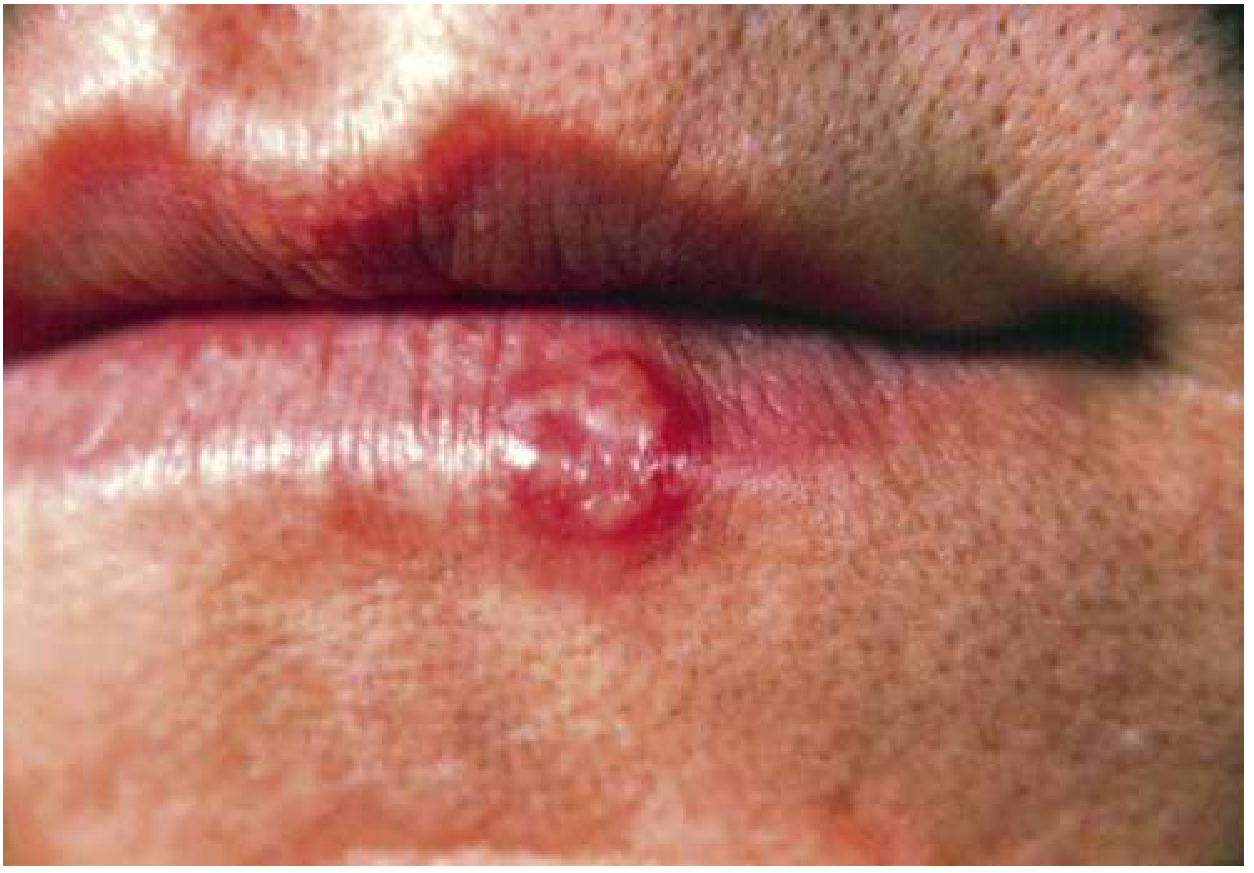
What Has Happened?
This patient has developed HSV-1 reactivation (Herpes Labialis / Cold Sore) - a known complication in the setting of acute febrile illness treated with NSAIDs. This is NOT a drug side effect in the classical sense, but rather a multi-factorial reactivation event driven by the following concurrent triggers:
Why Did This Happen? - Reactivation Triggers in This Case
As per Robbins & Kumar Pathology and Rosen's Emergency Medicine, HSV-1 lies latent in the trigeminal (sensory nerve) ganglia in the vast majority of adults. Reactivation is triggered by:
| Trigger | Present in this Patient? |
|---|---|
| Fever (systemic illness itself) | YES - 2 days of fever |
| Acute illness / infection | YES - bacterial/viral febrile illness |
| Stress on the immune system | YES - concurrent systemic illness |
| NSAIDs (diclofenac) | YES - prostaglandin suppression impairs local immune surveillance |
| Broad-spectrum antibiotics (ceftriaxone) | Possible - disrupts mucosal flora |
| Trauma / physiological stress | YES - bodyache, systemic inflammatory state |
Key mechanism of NSAID contribution: Diclofenac and other NSAIDs inhibit COX-1 and COX-2, reducing prostaglandin synthesis. Prostaglandins play an important role in local innate immune responses. Their suppression can reduce the ability of mucosal tissues to contain latent viral reactivation. The fever itself - not the drug - is the primary trigger, and diclofenac may have facilitated the process by blunting the local immune response at the lip/mucosal border.
- Robbins & Kumar: "Factors associated with HSV reactivation include trauma, allergies, exposure to ultraviolet light, upper respiratory tract infections, and immunosuppression."
- Rosen's EM: "Any stressor such as acute illness, emotional stress, trauma, intense sunlight, or fever can trigger reactivation of the virus."
Is This a Concern?
In this immunocompetent 50-year-old:
- The cold sore is self-limiting - typically resolves in 7-10 days without treatment
- The WBC (12,000) and platelets (192,000) are relatively reassuring - no severe immunosuppression
- CRP 51 indicates moderate acute phase response, consistent with the original bacterial/viral infection
However, a few points require attention:
- Reassess the primary diagnosis - has the original infection actually responded to ceftriaxone + NSAIDs? A new viral sign on day 3 should prompt questioning whether the original illness was viral (e.g., influenza, EBV, adenovirus) rather than bacterial.
- Is the fever still persisting? If so, ceftriaxone may not be addressing the underlying cause.
- Oral candidiasis vigilance - Ceftriaxone (broad-spectrum) can alter oral flora; monitor for thrush appearing alongside the cold sore.
Management Plan
For the Cold Sore (Herpes Labialis)
Immunocompetent host - mild recurrent episode:
- Topical acyclovir 5% cream - Apply 5x/day for 5 days (started early in prodrome/vesicle stage gives best results)
- Topical penciclovir 1% cream - Apply every 2 hours while awake x 4 days (FDA-approved, slightly superior to topical acyclovir)
- Docosanol 10% cream - OTC option, apply 5x/day until healed
- Oral antivirals (faster healing, preferred if many lesions or frequent recurrences):
- Acyclovir 400 mg TID x 5 days, OR
- Valacyclovir 2g twice in one day (single-day pulse dosing), OR
- Famciclovir 1500 mg single dose
Important: Treatment is most effective when started in the prodromal phase (tingling/burning before vesicle appears). Once ulcerated, benefit is reduced but still worthwhile.
For the Original Febrile Illness - Reassessment Needed
- Review diagnosis - consider whether the original cause was viral (no antibiotic benefit expected)
- Reconsider NSAID use - diclofenac + nimesulide dual NSAID combination is aggressive and increases GI/renal risk; consider switching to paracetamol alone for symptomatic fever if primary infection is responding
- Repeat CRP/CBC at day 5-7 to assess treatment response
- If fever persists beyond 5-7 days with no improvement - broaden workup (dengue serology, malaria smear, viral panels depending on local epidemiology)
Key Teaching Point
This cold sore is a clinical marker telling you two things:
- The patient's systemic immunity is under stress (the underlying infection is still active)
- Fever + acute illness is the most common reactivator of latent HSV-1 in adults
It is not a sign of antibiotic failure by itself, but it does signal that the patient's febrile/inflammatory state has not yet fully resolved. Treating the cold sore with a topical or oral antiviral alongside monitoring the primary illness is the appropriate next step.
- Robbins Basic Pathology, p. 539 - Herpes Simplex Virus Infections
- Rosen's Emergency Medicine - Herpes Simplex, Chapter 119
Can we give oral steroids or just lay out disease course naturally
Oral steroids in active herpes labialis is generally contraindicated - they suppress cellular immunity and can cause viral dissemination. The natural course is self-limiting in 7-10 days. Let me get the evidence base on this properly.
Searching sources...
Finding Sources
Finding Sources
Searching PubMed
oral corticosteroids herpes simplex labialis contraindication
Finding Sources
Finding Sources
Searching PubMed
herpes simplex glucocorticoids dissemination risk
Finding Sources
Finding Sources
Searching the Web
oral corticosteroids herpes labialis cold sore contraindicated worsening viral replication
I have all I need. Here is the full answer:
Oral Steroids in Herpes Labialis - Short Answer: No, Avoid Them
The Core Problem with Oral Steroids Here
Oral corticosteroids (prednisolone, dexamethasone etc.) suppress cell-mediated immunity - specifically the CD8+ cytotoxic T-cell response that is the primary defense against HSV replication. In an active herpes labialis outbreak, giving systemic steroids can:
- Enhance viral replication - corticosteroids remove the T-cell brake on HSV proliferating in keratinocytes
- Risk dissemination - from localized lip lesion to a wider cutaneous, ocular, or systemic spread
- Prolong the episode - instead of the natural 7-10 day resolution, the lesion may persist or enlarge
- Reactivate deeper HSV disease - in rare cases, can push toward HSV encephalitis or hepatitis in a systemically stressed patient
The University of Iowa Head & Neck Protocols are explicit: "These medications are all contraindicated in microbial diseases. If given to patients with microbial diseases, microbial proliferation is usually enhanced and systemic dissemination is possible."
BUT - There Is One Nuanced Exception
Topical acyclovir + LOW-DOSE topical hydrocortisone combination (XERESE = acyclovir 5% + hydrocortisone 1% cream) is FDA-approved for herpes labialis. The rationale here is:
- The antiviral (acyclovir) suppresses viral replication
- The low-dose topical steroid reduces the local inflammatory tissue damage (which contributes to ulceration and pain)
- Systemic absorption is negligible - no immune suppression occurs at the whole-body level
- Net effect: reduces ulceration risk and shortens healing time
This is categorically different from giving oral prednisolone. The topical corticosteroid is only safe because it is combined with an antiviral and because systemic levels are negligible.
Natural Disease Course - What to Expect
| Stage | Timing | What Happens |
|---|---|---|
| Prodrome | Hours 0-24 | Tingling, burning, itching at lip border |
| Vesicle | Day 1-2 | Small 1-3mm fluid-filled blisters appear in clusters |
| Ulceration | Day 2-4 | Vesicles rupture, shallow ulcers form (most painful, most infectious) |
| Crusting | Day 4-6 | Yellowish-brown scab forms |
| Healing | Day 7-10 | Crust falls off, skin regenerates without scar |
In this immunocompetent 50-year-old, doing nothing (watchful waiting) is a perfectly valid option. The lesion will resolve within 7-10 days on its own. Antivirals shorten this by roughly 1-2 days and reduce pain - they are helpful but not mandatory.
What You SHOULD Do Instead of Steroids
| Approach | Recommendation |
|---|---|
| Stop diclofenac if the original fever has settled | Removes one reactivation-perpetuating trigger |
| Topical acyclovir 5% cream | 5x/day x 5 days - helps if still in vesicle stage |
| Topical penciclovir 1% cream | Every 2 hours while awake x 4 days - slightly better than acyclovir topically |
| Oral acyclovir 400mg TID x 5 days | If lesion is large, painful, or patient wants faster resolution |
| Oral valacyclovir 2g BD x 1 day | Single-day pulse - convenient, effective |
| Lip protection (zinc oxide) | Reduces drying, prevents secondary bacterial superinfection of the crust |
| Avoid kissing/contact | Patient is infectious until fully crusted over |
Bottom Line
Do NOT give oral steroids. This patient already has immune stress from the underlying febrile illness + NSAIDs. Adding systemic corticosteroids risks viral spread and prolonged disease. The natural course resolves in 7-10 days on its own. If treatment is desired, a topical antiviral (or short oral antiviral course) is the right move - not immunosuppression.
This is a shared conversation. Sign in to Orris to start your own chat.