
note on Algor Mortis
Algor mortis is the post-mortem cooling of the body toward ambient temperature. It follows roughly a sigmoid/linear pattern (the "lazy S" curve), with the body losing about 1-1.5°C per hour under standard conditions, though this varies widely with body size, clothing, environment, and cause of death.
Searching sources...
Reading File
Searching the Web
algor mortis post-mortem cooling forensic pathology
Finding Sources
Reading Web Page
https://www.ncbi.nlm.nih.gov/books/NBK534875
Reading File
Reading File
Reading File
Reading File
I now have comprehensive content from the textbook. Let me compile the full note.
Loading Image
Here is the complete note on Algor Mortis, sourced from The Essentials of Forensic Medicine and Toxicology, 36th edition (2026).
Algor Mortis (Postmortem Cooling / Dead Body Chill)
Definition
Algor mortis (Latin: algor = coldness, mortis = of death) is the gradual cooling of the body after death to the level of the ambient (environmental) temperature, resulting from cessation of thermoregulation. It is also called postmortem cooling or dead body chill. The term was coined by Bennet Dowler in 1849; the first recorded measurements were made by John Davy in 1839.
During life, body temperature is maintained at approximately 37°C by metabolic activity. After death, when metabolic heat production stops and the environmental temperature is lower than the body, heat is lost by conduction, convection, and radiation.
Physiological Basis of Heat Loss
The cooling of the body is a complex process that does not occur at a uniform rate throughout:
- After circulation stops, convectional transport of heat inside the body ceases.
- Residual metabolic activity (glycogenolysis in dying tissues) and intestinal bacterial metabolism temporarily generate heat, so body temperature does not fall immediately.
- A temperature gradient develops from the surface to the core.
- Heat exchange from deeper to superficial layers occurs only by conduction (slow process).
- Internal organs cool primarily by conduction.
Modes of External Heat Exchange
| Mode | Details |
|---|---|
| Conduction | Heat absorbed by objects in contact with the body (clothing, air, surface) |
| Convection | Movement of air around the body - dominates at non-contact surfaces |
| Radiation | Loss as infrared rays; extensive in the first hour, then decreases as skin cools |
| Evaporation | Only a small fraction; more significant if the body is wet |
Postmortem Cooling Pattern
The cooling curve is sigmoid (inverted S-shaped) due to residual enzymatic activity and initial heat retention:
- Isothermic phase (Postmortem Temperature Plateau): For the first ~0.5 to 1 hour after death, the rectal temperature falls little or not at all.
- Linear cooling phase: Over the next 12-16 hours, cooling proceeds at a linear rate of 0.4-0.6°C per hour (tropical climates) or ~1°C per hour (temperate climates).
- Deceleration phase: When temperature approaches within ~4°C of the environment, the rate becomes very slow.
The body rarely reaches ambient temperature unless the environment is at or near freezing - because early decomposition (enzyme and bacterial action) itself generates heat.
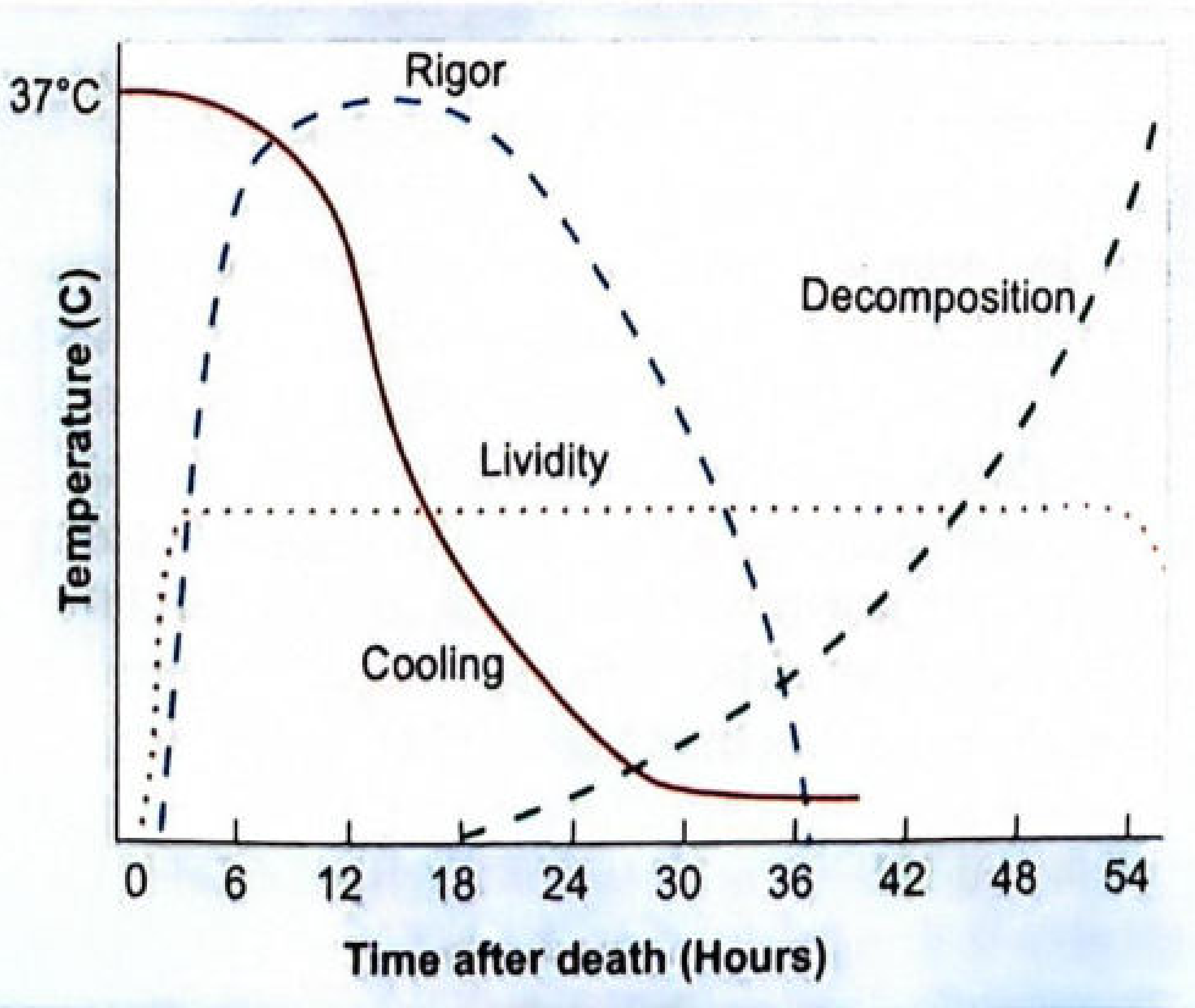
A naked average-sized body reaches ambient temperature in about 15-20 hours.
Measurement of Core Temperature
- Instrument: Laboratory thermometer (25 cm long, 0-50°C range) or electronic thermocouple with digital readout.
- Standard site: Rectum - thermometer inserted 8-10 cm, left for 2 minutes (except in sodomy cases).
- Alternative sites: Peritoneal cavity (contact with inferior surface of liver), external auditory meatus, nasal passages (probe to cribiform plate / probe through tympanic membrane).
- Record environmental temperature simultaneously.
- Readings at 1-2 hour intervals to obtain rate of fall.
Formula for Estimating Time Since Death
Time since death (hours) = (Normal body temperature - Rectal temperature) / Rate of temperature fall per hour
Variations in Rectal Temperature at Death
Normal rectal temperature: 36.5-37.5°C (diurnal variation up to 1.5°C - lowest in early morning, highest in late evening).
Raised at time of death (prolongs cooling time):
- Heatstroke, pontine hemorrhage, thyrotoxicosis
- Septicemia, cholera, other fevers
- Convulsive deaths (tetanus, strychnine poisoning)
- CO poisoning, cocaine/heroin intoxication
- Neuroleptic malignant syndrome, psychotic/emotional stress
- Exercise or struggle before death (raises temperature by 1.5-2°C)
- Fat/air embolism
Lowered at time of death (shortens cooling time):
- Collapse, congestive cardiac failure
- Hypothermia, hypothyroidism
- Muscle relaxants, cholera, secondary shock
Factors Affecting Rate of Cooling
| Factor | Effect |
|---|---|
| Temperature difference (body vs. environment) | Greater difference → faster cooling; in tropical summers, environment may exceed body temperature, nearly halting cooling |
| Build (weight-to-surface-area ratio) | Children and old people cool faster than adults |
| Physique (fat vs. lean) | Fat is a poor heat conductor - obese bodies cool slowly; lean bodies cool rapidly |
| Environment (ventilation) | Well-ventilated room → faster; closed room → slower |
| Humidity | Moist air conducts better → faster cooling than dry air |
| Immersion in water | Cooling is ~2x faster in still water, ~3x faster in flowing water vs. air; slower in sewage/putrefying water |
| Clothing/covering | Clothes are poor heat conductors - slow cooling; a bedspread may halve the cooling rate |
| Cause of death | Blood loss/diarrhea (dehydrated body) → rapid cooling; septicemia/convulsions (elevated pre-death temp) → prolonged cooling |
Postmortem Caloricity
A special condition where body temperature remains raised for the first ~2 hours after death. Causes:
- Severely disturbed heat regulation before death (sunstroke, certain nervous disorders)
- Excessive muscle heat production from convulsions (tetanus, strychnine poisoning)
- Excessive bacterial activity (septicemia, cholera, fevers)
Medicolegal Importance
- Used to estimate the postmortem interval (PMI) - time since death.
- One of the three cardinal signs of death (along with livor mortis and rigor mortis).
- Most useful in cold and temperate climates where deaths occur indoors.
- Limited utility in tropical/warm climates (postmortem temperature fall may be minimal) and outdoor deaths.
- An accurate formula cannot be devised because of the many variable factors.
- In refrigerated bodies, cooling rates are disrupted making algor mortis particularly unreliable for PMI estimation.
- If the body is exposed to external heat post-mortem, temperature may actually rise.
- In extreme cold (near 0°C), body may freeze with ice forming in cavities/blood vessels; expansion may cause separation of cranial sutures.
Source: The Essentials of Forensic Medicine and Toxicology, 36th edition (2026), pp. 159-160
This is a shared conversation. Sign in to Orris to start your own chat.