
Pressure in cylinder is 2000psig but in pipelines it is reduced to 500- 600 psig so how does it change in continuous system in anaesthesia setup
The pressure in an anaesthesia gas supply system drops in stages - from ~2000 psig in the cylinder, to ~500-600 psig at the pipeline/hospital supply, then further down to ~45-50 psig at the machine inlet, and finally to just a few cmH2O or psig at the patient end. Each stage uses a regulator to safely step down pressure.
Searching sources...
Reading File
Searching the Web
anaesthesia machine gas pressure regulation cylinder pipeline continuous system
Finding Sources
Reading Web Page
https://pmc.ncbi.nlm.nih.gov/articles/PMC3821260
Finding Sources
Finding Sources
Finding Sources
Finding Sources
Finding Sources
Finding Sources
Reading File
Finding Sources
Reading File
Excellent - I now have comprehensive textbook content from Miller's Anesthesia. Let me also fetch the schematic diagram image and read a bit more for the intermediate and low pressure sections.
Loading Image
Reading File
Now I have all the detail needed for a thorough answer. Let me compile it.
Pressure Changes in a Continuous-Flow Anaesthesia Machine
The gas supply system in a modern anaesthesia machine is divided into three pressure sections: high, intermediate, and low. Here is how pressure changes at each stage, from the source cylinder all the way to the patient.
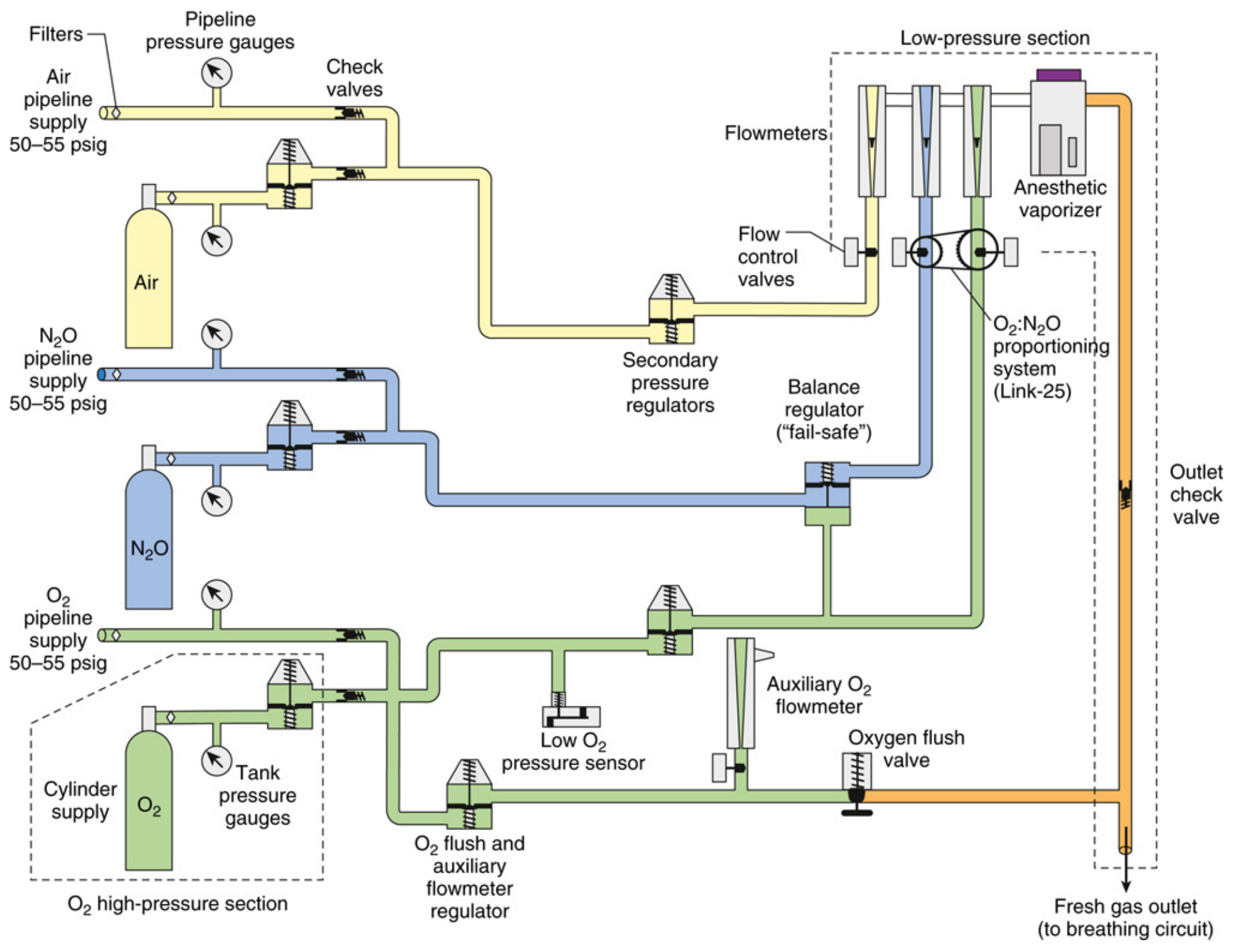
1. High-Pressure Section - Cylinder (~2000 psig)
- E-cylinders (backup supply on the back of the machine) store O2 and air at approximately ~2000 psig, and N2O at ~745 psig.
- These are the only high-pressure elements in the whole machine.
- The cylinder connects to the machine via the hanger yoke assembly, which has:
- A gas-tight seal
- Unidirectional (check) valves to prevent backflow
- The Pin Index Safety System (PISS) to prevent wrong-gas connection (each gas has a unique two-pin pattern on the yoke)
- A cylinder pressure gauge displays the tank pressure so the clinician can estimate remaining supply.
- Immediately downstream, a first-stage pressure regulator drops this variable, high cylinder pressure down to a fixed ~45-60 psig - the same range as the hospital pipeline. This makes cylinder and pipeline inputs compatible and interchangeable.
Key point: During normal operation, the high-pressure section is largely dormant because the hospital pipeline is the primary gas source. The cylinder is a backup.
2. Intermediate-Pressure Section - Pipeline / Post-Regulator (~50-55 psig)
This is where both sources - the pipeline and the stepped-down cylinder supply - converge at the same pressure.
-
The hospital central pipeline delivers gas at 50-55 psig directly to the machine via colour-coded, DISS (Diameter Index Safety System) quick-connect wall outlets.
-
Each pipeline inlet has:
- A filter to trap particulates
- A check valve to prevent backflow into the hospital system
- A pipeline pressure gauge (visible on the front of the machine)
-
Because the cylinder regulator is set to ~45-50 psig (just below pipeline pressure ~50-55 psig), the machine preferentially draws from the pipeline when both are connected. The cylinder only kicks in if pipeline pressure drops.
-
From here, intermediate-pressure gas feeds:
- The flow control valves (the knobs the anaesthetist turns)
- The O2 flush valve (delivers ~35-75 L/min directly to the circuit, bypassing the flowmeters)
- Fail-safe / oxygen supply failure protection devices - these monitor O2 pressure and shut off or proportionally reduce other gases (N2O, air) if O2 supply pressure falls
- The O2:N2O proportioning system (e.g., Link-25) which mechanically prevents delivering a hypoxic mixture
-
Some machines also have second-stage regulators here, which further drop pressure from ~50 psig to 14-35 psig to give the flow control valves a more stable input regardless of pipeline pressure fluctuations.
3. Low-Pressure Section - Flowmeters to Fresh Gas Outlet (near atmospheric / a few cmH2O)
- Begins at the flow control valves and ends at the fresh gas outlet (common gas outlet).
- Pressure here is just slightly above atmospheric - only a few cmH2O above ambient.
- Contains:
- Flowmeters (Thorpe tubes) or electronic flow sensors - these measure and set the flow rate (L/min) of each gas at near-atmospheric pressure
- Vaporizer - anaesthetic agent is added here; the low pressure and precise gas flow allow accurate agent delivery
- Check valves / backpressure relief valves to protect flowmeters from pressure surges (e.g., from ventilator cycling)
- The combined gas mixture (O2 + N2O or air + anaesthetic vapour) exits at the fresh gas outlet into the breathing circuit.
Pressure Summary Table
| Stage | Location | Pressure |
|---|---|---|
| Cylinder (E-size) | O2, Air cylinders | ~2000 psig |
| Cylinder (N2O) | N2O cylinder | ~745 psig |
| Hospital pipeline supply | Wall outlet to machine inlet | 50-55 psig |
| After 1st-stage regulator | Post-cylinder, enters intermediate section | ~45-55 psig |
| After 2nd-stage regulator | (if present) Before flow control valves | 14-35 psig |
| Low-pressure section | Flowmeters, vaporizer | Slightly above atmospheric |
| Breathing circuit | Patient airway | Airway pressure (cmH2O range) |
Why Does This Staged Reduction Matter?
- Safety: A sudden 2000 psig surge reaching the patient would be fatal. Staged regulation prevents this.
- Accuracy: Flowmeters only work accurately at low, stable pressure. Regulators ensure consistent input.
- Preferential use of pipeline: Setting the cylinder regulator just below pipeline pressure means the machine automatically switches to the cylinder only when the pipeline fails - a passive fail-safe.
- Fail-safe systems: The intermediate pressure section houses the O2 failure protection device. If O2 pressure drops, N2O is automatically cut off, preventing a hypoxic mixture from reaching the patient.
Sources: Miller's Anesthesia, 10e - Gas Supply System, pp. 2228-2245; The Basic Anaesthesia Machine (PMC3821260)
This is a shared conversation. Sign in to Orris to start your own chat.