
Diagram for lymphatic drainage of vulva
Reading File
The lymphatic drainage of the vulva primarily flows to the superficial inguinal lymph nodes, then to deep inguinal and external iliac nodes. The clitoris and deep structures also drain to internal iliac nodes.
Searching sources...
Finding Sources
Finding Sources
There's a diagram from Schwartz's Surgery and a figure reference from Berek & Novak's. Let me fetch those images and read the detailed text sections in parallel.
Loading Image
Reading File
Reading File
Let me also fetch the Berek & Novak pelvis lymphatic drainage figure for a more complete picture.
Loading Image
Here is a complete overview of the lymphatic drainage of the vulva, supported by diagrams from authoritative textbooks.
Lymphatic Drainage of the Vulva
Diagram 1 - Inguinal Lymph Node Groups (Schwartz's Principles of Surgery, Fig. 41-17)
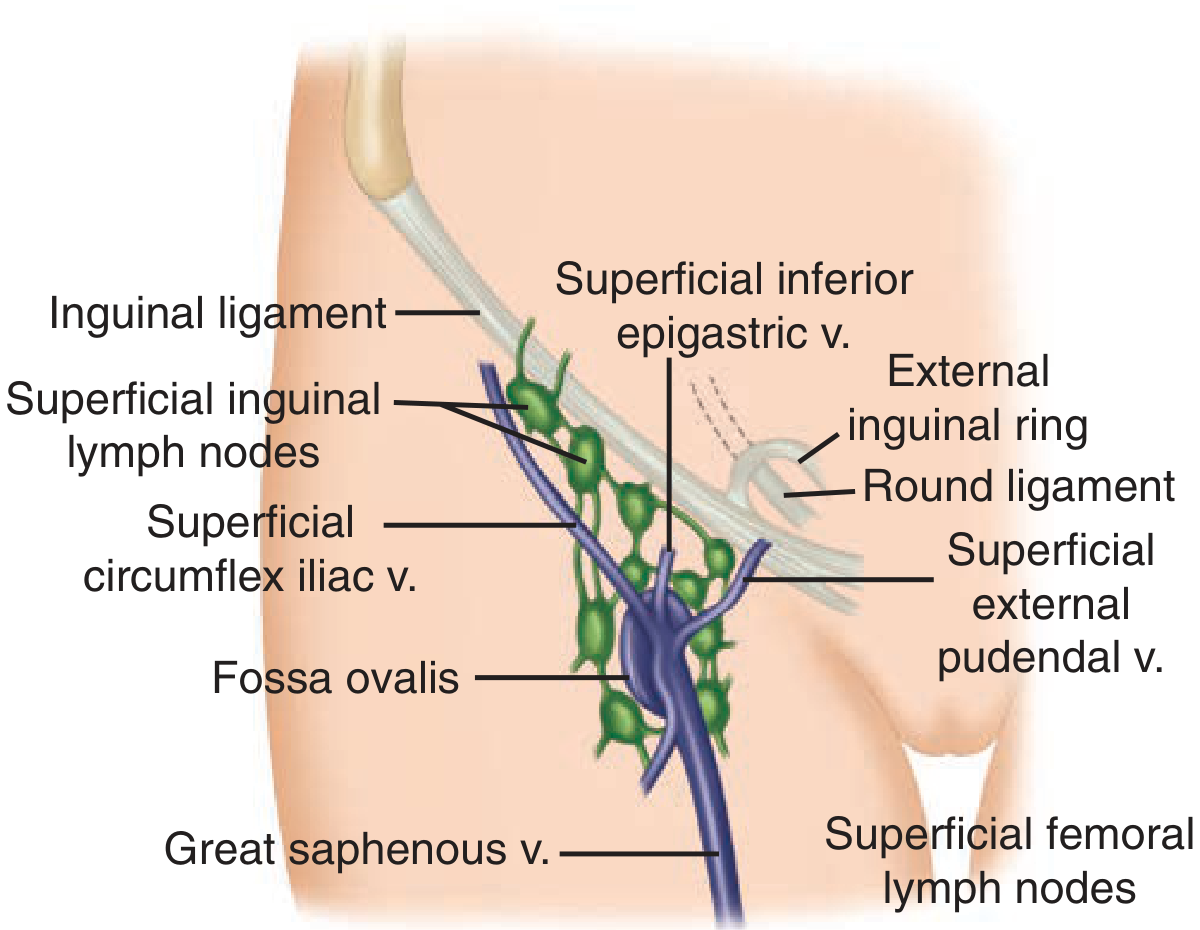
This diagram shows the superficial inguinal and superficial femoral lymph nodes clustered around the fossa ovalis, in relation to the inguinal ligament and great saphenous vein - the primary drainage basin for the vulva.
Diagram 2 - Female Pelvic Lymphatic Drainage (Berek & Novak's Gynecology, Fig. 5-11)
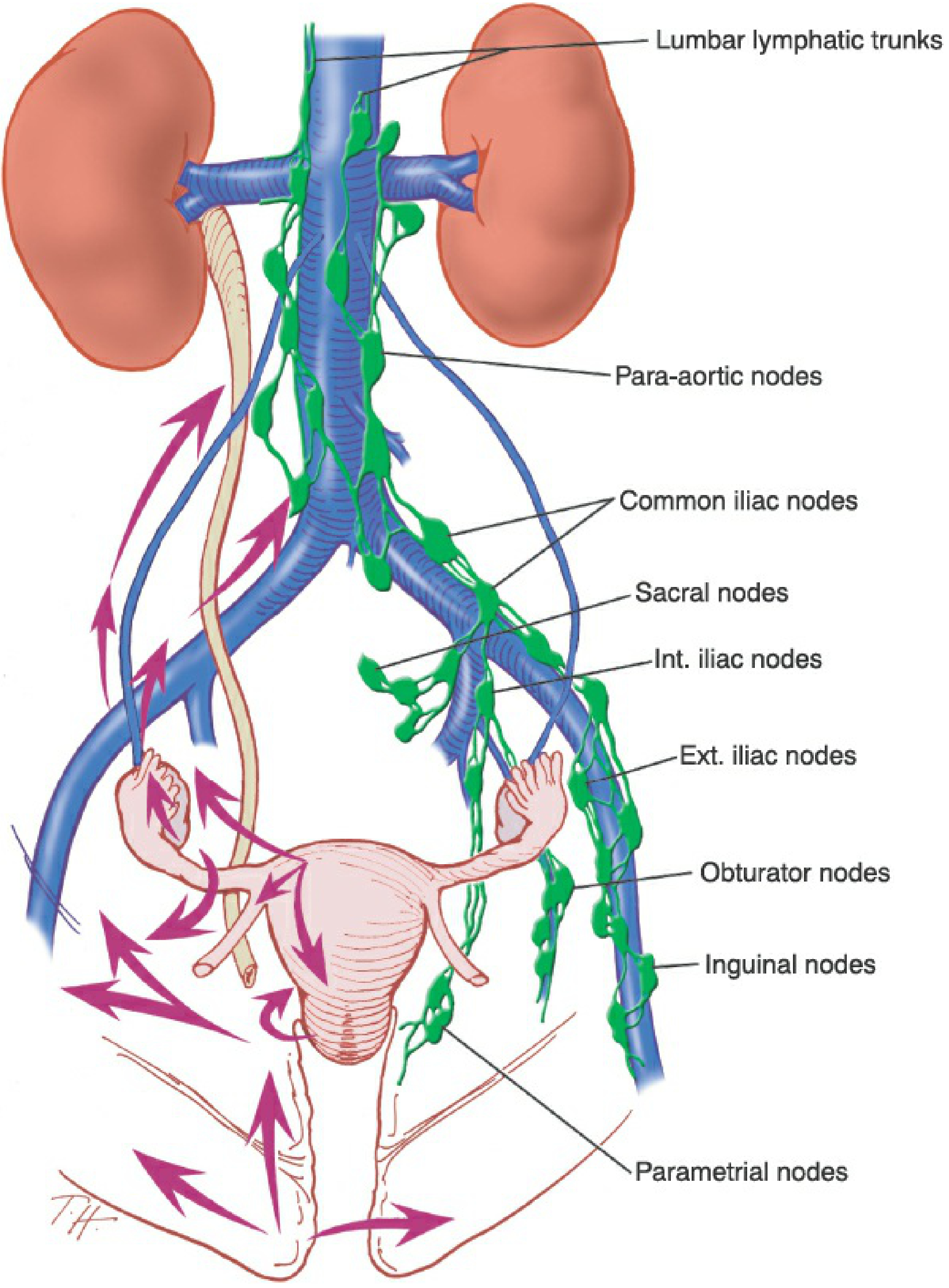
The arrows from the vulva (bottom) show the upward flow through inguinal nodes to external iliac, common iliac, and ultimately para-aortic nodes.
Drainage Pathway - Step by Step
| Step | Station | Notes |
|---|---|---|
| 1st | Superficial inguinal nodes | Primary drainage from most of the vulva - labia majora, labia minora, clitoral hood, perineal skin |
| 2nd | Deep femoral (deep inguinal) nodes | Drain the superficial inguinal nodes; the most distal is Cloquet's node (just under inguinal ligament) |
| 3rd | External iliac nodes | Drain the deep femoral nodes upward |
| 4th | Common iliac nodes | Further upward drainage |
| 5th | Para-aortic nodes | Final common pathway |
Special Drainage Routes
- Clitoris and labia minora: Drain directly to the deep inguinal nodes, bypassing the superficial nodes. The clitoris also has direct efferents to the internal iliac nodes via the dorsal vein.
- Perineum and lower labia majora: Some drainage goes to the rectal lymphatic plexus.
- Midline crossing: The lymphatics from either side of the vulva form rich midline anastomoses. Drainage from the clitoris, anterior labia minora, and perineum is bilateral - meaning metastases can appear contralaterally even without ipsilateral nodal involvement.
Clinical Relevance (Vulvar Cancer)
- The primary sentinel/drainage nodes are the superficial inguinal nodes - this is why radical vulvectomy includes bilateral inguinal lymph node dissection.
- Cloquet's node (deep femoral, beneath inguinal ligament) acts as a gateway to pelvic nodes.
- Bilateral nodal spread is possible even for unilateral lesions when they involve midline structures (clitoris, anterior vulva, perineum).
Sources:
- Campbell-Walsh-Wein Urology, "Vulva: Vascularization, Lymphatic Drainage, and Neuroanatomy"
- Berek & Novak's Gynecology, Fig. 5-11 and Table 5-5
- Schwartz's Principles of Surgery (11th ed.), Fig. 41-17
Simple diagram
Generating Image
Simple clean medical flowchart diagram showing lymphatic drainage of the vulva. Flow arrows going upward: Vulva (labia majora, labia minora, perineum) at the bottom draining to Superficial Inguinal Nodes, then to Deep Femoral Nodes (with a label for Cloquet's node), then to External Iliac Nodes, then to Common Iliac Nodes, then to Para-aortic Nodes at the top. A separate side arrow from Clitoris going directly to Deep Inguinal Nodes and also to Internal Iliac Nodes. Clean white background, simple boxes and arrows, medical textbook style.
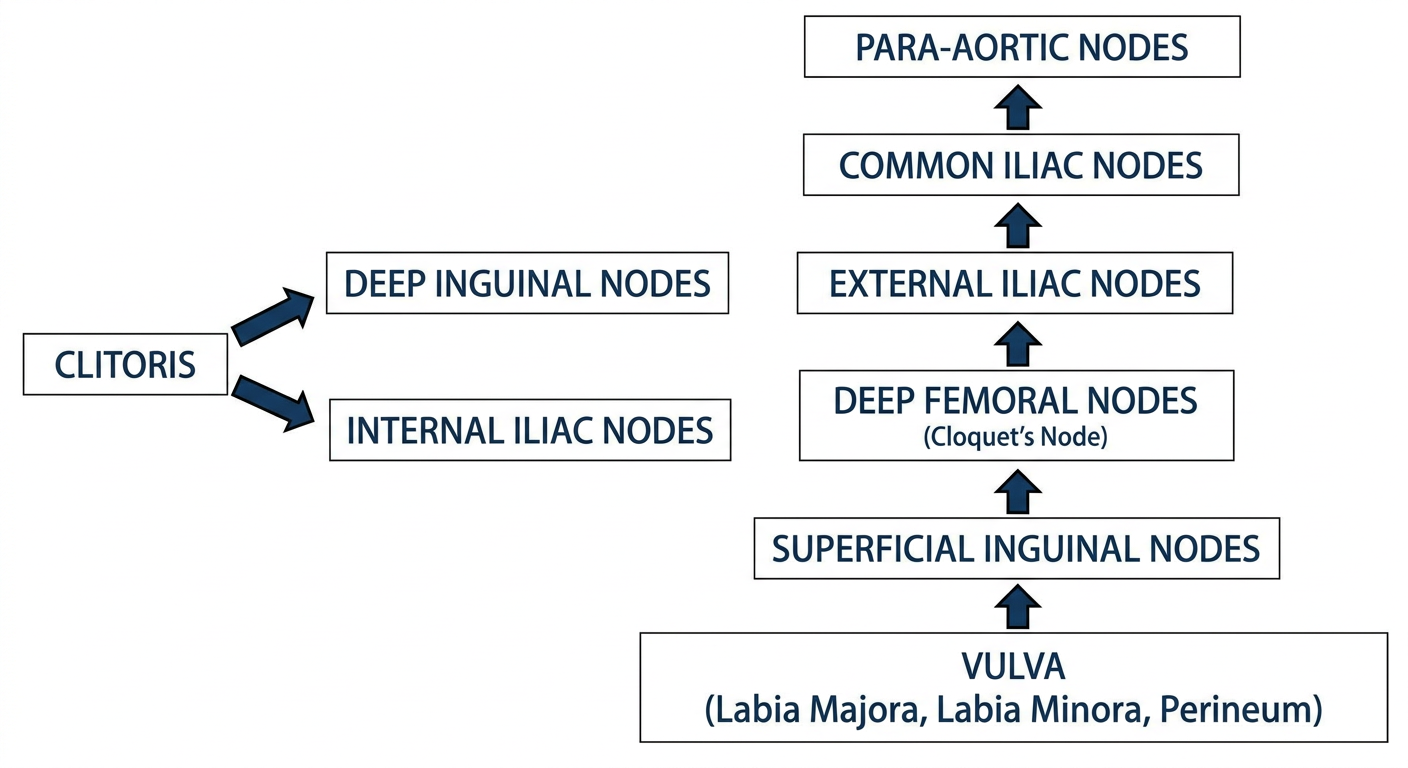
Key points to remember:
- Main route: Vulva → Superficial Inguinal → Deep Femoral (Cloquet's node) → External Iliac → Common Iliac → Para-aortic
- Clitoris has a direct bypass route to Internal Iliac nodes
- Drainage is bilateral for midline structures (clitoris, anterior labia minora)
This is a shared conversation. Sign in to Orris to start your own chat.