
Mitral clips
I'll look this up in the medical library for you right away.
Reading File
Now let me search the library and PubMed in parallel for mitral clips.
Finding Sources
Finding Sources
Searching PubMed
"MitraClip" AND "mitral regurgitation"
Good - rich results from multiple textbooks. Let me now read the key sections in parallel.
Reading File
Reading File
Reading File
Now let me read the Edge-to-Edge Repair section from Fuster & Hurst and get the Miller's Anesthesia section + the image:
Reading File
Reading File
Reading File
Let me also get the procedure technique and patient selection details, and fetch the key 3D echo image:
Reading File
Loading Image
I now have comprehensive information to provide a thorough answer. Let me compile everything.
Mitral Clips (Transcatheter Edge-to-Edge Repair / TEER)
What is a Mitral Clip?
The MitraClip (Abbott Vascular) is a percutaneous device that mimics the Alfieri edge-to-edge surgical repair - it clips the free edges of the anterior and posterior mitral leaflets together to create a double-orifice mitral valve, reducing mitral regurgitation (MR) without open-heart surgery.
- Delivered via a transfemoral transseptal approach under general anesthesia with TEE guidance
- The clip grasps both leaflets on the ventricular side to create leaflet apposition
- The effect on MR is evaluated in real time by echocardiography (unlike open surgery, which is assessed after cardiopulmonary bypass is discontinued)
- Multiple clips can be placed if the initial result is suboptimal
- Classic clip position: between the A2 and P2 scallops, creating a double orifice
- Barash Clinical Anesthesia 9e, p. 2687; Braunwald's Heart Disease, p. 809
3D Echo View After MitraClip Placement
Here is an intraoperative 3D TEE "surgeon's view" showing the MitraClip in position between the A2/P2 scallops, with the double orifice visible on either side:
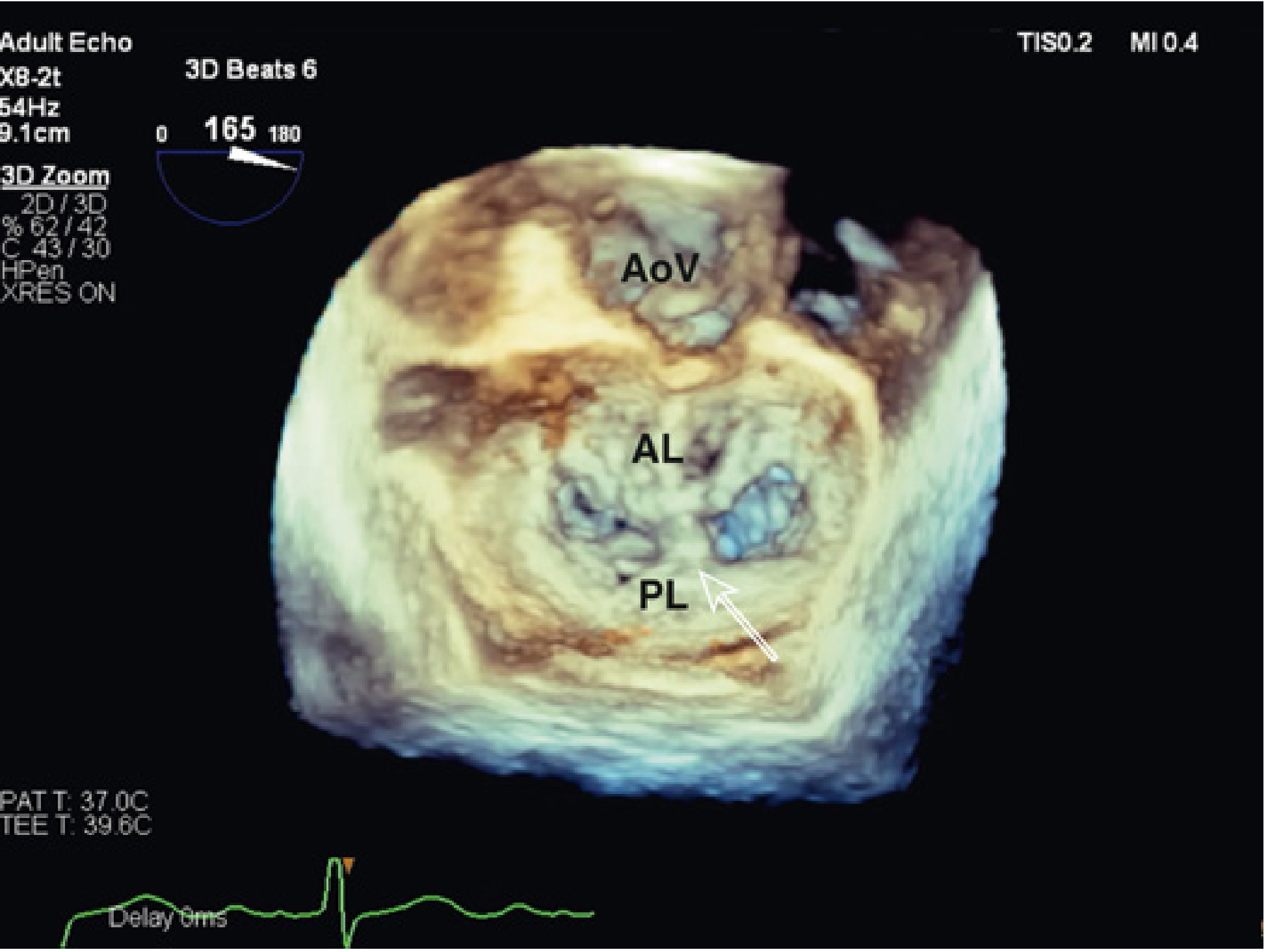
3D en face (surgeon's view) TEE showing MitraClip between anterior leaflet (AL) and posterior leaflet (PL), with the aortic valve (AoV) visible superiorly. - Miller's Anesthesia 10e, Fig. 33.30
Indications
| Type of MR | Indication |
|---|---|
| Primary (degenerative) MR | High surgical risk patients with symptomatic moderately-severe to severe MR (e.g., flail leaflet, prolapse) |
| Secondary (functional) MR | Heart failure patients with secondary MR who remain symptomatic despite optimal guideline-directed medical therapy (GDMT) |
Contraindications/unfavorable features (per Fuster & Hurst):
- LVEF <30%
- Extreme NT-proBNP >10,000 pg/mL
- Significant RV dysfunction (TAPSE <15 mm)
- Severe pulmonary hypertension or severe TR
- Major comorbidities (significant renal dysfunction)
- Excessive LV dilatation (LVESD >70 mm per COAPT)
- Fuster & Hurst's The Heart 15e, p. 969
Key Clinical Trials
Primary MR - EVEREST II
- 184 MitraClip vs. 95 surgical repair/replacement
- 30-day major adverse events: 9.6% vs. 57% (surgery) - largely driven by transfusion requirement
- Freedom from death/MV surgery/MR >2+ at 12 months: 55% (clip) vs. 73% (surgery) - surgery superior for durability
- BUT: MitraClip showed greater benefit than surgery in higher-risk patients
- Durable results at follow-up in patients with acute procedural success
Secondary MR - COAPT Trial (US/Canada, n=614)
- Symptomatic HF + moderate-severe secondary MR; all on optimal GDMT
- LVEF 20-50%, LVESD ≤69 mm, MR grade 3-4+
- Primary endpoint (HF hospitalization at 24 months): 35.8 vs 67.9 per 100 patient-years (NNT = 3.1) - P<0.001
- All-cause mortality at 24 months: 29.1% vs 46.1% (NNT = 5.9) - P<0.001
- Benefits even more pronounced at 3 years
Secondary MR - MITRA-FR Trial (France, n=304)
- No significant difference in all-cause death + HF hospitalization at 12 months (54.6% vs 51.3%, P=NS)
- No change at 24-month follow-up either
Why did COAPT and MITRA-FR conflict?
| Feature | MITRA-FR | COAPT |
|---|---|---|
| MR severity criteria | ERO >20 mm² | MR grade 3-4+ (AHA) |
| LV size exclusion | None | LVESD >70 mm |
| RV dysfunction exclusion | None | Moderate/severe excluded |
| Follow-up endpoint | 1 year | 2 years (recurrent events) |
| GDMT intensity | Less strict | More intensive |
Post-hoc analysis: COAPT enrolled patients with proportionally more severe MR relative to LV size (more "valve-driven" rather than "ventricle-driven" disease), hence more potential for benefit. Patients most likely to benefit: ERO ≥0.30 cm² + no excessive LV dilatation + after intensive GDMT has failed.
- Fuster & Hurst's The Heart 15e, p. 972; Braunwald's Heart Disease, p. 810
Procedure - Anesthetic Considerations
- General anesthesia with invasive monitoring is standard
- TEE is mandatory - guides transseptal puncture, clip positioning, and real-time MR assessment
- Transseptal puncture target: superior and posterior in the fossa ovalis (to allow adequate working height above the mitral valve)
- Mortality is lower with MitraClip vs. surgery using standard surgical risk prediction models
- Barash Clinical Anesthesia 9e, p. 2687; Miller's Anesthesia 10e, p. 5057
Next-Generation Devices
| Device | Key Feature |
|---|---|
| MitraClip NTR/XTR (Abbott) | Newer iterations with better grasping; EXPAND registry showed improved outcomes with experience |
| PASCAL (Edwards Lifesciences) | Wider paddles + central spacer to fill regurgitant orifice; independent leaflet capture; 98% success in early series |
| DRAGONFLY (Hangzhou Valgen, China) | Early clinical development |
Tricuspid Extension
Both MitraClip and PASCAL are also being used in the tricuspid position (anterior + septal leaflet clipping):
- Trivalve Registry (n=249): 96% technical success; TR ≥3+ reduced from 97% to 23% at discharge; 1-year mortality 20.3%
- TRILUMINATE trial: Prospective multicenter study ongoing
- Braunwald's Heart Disease, p. 811
Recent Evidence (2023-2026)
- TEER for MR in cardiogenic shock (2025 meta-analysis) - PMID 40055145: Systematic review confirming procedural feasibility in this very high-risk setting
- MitraClip vs. PASCAL meta-analysis (2025) - PMID 39754135: Both devices show comparable clinical outcomes; PASCAL may achieve better MR reduction
- MitraClip vs. surgery for secondary MR (2025) - PMID 40851316: Updated meta-analysis ongoing
Summary Points
- MitraClip = percutaneous edge-to-edge repair; mimics Alfieri technique; creates double-orifice MV
- Main indications: high-surgical-risk primary MR; secondary MR with HF after adequate GDMT
- EVEREST II: less durable than surgery overall, but better for high-risk patients
- COAPT: landmark benefit for secondary MR (NNT 3.1 for HF hospitalization, NNT 5.9 for mortality)
- MITRA-FR: negative trial - key lesson is patient selection (proportionate vs. disproportionate MR)
- TEE guidance is essential throughout the procedure
- Expanding to tricuspid valve repair and newer devices (PASCAL)
This is a shared conversation. Sign in to Orris to start your own chat.