
Undernutrition-spm from park textbook
Reading File
Now let me search the library for the Park textbook's SPM content on undernutrition.
Finding Sources
Finding Sources
Finding Sources
Reading File
Now let me read more sections - the "Under nutrition" heading and "Types of Undernutrition" in Park's:
Reading File
Reading File
Reading File
Finding Sources
Reading File
Finding Sources
Finding Sources
Loading Image
Reading File
Now I have enough content from Park's textbook to compile a comprehensive answer on Undernutrition from the SPM perspective. Let me now compile everything.
Undernutrition - Park's Textbook of Preventive and Social Medicine
Definition and Scope
Undernutrition is a major health and nutrition problem in India. It is not only an important cause of childhood morbidity and mortality, but leads to permanent impairment of physical and possibly mental growth of those who survive.
The term undernutrition encompasses three main forms:
- Stunting - chronic malnutrition
- Wasting - acute malnutrition
- Underweight - composite indicator
The nutrition problems most frequently encountered, particularly among the rural poor and urban slums in India, are protein-energy malnutrition (PEM) and micronutrient deficiencies.
Magnitude of the Problem (NFHS-4 Data)
| Indicator | Prevalence |
|---|---|
| Low birth weight | 18.5% |
| Underweight (weight-for-age, <5 yrs) | 35.7% |
| Stunted (height-for-age, <5 yrs) | 38.4% |
| Wasted (weight-for-height) | 21% |
| Kwashiorkor/Marasmus (<5 yrs) | <1% |
In adults, about 33% of men and 36% of women have BMI <18.5 (chronic energy deficiency). Among tribal adults, 40% men and 49% women have BMI <18.5.
Causes (Web of Causation)
Historically (1970s), PEM was attributed to protein deficiency ("protein gap"), but this concept has been replaced by the "food gap" concept. PEM is now understood to be primarily due to:
- Inadequate food intake - insufficient in both quantity and quality
- Infections - diarrhoea, respiratory infections, measles, intestinal worms (increase nutrient requirements, decrease absorption)
Malnutrition-Infection Cycle
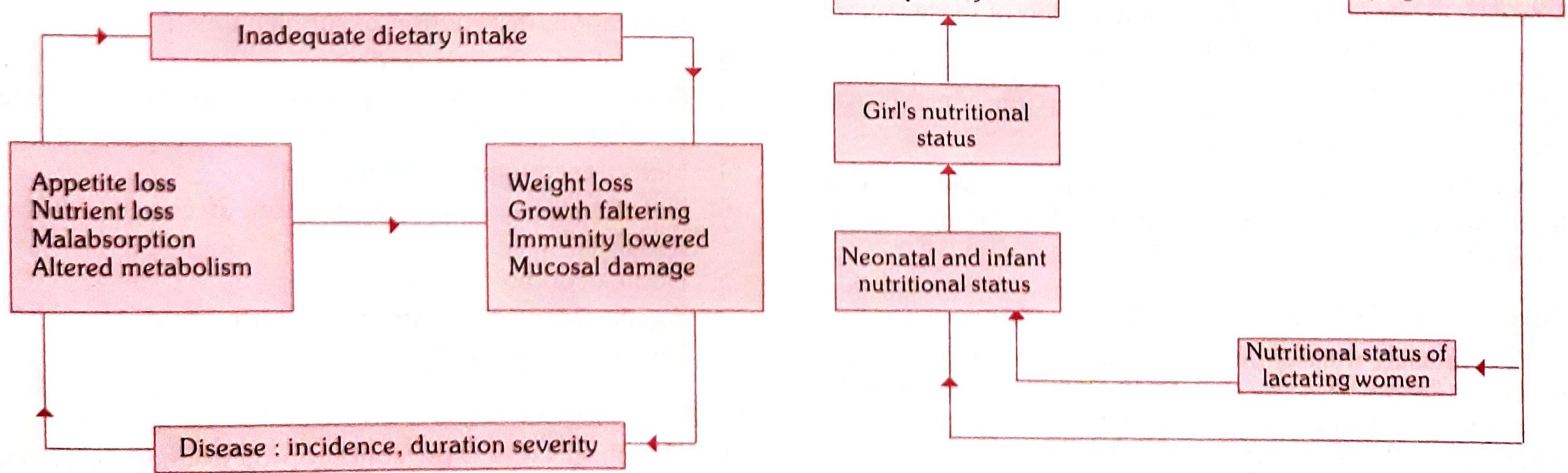
Fig. 2 - Malnutrition/Infection Cycle: Inadequate dietary intake leads to weight loss, growth faltering, lowered immunity and mucosal damage; disease in turn causes appetite loss, nutrient loss, malabsorption and altered metabolism - creating a vicious cycle.
Other Contributing Factors in the Web of Causation:
- Poor environmental conditions
- Large family size
- Poor maternal health
- Failure of lactation / premature termination of breast-feeding
- Adverse cultural practices (over-diluted cow's milk, discarding cooking water from cereals, delayed supplementary feeding)
Self-Perpetuating Nature
Malnutrition is self-perpetuating across generations. A child's nutritional status depends on past nutritional history, which links to the mother's own health and nutritional history from her childhood (intergenerational cycle).
Measurement of Undernutrition (Anthropometry)
In children, undernutrition is synonymous with growth failure. The standard tool is anthropometry - inexpensive and non-invasive.
Three Anthropometric Indices:
- Weight-for-Age (WFA) - used for underweight
- Length/Height-for-Age (HFA) - used for stunting
- Weight-for-Height/Length (WFH) - used for wasting
Each index is expressed in Z-scores (standard deviation units) from the WHO Child Growth Standards median. Below −2 SD = moderate; Below −3 SD = severe.
Types of Undernutrition
1. Underweight (Weight-for-Age)
- Composite measure of both stunting and wasting
- Can result from chronic or acute malnutrition, or both
- Preferred indicator to assess changes in magnitude over time
- Z-score: <−2 SD of WHO median
- Even mild underweight increases child mortality risk; severely underweight = greatly increased risk
2. Stunting (Height-for-Age)
- Failure to achieve expected height compared to well-nourished children of the same age
- Indicator of past/chronic growth failure (long-term malnutrition)
- Associated with: chronic insufficient nutrient intake, frequent infections, sustained inappropriate feeding, poverty
- Leads to: delayed psycho-social and cognitive development, poor school performance
- Z-score: <−2 SD of WHO median
3. Wasting (Weight-for-Height)
- Represents recent/acute failure to receive adequate nutrition
- Very sensitive to seasonal changes in food availability and disease prevalence
- Causes: inadequate food intake, incorrect feeding practices, disease/infection
- Z-score: <−2 SD of WHO median
4. Severe Acute Malnutrition (SAM)
Defined by any ONE of:
- Weight-for-height Z-score <−3 SD
- Mid-upper arm circumference (MUAC) <115 mm
- Presence of nutritional oedema
Severely wasted children are 9 times more likely to die than well-nourished children. SAM increases case fatality in diarrhoea and pneumonia.
Kwashiorkor vs. Marasmus
| Feature | Kwashiorkor | Marasmus |
|---|---|---|
| Cause | Low protein/energy ratio (predominantly protein deficient) | Inadequate intake of both protein AND energy |
| Oedema | Present (hallmark) | Absent or minimal |
| Wasting | Present | Severe wasting (cachexia) |
| Subcutaneous fat | Present | Very little/none |
| Liver | Enlarged, steatosis | - |
| Albumin | Hypoalbuminaemia | Non-normal levels |
| Skin/Hair | Possible depigmentation | - |
Early Detection of PEM
- Growth charts - first indicator is underweight for age; practical for field health workers
- Arm circumference (MUAC):
- >13.5 cm = satisfactory nutritional status
- 12.5 - 13.5 cm = mild-moderate malnutrition
- <12.5 cm = severe malnutrition
- (Cannot be used before age 1 year; between ages 1-5, it hardly varies)
Protein-Energy Malnutrition (PEM) - SPM Perspective
PEM is estimated to be an underlying cause in 30% of deaths among children under 5 years. It:
- Occurs particularly in low birth weight babies and children in first years of life
- Is characterized by low birth weight (if mother malnourished), poor child growth, high child mortality at 12-24 months
- 27% of children in low-income countries have low height-for-age (stunting)
- 17% have low weight-for-height
Preventive Measures (8th FAO/WHO Expert Committee)
(a) Health Promotion
- Measures for pregnant and lactating women (education + supplements)
- Promotion of breast-feeding
- Development of low-cost weaning foods; feed more frequently
- Measures to improve family diet
- Nutrition education - correct feeding practices
- Environmental sanitation and safe water supply
- Family planning and birth spacing
- Improved family environment
(b) Specific Protection
- Child's diet must contain protein- and energy-rich foods (milk, eggs, fresh fruits)
- Immunization
- Food fortification
(c) Early Diagnosis and Treatment
- Periodic surveillance
- Early diagnosis of growth lag
- Early diagnosis and treatment of infections and diarrhoea
- Early rehydration programmes for diarrhoea
- Supplementary feeding during epidemics
- Deworming of heavily infested children
(d) Rehabilitation
- Nutritional rehabilitation services
- Hospital treatment
- Follow-up care
Micronutrient Malnutrition (also under Undernutrition)
Deficiencies of essential vitamins and minerals affect ~2 billion people globally:
- Vitamin A deficiency - most common preventable cause of childhood blindness; 20% of deficient children at increased risk of death from infections
- Iodine deficiency - goitre, cretinism, brain damage; 1.5 billion at risk
- Iron deficiency - nutritional anaemia; affects all age groups, reduces fatigue resistance
Source: Park's Textbook of Preventive and Social Medicine, pp. 735-738 (Block 9)
This is a shared conversation. Sign in to Orris to start your own chat.