
Damage control orthopedic according to latest ATLS guideline, tintinaali,rosens emergency book
Reading File
Damage Control Orthopaedics (DCO) is a staged surgical strategy in multiply-injured patients where definitive fixation is deferred in favour of rapid temporary stabilisation (external fixation), allowing resuscitation to proceed before definitive surgery. It sits within the broader Damage Control Surgery (DCS) philosophy from ATLS.
Searching sources...
Finding Sources
Finding Sources
Searching PubMed
damage control orthopedics polytrauma
Good - found Rosen's section on DCO. Let me now read it and simultaneously search for more relevant content.
Reading File
Finding Sources
Finding Sources
Excellent - multiple rich sources found. Now let me read the key sections from Campbell's, Rockwood & Green's, and Bailey & Love's simultaneously.
Reading File
Reading File
Reading File
Let me now read more of the Rockwood & Green's section on Indications for DCO and the Bailey & Love's DCO stages, and also search for Tintinalli content.
Reading File
Reading File
Finding Sources
Let me now get the full DCS vs ETC table from Bailey & Love's, more from Rockwood & Green's on indications, and search for Tintinalli content on this topic.
Reading File
Reading File
Finding Sources
Now let me search for ATLS-specific content and Tintinalli content simultaneously.
Finding Sources
Finding Sources
Searching the Web
ATLS 11th edition damage control orthopedics DCO guidelines 2025
ATLS 11th edition (2025) is confirmed. Let me now get the Rockwood & Green's lethal triad/resuscitation section and also search for Tintinalli content on DCO/polytrauma.
Reading File
Finding Sources
I now have comprehensive content from Rosen's, Rockwood & Green's (10th ed 2025), Campbell's (15th ed 2026), and Bailey & Love's (28th ed), plus ATLS 11th edition (2025) updates from the web search. Let me also fetch the lethal triad image and get the PubMed abstract on the 2025 systematic review.
Loading Image
Reading Article
PMID: 39827327
I now have all the material needed for a comprehensive answer. Let me compile it.
Damage Control Orthopaedics (DCO)
Sources: Rockwood & Green's Fractures in Adults 10th ed (2025), Campbell's Operative Orthopaedics 15th ed (2026), Bailey & Love's Short Practice of Surgery 28th ed, Rosen's Emergency Medicine 9th ed, ATLS 11th Edition (2025)
1. Historical Background and Concept
The management of multiply-injured patients has evolved dramatically over the past 50 years:
- 1970s: Literature began to challenge non-operative management of multiple injuries, as prolonged bed rest worsened outcomes.
- Early total care (ETC): Emerged in the 1980s - fix all fractures within 24 hours. Became the gold standard for most polytrauma patients.
- 1993: The term "damage control" was first introduced for abbreviated abdominal surgery in penetrating trauma, aimed at avoiding the lethal triad.
- Late 1990s: ETC found to cause ARDS in 33% and mortality in 21% of patients with severe chest trauma who underwent early femoral nailing (Pape et al.). This led to the "second hit model" and the birth of DCO.
Rosen's Emergency Medicine: "The overall approach to all major fractures gradually shifted to early temporary fracture stabilization, resuscitation of the patient to a stable physiologic state, and definitive fixation at a later time once the patient is hemodynamically stable."
2. The Lethal Triad - Core Rationale for DCO
The lethal triad is the central pathophysiologic target of DCO:
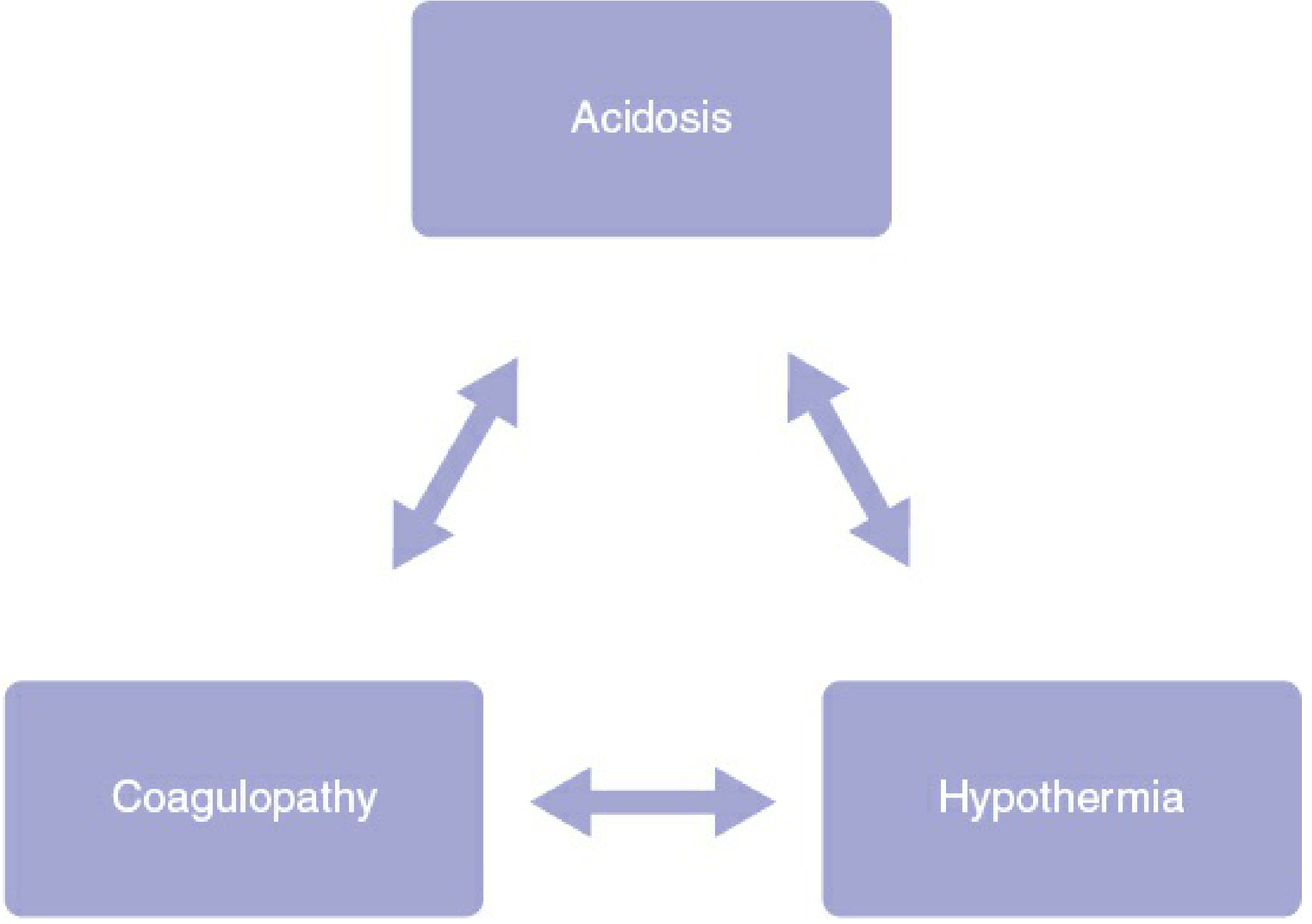
These three conditions are mutually reinforcing:
- Acidosis impairs enzymatic clotting factor function
- Hypothermia worsens coagulopathy and cellular metabolism
- Coagulopathy leads to ongoing hemorrhage and worsening acidosis
In polytrauma, the injury itself is the first hit. Definitive surgery in an inadequately resuscitated patient constitutes a second hit - an additional physiologic stress that can trigger uncontrolled Systemic Inflammatory Response Syndrome (SIRS), ARDS, Multiple Organ Dysfunction Syndrome (MODS), and death.
3. ATLS 11th Edition (2025) Updates Relevant to DCO
The latest ATLS edition (released 2025) introduced a major paradigm shift:
| Feature | ATLS 10th (2018) | ATLS 11th (2025) |
|---|---|---|
| Primary survey mnemonic | ABCDE | xABCDE (x = exsanguinating haemorrhage control first) |
| Resuscitation fluids | Crystalloid-based | Limit crystalloids; early blood products |
| Coagulopathy monitoring | Basic labs | TEG/ROTEM recommended |
| Haemorrhage strategy | Conventional | Damage control resuscitation (DCR) |
| Hypotension | Treat to normal BP | Permissive hypotension in non-TBI patients |
| Massive transfusion | Variable ratios | 1:1:1 (FFP:Platelets:pRBC) |
| Spine restriction | Rigid collars broadly | More selective, evidence-based |
Key ATLS 11 principle: Control of exsanguinating haemorrhage ("x") now precedes airway management. This directly underpins DCO - stop the bleeding first, stabilise fractures temporarily, resuscitate, then plan definitive surgery.
4. Phases / Stages of DCO
(Bailey & Love's 28th ed, Campbell's 15th ed)
The DCO concept involves a staged approach:
Stage 1 - Damage Control Phase (Emergency/ICU):
- Resuscitation - correct the lethal triad; DCR with 1:1:1 blood products
- Haemorrhage control - pelvic binder, external fixator, REBOA if available, angioembolisation
- Decompression - fasciotomy for compartment syndrome
- Decontamination - wound washout, debridement of open fractures
- Fracture splintage - temporary external fixation of long bones and pelvis
Stage 2 - ICU Resuscitation (typically 24-72 hours):
- Normalise physiology: correct hypothermia, acidosis, coagulopathy
- Monitor: lactate, base excess, pH, core temperature, urine output
- Avoid further surgical insults until stable
Stage 3 - Definitive Fixation (typically ≥4 days post-injury, when physiologically normalised):
- Convert external fixators to intramedullary nailing (femur)
- Definitive pelvic plating
- ORIF of other fractures
Bailey & Love's: "Definitive fixation of the fractures (conversion of the external fixators to intramedullary nailing for the femur and plating of the pelvis) would usually take place 4 days later, when the physiological state of the patient has been normalised, or even later if necessary."
5. Indications for DCO vs. Early Total Care (ETC)
(Rockwood & Green's 10th ed 2025, Bailey & Love's 28th ed)
The vast majority (80-90%) of polytrauma patients are suitable for ETC. DCO is reserved for patients meeting specific high-risk criteria:
| Criteria for DCO | Criteria for ETC |
|---|---|
| Hypothermia: core temp <34°C | Stable haemodynamics |
| Acidosis: pH <7.2 | No need for vasoactive/inotropic support |
| Serum lactate >5 mmol/L | No hypoxaemia, no hypercapnia |
| Coagulopathy (INR >1.5) | Serum lactate <2 mmol/L |
| Blood pressure <70 mmHg | Normal coagulation |
| Transfusion approaching 15 units | Normothermia |
| Injury Severity Score (ISS) >36 | Urinary output >1 mL/kg/h |
| Severe head injury (need to maintain CPP >70 mmHg) | No severe associated injuries |
| Severe chest trauma with bilateral pulmonary contusions |
Additional clinical indicators (Rockwood & Green's):
Clinical readiness for definitive surgery ("Early Appropriate Care / EAC" thresholds):
- pH ≥ 7.25
- Base excess ≥ -5.5 mmol/L
- Lactate < 4.0 mmol/L
- No severe head injury or cardiac ischaemia
Rockwood & Green's: "The type and timing of surgical intervention will depend on the magnitude and duration of acidosis, associated coagulopathy, and the response to resuscitation."
6. Techniques of DCO
(Rockwood & Green's 10th ed 2025, Campbell's 15th ed 2026)
Femoral Fractures
- Provisional external fixation: 2 Schantz pins on each side of fracture in unipolar configuration
- Distal femoral skeletal traction is an acceptable alternative
- Unreamed retrograde intramedullary nail: occasionally used as an alternative to external fixation in damage control
- Convert external fixation to definitive IMN within 2 weeks to minimise infection risk
Pelvic Ring Injuries
- External fixation with iliac crest pins (easier) or supra-acetabular pins (greater rotational control) for anterior ring injuries
- Circumferential pelvic sheet reduction for complete posterior ring disruption
- Skeletal traction for vertical shear (VS) pelvic ring injuries
- Acetabulum fractures: not amenable to external fixation; skeletal traction is provisional
Thoracolumbar Spine
- "Spine damage control": posterior reduction and instrumentation within 24 hours, followed by anterior fusion ≥3 days later if needed
- Reduces complications and length of stay compared with delayed fixation
Open Fractures
- Emergency washout and debridement
- External fixation for temporary stabilisation
- Definitive management after wound is clean and patient is stable
Compartment Syndrome
- Fasciotomy is an urgent/emergent DCO procedure that can be performed in the emergency department or resuscitation area
7. Physiologic Monitoring During DCO
(Rockwood & Green's 10th ed 2025, ATLS 11th)
| Parameter | Adequate Resuscitation Target |
|---|---|
| pH | ≥ 7.25 (ideally >7.35) |
| Base excess | ≥ -5.5 mmol/L |
| Serum lactate | < 4 mmol/L (ideally <2) |
| Core temperature | >35°C |
| Urine output | >1 mL/kg/h |
| Coagulation | INR <1.5; fibrinogen >2 g/L |
| Haematocrit | >24% |
TEG/ROTEM (ATLS 11 recommended): Guides targeted blood product use:
- Prolonged R time → FFP/clotting factor concentrates
- Delayed K time → cryoprecipitate (fibrinogen)
- Reduced maximum amplitude → platelets
-
30% amplitude reduction at 30 min post-maximum → tranexamic acid
8. Role of Rosen's Emergency Medicine (EM Perspective)
From an emergency medicine standpoint (Rosen's 9th ed):
- Setting: DCO measures can begin in the ED, resuscitation bay, or OR
- EM role: Facilitate stabilisation, coordinate OR/angiography suite transfer, and pre-operative preparation
- Key principle: Do NOT proceed to operative fixation if:
- Haemodynamic stabilisation has not been achieved
- Potentially life-threatening conditions remain unresolved
- Adequate lab/imaging workup is incomplete
- Temporary stabilisation: External fixation or splinting to aid haemorrhage control and tissue oxygenation
- Complications of immobilisation to watch for: DVT/PE, pneumonia, pressure sores, catheter UTI, delirium (especially in elderly)
9. DCO vs. ETC: Modern Nuances and Newer Concepts
(Bailey & Love's 28th ed, Rockwood & Green's)
Beyond the binary ETC vs DCO framework, newer approaches now include:
- Early Appropriate Care (EAC): Definitive stabilisation of pelvis, spine, acetabulum, and femur within 36 hours in adequately resuscitated patients (pH ≥7.25, BE ≥-5.5, lactate <4)
- Safe Definitive Surgery (SDS)
- PRISM (Prompt Individualised Safe Management): Patient-centred, personalised approach recognising that each patient has a different genetic/physiologic response to the same trauma - the team makes real-time decisions based on evolving physiology rather than rigid protocols
Bailey & Love's: "The PRISM concept accepts that the decision-making process should be based on the principles of doing no 'further harm to the patient', intervening promptly and utilising the idea of individualised/personalised medicine."
10. Missed Injuries - A DCO Pitfall
(Campbell's 15th ed 2026)
An estimated 5-20% of polytrauma patients have injuries not recognised during initial assessment due to:
- Altered level of consciousness
- Haemodynamic instability precluding thorough examination
- A more apparent injury in the same extremity distracting from a second injury
- Inadequate initial radiographs
Recommendation: Repeat orthopaedic examination after critical injuries are stabilised, specifically targeting missed injuries.
11. Recent Evidence (2025 Systematic Review)
A 2025 systematic review and meta-analysis by Steinfeld et al., Eur J Trauma Emerg Surg (PMID 39827327) analysed 5 RCTs (335 patients) on fracture stabilisation timing in polytrauma:
- No statistically significant difference in overall mortality between early (<24h) and late fracture stabilisation
- Femoral nailing reduced ICU length of stay and duration of mechanical ventilation compared with external fixation
- Conclusion: Immediate nailing is superior to staged approaches in stable polytrauma patients; DCO (external fixation) remains appropriate for unstable patients, but high-quality evidence remains limited
Summary: DCO Decision Framework
POLYTRAUMA PATIENT
        ↓
Is patient physiologically stable?
(pH >7.25 | lactate <4 | normothermic | normal coag)
        ↓
    YES → Early Total Care / EAC:
           Definitive fixation within 24-36h

    NO → DAMAGE CONTROL ORTHOPAEDICS:
           1. xABCDE resuscitation (ATLS 11)
           2. Temporary external fixation
           3. ICU resuscitation (correct lethal triad)
           4. Reassess at 24-72h
           5. Definitive fixation when physiologically normalised (≥4 days)
Key references:
- Rockwood and Green's Fractures in Adults, 10th ed (2025), pp. 564-580
- Campbell's Operative Orthopaedics, 15th ed (2026), Damage Control Orthopaedics section
- Bailey & Love's Short Practice of Surgery, 28th ed, Chapter 26, Table 26.2
- Rosen's Emergency Medicine, 9th ed, Chapter 41: Damage Control Orthopaedic Surgery section
- ATLS 11th Edition (ACS, 2025) - xABCDE and damage control resuscitation
This is a shared conversation. Sign in to Orris to start your own chat.