
Stomach parts
Reading File
Finding Sources
Searching Images
anatomy of the stomach parts diagram fundus body antrum pylorus
Finding Sources
query_images_db
Reading File
Parts of the Stomach
The stomach is the most dilated part of the GI tract, shaped like a "J," lying in the epigastric, umbilical, and left hypochondriac regions of the abdomen. It is divided into four main regions, plus several named curvatures/landmarks:
1. Cardia
Surrounds the opening where the esophagus enters the stomach (the gastroesophageal junction). It lies just distal to this junction.
2. Fundus
The dome-shaped portion above the level of the cardial orifice - the highest point of the stomach, tucked under the left side of the diaphragm.
3. Body (Corpus)
The largest region of the stomach, between the fundus and the pyloric part. Most of the acid- and pepsinogen-secreting glands (oxyntic mucosa) are here.
4. Pyloric part
The distal end of the stomach, itself subdivided into:
- Pyloric antrum - the wider proximal segment
- Pyloric canal - narrows toward the pylorus
- Pylorus - the terminal segment marked by the pyloric constriction, containing the thickened pyloric sphincter (circular muscle) that guards the pyloric orifice opening into the duodenum. This sits roughly at the transpyloric plane (lower border of L1 vertebra), just right of midline.
Other key landmarks
- Greater curvature - the longer, convex left/inferior border; attachment site for the gastrosplenic ligament and greater omentum.
- Lesser curvature - the shorter, concave right/superior border; attachment site for the lesser omentum.
- Cardiac notch (incisura cardiaca) - the sharp superior angle formed where the esophagus joins the fundus.
- Angular incisure (incisura angularis) - a bend along the lesser curvature marking the junction of the body and pyloric part.
Functional grouping
Physiologically the stomach is often grouped into two zones:
- Oxyntic (acid-secreting) region: cardia, fundus, and body - contains parietal and chief cells producing acid and pepsinogen.
- Pyloric region: antrum and pylorus - contains G cells (gastrin) and mucus-secreting cells, and controls gastric emptying via the pyloric sphincter.
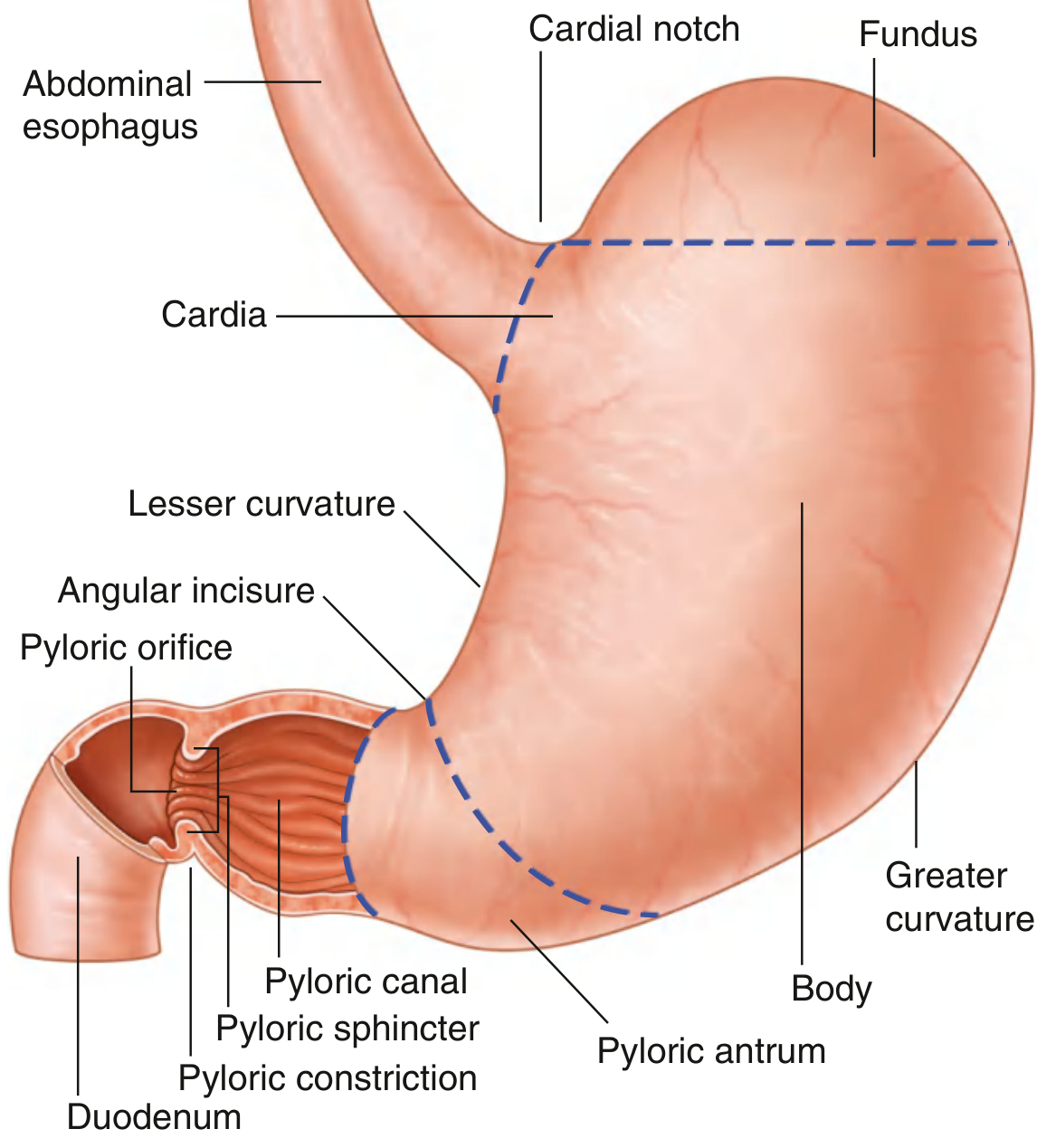
Fig: Stomach regions - fundus, cardia, body, pyloric antrum/canal, and pylorus - along with the greater and lesser curvatures.
Sources:
- Gray's Anatomy for Students, p. 370
- Grainger & Allison's Diagnostic Radiology, "Anatomy" section
- Yamada's Textbook of Gastroenterology, 7th ed. (gastric acid secretion - oxyntic vs. pyloric regions)
This is a shared conversation. Sign in to Orris to start your own chat.