
Types of suturing with diagram create image
Medical educational diagram showing types of suturing techniques. Clean white background with labeled illustrations of 6 suture types arranged in a grid layout: 1. Simple Interrupted Suture - individual stitches with knots 2. Continuous (Running) Suture - single thread running along wound 3. Vertical Mattress Suture - deep U-shaped stitch with surface loop 4. Horizontal Mattress Suture - parallel surface loops 5. Figure-of-Eight Suture - crossed stitch pattern 6. Subcuticular (Intradermal) Suture - buried horizontal stitch below skin surface Each type shown in cross-section and top view with skin layers visible (epidermis, dermis, subcutaneous tissue). Clear anatomical labels, color-coded suture threads (blue), neat arrows pointing to each technique name. Professional medical illustration style.
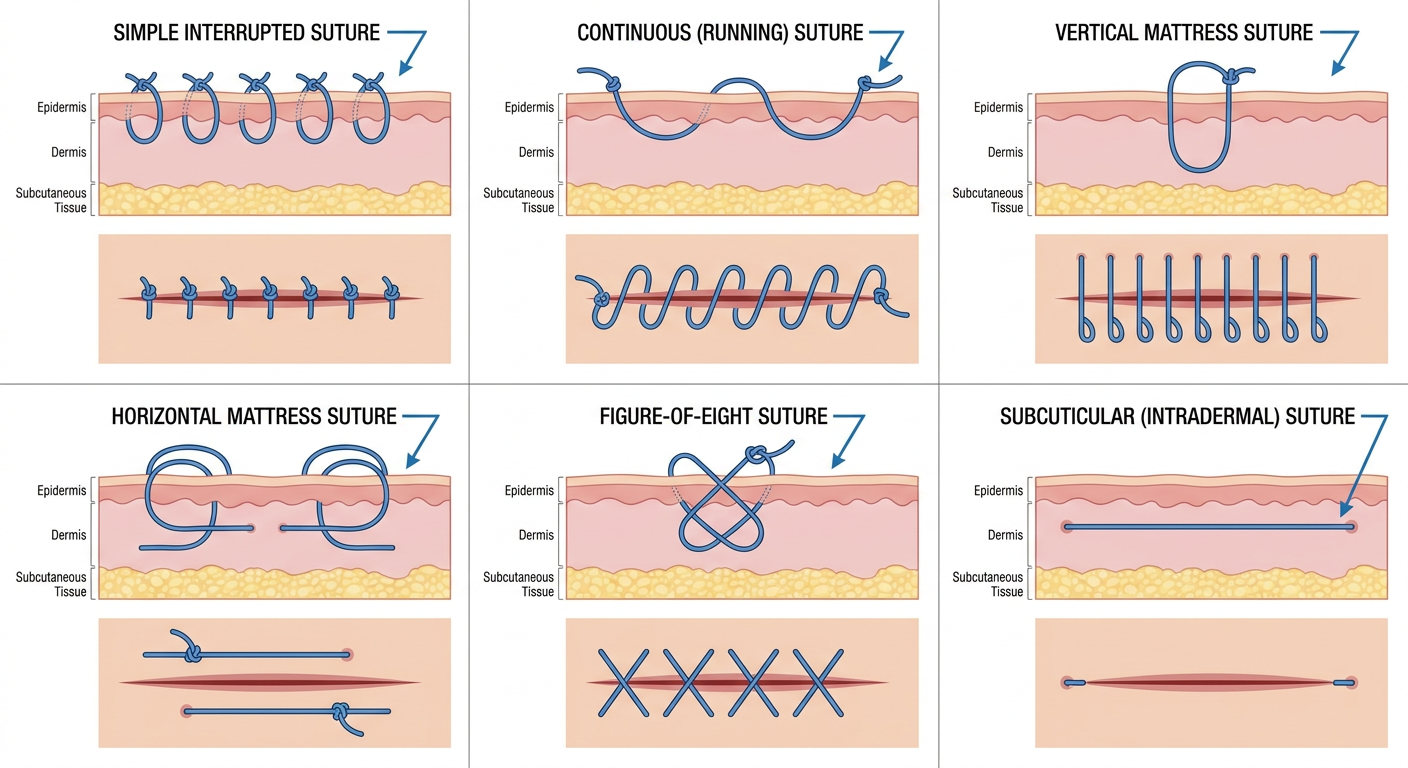
Types of Suturing Techniques
1. Simple Interrupted Suture
- Most commonly used technique
- Each stitch is placed and tied individually
- Easy to adjust tension, remove selectively
- Good for skin closure and contaminated wounds
2. Continuous (Running) Suture
- Single thread runs along the wound with multiple loops
- Faster to place than interrupted
- Subtypes: simple running, locking (blanket) stitch
- Used for fascia, peritoneum, and long lacerations
3. Vertical Mattress Suture
- Deep U-shaped bite + superficial surface loop
- Excellent for everting wound edges and reducing dead space
- Ideal for areas under high tension (back, scalp)
4. Horizontal Mattress Suture
- Two parallel bites placed horizontally
- Provides strong tension distribution
- Used in thick or tough tissues; can cause ischemia if too tight
5. Figure-of-Eight Suture
- Two crossing loops forming a figure-8 pattern
- Very strong - used for fascia, tendon repairs, and sternum closure
- Excellent for tissues requiring high holding strength
6. Subcuticular (Intradermal) Suture
- Thread runs horizontally just below the epidermis
- Produces the best cosmetic result - no external suture marks
- Used for clean elective incisions and facial wounds
- Can use absorbable or non-absorbable material
| Situation | Best Suture Type |
|---|---|
| Contaminated wound | Simple interrupted |
| Cosmetic closure | Subcuticular |
| High tension area | Vertical mattress |
| Long wound, fast closure | Continuous running |
| Fascial repair | Figure-of-eight |
| Skin eversion needed | Horizontal mattress |