
Omeprazole moa adverse effects
Reading File
Now let me search the medical library for omeprazole MOA and adverse effects in parallel.
Finding Sources
Finding Sources
Good results. Now let me read the most relevant sections in parallel.
Reading File
Reading File
Finding Sources
The file reads gave me a lot of content. Let me read the Goodman & Gilman section on PPI adverse effects in detail.
Reading File
Excellent - I have the key diagram URL and rich content. Let me fetch the diagram and also read a bit more from the adverse effects section.
Loading Image
Reading File
I now have comprehensive information from Goodman & Gilman's. Let me compile the full answer.
Omeprazole - Mechanism of Action & Adverse Effects
Classification
Omeprazole is a proton pump inhibitor (PPI) - the most potent class of gastric acid suppressants, capable of reducing daily acid production (basal and stimulated) by 80-95%.
Mechanism of Action
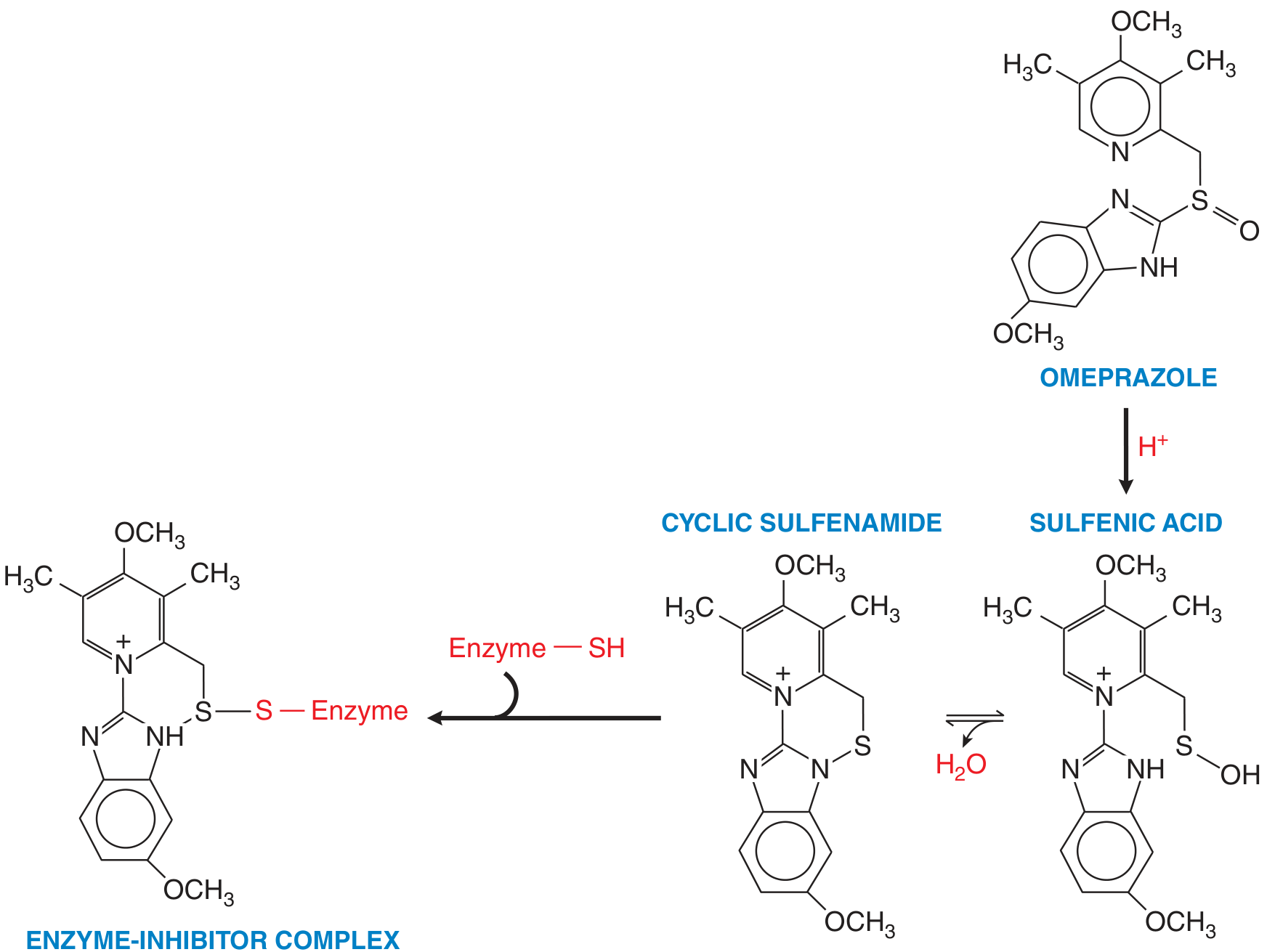
1. Prodrug activation (acid-dependent):
Omeprazole is a weak base prodrug (pKa ~4.0). It is absorbed in the small intestine, enters the systemic circulation, and then accumulates in the acidic secretory canaliculi of gastric parietal cells, where it undergoes protonation and acid-catalyzed conversion to two reactive species:
- Sulfenic acid
- Cyclic sulfenamide
These two forms are in equilibrium with each other in the canalicular lumen.
2. Irreversible covalent binding:
The activated sulfenamide reacts with sulfhydryl (-SH) groups on cysteine residues of the H⁺/K⁺-ATPase (the proton pump), forming a disulfide covalent bond and creating a permanent enzyme-inhibitor complex. This irreversibly inactivates the pump.
3. Target enzyme - H⁺/K⁺-ATPase:
This enzyme (encoded by ATP4A for the catalytic α-subunit, ATP4B for the β-subunit) is responsible for secreting H⁺ into the gastric lumen in exchange for K⁺. It is the final common step in gastric acid secretion, regardless of the stimulus (histamine, gastrin, acetylcholine).
4. Duration of action:
Because the inhibition is irreversible, acid suppression lasts 24-48 hours - until the parietal cell synthesizes new proton pumps. Since not all pumps are active simultaneously, maximal inhibition (~70% at steady state) takes 2-5 days of once-daily dosing.
Key pharmacokinetic note: PPIs must be taken before meals (30-60 min), so they are absorbed and reach parietal cells just as pumps are being activated by food.
Adverse Effects
Common (GI and general)
- Headache
- Nausea
- Abdominal pain
- Constipation or diarrhea
- Flatulence
Drug interactions (CYP450 metabolism)
Omeprazole is metabolized by hepatic CYPs (primarily CYP2C19) and can interfere with:
- Warfarin - increased anticoagulant effect
- Diazepam - reduced clearance
- Clopidogrel - reduced antiplatelet activation (clinically important)
- Atazanavir/nelfinavir - reduced antiretroviral absorption due to raised gastric pH
- Ketoconazole, ampicillin esters, iron salts - reduced bioavailability in less acidic environment
Long-term / chronic use effects
| Effect | Mechanism |
|---|---|
| Hypomagnesemia | Unknown; not via renal wasting. Monitor Mg²⁺ in long-term users, especially those on diuretics |
| Vitamin B12 deficiency | Reduced acid impairs intrinsic factor release and B12 absorption; check levels in long-term/high-dose users |
| Hypergastrinemia | Reduced acid → loss of negative feedback → elevated gastrin. Leads to ECL cell hyperplasia, fundic gland polyposis, atrophic gastritis |
| Rebound acid hypersecretion | On stopping PPIs, elevated gastrin drives surge in acid secretion |
| Bone fractures | Reduced Ca²⁺ and Mg²⁺ absorption; risk increases with high-dose, long-term use |
| Infection susceptibility | Reduced gastric acidity impairs the acid barrier: increased risk of C. difficile, community-acquired pneumonia, spontaneous bacterial peritonitis (in cirrhosis) |
| Small intestinal bacterial overgrowth (SIBO) | Gastric acid normally limits bacterial colonization of the upper GI tract |
Rare/reported effects
- Subacute myopathy
- Arthralgias
- Interstitial nephritis
- Pharyngitis
- Skin rashes
Special populations
- Hepatic disease: Dose reduction needed for esomeprazole and lansoprazole (substantially reduced clearance). Omeprazole itself has moderately prolonged half-life in severe liver disease.
- Pregnancy: Category C; use only if clearly needed.
- Renal failure: No dose adjustment needed with standard dosing.
Sources: Goodman & Gilman's The Pharmacological Basis of Therapeutics, Chapter 53; Harrison's Principles of Internal Medicine 22E; Yamada's Textbook of Gastroenterology 7E.
This is a shared conversation. Sign in to Orris to start your own chat.