
2nd unit of community health nursing notes
What is your course/program? · Which Unit 2 topics do you need? (Community Health Nursing syllabi vary by institution)
BSc Nursing Community Health Nursing Unit 2 Epidemiology Disease Prevention notes syllabus
https://www.omicsonline.org/open-access-pdfs/integrating-epi…
Unit 2: Epidemiology and Disease Prevention
Community Health Nursing - B.Sc Nursing
1. DEFINITION AND CONCEPTS OF EPIDEMIOLOGY
| Clinical Medicine | Epidemiology |
|---|---|
| Unit of study = individual patient | Unit of study = defined population |
| Concerned with sick individuals | Concerned with both sick AND healthy |
| Patient comes to the doctor | Investigator goes to the community |
| Aims for diagnosis + treatment | Aims for cause identification + prevention |
2. AIMS OF EPIDEMIOLOGY
- Describe the distribution and magnitude of health and disease problems in human populations
- Identify aetiological factors (risk factors) in the pathogenesis of disease
- Provide data essential to the planning, implementation, and evaluation of services for prevention, control, and treatment of disease
3. USES OF EPIDEMIOLOGY
- Studying the community's health - disease burden, distribution patterns
- Evaluating historical trends in disease patterns over time
- Diagnosing the community - identifying health problems needing attention
- Investigating the natural history and prognosis of disease
- Describing the health status of populations
- Identifying risk factors and causes of disease
- Evaluating the effectiveness of health services and interventions
- Providing information for health planning and policy-making
- Estimating risks for individuals - counselling and risk communication
- Searching for the aetiology of disease (disease causation)
4. EPIDEMIOLOGICAL TRIAD (Triangle of Epidemiology)
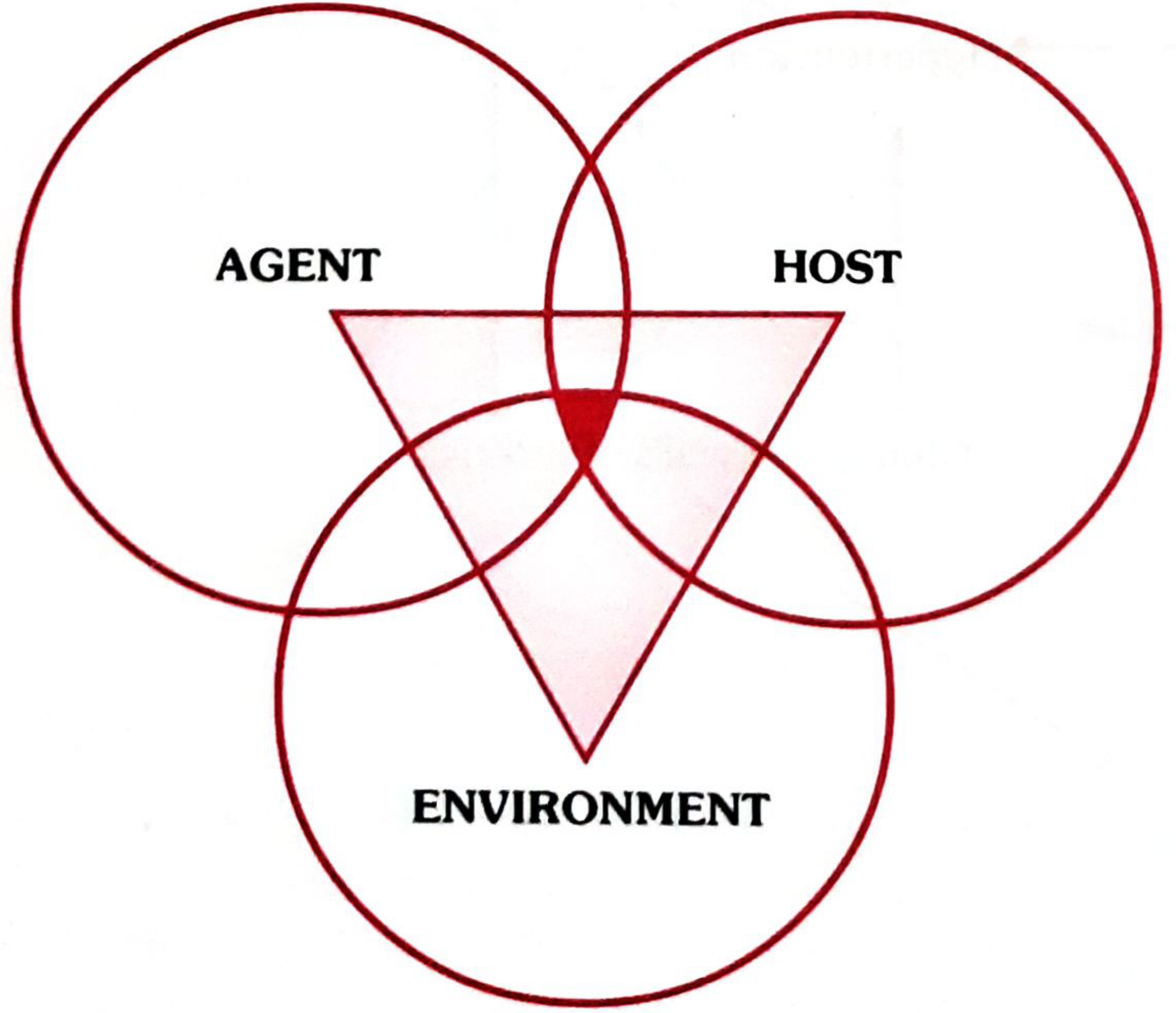
a. Agent
b. Host
c. Environment
- Physical environment: climate, geography, water, air
- Biological environment: insects, animals, microorganisms
- Social/cultural environment: sanitation, housing, socioeconomic status, lifestyle
d. Time
Key principle: The primary mission of epidemiology is to break one of the legs of the triangle, thereby disrupting the connection among environment, host, and agent, and stopping the outbreak.
5. DISEASE CAUSATION CONCEPTS
Germ Theory (Single Cause Theory)
Multi-factorial Causation
Web of Causation (Brian MacMahon)
Key insight: Even removing one important link in the chain may be sufficient to prevent disease - not all factors need to be removed.
6. NATURAL HISTORY OF DISEASE
Phase 1: Prepathogenesis Phase
- The disease agent has not yet entered man
- Factors that favour interaction between agent and host already exist in the environment
- Described as "man in the midst of disease" or "man exposed to the risk of disease"
- We are all potentially in the prepathogenesis phase of many diseases
- Intervention here = Primary Prevention
Phase 2: Pathogenesis Phase
| Sub-phase | Description |
|---|---|
| Early pathogenesis | Agent enters host; tissue/physiological changes begin; still subclinical |
| Presymptomatic stage (chronic diseases) | Pathological changes below the "clinical horizon"; no manifest disease |
| Clinical stage | Signs and symptoms appear; disease well advanced |
| Outcome | Recovery, disability, or death |
7. LEVELS OF PREVENTION
1. Primordial Prevention
- Newest concept; especially relevant for chronic diseases
- Prevention of the emergence or development of risk factors in populations/groups where they have not yet appeared
- Targets children before harmful lifestyles are formed (smoking, poor diet, physical inactivity)
- Main intervention: individual and mass education
- Example: Programs discouraging children from smoking before they start
2. Primary Prevention
- "Action taken prior to the onset of disease, which removes the possibility that a disease will ever occur"
- Intervention in the prepathogenesis phase
- Two approaches:
- Health promotion - general well-being, positive health
- Specific protection - immunization, chemoprophylaxis, use of specific nutrients
- WHO strategies for chronic diseases:
- Population (mass) strategy - directed at the whole population regardless of individual risk (e.g., reducing average blood pressure/cholesterol of a population)
- High-risk strategy - targets individuals at special risk via clinical screening
- Examples: Vaccination, sanitation, food safety, hand washing, safe water supply, occupational hazard protection
3. Secondary Prevention
- "Action which halts the progress of a disease at its incipient stage and prevents complications"
- Intervention in the early pathogenesis phase
- Key measures: Early diagnosis and prompt treatment (EDPT)
- Tools: Screening programs, case-finding, surveillance
- Aims to shorten the duration of illness and prevent spread
- Examples: Screening for cervical cancer (Pap smear), blood pressure screening, TB contact tracing
4. Tertiary Prevention
- Action to reduce or limit impairment and disability and promote rehabilitation in those who have already developed a disease
- Intervention in the late pathogenesis phase
- Includes: Rehabilitation (physical, social, vocational), preventing relapse, palliative care
- Examples: Physiotherapy after stroke, vocational rehabilitation for TB patients, support groups
| Level | Phase of Disease | Goal | Example |
|---|---|---|---|
| Primordial | Before risk factors develop | Prevent risk factor emergence | Anti-smoking campaigns in schools |
| Primary | Prepathogenesis | Prevent disease onset | Immunization, safe water |
| Secondary | Early pathogenesis | Detect and treat early | Pap smear, blood pressure screening |
| Tertiary | Late pathogenesis/disability | Reduce disability, rehabilitate | Physiotherapy, vocational training |
8. TYPES OF EPIDEMIOLOGICAL STUDIES
A. Descriptive Epidemiology
- First phase of epidemiological investigation
- Describes distribution of disease by asking:
- When is the disease occurring? → Time distribution
- Where is it occurring? → Place distribution
- Who is getting the disease? → Person distribution
- Define the population to be studied
- Define the disease under study
- Describe the disease by time, place, and person
- Measure disease frequency
- Compare with known indices/standards
- Formulate an aetiological hypothesis
- Provides baseline data on disease burden
- Identifies at-risk groups
- Generates hypotheses for analytical studies
- Evaluates health services
- Helps in health planning
B. Analytical Epidemiology
- Tests hypotheses generated by descriptive studies
- Studies the individual within the population
- Two major types:
- Both exposure and outcome have already occurred
- Proceeds backwards from effect (disease) to cause (exposure)
- Uses a control/comparison group
- Identifies cases (with disease) and controls (without disease), then looks back at their exposures
- Advantages: Quick, cheap, good for rare diseases
- Disadvantage: Recall bias, cannot establish incidence
- Follows a group forward in time from exposure to outcome
- Compares those exposed to a risk factor vs. not exposed
- Determines incidence and relative risk
- Advantages: Establishes temporal relationship, calculates incidence
- Disadvantage: Expensive, time-consuming, not suitable for rare diseases
C. Experimental Epidemiology
- Study conditions are under the direct control of the investigator
- Involves deliberate application or withdrawal of a suspected cause
- Modern usage = Randomized Controlled Trials (RCTs)
- Types:
- Animal experiments - study pathogenesis, test vaccines/drugs, complete natural history
- Human experiments/clinical trials - test interventions in people (vaccine trials, drug trials)
- Aims:
- Provide scientific proof of aetiological (risk) factors
- Measure effectiveness of health services for prevention and treatment
9. BASIC MEASUREMENTS IN EPIDEMIOLOGY
Scope of Measurements
- Mortality
- Morbidity
- Disability
- Natality (births)
- Presence/distribution of disease characteristics
- Health care utilization
- Environmental factors
- Demographic variables
Tools of Measurement
- Crude Death Rate = (Deaths in 1 year / Mid-year population) × 1000
- Infant Mortality Rate = (Deaths under 1 year / Live births in same year) × 1000
- Crude rates - actual observed rates (e.g., crude birth rate, crude death rate) - unstandardized
- Specific rates - rates for specific causes, age groups, or time periods (e.g., age-specific mortality rate)
- Standardized rates - adjusted for confounding variables (e.g., age-standardized rates)
- Example: Male:Female ratio = 1:1.06; Doctor:population ratio
- Example: Proportion of children with scabies = (Children with scabies / Total children) × 100
Key Epidemiological Rates to Know
| Rate | Formula | Multiplier |
|---|---|---|
| Crude Birth Rate | (Live births / Mid-year population) × | 1000 |
| Crude Death Rate | (Total deaths / Mid-year population) × | 1000 |
| Infant Mortality Rate | (Deaths < 1 yr / Live births) × | 1000 |
| Maternal Mortality Rate | (Maternal deaths / Live births) × | 100,000 |
| Incidence Rate | (New cases / Population at risk) × | 1000 or 100,000 |
| Prevalence Rate | (Existing cases / Total population) × | 1000 |
Incidence vs. Prevalence
| Feature | Incidence | Prevalence |
|---|---|---|
| Measures | New cases in a period | All existing cases at a point/period |
| Time | Over a time period | At a point in time (point prevalence) or period |
| Formula | New cases / Population at risk | All cases / Total population |
| Used for | Measuring disease risk, causation studies | Planning health services, burden of disease |
| Relationship | Prevalence ≈ Incidence × Duration of disease |
10. ROLE OF COMMUNITY HEALTH NURSE IN EPIDEMIOLOGY
- Surveillance and data collection - reporting communicable diseases, monitoring health trends in the community
- Case finding and contact tracing - identifying new cases, tracking contacts in outbreaks
- Health assessment - conducting community health surveys, home visits
- Risk factor identification - identifying populations at risk using epidemiological data
- Health education - educating communities on disease prevention and health promotion
- Implementing prevention programs - carrying out immunization, screening, and health promotion activities
- Outbreak investigation - assisting in investigating epidemics in the community
- Referral and follow-up - ensuring continuity of care and treatment adherence
- Rehabilitation support - helping patients reintegrate into community after illness
- Liaison with public health teams - working with epidemiologists, MOH, and other public health professionals
11. KEY TERMS TO REMEMBER
| Term | Definition |
|---|---|
| Epidemic | Occurrence of a disease in excess of normal expectancy in a defined area/period |
| Endemic | Constant presence of a disease or agent in a given geographic area |
| Pandemic | Worldwide spread of a new disease affecting a large number of people |
| Sporadic | Disease occurring irregularly, without regular pattern |
| Incubation period | Time between entry of agent and appearance of first symptoms |
| Herd immunity | Resistance of a group to attack by a disease when a sufficiently high proportion is immune |
| Susceptibility | Being at risk of acquiring an infection |
| Carrier | A person who harbours an infectious agent without apparent clinical disease |
| Reservoir | The living or non-living habitat in which an agent normally lives and multiplies |
| Fomite | An inanimate object that can carry and transmit infectious agents |
| Zoonosis | Infectious disease transmitted from animals to humans |
| Iatrogenic disease | Disease caused by medical treatment or diagnostic procedures |
| Screening | Presumptive identification of unrecognised disease using tests in apparently healthy persons |
QUICK REVISION: Important Points for Exams
- Definition of epidemiology (John Last) - distribution, determinants, application
- Epidemiological triad = Agent + Host + Environment (+Time)
- Natural history has 2 phases: Prepathogenesis and Pathogenesis (Leavell & Clark)
- 4 levels of prevention: Primordial → Primary → Secondary → Tertiary
- Secondary prevention = EDPT (Early Diagnosis and Prompt Treatment)
- Incidence = new cases; Prevalence = all existing cases
- Case-control study = retrospective (looks backward)
- Cohort study = prospective (follows forward)
- Herd immunity threshold for most vaccines: >90-95% of population immune
- IMR (Infant Mortality Rate) = most sensitive indicator of community health
Provid all topic notes
BSc Nursing Community Health Nursing Unit 2 complete topics list epidemiology disease prevention India syllabus INC
https://nc.smbt.edu.in/pdf/syllabus/syllabus-semesters/5-sem…
community health nursing Unit 2 epidemiology chain of infection modes of transmission screening investigation epidemic notes PDF
UNIT 2: EPIDEMIOLOGY AND DISEASE PREVENTION
Community Health Nursing - I | B.Sc Nursing (5th Semester)
SECTION A: INTRODUCTION TO EPIDEMIOLOGY
1. Definition of Epidemiology
2. Epidemiology vs. Clinical Medicine
| Feature | Clinical Medicine | Epidemiology |
|---|---|---|
| Unit of study | Individual patient | Defined population |
| Concern | Sick individuals only | Both sick AND healthy |
| Approach | Patient comes to doctor | Investigator goes to community |
| Goal | Diagnose + treat one person | Identify cause + prevent in population |
| Focus | Single case | Rates and patterns |
"Clinicians are interested in cases with disease, the statistician with the population from which the cases are derived, and the epidemiologist is interested in the relationship between cases and the population in the form of a rate."
3. Aims of Epidemiology
- Describe - the distribution and magnitude of health and disease problems in human populations
- Identify - aetiological factors (risk factors) in the pathogenesis of disease
- Provide data - for planning, implementation, and evaluation of health services for prevention, control, and treatment of disease
- Eliminate or reduce the health problem and its consequences
- Promote the health and well-being of society as a whole
4. Uses of Epidemiology (Morris - 7 Uses)
- Historical trends - Study rise and fall of disease in population over time; make future projections
- Community diagnosis - Identify and quantify health problems; identify groups at risk
- Planning and evaluation - Provide data for rational allocation of health resources
- Individual risk estimation - Determine probability that an individual will develop a condition
- Health service evaluation - Measure utilization, effectiveness, and efficiency of health services
- Identification of syndromes - Define clinical syndromes and complete the clinical picture
- Search for causes - Identify aetiological factors to guide control and prevention
SECTION B: DISEASE CAUSATION
5. Concepts of Disease Causation
A. Germ Theory (Koch's Postulates - Single Cause)
- The microorganism is present in every case of the disease
- It can be isolated from the diseased host
- When inoculated into a susceptible host it produces the disease
- It can then be re-isolated from the experimentally diseased host
B. Multi-factorial Causation
C. Web of Causation (Brian MacMahon)
Key principle: Sometimes removing even one important link in the chain is sufficient to prevent disease - not all factors need to be removed.
6. Epidemiological Triad (Triangle of Epidemiology)
A. AGENT
- Biological agents: Bacteria, viruses, fungi, parasites, helminths
- Chemical agents: Dietary factors, drugs, tobacco, solvents, poisons
- Physical agents: Radiation, heat, mechanical forces
- Nutritional agents: Deficiencies or excesses of nutrients
| Property | Definition |
|---|---|
| Infectivity | Ability to enter, survive, and multiply in a host |
| Pathogenicity | Ability to produce disease in an infected host |
| Virulence | Severity of the disease produced |
| Antigenicity | Ability to induce immunity in the host |
| Communicability | Ease with which an agent is transmitted from one person to another |
| Invasiveness | Ability of an organism to invade tissues |
B. HOST
- Age, sex, genetics
- Immunity (natural/acquired)
- Nutritional status
- Occupation
- Lifestyle/habits (smoking, alcohol)
- Pre-existing disease/comorbidities
C. ENVIRONMENT
- Physical: Climate, temperature, humidity, geography, water
- Biological: Insects, animals, microorganisms, vegetation
- Social/Cultural: Socioeconomic status, education, housing, occupation, sanitation
D. TIME
Mission of epidemiology: Break one leg of the triangle to stop disease transmission.
SECTION C: NATURAL HISTORY OF DISEASE
7. Natural History of Disease (Leavell and Clark)
Phase 1: PREPATHOGENESIS PHASE
- The disease agent has NOT yet entered man
- The agent, host, and environmental factors are already interacting in the environment
- Man is described as "man in the midst of disease" or "man exposed to the risk of disease"
- We are all potentially in the prepathogenesis phase of many diseases
- Intervention here = Primordial and Primary Prevention
Phase 2: PATHOGENESIS PHASE
| Sub-phase | Description |
|---|---|
| Early pathogenesis | Agent enters host; tissue changes begin; still below clinical horizon |
| Presymptomatic stage | Pathological changes present but no symptoms yet (especially chronic diseases) |
| Clinical stage | Signs and symptoms appear; disease becomes manifest |
| Outcome | Recovery, disability, or death |
- Clinical illness - mild, moderate, severe, or fatal
- Subclinical/inapparent infection - agent multiplies, no symptoms, but person can spread disease (very important epidemiologically!)
- Latent infection - agent dormant in host, no shedding (e.g., herpes simplex, slow viruses)
- Carrier state - person harbours agent without disease but can transmit
Epidemiological importance of subclinical cases: They are ambulatory (moving about freely), do not appear in statistics, and contribute MORE to the chain of transmission than clinical cases.
SECTION D: CHAIN OF INFECTION
8. Chain of Infection
Infectious Agent → Reservoir → Portal of Exit → Mode of Transmission → Portal of Entry → Susceptible Host
Link 1: Infectious Agent
Link 2: Reservoir
- Human reservoir - Cases (clinical, subclinical) and Carriers
- Animal reservoir - Zoonotic diseases (rabies, plague, anthrax)
- Non-living reservoir - Soil (tetanus, anthrax), water (cholera, typhoid), food
Types of Carriers:
| Type | Description | Example |
|---|---|---|
| Incubatory carrier | Spreads infection during the incubation period | Measles, cholera |
| Convalescent carrier | Carries and sheds after recovery | Typhoid |
| Chronic carrier | Carries for months to years | Typhoid (Typhoid Mary), Hepatitis B |
| Healthy carrier | Never had disease but carries agent | Diphtheria, meningococcus |
| Contact carrier | Acquires infection from a case | Various |
| Paradoxical carrier | Immune individual who carries virulent organisms | - |
Epidemiological note: Mild cases and subclinical cases are MORE important than severe cases in spreading infection because they are ambulant.
Link 3: Portal of Exit
- Respiratory tract - coughing, sneezing (TB, influenza, measles)
- Gastrointestinal tract - feces, vomit (cholera, typhoid, hepatitis A)
- Genitourinary tract - urine, sexual secretions (gonorrhea, HIV)
- Skin/wounds - discharge from lesions (staphylococcal infections, syphilis)
- Blood - via needles, blood transfusion (HIV, Hepatitis B, malaria)
- Transplacental - from mother to fetus (congenital rubella, syphilis, HIV)
Link 4: Mode of Transmission
A. DIRECT TRANSMISSION
- Direct contact: Touching, kissing, sexual intercourse, biting (rabies)
- Droplet infection: Large droplets of respiratory secretions (< 1 meter) - measles, influenza
- Transplacental/congenital: Mother to fetus across placenta - rubella, syphilis, HIV
B. INDIRECT TRANSMISSION
| Type | Description | Examples |
|---|---|---|
| Airborne | Droplet nuclei (< 5 microns) suspended in air, travel long distances | Tuberculosis, varicella, measles |
| Fomites | Inanimate objects contaminated with agent | Bedding, clothing, toys, instruments |
| Vehicle-borne | Contaminated food, water, milk, blood, biological products | Cholera (water), salmonellosis (food), Hep B (blood) |
| Vector-borne | Living organisms transmit agent | Malaria (mosquito), plague (flea), dengue (Aedes) |
- Mechanical transmission: Agent passively transported on vector's body/feet; no development in vector (e.g., housefly and dysentery)
- Biological transmission: Agent undergoes development/multiplication in vector before transmission (e.g., malaria in anopheles mosquito)
Link 5: Portal of Entry
- Respiratory tract (inhalation)
- Gastrointestinal tract (ingestion)
- Skin/mucous membranes (direct contact, inoculation)
- Genitourinary tract (sexual contact)
- Transplacental (congenital)
Link 6: Susceptible Host
- Age (infants and elderly most vulnerable)
- Nutritional status (malnutrition increases susceptibility)
- Immune status (natural/acquired/passive immunity)
- Comorbidities
- Genetic factors
9. Important Epidemiological Terms
| Term | Definition |
|---|---|
| Epidemic | Occurrence of a disease in a community/region clearly in excess of normal expectancy |
| Endemic | Constant presence and usual prevalence of a disease/agent in a given geographic area |
| Pandemic | Worldwide spread of a new disease affecting large numbers across international boundaries |
| Sporadic | Disease occurring irregularly, occasionally, without specific pattern, no apparent connection between cases |
| Epizootic | Epidemic of disease in animal population |
| Enzootic | Endemic in animal population |
| Hyperendemic | Disease constantly present at a high incidence/prevalence rate |
| Holoendemic | High level of infection beginning early in life affecting most of the population (e.g., malaria in some areas) |
| Outbreak | More restricted than epidemic; sudden increase in incidence of a disease in a limited area |
| Incubation period | Time between entry of an infectious agent and appearance of first signs/symptoms |
| Communicable period | Time during which an infectious agent may be transferred from infected to susceptible person |
| Generation time | Interval between receipt of infection by a host and maximal infectivity of that host |
| Herd immunity | Resistance of a group as a whole to disease because a high proportion of individuals are immune |
| Primary case | First case of a communicable disease introduced into a population unit |
| Index case | First case to come to attention of the investigator (may not be the primary case) |
| Secondary case | Cases developing from contact with primary case |
| Nosocomial infection | Hospital-acquired infection (not present or incubating at time of admission) |
| Opportunistic infection | Infection by normally harmless organisms in immunocompromised hosts |
| Iatrogenic disease | Disease caused by medical treatment or diagnostic procedures |
10. Secondary Attack Rate (SAR)
- SAR = 2/3 × 100 = 66.6%
- (Primary case excluded from both numerator and denominator)
SECTION E: IMMUNITY AND VACCINATION
11. Types of Immunity
A. Natural Immunity (Innate/Non-specific)
- Present from birth; not acquired through previous contact with antigen
- Racial immunity (e.g., certain races are resistant to certain diseases)
- Species immunity (e.g., humans do not get distemper)
B. Acquired Immunity (Specific)
| Type | How Acquired | Examples |
|---|---|---|
| Active natural | From actual infection/disease | Measles, chickenpox confers lifelong immunity |
| Active artificial | From vaccination | DPT, OPV, MMR vaccines |
| Passive natural | Maternal antibodies via placenta or breast milk | Newborn protection from IgG (placental), IgA (colostrum) |
| Passive artificial | From injection of ready-made antibodies (immunoglobulin/antiserum) | Tetanus antitoxin, rabies immunoglobulin |
- Active immunity = longer lasting; takes time to develop
- Passive immunity = immediate; short-lasting
C. Types of Immunity at Cellular Level
-
Humoral immunity - Mediated by B-cells → produce antibodies (IgG, IgM, IgA, IgD, IgE)
- Effective against bacteria, viruses, toxins
- IgG: Crosses placenta; major serum immunoglobulin (80%)
- IgM: First to appear in infection; indicates recent infection
- IgA: Present in secretions (saliva, milk, bronchial); protects mucous membranes
- IgE: Involved in allergic reactions
-
Cellular immunity - Mediated by T-cells
- Effective against intracellular pathogens (M. tuberculosis, M. leprae, viruses)
- Responsible for delayed hypersensitivity, rejection of grafts
- Important in immunity to tuberculosis, brucellosis
12. Herd Immunity
| Disease | Herd Immunity Threshold |
|---|---|
| Measles | 92-95% |
| Polio | 80-85% |
| Diphtheria | 83-85% |
| Smallpox | 80-85% |
| Rubella | 83-85% |
13. Types of Vaccines
| Type | Description | Examples |
|---|---|---|
| Live attenuated | Weakened live organisms | OPV, BCG, MMR, Varicella |
| Killed/Inactivated | Dead organisms | IPV, whole-cell pertussis, typhoid |
| Toxoid | Inactivated toxin | DT, Tetanus toxoid |
| Subunit | Specific antigen portion | Hepatitis B, acellular pertussis |
| Conjugate | Antigen + carrier protein | Hib, PCV, MenC |
| Feature | Live Vaccine | Killed Vaccine |
|---|---|---|
| Doses needed | Single | Multiple |
| Duration of immunity | Longer | Shorter |
| Protection level | Greater | Lower |
| Adjuvant needed | No | Yes |
| Risk of reversion to virulence | Possible | No |
| Mucosal immunity | Yes | Poor |
SECTION F: EPIDEMIOLOGICAL STUDIES
14. Types of Epidemiological Studies
A. DESCRIPTIVE EPIDEMIOLOGY
- WHEN? - Time distribution (secular trends, seasonal trends, epidemic curves)
- WHERE? - Place distribution (geographic patterns, rural vs. urban, spot maps)
- WHO? - Person distribution (age, sex, occupation, socioeconomic status, race, religion)
- Define the population to be studied
- Define the disease under study
- Describe by time, place, person
- Measure disease frequency
- Compare with known indices/standards
- Formulate an aetiological hypothesis
- Provides data on disease burden
- Identifies groups at risk
- Generates hypotheses for analytical studies
- Helps in health planning
- Evaluates health services
B. ANALYTICAL EPIDEMIOLOGY
1. Case-Control Study (Retrospective Study)
- Both exposure and outcome have already occurred before the study starts
- Proceeds backward from effect to cause
- Uses a comparison/control group
- Determines Odds Ratio (OR) as measure of association
- Quick and inexpensive
- Good for rare diseases
- Can study multiple exposures
- Suitable for diseases with long latency
- Recall bias (patients may remember exposures differently)
- Cannot establish incidence rates
- Cannot establish temporal relationship definitively
- Selection of appropriate controls is difficult
2. Cohort Study (Prospective Study / Follow-up Study)
- Proceeds forward from cause to effect
- Exposure precedes the outcome
- Can calculate incidence rates and Relative Risk (RR)
- Prospective cohort - Exposure assessed now; outcome measured in the future (most rigorous)
- Retrospective cohort - Uses historical data on past exposure; outcome has already occurred
- Ambispective cohort - Combination of both
- Establishes temporal relationship (cause precedes effect)
- Can calculate incidence and relative risk
- Less prone to recall bias
- Can study multiple outcomes of a single exposure
- Expensive and time-consuming
- Not suitable for rare diseases
- Subject to losses to follow-up
- Changes in exposure/disease criteria over time
3. Cross-Sectional Study (Prevalence Study)
- Planning health services
- Disease burden studies
- Vaccine coverage surveys
C. EXPERIMENTAL EPIDEMIOLOGY (Intervention Studies)
- Randomized Controlled Trial (RCT) - Gold standard; subjects randomly allocated to intervention or control group
- Field trials - Conducted on healthy populations to test preventive measures (e.g., vaccine trials)
- Community trials - Entire communities randomized (e.g., water fluoridation trials)
- Animal experiments - Test hypotheses in animals first
- Provide scientific proof of aetiological factors
- Measure effectiveness of health interventions
- Controls for confounding
- Randomization ensures comparability
- Establishes causation
Comparison of Study Designs
| Feature | Case-Control | Cohort | Cross-Sectional | RCT |
|---|---|---|---|---|
| Direction | Backward | Forward | Simultaneous | Forward |
| Rare disease | Yes | No | No | No |
| Incidence | No | Yes | No | Yes |
| Relative Risk | No (OR only) | Yes | No | Yes |
| Cost | Low | High | Moderate | Very High |
| Time | Short | Long | Short | Variable |
| Bias | Recall bias | Loss to follow-up | - | Minimal |
SECTION G: MEASUREMENTS IN EPIDEMIOLOGY
15. Tools of Measurement
A. RATE
- Crude rate - Unstandardized; actual observed rate for entire population
- Specific rate - For specific cause, age group, or time period
- Standardized rate - Adjusted for confounders like age (allows valid comparisons)
B. RATIO
- Example: Sex ratio = males : females
C. PROPORTION
- Example: Proportion of hypertensive = (Hypertensive patients / Total population) × 100
16. Key Epidemiological Rates
Mortality Rates
| Rate | Formula | Multiplier | Notes |
|---|---|---|---|
| Crude Death Rate (CDR) | Total deaths / Mid-year population | × 1000 | Overall mortality |
| Infant Mortality Rate (IMR) | Deaths < 1 year / Live births | × 1000 | Most sensitive indicator of community health |
| Neonatal Mortality Rate | Deaths < 28 days / Live births | × 1000 | Reflects antenatal + delivery care |
| Post-neonatal MR | Deaths 28 days to 1 yr / Live births | × 1000 | Reflects environmental conditions |
| Perinatal MR | Stillbirths + Deaths < 7 days / Births | × 1000 | Reflects obstetric care quality |
| Maternal Mortality Rate (MMR) | Maternal deaths / Live births | × 100,000 | Deaths from pregnancy-related causes |
| Cause-specific MR | Deaths from specific cause / Mid-year pop | × 100,000 | Eg: TB mortality rate |
| Case Fatality Rate (CFR) | Deaths from disease / Cases of disease | × 100 | Measures severity of disease |
| Proportional Mortality Rate | Deaths from specific cause / All deaths | × 100 | Relative importance of a cause |
IMR is considered the most sensitive indicator of the health status of a community - it reflects nutritional status, maternal health, environmental sanitation, and quality of healthcare.
Morbidity Rates
| Rate | Formula | Notes |
|---|---|---|
| Incidence Rate | New cases in period / Population at risk × 1000 | Measures risk; used in causation studies |
| Prevalence Rate | All existing cases at a point / Total population × 1000 | Measures burden; used in planning |
| Attack Rate | Cases during epidemic / Population exposed × 100 | Used during outbreaks |
| Secondary Attack Rate | Secondary cases / Susceptible contacts × 100 | Measures communicability |
Natality Rates
| Rate | Formula | Multiplier |
|---|---|---|
| Crude Birth Rate | Live births / Mid-year population | × 1000 |
| General Fertility Rate | Live births / Women 15-44 yrs | × 1000 |
| Total Fertility Rate | Sum of age-specific fertility rates × 5 | - |
| Sex Ratio at Birth | Male births / Female births | × 1000 |
17. Incidence vs. Prevalence
| Feature | Incidence | Prevalence |
|---|---|---|
| What it measures | New cases appearing in a period | All existing cases at a point/period |
| Time | Over a defined period | At a point in time or over a period |
| Population | Population at risk (excludes pre-existing cases) | Total population |
| Formula | New cases / Population at risk | Total cases / Total population |
| Use | Studying risk and causation | Planning services, burden assessment |
| Affected by | Rate of new disease occurrence | Incidence × Duration of disease |
SECTION H: LEVELS OF PREVENTION
18. Four Levels of Prevention
Level 1: PRIMORDIAL PREVENTION
- Newest concept; especially for chronic diseases
- Prevents the emergence of risk factors themselves
- Targets populations or groups where risk factors have not yet appeared
- Focus is on children (before harmful lifestyles form)
- Intervention: Individual and mass education
- Example: School programs discouraging children from starting to smoke; promoting physical activity and healthy eating from childhood
Level 2: PRIMARY PREVENTION
- "Action taken prior to the onset of disease, which removes the possibility that disease will ever occur"
- Intervention in the prepathogenesis phase
- Two approaches:
- Health education, nutrition education
- Adequate housing, sanitation
- Regular exercise
- Maternal and child health care
- Genetic counselling
- Marriage counselling
- Immunization
- Use of specific nutrients (iodized salt, vitamin A supplementation)
- Chemoprophylaxis (malaria prophylaxis)
- Protection from carcinogens/occupational hazards
- Fluoridation of water (dental caries prevention)
- Seat belts, helmets (accident prevention)
- Population (mass) strategy: Directed at the whole population, regardless of individual risk. Even small reductions in average blood pressure or cholesterol across a population produce large reductions in cardiovascular disease incidence.
- High-risk strategy: Targets individuals identified as being at special risk through clinical screening.
Level 3: SECONDARY PREVENTION
- "Action which halts the progress of disease at its incipient stage and prevents complications"
- Intervention in early pathogenesis phase
- Key measure: EDPT - Early Diagnosis and Prompt Treatment
- Additional measures: Disability limitation
- Mass screening programs (e.g., Pap smear for cervical cancer, mammography for breast cancer)
- Periodic health examinations
- Case-finding (active search for cases in community)
- Disease surveillance and reporting
- Contact tracing
- Chemotherapy (e.g., TB treatment before complications develop)
- Shorten duration of illness
- Reduce severity
- Prevent complications
- Reduce transmission to others
"The presumptive identification of unrecognized disease or defect by the application of tests, examinations, or other procedures which can be applied rapidly."
- Disease should be an important health problem
- Effective treatment should be available
- Natural history of disease should be understood
- Detectable at early/latent stage
- Test should be acceptable, simple, safe, valid, reliable
- Cost should be reasonable and justified
Level 4: TERTIARY PREVENTION
- "All measures available to reduce or limit impairment and disability, minimize suffering caused by existing departures from good health, and promote the patient's adjustment to irremediable conditions"
- Intervention in late pathogenesis phase
- Rehabilitation - Physical, mental, social, vocational rehabilitation
- Preventing relapse and complications
- Palliation and supportive care
- Long-term medication adherence
- Support groups and community reintegration
- Medical rehabilitation - Restoration of physical function
- Psychological rehabilitation - Mental health support, counselling
- Social rehabilitation - Restoring social relationships, community living
- Vocational rehabilitation - Return to productive employment
Summary: Levels of Prevention
| Level | Phase of Disease | Goal | Intervention | Examples |
|---|---|---|---|---|
| Primordial | Before risk factors develop | Prevent risk factor emergence | Education, policy | Anti-smoking campaigns in schools |
| Primary | Prepathogenesis | Prevent disease onset | Immunization, health promotion | BCG, OPV, sanitation |
| Secondary | Early pathogenesis | Early detection and prompt treatment | Screening, surveillance | Pap smear, TB sputum testing |
| Tertiary | Late pathogenesis/disability | Reduce disability, rehabilitate | Rehabilitation, palliation | Physiotherapy, DOTS, prosthetics |
SECTION I: EPIDEMIC INVESTIGATION
19. Investigation of an Epidemic
- Verify that cases are real; obtain laboratory confirmation
- Establish case definition: What constitutes a "case"?
- Compare current incidence to expected (baseline) incidence
- Is it truly above normal expectancy?
- Time - Epidemic curve (plot cases over time); identifies point source vs. propagated epidemic
- Place - Spot map; identifies geographic clustering
- Person - Age, sex, occupation, habits of affected persons
- Based on descriptive data: What is the likely source? Mode of transmission?
- Analytical study (case-control or cohort) to test the hypothesis
- Laboratory analysis of specimens, food, water, etc.
- Implement control even while investigation continues
- Eliminate source (contaminated food/water)
- Break chain of transmission
- Protect susceptible persons (immunization, chemoprophylaxis)
- Write and communicate findings to health authorities
- Recommendations for future prevention
20. Types of Epidemics
| Type | Description | Epidemic Curve |
|---|---|---|
| Point source | All exposed at same time and place | Sharp rise, rapid fall; all cases within one incubation period |
| Propagated/Progressive | Person-to-person spread; successive generations | Multiple waves; gradual increase |
| Continuous source | Ongoing exposure to common source over prolonged time | Prolonged plateau |
| Mixed | Initially point source, then person-to-person | Initial sharp peak, then prolonged tail |
SECTION J: DISEASE SURVEILLANCE
21. Surveillance
Types of Surveillance:
- Passive surveillance - Routine collection of data by health facilities; health workers report cases upward; requires little effort but incomplete
- Active surveillance - Active search for cases by health workers (home visits, contact tracing); more complete but resource-intensive
- Sentinel surveillance - Data collected from selected sentinel sites (representative) rather than all facilities
- Syndromic surveillance - Monitors symptoms/syndromes (not confirmed diagnoses) for early outbreak detection
- Serological surveillance - Studies antibody levels in population to estimate immunity
Components of a Surveillance System:
- Data collection - Case reporting, vital statistics, laboratory reports, surveys
- Data compilation/analysis - Processing and interpretation of data
- Dissemination - Sharing findings with relevant stakeholders
SECTION K: ROLE OF COMMUNITY HEALTH NURSE IN EPIDEMIOLOGY
22. Roles and Responsibilities
- Surveillance and reporting - Report notifiable diseases to health authorities; maintain disease registers
- Case finding - Active search for cases in community through home visits and outreach
- Contact tracing - Identify and follow-up contacts of communicable disease cases
- Health assessment - Conduct community health surveys and needs assessment
- Outbreak investigation - Assist in epidemiological investigation of outbreaks
- Immunization - Conduct and oversee vaccination programs
- Screening programs - Participate in and run screening for early detection
- Health education - Educate community on disease prevention, sanitation, nutrition
- Risk factor identification - Identify high-risk individuals and groups using epidemiological data
- Data collection - Gather morbidity/mortality data for health planning
- Referral - Refer cases requiring higher-level care
- Rehabilitation support - Support patients and families during rehabilitation
- Intersectoral coordination - Liaise with public health officials, doctors, community leaders
- Advocacy - Advocate for resources and policies to prevent disease
QUICK REVISION TABLES
Must-Know Definitions
| Term | One-line Definition |
|---|---|
| Epidemiology | Study of distribution and determinants of disease in populations |
| Incidence | New cases per population at risk per unit time |
| Prevalence | All existing cases per total population at a point in time |
| Carrier | Person who harbours agent without disease but can transmit |
| Herd immunity | Group protection from disease when enough members are immune |
| Secondary attack rate | % of susceptible contacts developing disease after exposure to primary case |
| Screening | Presumptive identification of unrecognised disease using rapid tests |
| Epidemic | Disease occurrence clearly in excess of normal expectancy |
| Nosocomial infection | Hospital-acquired infection |
| Surveillance | Continued watchfulness over disease distribution and trends |
| IMR | Deaths under 1 year per 1000 live births - most sensitive health indicator |
| CFR | Deaths from a disease / total cases of that disease × 100 |
| Cohort study | Prospective study following exposed vs. unexposed groups forward in time |
| Case-control study | Retrospective study comparing cases and controls for past exposures |
| RCT | Randomized controlled trial - gold standard experimental study |
High-Yield Points for Exams
- Epidemiological triad = Agent + Host + Environment (+ Time)
- Leavell and Clark described the natural history of disease
- 2 phases of natural history: Prepathogenesis + Pathogenesis
- 4 levels of prevention: Primordial → Primary → Secondary → Tertiary
- Secondary prevention = EDPT (Early Diagnosis and Prompt Treatment)
- Incidence = new cases; Prevalence = all cases
- IMR = most sensitive indicator of community health status
- Case-control study = retrospective (looks back)
- Cohort study = prospective (follows forward)
- RCT = experimental study; gold standard
- Carrier types: Incubatory, Convalescent, Chronic, Healthy
- Herd immunity threshold for measles = 92-95%
- IgG = crosses placenta; IgA = found in secretions; IgM = indicates recent infection
- Subclinical cases are MORE important epidemiologically than clinical cases (ambulatory, undetected)
- Web of causation = MacMahon; removing even ONE important link can break the chain
- Nosocomial infection = hospital-acquired; e.g., surgical wound infection, Hep B, UTI
Create a study guide PDF with Unit 2 topics for quick revision
mkdir -p /home/daytona/workspace/chn-unit2 && ls /home/daytona/workspace/chn-unit2
~/chn-unit2/generate_pdf.py
from reportlab.lib.pagesizes import A4
from reportlab.lib import colors
from reportlab.lib.styles import getSampleStyleSheet, ParagraphStyle
from reportlab.lib.units import cm, mm
from reportlab.platypus import (
SimpleDocTemplate, Paragraph, Spacer, Table, TableStyle,
HRFlowable, PageBreak, KeepTogether
)
from reportlab.lib.enums import TA_CENTER, TA_LEFT, TA_JUSTIFY
from reportlab.platypus import ListFlowable, ListItem
OUTPUT = "/home/daytona/workspace/chn-unit2/CHN_Unit2_Study_Guide.pdf"
# ─── Colour Palette ──────────────────────────────────────────────────────────
NAVY = colors.HexColor("#1B2A4A")
TEAL = colors.HexColor("#0D7377")
LTBLUE = colors.HexColor("#E8F4F8")
ACCENT = colors.HexColor("#F4A261")
GREEN = colors.HexColor("#2D6A4F")
LTGREEN = colors.HexColor("#D8F3DC")
RED = colors.HexColor("#C1121F")
LTRED = colors.HexColor("#FFE5E5")
YELLOW = colors.HexColor("#FFF3CD")
PURPLE = colors.HexColor("#5A189A")
LTPURPLE = colors.HexColor("#EDE7F6")
GREY = colors.HexColor("#F0F4F8")
DARKGREY = colors.HexColor("#555555")
WHITE = colors.white
# ─── Styles ──────────────────────────────────────────────────────────────────
base = getSampleStyleSheet()
def S(name, **kw):
return ParagraphStyle(name, **kw)
COVER_TITLE = S("CoverTitle",
fontName="Helvetica-Bold", fontSize=28, textColor=WHITE,
alignment=TA_CENTER, spaceAfter=8, leading=34)
COVER_SUB = S("CoverSub",
fontName="Helvetica", fontSize=14, textColor=colors.HexColor("#BDD5EA"),
alignment=TA_CENTER, spaceAfter=6, leading=18)
COVER_TAG = S("CoverTag",
fontName="Helvetica-Bold", fontSize=11, textColor=ACCENT,
alignment=TA_CENTER, spaceAfter=4)
H1 = S("H1",
fontName="Helvetica-Bold", fontSize=14, textColor=WHITE,
backColor=NAVY, borderPad=6, spaceAfter=6, spaceBefore=14,
leftIndent=-6, rightIndent=-6, leading=18)
H2 = S("H2",
fontName="Helvetica-Bold", fontSize=12, textColor=NAVY,
spaceAfter=4, spaceBefore=10, leading=15,
borderPad=2, borderColor=TEAL, borderWidth=0)
H3 = S("H3",
fontName="Helvetica-Bold", fontSize=10, textColor=TEAL,
spaceAfter=3, spaceBefore=6, leading=13)
BODY = S("Body",
fontName="Helvetica", fontSize=9.5, textColor=colors.black,
spaceAfter=4, leading=14, alignment=TA_JUSTIFY)
BOLD_BODY = S("BoldBody",
fontName="Helvetica-Bold", fontSize=9.5, textColor=NAVY,
spaceAfter=3, leading=13)
SMALL = S("Small",
fontName="Helvetica", fontSize=8.5, textColor=DARKGREY,
spaceAfter=2, leading=12)
BOX_TITLE = S("BoxTitle",
fontName="Helvetica-Bold", fontSize=10, textColor=NAVY,
spaceAfter=2, leading=13)
BOX_BODY = S("BoxBody",
fontName="Helvetica", fontSize=9, textColor=colors.black,
spaceAfter=3, leading=13)
BULLET = S("Bullet",
fontName="Helvetica", fontSize=9.5, textColor=colors.black,
spaceAfter=2, leading=13, leftIndent=14, bulletIndent=4)
SUBBULLET = S("SubBullet",
fontName="Helvetica", fontSize=9, textColor=DARKGREY,
spaceAfter=1, leading=12, leftIndent=26, bulletIndent=14)
FOOTER_ST = S("Footer",
fontName="Helvetica", fontSize=7.5, textColor=DARKGREY,
alignment=TA_CENTER)
# ─── Helpers ─────────────────────────────────────────────────────────────────
def header_bar(text, style=H1):
return Paragraph(f" {text}", style)
def h2(text): return Paragraph(text, H2)
def h3(text): return Paragraph(text, H3)
def body(text): return Paragraph(text, BODY)
def bold(text): return Paragraph(text, BOLD_BODY)
def small(text): return Paragraph(text, SMALL)
def sp(h=4): return Spacer(1, h)
def hr(): return HRFlowable(width="100%", thickness=0.5, color=TEAL, spaceAfter=4)
def bullet_list(items, sub=False):
st = SUBBULLET if sub else BULLET
return [Paragraph(f"• {i}", st) for i in items]
def note_box(title, items, bg=LTBLUE, border=TEAL):
rows = [[Paragraph(f"<b>{title}</b>", BOX_TITLE)]]
for i in items:
rows.append([Paragraph(f"• {i}", BOX_BODY)])
t = Table(rows, colWidths=[16.5*cm])
t.setStyle(TableStyle([
("BACKGROUND", (0,0), (-1,0), bg),
("BACKGROUND", (0,1), (-1,-1), WHITE),
("BOX", (0,0), (-1,-1), 1, border),
("LINEBELOW", (0,0), (0,0), 0.5, border),
("TOPPADDING", (0,0), (-1,-1), 5),
("BOTTOMPADDING", (0,0), (-1,-1), 5),
("LEFTPADDING", (0,0), (-1,-1), 8),
]))
return t
def two_col_table(headers, rows, col_widths=None, header_bg=NAVY):
if col_widths is None:
col_widths = [4*cm, 12.5*cm]
data = [[Paragraph(f"<b>{h}</b>", S("th", fontName="Helvetica-Bold",
fontSize=9, textColor=WHITE)) for h in headers]]
for r in rows:
data.append([Paragraph(str(c), S("td", fontName="Helvetica",
fontSize=9, textColor=colors.black, leading=12)) for c in r])
t = Table(data, colWidths=col_widths)
t.setStyle(TableStyle([
("BACKGROUND", (0,0), (-1,0), header_bg),
("ROWBACKGROUNDS",(0,1),(-1,-1), [WHITE, GREY]),
("BOX", (0,0), (-1,-1), 0.8, NAVY),
("INNERGRID", (0,0), (-1,-1), 0.4, colors.HexColor("#CCCCCC")),
("TOPPADDING", (0,0),(-1,-1), 4),
("BOTTOMPADDING", (0,0),(-1,-1), 4),
("LEFTPADDING", (0,0),(-1,-1), 6),
("VALIGN", (0,0),(-1,-1), "TOP"),
]))
return t
def wide_table(headers, rows, col_widths=None, header_bg=NAVY):
if col_widths is None:
n = len(headers)
w = 16.5*cm / n
col_widths = [w]*n
data = [[Paragraph(f"<b>{h}</b>", S("th2", fontName="Helvetica-Bold",
fontSize=8.5, textColor=WHITE, leading=11)) for h in headers]]
for r in rows:
data.append([Paragraph(str(c), S("td2", fontName="Helvetica",
fontSize=8.5, textColor=colors.black, leading=11)) for c in r])
t = Table(data, colWidths=col_widths)
t.setStyle(TableStyle([
("BACKGROUND", (0,0), (-1,0), header_bg),
("ROWBACKGROUNDS",(0,1), (-1,-1), [WHITE, GREY]),
("BOX", (0,0), (-1,-1), 0.8, NAVY),
("INNERGRID", (0,0), (-1,-1), 0.4, colors.HexColor("#CCCCCC")),
("TOPPADDING", (0,0), (-1,-1), 4),
("BOTTOMPADDING", (0,0), (-1,-1), 4),
("LEFTPADDING", (0,0), (-1,-1), 5),
("VALIGN", (0,0), (-1,-1), "TOP"),
]))
return t
def highlight_box(text, bg=YELLOW, border=ACCENT):
t = Table([[Paragraph(text, BOX_BODY)]], colWidths=[16.5*cm])
t.setStyle(TableStyle([
("BACKGROUND", (0,0),(-1,-1), bg),
("BOX", (0,0),(-1,-1), 1.2, border),
("TOPPADDING", (0,0),(-1,-1), 7),
("BOTTOMPADDING", (0,0),(-1,-1), 7),
("LEFTPADDING", (0,0),(-1,-1), 10),
]))
return t
# ─── Page callbacks ──────────────────────────────────────────────────────────
def on_page(canvas, doc):
w, h = A4
# header stripe
canvas.setFillColor(NAVY)
canvas.rect(0, h-1.1*cm, w, 1.1*cm, stroke=0, fill=1)
canvas.setFont("Helvetica-Bold", 8)
canvas.setFillColor(WHITE)
canvas.drawString(1.5*cm, h-0.7*cm, "CHN Unit 2 - Epidemiology & Disease Prevention")
canvas.setFont("Helvetica", 8)
canvas.drawRightString(w-1.5*cm, h-0.7*cm, "B.Sc Nursing | Quick Revision Guide")
# footer
canvas.setFillColor(NAVY)
canvas.rect(0, 0, w, 0.8*cm, stroke=0, fill=1)
canvas.setFont("Helvetica", 7.5)
canvas.setFillColor(WHITE)
canvas.drawCentredString(w/2, 0.3*cm, f"Page {doc.page} | Source: Park's Textbook of Preventive & Social Medicine")
def on_first_page(canvas, doc):
# no header/footer on cover page - handled inline
pass
# ─── Content builder ─────────────────────────────────────────────────────────
def build_story():
story = []
# ══════════════════════════════════════════════════════════════
# COVER PAGE
# ══════════════════════════════════════════════════════════════
cover_data = [[
Paragraph("COMMUNITY HEALTH NURSING", COVER_TITLE),
]]
cover = Table(cover_data, colWidths=[16.5*cm])
cover.setStyle(TableStyle([
("BACKGROUND", (0,0),(-1,-1), NAVY),
("TOPPADDING", (0,0),(-1,-1), 30),
("BOTTOMPADDING", (0,0),(-1,-1), 10),
("LEFTPADDING", (0,0),(-1,-1), 20),
("RIGHTPADDING", (0,0),(-1,-1), 20),
]))
story.append(sp(60))
story.append(cover)
sub_data = [[
Paragraph("UNIT 2", S("u2", fontName="Helvetica-Bold", fontSize=36,
textColor=ACCENT, alignment=TA_CENTER)),
]]
sub = Table(sub_data, colWidths=[16.5*cm])
sub.setStyle(TableStyle([
("BACKGROUND", (0,0),(-1,-1), TEAL),
("TOPPADDING", (0,0),(-1,-1), 14),
("BOTTOMPADDING", (0,0),(-1,-1), 14),
]))
story.append(sub)
detail_data = [[
Paragraph("EPIDEMIOLOGY & DISEASE PREVENTION", COVER_TITLE),
Paragraph("Quick Revision Study Guide", COVER_SUB),
Paragraph("B.Sc Nursing · 5th Semester · Community Health Nursing - I", COVER_TAG),
Paragraph("Source: Park's Textbook of Preventive & Social Medicine", COVER_TAG),
]]
detail = Table([[Paragraph("EPIDEMIOLOGY & DISEASE PREVENTION", COVER_TITLE)],
[Paragraph("Quick Revision Study Guide", COVER_SUB)],
[Paragraph("B.Sc Nursing · 5th Semester · CHN - I", COVER_TAG)],
[Paragraph("Based on Park's Preventive & Social Medicine", COVER_TAG)],
], colWidths=[16.5*cm])
detail.setStyle(TableStyle([
("BACKGROUND", (0,0),(-1,-1), NAVY),
("TOPPADDING", (0,0),(-1,-1), 6),
("BOTTOMPADDING", (0,0),(-1,-1), 6),
("LEFTPADDING", (0,0),(-1,-1), 20),
("RIGHTPADDING", (0,0),(-1,-1), 20),
]))
story.append(detail)
story.append(sp(20))
# Topics covered box
topics = Table([
[Paragraph("<b>TOPICS COVERED IN THIS GUIDE</b>", S("tc", fontName="Helvetica-Bold",
fontSize=10, textColor=NAVY, alignment=TA_CENTER))],
[wide_table(
["A. Intro to Epidemiology", "B. Disease Causation", "C. Natural History", "D. Chain of Infection"],
[["Definition, Aims, Uses", "Triad, Web of Causation", "2 Phases, Spectrum", "6 Links, Carriers, Modes"]],
col_widths=[4.1*cm]*4, header_bg=TEAL
)],
[wide_table(
["E. Immunity & Vaccination", "F. Epidemiological Studies", "G. Measurements", "H. Levels of Prevention"],
[["Types, Herd Immunity", "Descriptive, Analytical, Experimental", "Rates, IMR, Incidence", "Primordial to Tertiary"]],
col_widths=[4.1*cm]*4, header_bg=TEAL
)],
[wide_table(
["I. Epidemic Investigation", "J. Surveillance", "K. Role of CHN", "L. Quick Revision"],
[["Steps, Types of Epidemic", "Types, Components", "14 Roles", "Key Definitions & Tables"]],
col_widths=[4.1*cm]*4, header_bg=TEAL
)],
], colWidths=[16.5*cm])
topics.setStyle(TableStyle([
("BACKGROUND", (0,0),(0,0), LTBLUE),
("BOX", (0,0),(-1,-1), 1, TEAL),
("TOPPADDING", (0,0),(-1,-1), 6),
("BOTTOMPADDING", (0,0),(-1,-1), 6),
("LEFTPADDING", (0,0),(-1,-1), 8),
]))
story.append(topics)
story.append(PageBreak())
# ══════════════════════════════════════════════════════════════
# SECTION A: INTRODUCTION TO EPIDEMIOLOGY
# ══════════════════════════════════════════════════════════════
story.append(header_bar("SECTION A: INTRODUCTION TO EPIDEMIOLOGY"))
story.append(sp(4))
story.append(h2("1. Definition"))
story.append(highlight_box(
'<b>John Last (1988):</b> "The study of the distribution and <b>determinants</b> of '
'health-related states or events in <b>specified populations</b>, and the application '
'of this study to the <b>prevention and control</b> of health problems."',
bg=LTBLUE, border=TEAL))
story.append(sp(6))
story.append(body("<b>Word origin:</b> Greek — Epi (upon) + Demos (people) + Logos (study) = "
"<i>Study of what falls upon people</i>"))
story.append(sp(6))
story.append(h2("2. Epidemiology vs. Clinical Medicine"))
story.append(wide_table(
["Feature", "Clinical Medicine", "Epidemiology"],
[
["Unit of study", "Individual patient", "Defined population"],
["Concern", "Sick individuals only", "Both sick AND healthy"],
["Approach", "Patient comes to doctor", "Investigator goes to community"],
["Goal", "Diagnose + treat one person", "Identify cause + prevent in population"],
["Measure", "Clinical signs", "Rates and patterns"],
],
col_widths=[4*cm, 6.2*cm, 6.2*cm]
))
story.append(sp(8))
story.append(h2("3. Three Aims of Epidemiology (IEA)"))
for i, item in enumerate([
"<b>Describe</b> — the distribution and magnitude of health and disease in human populations",
"<b>Identify</b> — aetiological factors (risk factors) in the pathogenesis of disease",
"<b>Provide data</b> — for planning, implementation, and evaluation of prevention and treatment services",
], 1):
story.append(body(f" <b>{i}.</b> {item}"))
story.append(highlight_box(
"<b>Ultimate aims:</b> (a) Eliminate or reduce the health problem and its consequences; "
"(b) Promote health and well-being of society as a whole.", bg=LTGREEN, border=GREEN))
story.append(sp(8))
story.append(h2("4. Seven Uses of Epidemiology (J.N. Morris)"))
story.append(wide_table(
["#", "Use", "Example"],
[
["1", "Study historical rise and fall of disease", "Tracking decline of smallpox"],
["2", "Community diagnosis", "Identifying TB burden in a district"],
["3", "Planning and evaluation of health services", "Planning beds, manpower, screening"],
["4", "Individual risk estimation", "Counselling smokers about lung cancer risk"],
["5", "Health service evaluation", "Measuring effectiveness of a vaccine program"],
["6", "Identification of syndromes", "Defining AIDS as a clinical syndrome"],
["7", "Search for causes (aetiology)", "Linking H. pylori to peptic ulcer disease"],
],
col_widths=[0.8*cm, 7.5*cm, 8.2*cm]
))
story.append(sp(6))
# ══════════════════════════════════════════════════════════════
# SECTION B: DISEASE CAUSATION
# ══════════════════════════════════════════════════════════════
story.append(header_bar("SECTION B: DISEASE CAUSATION & EPIDEMIOLOGICAL TRIAD"))
story.append(sp(4))
story.append(h2("5. Concepts of Disease Causation"))
story.append(wide_table(
["Theory", "Key Concept", "Limitation"],
[
["Germ Theory (Koch)", "One agent → one disease; Koch's postulates", "Incomplete; most diseases are multifactorial"],
["Multi-factorial Causation", "Disease results from multiple interacting factors", "Complex; harder to isolate single cause"],
["Web of Causation (MacMahon)", "All predisposing factors form a complex interrelated web", "Removing ONE key link can break the chain"],
],
col_widths=[4.5*cm, 6.5*cm, 5.5*cm]
))
story.append(sp(8))
story.append(h2("6. Epidemiological Triad — Agent, Host, Environment (+Time)"))
story.append(highlight_box(
"<b>Key principle:</b> The primary mission of epidemiology is to <b>break one leg of the triangle</b>, "
"thereby disrupting the connection among environment, host, and agent, and stopping the outbreak.",
bg=YELLOW, border=ACCENT))
story.append(sp(6))
story.append(wide_table(
["Component", "Definition", "Examples / Sub-factors"],
[
["AGENT", "The cause of disease", "Biological: bacteria, viruses, fungi, parasites\nChemical: drugs, pesticides, toxins\nPhysical: radiation, heat\nNutritional: deficiencies/excesses"],
["HOST", "Living organism harbouring the agent", "Age, sex, genetics, immunity, nutrition, occupation, lifestyle, comorbidities"],
["ENVIRONMENT", "External conditions influencing disease", "Physical: climate, water, air\nBiological: insects, animals\nSocial: housing, SES, sanitation, education"],
["TIME", "Temporal relationships", "Incubation period, epidemic duration, seasonal trends, secular trends"],
],
col_widths=[3*cm, 5*cm, 8.5*cm]
))
story.append(sp(6))
story.append(h3("Agent Properties (Memorise these 6)"))
story.append(wide_table(
["Property", "Definition", "Example"],
[
["Infectivity", "Ability to enter, survive, and multiply in a host", "Measles — very high infectivity"],
["Pathogenicity", "Ability to produce disease in an infected host", "Rabies — very high pathogenicity"],
["Virulence", "Severity of disease produced (CFR)", "Ebola — high virulence"],
["Antigenicity", "Ability to induce immunity in host", "Measles virus — high antigenicity"],
["Communicability", "Ease of transmission to another person", "Influenza — high communicability"],
["Invasiveness", "Ability to invade host tissues", "Salmonella — invades gut wall"],
],
col_widths=[3.5*cm, 7.5*cm, 5.5*cm]
))
story.append(PageBreak())
# ══════════════════════════════════════════════════════════════
# SECTION C: NATURAL HISTORY OF DISEASE
# ══════════════════════════════════════════════════════════════
story.append(header_bar("SECTION C: NATURAL HISTORY OF DISEASE (Leavell & Clark)"))
story.append(sp(4))
story.append(highlight_box(
"<b>Definition:</b> The way a disease evolves over time from the earliest stage of its "
"prepathogenesis phase to its termination as recovery, disability, or death — "
"<b>in the absence of treatment or prevention.</b>",
bg=LTBLUE, border=TEAL))
story.append(sp(6))
story.append(wide_table(
["Phase", "What Happens", "Intervention Level"],
[
["PREPATHOGENESIS\n(Phase 1)",
"Agent NOT yet entered man. Agent, host, and environment are interacting in the environment. "
"Man is 'in the midst of disease'. All of us are potentially in this phase for many diseases.",
"Primordial &\nPrimary Prevention"],
["PATHOGENESIS\n(Phase 2) — Early",
"Agent enters host. Tissue/physiological changes begin. Below the clinical horizon. "
"No symptoms yet (presymptomatic stage in chronic diseases).",
"Secondary Prevention\n(Screening)"],
["PATHOGENESIS\n(Phase 2) — Late",
"Signs and symptoms appear. Clinical stage begins. Disease well advanced. "
"Outcome: Recovery / Disability / Death.",
"Tertiary Prevention\n(Rehabilitation)"],
],
col_widths=[3.5*cm, 9*cm, 4*cm]
))
story.append(sp(8))
story.append(h3("Spectrum of Disease / Gradient of Infection"))
story.append(wide_table(
["Type", "Description", "Epidemiological Importance"],
[
["Clinical illness", "Mild, moderate, severe, or fatal", "Reported; appear in statistics"],
["Subclinical/Inapparent", "Agent multiplies; no symptoms; person can spread disease", "Most important — ambulatory; not in stats; maintain endemicity"],
["Latent infection", "Agent dormant; no shedding (e.g., herpes simplex)", "Maintains agent in population"],
["Carrier state", "Harbours agent without disease but can transmit", "Silent spreaders in community"],
],
col_widths=[4*cm, 6.5*cm, 6*cm]
))
story.append(highlight_box(
"⭐ <b>Exam point:</b> Subclinical cases are MORE important epidemiologically than clinical cases "
"because they are ambulant (moving freely), undetected, and do NOT appear in statistics — "
"yet they maintain the chain of infection in the community.",
bg=LTRED, border=RED))
story.append(sp(6))
story.append(h3("Types of Carriers"))
story.append(wide_table(
["Type", "Definition", "Example Disease"],
[
["Incubatory", "Carries and spreads during incubation period", "Measles, Cholera"],
["Convalescent", "Continues to carry and shed after clinical recovery", "Typhoid fever"],
["Chronic", "Carries for months to years", "Typhoid (Typhoid Mary), Hepatitis B"],
["Healthy", "Never had disease; acquires agent without becoming ill", "Diphtheria, Meningococcus"],
["Contact", "Acquires infection from a case without developing disease", "Various"],
],
col_widths=[3.5*cm, 7.5*cm, 5.5*cm]
))
story.append(sp(4))
# ══════════════════════════════════════════════════════════════
# SECTION D: CHAIN OF INFECTION
# ══════════════════════════════════════════════════════════════
story.append(header_bar("SECTION D: CHAIN OF INFECTION"))
story.append(sp(4))
chain_box = Table([
[Paragraph("<b>6 LINKS IN THE CHAIN OF INFECTION</b>",
S("cl", fontName="Helvetica-Bold", fontSize=10, textColor=WHITE, alignment=TA_CENTER))],
[wide_table(
["1. Infectious Agent", "2. Reservoir", "3. Portal of Exit", "4. Mode of Transmission", "5. Portal of Entry", "6. Susceptible Host"],
[["Bacteria, Virus,\nFungi, Parasite",
"Human, Animal,\nEnvironment",
"Resp tract, GIT,\nBlood, Skin, Placenta",
"Direct / Indirect\nContact, Air, Vector",
"Inhalation,\nIngestion, Skin",
"No immunity;\nMalnourished;\nYoung/Old"]],
col_widths=[2.75*cm]*6, header_bg=TEAL
)],
[Paragraph("<i>To stop an epidemic — break ANY ONE link in this chain!</i>",
S("ci", fontName="Helvetica-Oblique", fontSize=9, textColor=WHITE, alignment=TA_CENTER))],
], colWidths=[16.5*cm])
chain_box.setStyle(TableStyle([
("BACKGROUND", (0,0),(0,0), NAVY),
("BACKGROUND", (0,2),(0,2), NAVY),
("BOX", (0,0),(-1,-1), 1.5, NAVY),
("TOPPADDING", (0,0),(-1,-1), 8),
("BOTTOMPADDING", (0,0),(-1,-1), 8),
("LEFTPADDING", (0,0),(-1,-1), 6),
]))
story.append(chain_box)
story.append(sp(8))
story.append(h2("Modes of Transmission"))
story.append(wide_table(
["Mode", "Type", "Description", "Examples"],
[
["DIRECT", "Direct contact", "Physical touching, kissing, sexual contact", "STIs, Rabies"],
["DIRECT", "Droplet infection", "Large droplets <1 metre", "Influenza, Measles"],
["DIRECT", "Transplacental", "Mother to fetus via placenta", "Rubella, Syphilis, HIV"],
["INDIRECT", "Airborne", "Droplet nuclei <5 microns; travel far", "TB, Varicella"],
["INDIRECT", "Fomites", "Contaminated inanimate objects", "Conjunctivitis, Tinea"],
["INDIRECT", "Vehicle-borne", "Contaminated food, water, milk, blood", "Cholera (water), HBV (blood)"],
["INDIRECT", "Vector-borne", "Living organism transmits agent", "Malaria (mosquito), Plague (flea)"],
],
col_widths=[2.5*cm, 3.5*cm, 5.5*cm, 5*cm]
))
story.append(sp(6))
story.append(h3("Vector Transmission Types"))
story.append(wide_table(
["Type", "Mechanism", "Example"],
[
["Mechanical transmission", "Agent passively transported on vector's body/feet; NO development in vector", "Housefly + dysentery bacilli"],
["Biological transmission", "Agent undergoes development/multiplication IN the vector (needs incubation)", "Malaria parasite in Anopheles mosquito"],
],
col_widths=[4*cm, 8*cm, 4.5*cm]
))
story.append(PageBreak())
# ══════════════════════════════════════════════════════════════
# KEY DEFINITIONS BOX (compact)
# ══════════════════════════════════════════════════════════════
story.append(header_bar("KEY EPIDEMIOLOGICAL DEFINITIONS"))
story.append(sp(4))
story.append(wide_table(
["Term", "Definition", "Term", "Definition"],
[
["Epidemic", "Disease occurrence clearly in excess of normal expectancy in a defined area/period",
"Incubation period", "Time between entry of agent and appearance of first symptoms"],
["Endemic", "Constant presence of disease/agent in a given geographic area",
"Communicable period", "Time during which infectious agent may be transferred to another person"],
["Pandemic", "Worldwide spread of a new disease across international boundaries",
"Generation time", "Interval from receipt of infection to maximal infectivity of host"],
["Sporadic", "Disease occurring irregularly, without apparent connection between cases",
"Herd immunity", "Resistance of a group due to high proportion of immune members"],
["Nosocomial", "Hospital-acquired infection (not present at time of admission)",
"Index case", "First case to come to attention of investigator (≠ primary case)"],
["Opportunistic","Infection by normally harmless organisms in immunocompromised host",
"Secondary case", "Cases developing from contact with primary case"],
["Zoonosis", "Infectious disease transmitted from animals to humans (e.g., Rabies, Plague)",
"Fomite", "Inanimate object that carries and transmits infectious agents"],
["Iatrogenic", "Disease caused by medical treatment or diagnostic procedures",
"SAR", "Secondary attack rate = cases among susceptible contacts / total susceptible contacts × 100"],
],
col_widths=[3*cm, 5.2*cm, 3*cm, 5.2*cm]
))
story.append(sp(8))
# ══════════════════════════════════════════════════════════════
# SECTION E: IMMUNITY AND VACCINATION
# ══════════════════════════════════════════════════════════════
story.append(header_bar("SECTION E: IMMUNITY & VACCINATION"))
story.append(sp(4))
story.append(h2("Types of Immunity"))
story.append(wide_table(
["Type", "How Acquired", "Onset", "Duration", "Examples"],
[
["Active Natural", "From actual disease/infection", "Slow (days-weeks)", "Lifelong", "Post-measles, post-chickenpox"],
["Active Artificial", "Vaccination", "Slow", "Long", "DPT, OPV, BCG, MMR vaccines"],
["Passive Natural", "Maternal IgG via placenta; IgA via colostrum/breastmilk","Immediate", "Short (3-6 months)", "Newborn protection"],
["Passive Artificial","Ready-made antibodies injected (antiserum/Ig)", "Immediate", "Short (weeks)", "Tetanus antitoxin, Rabies Ig"],
],
col_widths=[3.5*cm, 5*cm, 2.5*cm, 3*cm, 4.5*cm] if False else None
))
story.append(sp(6))
story.append(h3("Immunoglobulins — Quick Reference"))
story.append(wide_table(
["Ig", "% of serum", "Key Features"],
[
["IgG", "80%", "Crosses placenta (neonatal protection); anti-viral, anti-toxin; half-life 21 days"],
["IgM", "6%", "First to appear after infection; indicates RECENT infection; high agglutinating ability; half-life 7 days"],
["IgA", "13%", "Found in secretions (saliva, milk, colostrum, tears, mucus); protects mucous membranes"],
["IgD", "<1%", "Found on surface of B-lymphocytes; receptor function"],
["IgE", "<1%", "Involved in allergic reactions and parasitic infections"],
],
col_widths=[1.5*cm, 2.5*cm, 12.5*cm]
))
story.append(sp(6))
story.append(h3("Herd Immunity Thresholds"))
story.append(wide_table(
["Disease", "Threshold (%)", "Disease", "Threshold (%)"],
[
["Measles", "92–95%", "Polio", "80–85%"],
["Diphtheria", "83–85%", "Smallpox", "80–85%"],
["Rubella", "83–85%", "Pertussis","92–94%"],
],
col_widths=[5*cm, 3.2*cm, 5*cm, 3.3*cm]
))
story.append(sp(6))
story.append(h3("Live Attenuated vs. Killed (Inactivated) Vaccines"))
story.append(wide_table(
["Feature", "Live Attenuated", "Killed / Inactivated"],
[
["Doses required", "Single dose usually", "Multiple doses"],
["Adjuvant needed", "No", "Yes"],
["Duration of immunity","Longer", "Shorter"],
["Level of protection", "Greater (mimics natural infection)", "Lower"],
["Immunoglobulin", "IgA and IgG", "IgG only"],
["Mucosal immunity", "Yes", "Poor"],
["Cell-mediated immunity", "Yes", "Poor"],
["Reversion to virulence", "Possible", "No"],
["Stability", "Low (needs cold chain)","High"],
["Examples", "BCG, OPV, MMR, Varicella", "IPV, whole-cell pertussis, Typhoid TAB"],
],
col_widths=[5.5*cm, 5.5*cm, 5.5*cm]
))
story.append(PageBreak())
# ══════════════════════════════════════════════════════════════
# SECTION F: EPIDEMIOLOGICAL STUDIES
# ══════════════════════════════════════════════════════════════
story.append(header_bar("SECTION F: EPIDEMIOLOGICAL STUDY DESIGNS"))
story.append(sp(4))
story.append(wide_table(
["Study Type", "Direction", "Rare Disease?", "Calculates", "Cost/Time", "Main Bias", "Best for"],
[
["Descriptive", "—", "Yes/No", "Prevalence", "Low / Short", "—", "Hypothesis generation, disease burden"],
["Cross-sectional","Simultaneous","Yes/No", "Prevalence only", "Low / Short", "—", "Vaccine coverage, disease burden"],
["Case-Control", "Backward", "YES", "Odds Ratio (OR)", "Low / Short", "Recall bias", "Rare diseases; quick hypothesis testing"],
["Cohort", "Forward", "No", "Incidence, RR", "High / Long", "Loss to follow-up","Establishing causation; multiple outcomes"],
["RCT", "Forward", "No", "Efficacy, RR", "Very High", "Minimal", "Testing interventions; gold standard"],
],
col_widths=[3*cm, 2.5*cm, 2*cm, 2.5*cm, 2*cm, 2.5*cm, 2*cm]
))
story.append(sp(8))
story.append(h2("A. Descriptive Epidemiology — 3 W's"))
story.append(wide_table(
["Question", "Dimension", "Variables Studied"],
[
["WHEN is disease occurring?", "Time distribution", "Secular trends, seasonal variation, epidemic curves, point-time"],
["WHERE is it occurring?", "Place distribution", "Geographic areas, rural/urban, spot maps, international comparison"],
["WHO is getting disease?", "Person distribution", "Age, sex, ethnicity, occupation, SES, religion, marital status, lifestyle"],
],
col_widths=[4*cm, 4*cm, 8.5*cm]
))
story.append(sp(6))
story.append(h2("B. Case-Control Study vs. Cohort Study"))
story.append(wide_table(
["Feature", "Case-Control (Retrospective)", "Cohort (Prospective)"],
[
["Starting point", "Cases (with disease) + Controls (without)", "Exposed vs. Non-exposed persons — all disease-free at start"],
["Direction", "Backward: effect → cause", "Forward: cause → effect"],
["Time orientation","Past exposures examined retrospectively", "Future outcomes followed prospectively"],
["Measure", "Odds Ratio (OR)", "Relative Risk (RR), Incidence Rate"],
["Rare diseases", "YES — efficient for rare diseases", "NO — impractical for rare diseases"],
["Advantages", "Cheap, quick, multiple exposures studied", "Establishes temporal sequence; calculates incidence; less bias"],
["Disadvantages", "Recall bias; cannot calculate incidence", "Expensive, time-consuming; loss to follow-up"],
],
col_widths=[4*cm, 6.2*cm, 6.2*cm]
))
story.append(sp(6))
story.append(h2("C. Experimental Epidemiology"))
story.append(body("Investigator <b>controls conditions</b>. Gold standard = <b>Randomized Controlled Trial (RCT)</b>."))
story.append(wide_table(
["Type", "Description", "Example"],
[
["RCT (Clinical Trial)", "Subjects randomly assigned to intervention or control", "Testing efficacy of a new vaccine"],
["Field Trial", "Conducted on healthy persons in community", "OPV field trials (Sabin vaccine)"],
["Community Trial", "Entire communities randomized", "Water fluoridation trials"],
["Animal experiment", "Tests in animals before human application", "Testing pathogenesis of leprosy in armadillos"],
],
col_widths=[4*cm, 7*cm, 5.5*cm]
))
story.append(PageBreak())
# ══════════════════════════════════════════════════════════════
# SECTION G: MEASUREMENTS IN EPIDEMIOLOGY
# ══════════════════════════════════════════════════════════════
story.append(header_bar("SECTION G: MEASUREMENTS IN EPIDEMIOLOGY"))
story.append(sp(4))
story.append(h2("Tools of Measurement"))
story.append(wide_table(
["Tool", "Definition", "Numerator includes denominator?", "Example"],
[
["RATE", "Occurrence of event in defined population over a given time; expresses RISK",
"Numerator is part of denominator", "Death rate = Deaths/Mid-year population × 1000"],
["RATIO", "Relation in size between two quantities",
"Numerator is NOT part of denominator", "Sex ratio = Males : Females"],
["PROPORTION", "Ratio expressed as percentage; numerator included in denominator",
"YES", "% hypertensives = Hypertensive/Total × 100"],
],
col_widths=[2.5*cm, 5.5*cm, 4*cm, 4.5*cm]
))
story.append(sp(8))
story.append(h2("Key Mortality Rates"))
story.append(wide_table(
["Rate", "Formula", "Multiplier", "Significance"],
[
["Crude Death Rate (CDR)", "Total deaths / Mid-year population", "× 1,000", "Overall mortality"],
["Infant Mortality Rate (IMR)", "Deaths <1 yr / Live births", "× 1,000", "⭐ Most sensitive indicator of community health"],
["Neonatal Mortality Rate", "Deaths <28 days / Live births", "× 1,000", "Reflects antenatal + delivery care quality"],
["Perinatal Mortality Rate", "(Stillbirths + Deaths <7 days) / Births", "× 1,000", "Quality of obstetric care"],
["Maternal Mortality Rate (MMR)", "Maternal deaths / Live births", "× 100,000", "Pregnancy-related deaths"],
["Case Fatality Rate (CFR)", "Deaths from disease / Cases of disease", "× 100", "Severity / virulence of disease"],
["Proportional Mortality Rate", "Deaths from cause / All deaths", "× 100", "Relative importance of a cause"],
],
col_widths=[4.5*cm, 5.5*cm, 2*cm, 4.5*cm]
))
story.append(sp(6))
story.append(h2("Incidence vs. Prevalence"))
story.append(wide_table(
["Feature", "INCIDENCE", "PREVALENCE"],
[
["Measures", "NEW cases appearing in a period", "ALL existing cases at a point/period"],
["Time", "Over a defined period", "At a point (point prevalence) or period"],
["Population", "Population at RISK (no pre-existing cases)","Total population"],
["Formula", "New cases / Pop. at risk × 1000", "All cases / Total population × 1000"],
["Use", "Studying risk and causation; dynamic", "Planning services; static measure"],
["Relationship", "—", "Prevalence ≈ Incidence × Duration"],
],
col_widths=[3.5*cm, 6.5*cm, 6.5*cm]
))
story.append(highlight_box(
"<b>Relationship:</b> Prevalence ≈ Incidence × Mean duration of disease. "
"If TB incidence = 200/100,000/yr and average duration = 2 years: "
"Prevalence ≈ 200 × 2 = <b>400/100,000</b>",
bg=LTGREEN, border=GREEN))
story.append(PageBreak())
# ══════════════════════════════════════════════════════════════
# SECTION H: LEVELS OF PREVENTION
# ══════════════════════════════════════════════════════════════
story.append(header_bar("SECTION H: LEVELS OF PREVENTION"))
story.append(sp(4))
# Summary table first
story.append(wide_table(
["Level", "Phase of Disease", "Goal", "Key Interventions", "Examples"],
[
["PRIMORDIAL", "Before risk factors develop", "Prevent emergence of risk factors", "Individual & mass education; policy changes", "Anti-smoking campaigns in schools; promoting active lifestyle in children"],
["PRIMARY", "Prepathogenesis (before disease onset)", "Prevent disease from ever occurring", "Health promotion + Specific protection", "Immunization, safe water, sanitation, chemoprophylaxis, seat belts"],
["SECONDARY", "Early pathogenesis", "Early detection & prompt treatment (EDPT)","Screening, case-finding, surveillance", "Pap smear, blood pressure screening, TB contact tracing, sputum test"],
["TERTIARY", "Late pathogenesis / disability", "Reduce disability; rehabilitate", "Rehabilitation: physical, social, vocational","Physiotherapy after stroke, DOTS for TB, prosthetics, vocational training"],
],
col_widths=[2.5*cm, 3.5*cm, 3.5*cm, 3.5*cm, 3.5*cm]
))
story.append(sp(8))
story.append(h2("Detailed Notes on Each Level"))
# Primordial
story.append(h3("1. Primordial Prevention"))
for line in [
"Newest concept; especially relevant for <b>chronic diseases</b>",
"Prevents the <b>emergence of risk factors themselves</b> in populations where they have not yet appeared",
"Targets <b>children</b> before harmful lifestyles (smoking, poor diet, inactivity) are formed",
"Main intervention: <b>Individual and mass education; policy measures</b>",
]:
story.append(body(f"• {line}"))
story.append(sp(4))
# Primary
story.append(h3("2. Primary Prevention"))
story.append(body("<b>Definition:</b> 'Action taken <i>prior to the onset of disease</i> which removes "
"the possibility that disease will ever occur.' Intervention in the <b>prepathogenesis phase</b>."))
story.append(sp(3))
story.append(wide_table(
["Approach", "What it Involves", "Examples"],
[
["Health Promotion\n(Non-specific)", "Improve overall health; positive health", "Nutrition education, safe housing, exercise, maternal/child health care, genetic counselling"],
["Specific Protection", "Target specific agents or risk factors", "Immunization, chemoprophylaxis, iodized salt, fluoridation of water, occupational hazard protection, helmets/seatbelts"],
],
col_widths=[4*cm, 5.5*cm, 7*cm]
))
story.append(sp(3))
story.append(body("<b>WHO strategies for chronic disease primary prevention:</b>"))
for line in [
"<b>Population (mass) strategy</b> — Directed at the whole population regardless of individual risk level. "
"Small reductions in average BP or cholesterol across a population produce large reductions in CVD.",
"<b>High-risk strategy</b> — Targets individuals at special risk, identified by clinical screening.",
]:
story.append(body(f"• {line}"))
story.append(sp(4))
# Secondary
story.append(h3("3. Secondary Prevention — EDPT"))
story.append(highlight_box(
"<b>EDPT = Early Diagnosis and Prompt Treatment</b> — The cornerstone of secondary prevention.",
bg=LTBLUE, border=TEAL))
story.append(sp(3))
story.append(wide_table(
["Tool", "Description", "Examples"],
[
["Mass Screening", "Apply tests to apparently healthy populations to detect pre-clinical disease", "Pap smear, mammography, blood sugar testing"],
["Case-finding", "Active search for cases in the community (not waiting for patients to present)", "TB sputum surveys, leprosy surveys"],
["Contact tracing", "Identify contacts of cases and test/treat them", "TB contacts, STI contact tracing"],
["Disease surveillance", "Continued monitoring of disease occurrence", "Weekly disease reporting by health facilities"],
],
col_widths=[3.5*cm, 7*cm, 6*cm]
))
story.append(sp(3))
story.append(h3("Wilson & Jungner Criteria for a Good Screening Program"))
for c in [
"Disease is an important health problem",
"Accepted treatment or intervention is available",
"Facilities for diagnosis and treatment are available",
"Recognized latent or early symptomatic stage exists",
"Suitable test or examination available (valid, reliable, acceptable)",
"Test is safe and acceptable to the population",
"Natural history of disease should be adequately understood",
"Cost should be economically balanced against possible expenditure on medical care",
]:
story.append(body(f"• {c}"))
story.append(sp(4))
# Tertiary
story.append(h3("4. Tertiary Prevention"))
story.append(body("Reduces or limits impairment and disability; promotes rehabilitation and reintegration."))
story.append(sp(3))
story.append(wide_table(
["Type of Rehabilitation", "Focus", "Examples"],
[
["Medical rehabilitation", "Restore physical/physiological function", "Physiotherapy, occupational therapy, prosthetics"],
["Psychological rehabilitation","Restore mental health and emotional wellbeing", "Counselling, psychotherapy, support groups"],
["Social rehabilitation", "Restore social relationships and community life","Social reintegration, home visits, family support"],
["Vocational rehabilitation", "Return to productive employment", "Skill training, modified work duties for TB/leprosy patients"],
],
col_widths=[4.5*cm, 5.5*cm, 6.5*cm]
))
story.append(PageBreak())
# ══════════════════════════════════════════════════════════════
# SECTION I: EPIDEMIC INVESTIGATION
# ══════════════════════════════════════════════════════════════
story.append(header_bar("SECTION I: EPIDEMIC INVESTIGATION"))
story.append(sp(4))
story.append(h2("Steps in Investigating an Epidemic"))
story.append(wide_table(
["Step", "Action", "Details"],
[
["1", "Confirm the diagnosis", "Verify cases are real; establish case definition; laboratory confirmation"],
["2", "Confirm existence of epidemic", "Compare current incidence to expected (baseline) — is it truly in excess?"],
["3", "Describe the epidemic", "TIME (epidemic curve), PLACE (spot map), PERSON (age, sex, occupation, habits)"],
["4", "Formulate a hypothesis", "Based on descriptive data: likely source? mode of transmission? vehicle?"],
["5", "Test the hypothesis", "Analytical study (case-control / cohort); laboratory analysis of samples, food, water"],
["6", "Implement control measures", "Eliminate source, break transmission chain, protect susceptibles (vaccination/chemoprophylaxis)"],
["7", "Report and communicate findings", "Write report to health authorities; recommendations for future prevention"],
],
col_widths=[1*cm, 4.5*cm, 11*cm]
))
story.append(sp(6))
story.append(h2("Types of Epidemics"))
story.append(wide_table(
["Type", "Description", "Epidemic Curve Pattern", "Example"],
[
["Point source", "All cases exposed at same place and time", "Sharp rapid rise; all within one incubation period", "Food poisoning at a wedding feast"],
["Propagated", "Person-to-person spread; successive generations of cases", "Multiple waves; each wave = one incubation period", "Measles in a school"],
["Continuous source", "Ongoing exposure to contaminated common source", "Prolonged plateau; no clear peak", "Cholera from ongoing polluted water supply"],
["Mixed", "Starts as point source, then propagates person-to-person", "Initial sharp peak, then prolonged tail", "Hepatitis A: contaminated food + person-to-person"],
],
col_widths=[3*cm, 4.5*cm, 4.5*cm, 4.5*cm]
))
story.append(sp(8))
# ══════════════════════════════════════════════════════════════
# SECTION J: SURVEILLANCE
# ══════════════════════════════════════════════════════════════
story.append(header_bar("SECTION J: DISEASE SURVEILLANCE"))
story.append(sp(4))
story.append(highlight_box(
"<b>Alexander Langmuir (1963):</b> 'The continued watchfulness over the distribution and trends of "
"incidence through the systematic collection, consolidation and evaluation of morbidity and mortality "
"reports and other relevant data.'",
bg=LTBLUE, border=TEAL))
story.append(sp(6))
story.append(wide_table(
["Type", "Description", "Advantage", "Disadvantage"],
[
["Passive", "Routine reporting by health facilities upward; no special effort", "Simple; low cost", "Incomplete; under-reporting"],
["Active", "Active search for cases by health workers (home visits, contact tracing)","Complete; accurate", "Resource-intensive; expensive"],
["Sentinel", "Data from selected representative sentinel sites", "Cost-effective; focused", "May miss local variation"],
["Syndromic", "Monitors symptoms/syndromes before confirmed diagnoses", "Early outbreak detection", "Non-specific; many false alarms"],
["Serological","Studies antibody levels in population", "Estimates population immunity", "Requires laboratory support"],
],
col_widths=[3*cm, 5.5*cm, 3.5*cm, 4.5*cm]
))
story.append(sp(6))
story.append(h3("Components of a Surveillance System"))
for s in ["<b>Data collection</b> — Case reporting, vital statistics, laboratory reports, field surveys",
"<b>Data compilation and analysis</b> — Tabulation, processing, and epidemiological interpretation",
"<b>Dissemination of information</b> — Sharing findings with health authorities and relevant stakeholders"]:
story.append(body(f"• {s}"))
story.append(PageBreak())
# ══════════════════════════════════════════════════════════════
# SECTION K: ROLE OF CHN
# ══════════════════════════════════════════════════════════════
story.append(header_bar("SECTION K: ROLE OF COMMUNITY HEALTH NURSE IN EPIDEMIOLOGY"))
story.append(sp(4))
story.append(wide_table(
["#", "Role", "What the CHN Does"],
[
["1", "Surveillance & Reporting", "Report notifiable diseases to health authorities; maintain disease registers"],
["2", "Case Finding", "Actively search for cases in community through home visits and outreach"],
["3", "Contact Tracing", "Identify, test, and follow up contacts of communicable disease cases"],
["4", "Health Assessment", "Conduct community health surveys, needs assessments, and family health assessments"],
["5", "Outbreak Investigation", "Assist in epidemiological investigation of outbreaks; collect data"],
["6", "Immunization", "Conduct and oversee vaccination programs; maintain cold chain"],
["7", "Screening Programs", "Participate in and manage screening for early disease detection"],
["8", "Health Education", "Educate community on disease prevention, nutrition, sanitation, lifestyle"],
["9", "Risk Factor Identification", "Identify high-risk individuals and groups using epidemiological data"],
["10", "Data Collection", "Gather morbidity/mortality data for community diagnosis and health planning"],
["11", "Referral", "Refer cases requiring higher-level diagnostic or treatment care"],
["12", "Rehabilitation Support", "Support patients and families during rehabilitation; disability prevention"],
["13", "Intersectoral Coordination", "Liaise with public health officials, physicians, community leaders, NGOs"],
["14", "Advocacy", "Advocate for resources, policies, and social determinants to prevent disease"],
],
col_widths=[0.8*cm, 4.5*cm, 11.2*cm]
))
story.append(PageBreak())
# ══════════════════════════════════════════════════════════════
# SECTION L: QUICK REVISION / EXAM CHEAT SHEET
# ══════════════════════════════════════════════════════════════
story.append(header_bar("SECTION L: QUICK REVISION — EXAM CHEAT SHEET"))
story.append(sp(4))
story.append(highlight_box(
"<b>⭐ HIGH-YIELD POINTS TO REMEMBER FOR EXAMS ⭐</b>",
bg=NAVY, border=NAVY))
story.append(sp(4))
exam_points = [
"Epidemiological triad = <b>Agent + Host + Environment</b> (+Time)",
"Natural history of disease described by <b>Leavell and Clark</b> — 2 phases: Prepathogenesis + Pathogenesis",
"4 levels of prevention: <b>Primordial → Primary → Secondary → Tertiary</b>",
"Secondary prevention = <b>EDPT</b> (Early Diagnosis and Prompt Treatment)",
"<b>Incidence</b> = NEW cases; <b>Prevalence</b> = ALL existing cases",
"<b>IMR</b> = most sensitive indicator of community health status",
"<b>Case-control study</b> = retrospective (looks backward); calculates <b>Odds Ratio</b>",
"<b>Cohort study</b> = prospective (follows forward); calculates <b>Relative Risk</b>",
"<b>RCT</b> = experimental study; <b>gold standard</b> for testing interventions",
"Carrier types: <b>Incubatory, Convalescent, Chronic, Healthy</b>",
"Herd immunity threshold for <b>measles = 92–95%</b>",
"<b>IgG</b> crosses placenta (neonatal protection); <b>IgA</b> found in secretions; <b>IgM</b> = recent infection",
"Subclinical cases are <b>MORE important</b> epidemiologically — ambulatory, undetected, maintain endemicity",
"Web of causation = <b>MacMahon</b>; removing even <b>one key link</b> can break the chain",
"<b>Nosocomial infection</b> = hospital-acquired; not present at time of admission",
"Index case ≠ Primary case: Index = <b>first to come to investigator's attention</b>",
"<b>Herd immunity</b> = basis of immunization programs; protects those who cannot be vaccinated",
"Primary case = first case in population; Secondary cases = cases from contact with primary case",
"Point source epidemic = all cases within <b>ONE incubation period</b>; sharp rise and fall",
"Surveillance by <b>Langmuir</b>: 'continued watchfulness over distribution and trends'",
]
for pt in exam_points:
story.append(body(f"✓ {pt}"))
story.append(sp(10))
story.append(h2("Master Definitions Table"))
story.append(wide_table(
["Term", "One-Line Definition"],
[
["Epidemiology", "Study of distribution and determinants of disease in populations (John Last, 1988)"],
["Incidence", "New cases per population at risk per unit time"],
["Prevalence", "All existing cases per total population at a point in time"],
["Carrier", "Person who harbours agent without disease but can transmit"],
["Herd immunity", "Group protection from disease when enough members are immune"],
["Secondary attack rate","% of susceptible contacts developing disease after exposure to primary case"],
["Screening", "Presumptive identification of unrecognised disease using rapid tests in apparently healthy persons"],
["Epidemic", "Disease occurrence clearly in excess of normal expectancy in a defined area/period"],
["Nosocomial infection", "Hospital-acquired infection — not present or incubating at time of admission"],
["Surveillance", "Continued watchfulness over disease distribution and trends (Langmuir)"],
["IMR", "Deaths under 1 year per 1,000 live births — most sensitive health indicator"],
["CFR", "Deaths from a disease / Total cases × 100 — measures disease severity"],
["Cohort study", "Prospective study following exposed vs. unexposed groups forward in time"],
["Case-control study", "Retrospective study comparing cases and controls for past exposures"],
["RCT", "Randomized controlled trial — gold standard experimental study design"],
],
col_widths=[4.5*cm, 12*cm]
))
story.append(sp(10))
# Back cover
story.append(HRFlowable(width="100%", thickness=1, color=TEAL))
story.append(sp(6))
story.append(Paragraph(
"This study guide covers all topics of <b>Unit 2: Epidemiology and Disease Prevention</b> "
"for B.Sc Nursing (5th Semester) — Community Health Nursing I. "
"Content is sourced from <b>Park's Textbook of Preventive and Social Medicine</b> "
"and aligned with the Indian Nursing Council (INC) syllabus.",
S("Disc", fontName="Helvetica", fontSize=8.5, textColor=DARKGREY,
alignment=TA_CENTER, leading=13)))
return story
# ─── Build PDF ────────────────────────────────────────────────────────────────
def main():
doc = SimpleDocTemplate(
OUTPUT,
pagesize=A4,
topMargin=1.4*cm,
bottomMargin=1.2*cm,
leftMargin=1.5*cm,
rightMargin=1.5*cm,
title="CHN Unit 2 - Epidemiology & Disease Prevention Study Guide",
author="Community Health Nursing - B.Sc Nursing",
subject="Epidemiology, Disease Prevention, Community Health Nursing",
)
story = build_story()
doc.build(story, onFirstPage=on_page, onLaterPages=on_page)
print(f"PDF created: {OUTPUT}")
if __name__ == "__main__":
main()
cd /home/daytona/workspace/chn-unit2 && python generate_pdf.py 2>&1
ls -lh /home/daytona/workspace/chn-unit2/CHN_Unit2_Study_Guide.pdf
CHN Unit2 Study Guide
PDF Document · PDF
| Section | Topics |
|---|---|
| A | Introduction to Epidemiology — Definition, Aims, 7 Uses, Epi vs. Clinical Medicine |
| B | Disease Causation — Epidemiological Triad, Web of Causation, Agent Properties |
| C | Natural History of Disease — 2 Phases, Spectrum of Disease, Types of Carriers |
| D | Chain of Infection — 6 Links, Modes of Transmission, Vector types |
| E | Immunity & Vaccination — Types of Immunity, Immunoglobulins, Herd Immunity, Live vs. Killed vaccines |
| F | Epidemiological Study Designs — Descriptive, Case-control, Cohort, RCT comparison table |
| G | Measurements — Rate/Ratio/Proportion, Key Mortality Rates, Incidence vs. Prevalence |
| H | Levels of Prevention — Primordial, Primary, Secondary (EDPT + Screening criteria), Tertiary |
| I | Epidemic Investigation — 7 Steps, Types of Epidemics |
| J | Disease Surveillance — 5 Types, Components |
| K | Role of Community Health Nurse — 14 Roles |
| L | Exam Cheat Sheet — 20 high-yield points + Master Definitions Table |
Interpersonal relationship
Which subject is this for? · What do you need?
Nursing education bsc nursing
interpersonal relationship nursing education BSc nursing notes definition types principles Peplau
https://nurseslabs.com/hildegard-peplaus-interpersonal-relat…
interpersonal relationship nursing education BSc notes characteristics barriers therapeutic communication teacher student
https://www.slideshare.net/slideshow/ipr-by-ulfat-amin/78054…
INTERPERSONAL RELATIONSHIP (IPR)
Nursing Education | B.Sc Nursing
1. INTRODUCTION
- One of the most distinctive aspects of human beings is that we are social beings.
- Interpersonal relationships have been the core of our social system since the dawn of civilization.
- Nursing is a therapeutic process and demands an association between the nurse and the patient.
- The nurse is an important member of the health care team who must work in cooperation and harmony for the care of the patient.
- This harmony depends upon the interpersonal relationship maintained among members of the health care team and between the nurse and the patient.
2. DEFINITIONS
Interpersonal relationship refers to reciprocal social and emotional interactions between two or more individuals that involve sharing goals and interests.
Hildegard Peplau (1952): Nursing is "an interpersonal process of therapeutic interactions between an individual who is sick or in need of health services and a nurse especially educated to recognize, respond to the need for help."
Therapeutic nurse-patient relationship: A professional and planned relationship between client and nurse that focuses on the client's needs, feelings, problems, and ideas. It is goal-directed, patient-centred, time-limited, and structured.
3. HILDEGARD PEPLAU - THEORY OF INTERPERSONAL RELATIONS
- American nurse theorist; known as the "Mother of Psychiatric Nursing" and "Nurse of the Century"
- Only nurse to serve the American Nurses Association (ANA) as both Executive Director and President
- Published "Interpersonal Relations in Nursing" in 1952
- Her theory is considered a middle-range theory and a grand theory
Four Metaparadigm Concepts (Peplau's Model):
| Concept | Peplau's Definition |
|---|---|
| Person | A developing organism that tries to reduce anxiety caused by needs |
| Environment | Existing forces outside the person; put in the context of culture |
| Health | A word symbol implying a forward movement of personality and other human processes toward creative, constructive, productive, and community living |
| Nursing | A significant therapeutic interpersonal process that functions cooperatively with other human processes that make health possible for individuals in communities |
4. PHASES OF INTERPERSONAL RELATIONSHIP (Peplau's Model)
Comparison with the Nursing Process:
| Phase of IPR | Nursing Process Equivalent |
|---|---|
| Orientation | Assessment |
| Identification | Nursing Diagnosis + Planning |
| Exploitation/Working | Implementation |
| Resolution/Termination | Evaluation |
Phase 1: PRE-INTERACTION PHASE
- Begins before the nurse meets the patient
- The nurse gathers information about the patient from records, reports, and other sources
- The nurse examines her own feelings, fears, and anxieties before meeting the patient
- Nurse plans for the first interaction
- Goal: Prepare self before meeting the patient; reduce nurse's own anxiety
- Review available patient information
- Self-reflection and self-awareness
- Identify personal biases or prejudices
- Plan initial assessment
Phase 2: ORIENTATION PHASE
- Begins when the nurse and patient meet for the first time
- The nurse and patient are strangers to each other
- Patient presents with a "felt need" - recognizes a problem and seeks professional help
- Nurse helps patient recognize and understand the health problem
- Establish trust and rapport
- Clarify roles and expectations
- Identify patient's needs and problems
- Begin assessment
- Introduce self and explain the role
- Active listening
- Establish therapeutic environment
- Encourage patient to express needs and concerns
- Set limits and boundaries of the relationship
- Maintain confidentiality
Phase 3: WORKING PHASE (Identification + Exploitation)
a. Identification Sub-phase
- Patient identifies with the nurse who can meet their needs
- Patient begins to feel a sense of belonging and confidence
- Nurse clarifies patient's perceptions and expectations
- Patient responds selectively to people who can help them
b. Exploitation Sub-phase
- Patient makes full use of available services
- Patient explores alternatives and tries new approaches
- Patient becomes more independent and self-directed
- Nurse acts as a resource, counsellor, and guide
- Promote problem-solving
- Encourage patient participation in care
- Provide education and information
- Support the patient through challenges
- Therapeutic communication
- Health teaching
- Counselling
- Providing physical care
- Helping patient develop coping skills
- Using problem-solving approach
Phase 4: TERMINATION PHASE (Resolution)
- The relationship comes to a planned end
- Patient's needs have been met; goals achieved
- Patient is ready for independence
- Can also occur if patient is transferred or nurse leaves
- Evaluate if patient goals were achieved
- Promote patient independence
- Summarize what was accomplished
- Prepare patient for the end of the relationship
- Review progress and achievements
- Evaluate goals and outcomes
- Encourage patient's self-reliance
- Refer to other resources if needed
- Say proper goodbye; bring closure
Note: Termination can be difficult for both nurse and patient, especially if the relationship has been long-term. The nurse must help the patient work through feelings of loss or separation.
5. ROLES OF THE NURSE IN IPR (Peplau's 6 Roles)
| Role | Description | Example |
|---|---|---|
| Stranger | Offering the client the same acceptance and courtesy given to any stranger; non-judgmental | First meeting with a new patient |
| Resource Person | Providing specific answers to questions in the context of a larger health plan | Explaining medication to a patient |
| Teacher | Helping the client to learn formally or informally; identifying learning needs | Teaching a diabetic patient about diet |
| Leader | Offering direction to the client or group; democratic leadership | Leading a group therapy session |
| Surrogate | Serving as a substitute for another person (e.g., parent, sibling); patient relates to nurse in this role | Elderly patient who sees nurse as a daughter |
| Counsellor | Helping patient understand their current life situation; integrating experience into life | Helping a patient cope with chronic illness |
| Technical Expert | Providing physical care and technical skills with full knowledge and expertise | Wound dressing, IV insertion |
6. TYPES OF INTERPERSONAL RELATIONSHIPS IN NURSING EDUCATION
A. Teacher - Student Relationship
- The most significant relationship in nursing education
- Teacher facilitates learning; student is an active learner
- Based on respect, trust, empathy, and open communication
- Teacher acts as role model, facilitator, mentor, and guide
- Mutual respect and trust
- Open two-way communication
- Clear expectations and feedback
- Non-threatening learning environment
- Encouragement of critical thinking
B. Student - Student Relationship
- Peer relationships in classroom and clinical settings
- Promotes collaborative learning
- Peer teaching and peer support
- Development of teamwork and group work skills
C. Nurse - Patient Relationship
- Core of all nursing practice
- Therapeutic relationship; goal-directed and patient-centred
- Built on Peplau's theory of interpersonal relations
D. Nurse - Colleague Relationship
- Horizontal relationships among nursing staff
- Based on mutual respect, collaboration, and professional conduct
- Promotes teamwork and effective care delivery
E. Nurse - Other Health Team Members
- Interdisciplinary relationships (with doctors, physiotherapists, pharmacists, etc.)
- Based on professional respect and shared patient-care goals
- Requires effective communication and collaboration
7. CHARACTERISTICS OF INTERPERSONAL RELATIONSHIPS
A. Facilitative Characteristics
| Characteristic | Description |
|---|---|
| Trust | Confidence in the nurse's reliability, integrity, and care; the foundation of any IPR |
| Empathy | Understanding and sharing the feelings of another; "feeling with" the patient (not sympathy) |
| Respect | Accepting the patient as a unique individual with inherent worth and dignity |
| Autonomy and Mutuality | Recognizing the patient's right to make decisions; shared participation in the relationship |
| Non-possessive Warmth | Genuine care and concern for the patient without being possessive or controlling |
| Genuineness/Congruence | Being authentic; what the nurse says is consistent with how she feels |
| Confidentiality | Keeping patient information private and secure |
B. Action-Oriented Characteristics
| Characteristic | Description |
|---|---|
| Concreteness in Communication | Using specific, clear, and concrete language instead of vague or abstract terms |
| Immediacy | Awareness of what is happening in the present moment of the relationship |
| Sensitive Confrontation | Gently pointing out discrepancies between what the patient says and does, in a caring way |
8. PRINCIPLES OF INTERPERSONAL RELATIONSHIPS
- Respect for individuality - Treat each person as a unique individual; avoid stereotyping
- Acceptance - Accept the person as they are, without judgment
- Non-judgmental attitude - Avoid making moral judgments about the patient's behaviour or lifestyle
- Empathy - Understand the patient's perspective and feelings
- Confidentiality - Maintain patient privacy at all times
- Keep emotions in check - Maintain professional boundaries; avoid emotional over-involvement
- Active listening - Give full attention; listen not just to words but to feelings and meanings
- Clarity in communication - Be clear, simple, and precise in conveying messages
- Honesty - Be truthful and transparent with the patient
- Professional boundaries - Maintain appropriate role limits; avoid social relationships with patients
- Cultural sensitivity - Be aware of and respect cultural differences
- Patient-centred approach - Focus on the patient's needs, not the nurse's own needs
9. BARRIERS TO INTERPERSONAL RELATIONSHIPS
A. Personal Barriers
- Lack of self-awareness and self-understanding
- Personal prejudices, biases, and stereotyping
- Anxiety, fear, and stress in the nurse
- Poor communication skills
- Negative attitudes and judgmental behaviour
- Low empathy
- Language barriers (if nurse and patient speak different languages)
- Lack of confidence
B. Situational Barriers
- Complex interaction settings (noisy, crowded environments)
- Adverse environmental conditions (poor lighting, lack of privacy)
- Lack of territoriality (no private space for interaction)
- High density of individuals (overcrowded wards)
- Large physical distance between nurse and patient
- Lack of time - busy ward routines; inadequate time for therapeutic interaction
C. Socio-Cultural Barriers
- Cultural diversity - Different cultural beliefs about illness, treatment, gender roles
- Ethnic diversity - Different ethnic backgrounds and worldviews
- Language diversity - Communication in different languages; use of medical jargon
- Social diversity - Differences in socioeconomic status, education, social class
D. Psychological Barriers
- Patient's anxiety, fear, and depression
- Transference (patient displaces emotions onto nurse)
- Counter-transference (nurse displaces personal feelings onto patient)
- Defence mechanisms (denial, projection, rationalization)
- Resistance to treatment or change
10. THERAPEUTIC COMMUNICATION IN IPR
- Promote patient's understanding and wellbeing
- Gather and provide information
- Support emotional healing
- Promote health and prevent illness
Therapeutic Communication Techniques:
| Technique | Description | Example |
|---|---|---|
| Active listening | Full attention to verbal and non-verbal messages | Maintaining eye contact, nodding |
| Open-ended questions | Questions that invite elaborate responses | "How are you feeling today?" |
| Reflection | Repeating key words or mirroring feelings | "You seem worried about the surgery." |
| Clarification | Seeking understanding when message is unclear | "Can you tell me more about that?" |
| Silence | Purposeful pauses to allow patient to think | Sitting quietly with a grieving patient |
| Empathy | Acknowledging and validating patient's feelings | "I can understand why you feel scared." |
| Summarization | Pulling together key points of the interaction | "So you've been having pain for 3 days..." |
| Encouragement | Prompting patient to continue communicating | "Go on..." / "Tell me more." |
| Focusing | Helping patient concentrate on one issue | "Let's talk more about that pain you mentioned." |
| Touch | Appropriate physical contact to convey care | Holding a patient's hand during a procedure |
Non-Therapeutic Communication to Avoid:
| Technique | Why it is harmful |
|---|---|
| False reassurance - "Everything will be fine" | Dismisses patient's concerns; not honest |
| Giving advice - "You should do X" | Removes patient autonomy |
| Changing the subject | Avoids patient's real concerns |
| Excessive questioning | Makes patient feel interrogated |
| Stereotyping | Fails to see patient as an individual |
| Defending | Blocks further communication |
| Approving/disapproving | Places judgment on patient's behaviour |
11. TEACHER-STUDENT INTERPERSONAL RELATIONSHIP IN NURSING EDUCATION
Roles of the Nurse Educator in IPR:
- Facilitator - Creates conditions for learning; does not just transmit knowledge
- Mentor - Guides, supports, and advises students in their professional development
- Role Model - Demonstrates professional nursing values and behaviours
- Counsellor - Supports students during academic and personal difficulties
- Resource person - Provides information and directs students to learning resources
- Evaluator - Provides objective, constructive feedback on student performance
Characteristics of an Effective Teacher-Student IPR:
- Mutual respect - Teacher and student respect each other's role
- Trust - Students feel safe to ask questions and make mistakes
- Open communication - Feedback flows in both directions
- Clear boundaries - Professional relationship; not a personal friendship
- Constructive feedback - Non-threatening; focused on improvement
- Consistency - Teacher is consistent, fair, and predictable
- Empathy - Teacher understands the stress and challenges of student nurses
Factors Affecting Teacher-Student IPR:
- Teaching style (authoritarian vs. democratic vs. laissez-faire)
- Student's learning style and previous experiences
- Classroom and clinical environment
- Workload and stress on both teacher and student
- Communication skills of both parties
- Cultural and social backgrounds
12. IMPORTANCE OF IPR IN NURSING EDUCATION
- Enhances learning - A positive teacher-student relationship promotes engagement, motivation, and deeper learning
- Develops professional identity - Students learn professional values and nursing culture through relationships with teachers and mentors
- Improves clinical outcomes - Strong nurse-patient relationships lead to better patient adherence, satisfaction, and health outcomes
- Reduces anxiety - Therapeutic relationships reduce patient and student anxiety
- Promotes holistic care - IPR enables the nurse to understand the patient as a whole person, not just a diagnosis
- Foundation for nursing practice - All aspects of nursing (assessment, teaching, counselling, advocacy) depend on effective interpersonal relationships
- Supports socialization into nursing - Students learn professional norms and expectations through relationships with teachers and senior nurses
- Prevents burnout - Positive collegial relationships among nursing staff support mental health and reduce burnout
13. QUALITIES OF A NURSE FOR EFFECTIVE IPR
- Self-awareness - Understanding one's own values, beliefs, emotions, and reactions
- Empathy - Feeling with the patient; understanding their perspective
- Genuineness - Being authentic and honest
- Respect - Valuing each person's dignity and individuality
- Warmth - Showing genuine care and concern
- Patience - Being willing to invest time and effort
- Flexibility - Adapting to the needs of different patients
- Cultural competence - Sensitivity to cultural differences
- Good communication skills - Both verbal and non-verbal
- Ethical integrity - Maintaining professional and ethical standards
- Confidentiality - Keeping patient information private
- Professional boundaries - Maintaining appropriate limits
14. QUICK REVISION TABLE
| Topic | Key Points |
|---|---|
| Definition of IPR | Reciprocal social and emotional interactions between two or more individuals sharing goals and interests |
| Theorist | Hildegard Peplau (1952) — "Mother of Psychiatric Nursing" |
| Phases of IPR | Pre-interaction → Orientation → Working → Termination |
| Most important task (Orientation phase) | Building TRUST |
| Nurse's roles (Peplau) | Stranger, Resource, Teacher, Leader, Surrogate, Counsellor, Technical Expert |
| Facilitative characteristics | Trust, Empathy, Respect, Autonomy, Non-possessive warmth, Genuineness |
| Action-oriented characteristics | Concreteness, Immediacy, Sensitive confrontation |
| Barriers | Personal, Situational, Socio-cultural, Psychological |
| Therapeutic communication | Active listening, Open questions, Reflection, Empathy, Silence, Clarification |
| Non-therapeutic | False reassurance, Giving advice, Changing subject, Stereotyping |
| IPR in Nursing Education | Teacher-student, Student-student, Nurse-patient, Nurse-colleague |
| Nurse educator roles | Facilitator, Mentor, Role model, Counsellor, Resource person, Evaluator |
EXAM-IMPORTANT POINTS
- Peplau is the theorist of Interpersonal Relations in Nursing (1952)
- She is called "Mother of Psychiatric Nursing"
- IPR has 4 phases: Pre-interaction, Orientation, Working, Termination
- TRUST is the most important element to establish in the orientation phase
- Peplau identified 6 roles of the nurse (Stranger, Resource, Teacher, Leader, Surrogate, Counsellor)
- Empathy (feeling WITH) is different from sympathy (feeling FOR)
- Transference = patient displaces emotions onto nurse; Counter-transference = nurse displaces personal feelings onto patient
- IPR is goal-directed, patient-centred, time-limited, and structured
- Termination phase = resolution phase in Peplau's original model
- In nursing education, the teacher-student IPR is the most significant relationship
Barriers of communication and method of overcome
barriers of communication nursing education BSc nursing notes types methods to overcome classification
https://openstax.org/books/fundamentals-nursing/pages/2-5-ba…
barriers communication physical psychological semantic cultural organizational personal methods overcome nursing education detailed notes
https://lornawestonsmyth.com/barriers-to-effective-communica…
BARRIERS OF COMMUNICATION AND METHODS TO OVERCOME THEM
Nursing Education | B.Sc Nursing
1. INTRODUCTION
- Distort, interrupt, or misinterpret the message
- Lead to miscommunication and medical errors
- Break down the nurse-patient relationship
- Negatively affect patient outcomes and safety
- Hinder effective teaching and learning in nursing education
Park's Textbook: "Health education may often fail due to communication barriers between the educator and the community."
2. DEFINITION
Barrier to communication: Any obstacle, factor, or condition that interferes with the transmission, reception, or understanding of a message between the sender and the receiver.
Effective communication: A two-way process in which the message sent by the sender is received, understood, and responded to correctly by the receiver.
3. ELEMENTS OF COMMUNICATION (Basis for Understanding Barriers)
| Element | Description |
|---|---|
| Sender | The person initiating the message (encoder) |
| Message | The idea, feeling, or information being conveyed |
| Channel | The medium used to send the message (verbal, written, non-verbal) |
| Receiver | The person receiving and interpreting the message (decoder) |
| Feedback | The receiver's response back to the sender |
| Noise | Any interference that disrupts the message at any point |
| Context | The setting and environment in which communication occurs |
4. CLASSIFICATION OF BARRIERS TO COMMUNICATION
1. Physical / Environmental Barriers
2. Physiological Barriers
3. Psychological / Emotional Barriers
4. Semantic / Language Barriers
5. Socio-Cultural Barriers
6. Organizational Barriers
7. Attitudinal / Personal Barriers
5. DETAILED DESCRIPTION OF BARRIERS
TYPE 1: PHYSICAL / ENVIRONMENTAL BARRIERS
| Barrier | Description | Nursing Example |
|---|---|---|
| Noise | Loud sounds that interfere with hearing the message | Noisy ward environment; equipment alarms |
| Distance | Too far apart to communicate clearly | Large hospital wards; speaking across a room |
| Poor lighting | Inability to see facial expressions or written material | Dark rooms making non-verbal cues invisible |
| Lack of privacy | Patients unwilling to speak openly in public settings | Patients withholding sensitive information in open wards |
| Time pressure | Insufficient time for thorough communication | Busy ward rounds; limited consultation time |
| Physical environment | Poorly arranged furniture; multiple people talking simultaneously | Crowded OPD; lack of separate consultation rooms |
| Faulty equipment | Defective telephone, intercom, or PA system | Malfunctioning call bell; poor telephone connection |
TYPE 2: PHYSIOLOGICAL BARRIERS
| Barrier | Description | Example |
|---|---|---|
| Hearing impairment | Partial or total deafness; inability to hear the message | Elderly patient who is hard of hearing |
| Speech disorders | Stammering, stuttering, dysphasia, aphasia | Post-stroke patient with aphasia |
| Visual impairment | Cannot read written materials or see non-verbal cues | Blind patient unable to read health education leaflets |
| Poor memory | Inability to retain or recall communicated information | Elderly or confused patients |
| Fatigue and illness | Physical weakness reduces ability to communicate or concentrate | Critically ill patient; post-operative patient |
| Pain | Pain distracts and reduces attention to communication | Patient in acute pain unable to focus on teaching |
| Intellectual disability | Reduced capacity to understand complex messages | Patient with cognitive impairment |
TYPE 3: PSYCHOLOGICAL / EMOTIONAL BARRIERS
| Barrier | Description | Example |
|---|---|---|
| Anxiety and fear | High anxiety reduces attention, comprehension, and recall | Patient too anxious about diagnosis to listen to nurse |
| Anger and hostility | Emotional upset blocks rational listening | An angry family member rejecting health advice |
| Depression | Low mood reduces motivation to communicate | Depressed patient who does not respond or engage |
| Emotional disturbances | Grief, shock, or distress impair communication | Newly bereaved patient |
| Prejudice and bias | Pre-formed negative views about the other person | Nurse who dismisses a patient's complaints due to bias |
| Low self-esteem | Lack of confidence in expressing oneself | Student nurse too nervous to speak up in clinical |
| Resistance and denial | Refusal to accept information (e.g., a diagnosis) | Patient in denial about their cancer diagnosis |
| Transference | Patient projects emotions from past relationships onto nurse | Patient becomes overly dependent on nurse |
| Counter-transference | Nurse projects personal feelings onto patient | Nurse becomes emotionally over-involved |
| Lack of trust | Absence of trust prevents open communication | Patient does not disclose sensitive information |
TYPE 4: SEMANTIC / LANGUAGE BARRIERS
| Barrier | Description | Example |
|---|---|---|
| Language differences | Sender and receiver speak different languages | Nurse speaking in English to a patient who speaks only Hindi or Telugu |
| Medical jargon | Use of technical medical terms not understood by the patient | Saying "myocardial infarction" instead of "heart attack" |
| Different interpretation of words | Same word has different meanings for different people | "Taking your medicine regularly" - frequency varies |
| Ambiguity | Vague or unclear wording | "Take this medication when necessary" - patient unsure when to take it |
| Acronyms and abbreviations | Patient unfamiliar with medical abbreviations | "You have a UTI" - patient does not understand |
| Dialect variations | Regional dialects alter pronunciation and meaning | Different regional words for the same symptom |
| Literacy barriers | Patient cannot read written instructions | Illiterate patient cannot follow written discharge instructions |
| Symbols and signs | Different cultural meanings to the same symbol or gesture | A thumbs-up means different things in different cultures |
TYPE 5: SOCIO-CULTURAL BARRIERS
| Barrier | Description | Example |
|---|---|---|
| Cultural beliefs | Different beliefs about health, illness, and treatment | Patient refuses blood transfusion on religious grounds |
| Religious beliefs | Religious practices that conflict with medical treatment | Fasting during Ramadan affecting medication schedules |
| Gender differences | Cultural norms limiting communication between genders | Female patient uncomfortable discussing symptoms with male nurse |
| Social class differences | Social hierarchy affecting openness in communication | Lower socioeconomic class patient who feels intimidated by professionals |
| Illiteracy | Cannot read or write; limits written communication | Rural patient unable to read health education material |
| Customs and traditions | Traditional health practices conflicting with modern medicine | Patient preferring traditional healer over modern treatment |
| Ethnocentrism | Belief that one's own culture is superior | Nurse judging patient's traditional practices as inferior |
| Stereotyping | Making assumptions based on group membership | Assuming an elderly patient cannot understand technology |
TYPE 6: ORGANIZATIONAL BARRIERS
| Barrier | Description | Example |
|---|---|---|
| Complex hierarchies | Too many levels of authority slow down communication | Important information lost going through many layers of management |
| Poor organizational structure | No clear channels of communication | Nurses unsure who to report a problem to |
| Information overload | Too much information given at once | Patient overwhelmed with multiple instructions at discharge |
| Filtering | Distortion of a message as it passes through different people | Information altered as it passes from doctor to nurse to patient |
| Status differences | Power imbalances inhibit free communication | Junior nurse afraid to question a senior doctor's incorrect order |
| Lack of feedback systems | No structured way to confirm message was received | No formal feedback mechanism from patients to management |
| Rules and regulations | Rigid policies restrict open communication | Strict visiting hours prevent family from receiving updates |
| Lack of communication channels | No formal system for communication | No notice board, no handover record, no written protocols |
TYPE 7: ATTITUDINAL / PERSONAL BARRIERS
| Barrier | Description | Example |
|---|---|---|
| Poor listening skills | Not paying attention; half-listening | Nurse distracted by other tasks while patient talks |
| Premature conclusions | Jumping to conclusions before receiving the full message | Nurse assumes what the patient needs before they finish speaking |
| Lack of interest | Indifference to the communication | Nurse who appears bored or disinterested |
| Impatience | Cutting off the sender before they finish | Interrupting the patient mid-sentence |
| Over-talking | Dominating the conversation | Nurse talks too much; does not allow patient to speak |
| False reassurance | Dismissing concerns with empty comfort | "Don't worry, everything will be fine" |
| Lack of self-awareness | Unaware of how one's own behaviour affects communication | Nurse not realizing she is coming across as rude |
| Negative body language | Crossed arms, lack of eye contact, frowning | Patient feels unwelcome and stops communicating |
| Closed-mindedness | Unwilling to consider other perspectives | Teacher who dismisses student's questions |
| Judgmental attitude | Making moral judgments about the patient | Nurse who judges a patient's lifestyle choices |
6. SUMMARY TABLE: CLASSIFICATION AT A GLANCE
| Type of Barrier | Source | Key Examples |
|---|---|---|
| Physical/Environmental | External environment | Noise, distance, lack of privacy, time pressure |
| Physiological | Body/physical condition | Deafness, speech defect, pain, fatigue |
| Psychological/Emotional | Mental state | Anxiety, fear, anger, bias, low trust |
| Semantic/Language | Words and their meanings | Jargon, language differences, ambiguity, literacy |
| Socio-cultural | Culture, society, religion | Cultural beliefs, gender norms, illiteracy, stereotyping |
| Organizational | Institution/structure | Hierarchy, filtering, information overload, rigid rules |
| Attitudinal/Personal | Individual attitude | Poor listening, impatience, judgmental behaviour |
7. METHODS TO OVERCOME BARRIERS OF COMMUNICATION
OVERCOMING PHYSICAL / ENVIRONMENTAL BARRIERS
| Strategy | How to Apply |
|---|---|
| Control noise | Close doors, reduce background noise; choose a quiet time and place for important communication |
| Ensure privacy | Use curtains, private rooms, or separate consultation areas; assure confidentiality |
| Appropriate seating | Sit at the same level as the patient; maintain comfortable distance (not too close or too far) |
| Adequate lighting | Ensure room is well-lit; patient can see nurse's face and expressions |
| Allocate sufficient time | Do not rush communication; schedule dedicated time for patient teaching and counselling |
| Use appropriate technology | Use working intercoms, telephones, public address systems |
| Face the person | Always face the receiver; never speak with back turned |
OVERCOMING PHYSIOLOGICAL BARRIERS
| Strategy | How to Apply |
|---|---|
| Use of hearing aids | Ensure hearing-impaired patients have functioning hearing aids |
| Speak clearly and slowly | Face the patient directly; allow lip reading for the hearing-impaired |
| Written communication | Use written notes, whiteboards, or picture cards for patients who cannot speak |
| Augmentative communication | Use communication boards, apps, or assistive devices for non-verbal patients |
| Medical interpreters / sign language interpreters | Use certified interpreters for deaf patients or those with language barriers |
| Simple, short messages | Break information into small, manageable pieces for patients with cognitive limitations |
| Repeat and confirm understanding | Ask the patient to repeat back what was communicated (teach-back technique) |
| Assess timing | Do not attempt important communication when patient is in pain, very tired, or under sedation |
OVERCOMING PSYCHOLOGICAL / EMOTIONAL BARRIERS
| Strategy | How to Apply |
|---|---|
| Build trust and rapport | Begin with non-threatening, friendly conversation; demonstrate empathy and care |
| Active listening | Give full, undivided attention; show you are listening verbally and non-verbally |
| Acknowledge emotions | Validate the patient's feelings: "I understand this is difficult for you" |
| Reduce anxiety | Provide information; create a calm, comfortable environment; use therapeutic touch |
| Non-judgmental approach | Avoid making moral judgments about patient's behaviour, lifestyle, or beliefs |
| Address resistance gently | Do not confront denial; gradually introduce information; allow patient time to process |
| Self-awareness | Nurses must know their own biases, prejudices, and emotional triggers |
| Therapeutic silence | Allow periods of silence for the patient to process information |
| Seek mental health support | Refer patients with severe psychological barriers to counsellors or psychiatrists |
OVERCOMING SEMANTIC / LANGUAGE BARRIERS
| Strategy | How to Apply |
|---|---|
| Use simple, plain language | Avoid medical jargon; explain technical terms clearly |
| Use the patient's language | Communicate in the patient's native language where possible |
| Use professional interpreters | Use certified medical interpreters (not family members) to avoid distortion |
| Use visual aids | Diagrams, pictures, charts, and models to supplement verbal communication |
| Avoid abbreviations | Write out full terms; explain any abbreviations used |
| Check understanding (Teach-back) | Ask patient to repeat or demonstrate what was communicated: "Can you tell me in your own words what I just explained?" |
| Provide written material | Provide pamphlets, leaflets, or handouts in the patient's language at an appropriate reading level |
| Repeat and rephrase | If the patient does not understand, rephrase in different words, not just repeat louder |
OVERCOMING SOCIO-CULTURAL BARRIERS
| Strategy | How to Apply |
|---|---|
| Cultural competence | Learn about the cultural beliefs, practices, and values of the communities you serve |
| Respect cultural differences | Accept and respect different cultural health practices without judgment |
| Religious sensitivity | Be aware of religious observances that affect communication and care |
| Same-gender nurse assignment | Assign same-gender nurses when cultural norms require it |
| Community health workers | Use community health workers familiar with local culture and language as bridge communicators |
| Use culturally appropriate materials | Develop health education materials that are culturally sensitive and relevant |
| Avoid ethnocentrism | Do not assume that one's own cultural approach is superior or universally applicable |
| Involve family and community leaders | In some cultures, health decisions involve family elders - include them with the patient's consent |
OVERCOMING ORGANIZATIONAL BARRIERS
| Strategy | How to Apply |
|---|---|
| Establish clear communication channels | Create formal pathways for communication at all levels (written protocols, notice boards, handover records) |
| Flat communication structure | Reduce unnecessary layers of hierarchy to allow direct communication |
| Regular meetings and briefings | Hold daily ward handover meetings; team briefings; regular staff meetings |
| Open-door policy | Encourage staff to communicate concerns directly to managers without fear |
| Structured handover (SBAR) | Use SBAR (Situation, Background, Assessment, Recommendation) for clear, standardized communication |
| Avoid information overload | Provide information in stages; prioritize the most important messages |
| Feedback mechanisms | Implement suggestion boxes, patient feedback forms, regular staff appraisals |
| Documentation | Maintain accurate, complete written records to prevent loss of information |
OVERCOMING ATTITUDINAL / PERSONAL BARRIERS
| Strategy | How to Apply |
|---|---|
| Practice active listening | Give full attention; do not interrupt; maintain eye contact; nod to show understanding |
| Develop self-awareness | Reflect on personal biases, attitudes, and communication style; seek feedback |
| Empathy development | Train in empathetic communication; put yourself in the patient's position |
| Patience | Allow the patient or student time to speak; never rush or interrupt |
| Emotional intelligence | Develop ability to recognize, understand, and manage one's own emotions in communication |
| Avoid false reassurance | Be honest and realistic; do not dismiss the patient's fears with empty reassurances |
| Non-verbal awareness | Maintain open, welcoming body language: uncrossed arms, relaxed posture, appropriate eye contact |
| Professional development | Attend communication skills workshops, role-play exercises, simulation training |
| Reflective practice | After communication situations, reflect on what went well and what could be improved |
8. GENERAL PRINCIPLES TO OVERCOME COMMUNICATION BARRIERS
- Clarity - Use clear, simple, and precise language; one idea at a time
- Completeness - Give all necessary information; do not leave out important details
- Conciseness - Be brief and to the point; avoid unnecessary repetition
- Consistency - Ensure the message is consistent; avoid giving contradictory information
- Consideration - Consider the receiver's background, language, culture, and emotional state
- Courtesy - Be polite, respectful, and non-threatening in tone and manner
- Correctness - Ensure accuracy of information; avoid errors
- Feedback seeking - Always ask for feedback to confirm the message was received correctly
- Right timing - Choose the right moment - avoid communicating when the patient is in pain, distressed, or tired
- Right place - Choose a private, quiet, comfortable setting
- Two-way communication - Encourage dialogue; communication should not be one-sided
9. ROLE OF THE NURSE IN OVERCOMING COMMUNICATION BARRIERS
- Assess barriers before communicating - Identify the patient's language, literacy, culture, emotional state, and physical condition before beginning communication
- Create a therapeutic environment - Ensure privacy, quiet, and comfort
- Use teach-back technique - Ask patients to repeat back information in their own words to confirm understanding
- Use multiple communication methods - Combine verbal, written, and visual methods for important information
- Document communication - Record what was communicated, the patient's response, and understanding achieved
- Advocate for the patient - Ensure that language or cultural barriers do not result in the patient receiving substandard care
- Seek help when needed - Use interpreters, community health workers, or cultural liaisons when required
- Continue professional development - Regularly update communication skills through training and reflective practice
- Be a role model - Demonstrate effective communication to student nurses in clinical settings
- Collaborate with the team - Share communication challenges with the healthcare team so all members can adapt their approach
10. TEACHER-STUDENT COMMUNICATION BARRIERS IN NURSING EDUCATION
| Barrier Type | Examples |
|---|---|
| Physical | Large classroom, noisy learning environment, student sitting far from teacher |
| Psychological | Student's examination anxiety, fear of asking questions, low confidence |
| Semantic | Teacher using advanced medical terminology without explanation |
| Attitudinal | Authoritarian teacher style; student perceives teacher as unapproachable |
| Organizational | Rigid timetables; no time for student-teacher discussion |
| Cultural | Students from different linguistic backgrounds; varied educational backgrounds |
- Create a safe, non-threatening learning environment
- Encourage open questions and student participation
- Provide timely, constructive feedback on performance
- Use varied teaching methods (lectures, discussion, simulation, role-play)
- Maintain an open-door policy for students
- Practice democratic teaching style
- Use student-centred learning approaches
- Conduct regular formative assessments with feedback
11. QUICK REVISION TABLE
| Barrier Type | Key Causes | Key Solutions |
|---|---|---|
| Physical/Environmental | Noise, distance, no privacy, time pressure | Quiet environment, privacy, adequate time |
| Physiological | Deafness, speech defect, pain, fatigue | Hearing aids, interpreters, assistive devices, teach-back |
| Psychological/Emotional | Anxiety, anger, fear, low trust, bias | Active listening, trust-building, empathy, reduce anxiety |
| Semantic/Language | Jargon, language difference, illiteracy | Plain language, interpreters, visual aids, teach-back |
| Socio-cultural | Cultural beliefs, gender norms, religion | Cultural competence, sensitivity, appropriate materials |
| Organizational | Hierarchy, filtering, overload, rigid rules | Clear channels, SBAR, open-door policy, documentation |
| Attitudinal/Personal | Poor listening, impatience, judgment | Active listening, self-awareness, emotional intelligence |
12. EXAM POINTS TO REMEMBER
- Park's classifies communication barriers as: Physiological, Psychological, Environmental, Cultural
- Broader classification (B.Sc Nursing): Physical, Physiological, Psychological, Semantic, Socio-cultural, Organizational, Attitudinal
- Semantic barriers = related to the meaning of words (jargon, language differences, ambiguity)
- Physiological barriers = related to physical body limitations (deafness, speech disorders)
- Teach-back technique = most effective method to confirm patient understanding
- SBAR = Situation, Background, Assessment, Recommendation - used to overcome organizational barriers in handover
- Active listening = most important skill to overcome attitudinal and psychological barriers
- Transference and counter-transference are psychological barriers specific to nurse-patient relationship
- False reassurance = a non-therapeutic communication technique that is itself a barrier
- The right timing is critical - never communicate complex information to an anxious, fatigued, or in-pain patient
- Cultural competence = the primary strategy to overcome socio-cultural barriers
- Emotional intelligence helps overcome psychological and attitudinal barriers
- Information overload is an organizational barrier - avoid giving too much information at once