
Deltoid ligament orthopaeic 10 marks pg answer
Reading File
Now let me search the library for deltoid ligament content:
Finding Sources
Finding Sources
Excellent results. Now let me read the key sections simultaneously:
Reading File
Reading File
Reading File
Now let me read the isolated ruptures and injury sections for clinical content:
Reading File
Reading File
Reading File
Let me read the imaging and treatment sections:
Reading File
Reading File
Now let me fetch the key anatomical diagram:
Loading Image
Loading Image
I now have all the content needed for a comprehensive 10-mark orthopaedic answer. Let me compile it:
Deltoid Ligament - Orthopaedics (10 Marks)
Introduction
The deltoid ligament (medial collateral ligament of the ankle) is a large, strong, triangular-shaped ligament on the medial side of the ankle joint. It is the primary stabilizer of the medial ankle during stance phase of gait.
Anatomy
Proximal attachment: Apex attached to the medial malleolus (anterior colliculus, intercollicular groove, and posterior colliculus).
Distal attachment: Broad base fans out to the navicular, talus, and calcaneus.
The ligament is organized into two layers - superficial and deep - comprising five components in total:
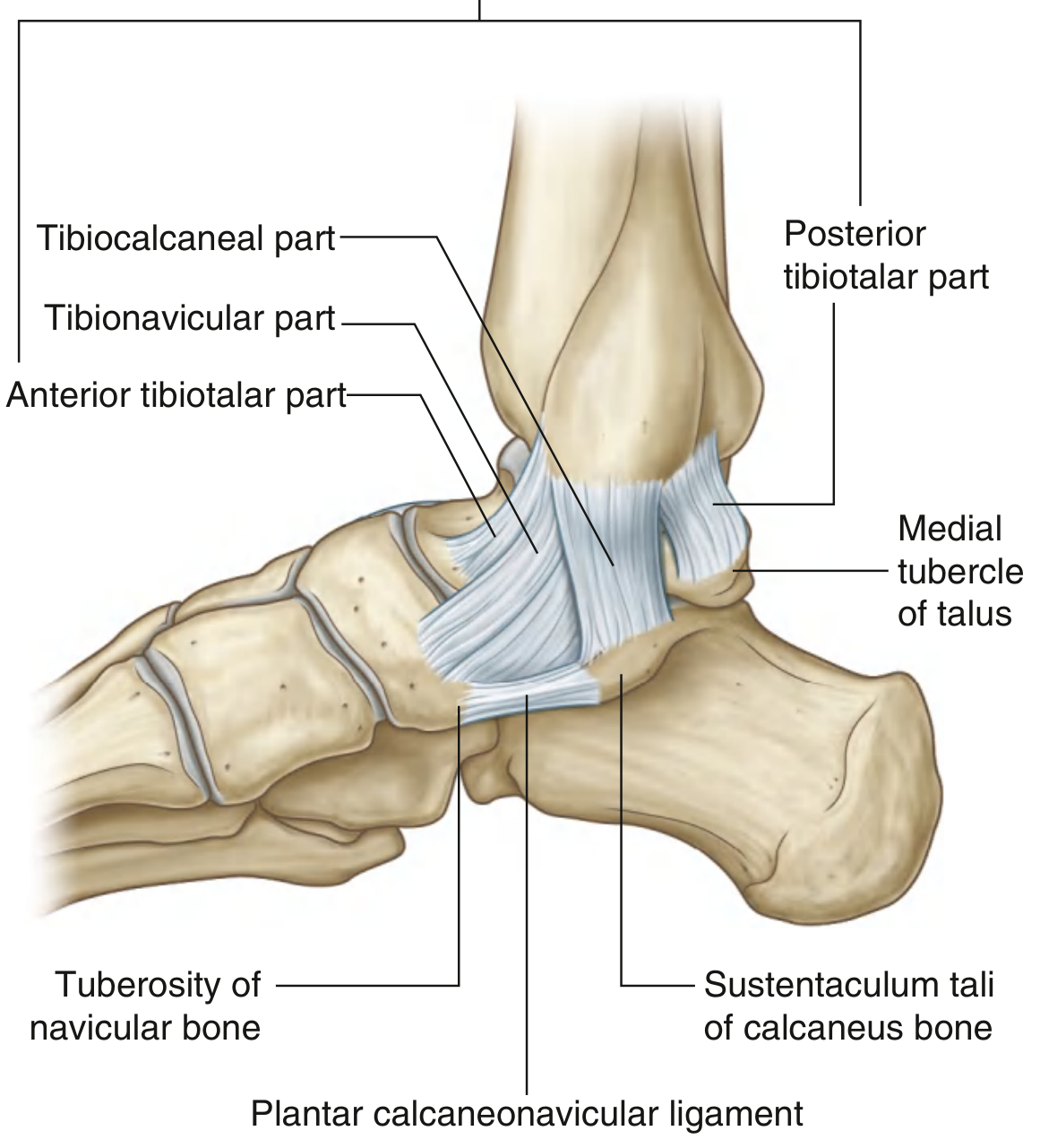
Fig. - Medial Ligament (Deltoid Ligament) of the Ankle Joint - Gray's Anatomy for Students
Superficial Layer (3 components)
| Component | Proximal Attachment | Distal Attachment | Function |
|---|---|---|---|
| Tibionavicular | Anterior medial malleolus | Tuberosity of navicular + spring ligament | Resists eversion / valgus tilt |
| Tibiocalcaneal | Medial malleolus (central) | Sustentaculum tali of calcaneus | Resists valgus tilt, eversion |
| Posterior superficial tibiotalar | Posterior medial malleolus | Medial surface of talus | Resists valgus / eversion |
Deep Layer (2 components)
| Component | Attachment | Function |
|---|---|---|
| Anterior deep tibiotalar | Undersurface of medial malleolus → medial talar body | Resists lateral talar translation + external rotation |
| Posterior deep tibiotalar | Undersurface of medial malleolus → medial talar body | Strongest component - primary restraint vs. lateral translation and external rotation |
Key point: Both deep components are intraarticular but extrasynovial. The posterior deep tibiotalar ligament is the strongest of the entire complex.
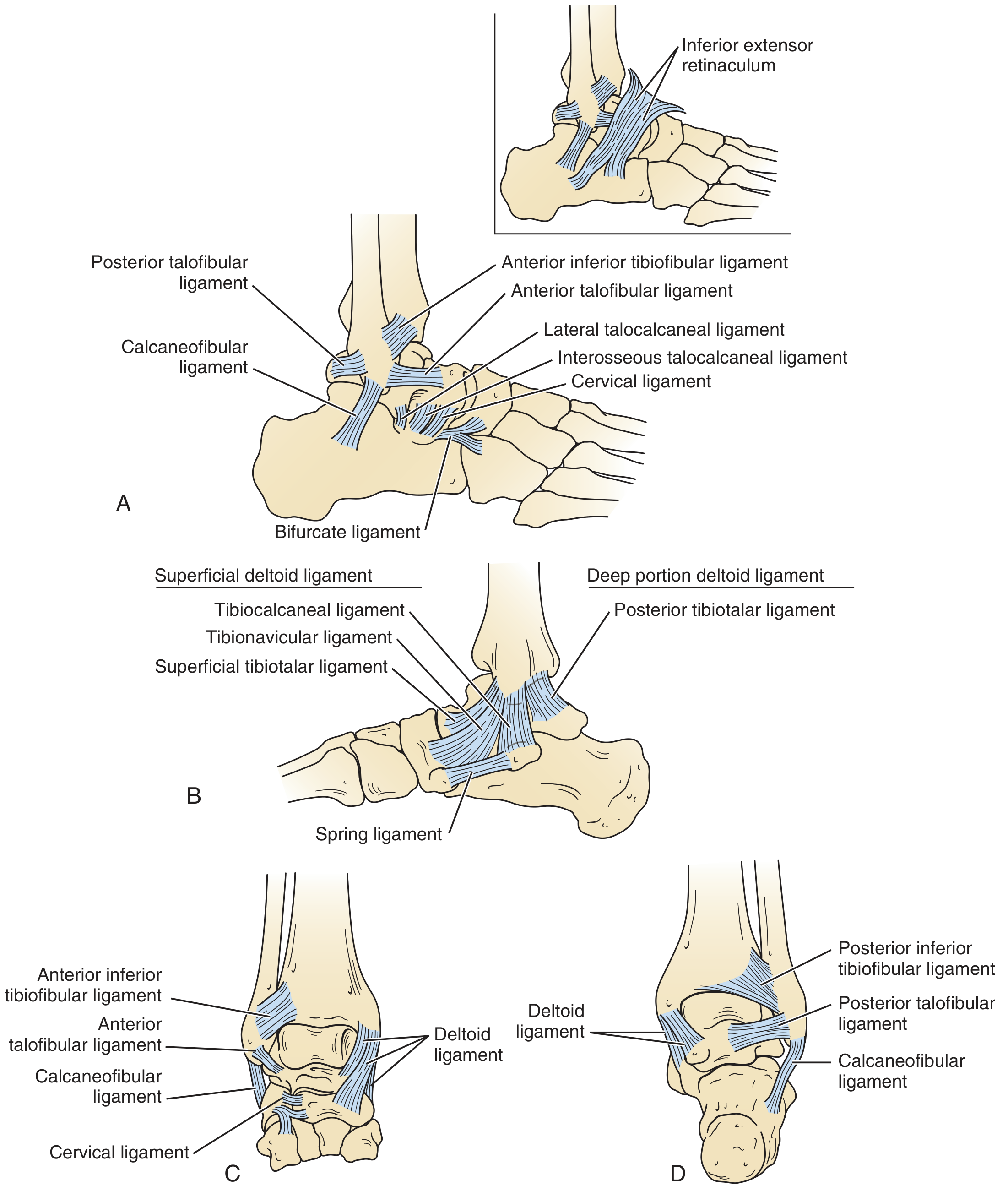
Fig. - Ligaments of the ankle and subtalar joint. (B) Medial view showing superficial and deep deltoid components.
Functions
- Primary ankle stabilizer during the stance phase of gait.
- Deep deltoid: resists lateral talar translation and external rotation of the talus.
- Superficial deltoid: resists valgus tilting (eversion) of the talus.
- Both layers act as secondary restraints against anterior translation of the talus.
- Prevents lateral displacement of the talus in the ankle mortise - a 1 mm lateral shift reduces tibiotalar weight-bearing area by 20-40%; a 5 mm shift reduces it by 80%.
Mechanism of Injury
- Deltoid ligament tears occur via supination + external rotation mechanism (same as bimalleolar fractures).
- Instead of fracturing the medial malleolus, the deltoid ligament tears, allowing the talus to displace laterally.
- 72% of patients with lateral ankle instability have concurrent deltoid ligament injury.
- 43% have injuries to both deep and superficial components.
- Deltoid lesion incidence significantly increases with complete rupture of the anterior talofibular ligament (ATFL).
Clinical Features
- Medial ankle pain, swelling, tenderness, hematoma after ankle sprain or ankle fracture.
- Isolated complete deltoid rupture is rare - isolated partial ruptures are more common.
- Suspect deltoid tear when a lateral malleolar fracture is accompanied by medial-sided tenderness and swelling (bimalleolar equivalent injury).
Note: No statistically significant relationship has been found between medial tenderness alone and deep deltoid ligament rupture.
Investigations
Radiographs:
- Routine AP may appear normal.
- Stress radiograph (supination + external rotation, ankle in neutral): shows medial clear space widening >4 mm and lateral talar shift in the mortise.
- Gravity external rotation stress radiograph is an alternative.
- Must be done in neutral (not plantarflexion) - plantarflexion brings the narrow part of talus into mortise and may give false widening.
MRI:
- Gold standard to determine extent and location of medial ankle ligament complex injury.
- Comparison MRI of the opposite ankle can be helpful.
Classification / Associated Injuries
- Concomitant pathology almost always present:
- Lateral ligamentous injury (ATFL, CFL)
- Lateral malleolar fracture
- Osteochondral injuries (medial talar dome)
- Distal tibiofibular syndesmotic disruption
Treatment
Non-operative
- Isolated complete disruption: below-knee non-weight-bearing cast for 6 weeks.
- Carefully monitor radiographically for displacement.
- Non-operative management: 1-year functional outcomes equivalent to ORIF of stress-positive fractures; however, risks include residual medial clear space widening and lateral malleolar delayed/non-union.
Operative (ORIF + Deltoid Repair)
Indications:
- Unstable ankle (positive anterior drawer or talar tilt clinically and radiographically).
- Active patients with complete rupture demonstrated on MRI or abnormal talar tilt/shift.
- Wide medial clear space with delayed presentation (ligament may be interposed).
Key principle: If only the fibular fracture is fixed without addressing the deltoid, the ligament may be caught between the medial malleolus and talus (preventing reduction) or relax after healing.
Technique (Technique 59.3 - Campbell's):
- Anteromedial curved incision distal to the medial malleolus.
- Identify the deltoid ligament and clear any interposed tissue from the mortise.
- ORIF of fibula is performed first.
- Repair deltoid ligament with primary suture or suture anchor to its native attachment.
- Many surgeons advocate fibular fixation without routine medial exploration - explore only when reduction is blocked.
Good results have been reported in high-performance athletes after direct repair (approximating the tibionavicular and tibiocalcaneal portions to their native attachment on the medial malleolus).
Deltoid Ligament Reconstruction (Chronic Insufficiency)
- Indicated in select patients with:
- Flexible, reducible deformity
- Less than 10 degrees tibiotalar tilt
- Minimal lateral ankle arthrosis
- Minimally invasive allograft technique (Jeng-Bluman-Myerson): uses tibial tunnel + talar tunnel + sustentaculum tali tunnel with biotenodesis screws.
Summary Table
| Feature | Detail |
|---|---|
| Shape | Triangular, flat |
| Layers | Superficial (3 components) + Deep (2 components) |
| Strongest component | Posterior deep tibiotalar ligament |
| Deep layer location | Intraarticular, extrasynovial |
| Primary function | Medial ankle stability; resist lateral talar translation + eversion |
| Injury mechanism | Supination + external rotation |
| Key radiological sign | Medial clear space >4 mm on stress view |
| Best imaging | MRI |
| Treatment | Cast (isolated) / ORIF ± repair (with fracture) / Reconstruction (chronic) |
Sources:
- Campbell's Operative Orthopaedics, 15th Ed. 2026, Chapter 94 (Ankle Ligaments) and Chapter 59 (Ankle Fractures)
- Miller's Review of Orthopaedics, 9th Edition, Ankle Anatomy
- Gray's Anatomy for Students, Medial Ligament of the Ankle
This is a shared conversation. Sign in to Orris to start your own chat.