
Questions Classification of muscle tissues Embryonic origin and development of muscle tissues Structural and functional units of each type of muscle tissues Structures of a skeletal muscle fiber forming its cytoskeletal, trophical, and contractile apparatus Ultrastructural organization of a myofibril 22 onducting and secretory Structure of a sarcomere Classification of skeletal muscle fibers. Their structural and functional peculiarities Mechanism of skeletal muscle contraction Skeletal muscle as an organ Muscle spindles and tendon organs Structural peculiarities cardiomyocytes Structure of smooth mus Intercellular junctions in Mechanism of smooth muscle contracuon Regeneration of different types of muscle tissues
Reading File
Finding Sources
Finding Sources
Finding Sources
Finding Sources
Finding Sources
Finding Sources
Finding Sources
Finding Sources
Excellent — Junqueira's Chapter 10 on Muscle Tissue is the primary source. Let me read the key sections in parallel.
Reading File
Excellent — I have rich content. Let me read more sections to cover all the topics.
Reading File
I have extensive content from Junqueira's Basic Histology Chapter 10. Now I'll compile the comprehensive answer.
Muscle Tissues — Comprehensive Histology Review
Based on Junqueira's Basic Histology, 17e, Chapter 10
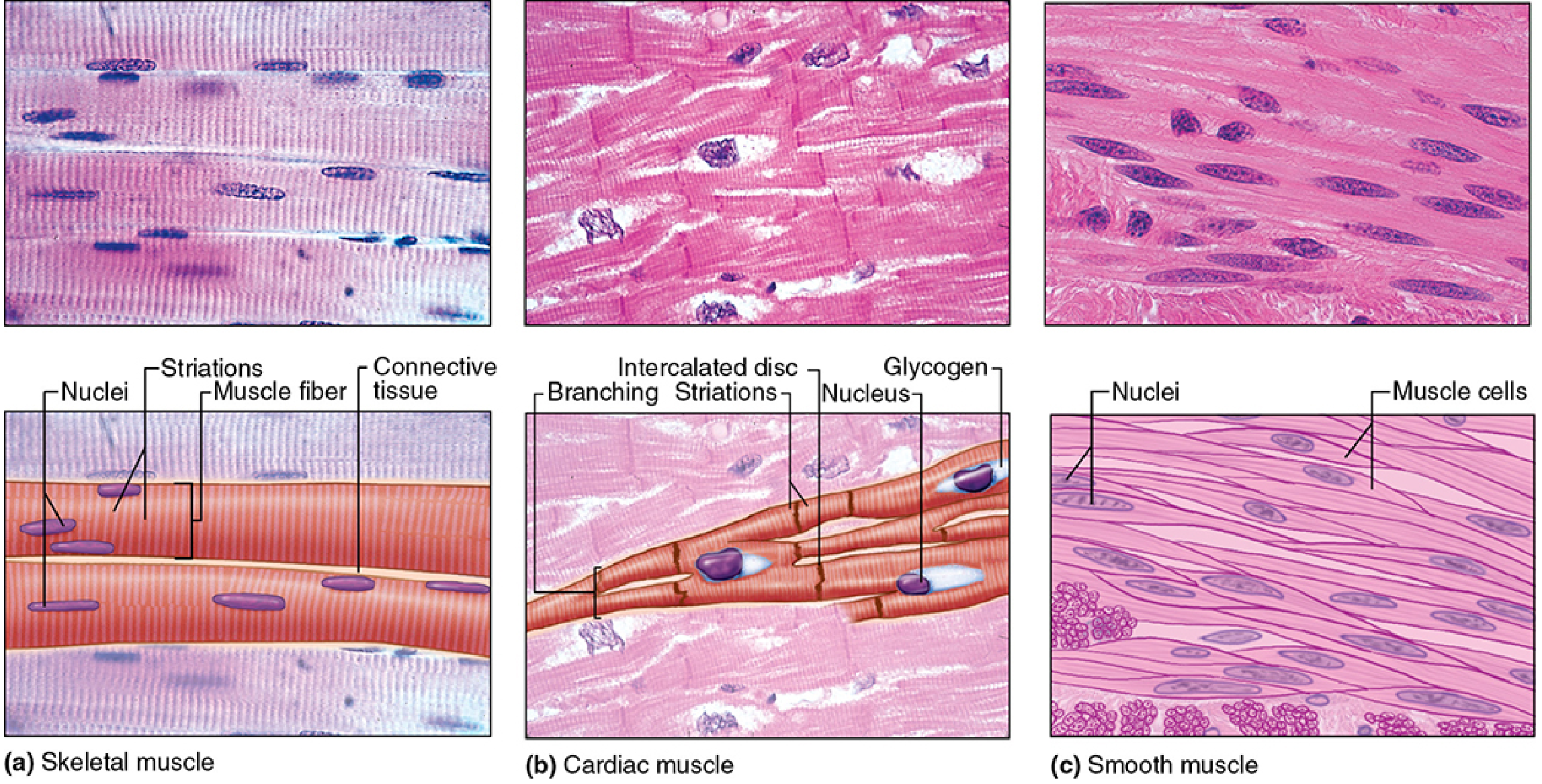
1. Classification of Muscle Tissues
Three types of muscle tissue exist, each adapted to its physiologic role:
| Feature | Skeletal | Cardiac | Smooth |
|---|---|---|---|
| Shape | Long, cylindrical fibers | Branched, irregular cells | Fusiform cells |
| Nuclei | Multiple, peripheral | 1–2, central | Single, central |
| Striations | Yes | Yes (less defined) | No |
| Control | Voluntary | Involuntary | Involuntary |
| Contraction speed | Quick, forceful | Vigorous, rhythmic | Slow |
Special nomenclature applies to all muscle cells: cytoplasm = sarcoplasm, smooth ER = sarcoplasmic reticulum, cell membrane = sarcolemma.
2. Embryonic Origin and Development
All three muscle types originate from embryonic mesoderm and differentiate by elongating and synthesizing myofibrillar proteins (actin and myosin).
- Skeletal muscle: Derived primarily from somitic mesoderm (myotomes). Myoblasts (mononucleated precursors) proliferate, align, and fuse to form multinucleated myotubes, which mature into muscle fibers. After birth, satellite cells (myogenic stem cells) located between the sarcolemma and basal lamina retain proliferative capacity for regeneration.
- Cardiac muscle: Derives from splanchnic (visceral) mesoderm surrounding the primitive heart tube. Mesenchymal cells align into chainlike arrays but do not fuse — they form fibers via complex cell–cell junctions with interdigitating processes.
- Smooth muscle: Derives mostly from splanchnic mesoderm; some smooth muscle (e.g., in blood vessels, iris) derives from neural crest cells. Differentiation does not require cell fusion.
3. Structural and Functional Units
| Muscle Type | Structural Unit | Functional Unit |
|---|---|---|
| Skeletal | Muscle fiber (myofiber) — multinucleated cell | Motor unit (one motor neuron + all fibers it innervates) |
| Cardiac | Cardiomyocyte — single branched cell | Functional syncytium (electrically coupled via gap junctions) |
| Smooth | Smooth muscle cell (fusiform) | Functional syncytium (coupled via gap junctions) |
4. Structures of a Skeletal Muscle Fiber
Cytoskeletal Apparatus
- Sarcolemma with T-tubules: The sarcolemma invaginates at the A–I band junction to form transverse (T) tubules, which carry action potentials deep into the fiber.
- Intermediate filaments (desmin): Connect adjacent myofibrils at the Z disc level, maintaining alignment and transmitting force to the sarcolemma and connective tissue sheath.
- Costameres: Connections between myofibrils and the sarcolemma via dystrophin–glycoprotein complexes, linking the cytoskeleton to the extracellular matrix.
Trophic (Support) Apparatus
- Sarcoplasmic reticulum (SR): Network of smooth ER cisternae surrounding each myofibril, storing Ca²⁺. Terminal cisternae of SR flank each T-tubule to form triads (one T-tubule + two terminal cisternae). Each triad sits at the A–I junction.
- Mitochondria: Abundant, located between myofibrils and beneath the sarcolemma; supply ATP for contraction.
- Glycogen granules and myoglobin: Energy reserves and O₂ storage.
- Multiple peripheral nuclei: Located at the periphery just beneath the sarcolemma (distinguishes skeletal from cardiac muscle).
- Satellite cells: Mononucleated stem cells between sarcolemma and basal lamina; essential for regeneration.
Contractile Apparatus
- Myofibrils: Cylindrical bundles of myofilaments running the length of the fiber, responsible for striated banding.
- Thick filaments (myosin II): Bipolar polymers with globular heads (S1 fragment) containing ATPase activity and actin-binding sites.
- Thin filaments (actin + troponin + tropomyosin): F-actin polymer with regulatory proteins.
- Titin: Elastic protein connecting the M line to the Z disc; provides passive tension.
- Nebulin: Inextensible protein along thin filaments; acts as a molecular ruler.
5. Ultrastructural Organization of a Myofibril
Myofibrils are composed of repeating units called sarcomeres, which give the characteristic cross-striated pattern:
| Band/Line | Composition | Appearance |
|---|---|---|
| A band | Thick (myosin) + overlapping thin filaments | Dark (anisotropic) |
| I band | Thin filaments only | Light (isotropic) |
| H zone | Thick filaments only (no thin filament overlap) | Pale center of A band |
| M line | Myomesin cross-links between thick filaments | Center of H zone |
| Z disc | α-actinin cross-links between thin filaments; titin anchoring | Dark line bisecting I band |
6. Structure of a Sarcomere
A sarcomere is defined as the segment of a myofibril between two consecutive Z discs. In a relaxed fiber:
- Length ≈ 2.0–2.5 μm
- Contains one full A band and two half-I bands
- Thick filaments (myosin) are centered, anchored at the M line
- Thin filaments (actin) extend from Z discs into the A band, partially overlapping with thick filaments
- Titin spans from M line to Z disc, maintaining sarcomere integrity
During contraction, the I band and H zone shorten while the A band length remains constant — the basis of the sliding filament theory.
7. Classification of Skeletal Muscle Fibers
Three fiber types based on metabolism and myosin isoforms:
| Property | Type I (Slow oxidative) | Type IIA (Fast oxidative-glycolytic) | Type IIB/IIX (Fast glycolytic) |
|---|---|---|---|
| Myosin ATPase | Slow | Fast | Fast |
| Metabolism | Oxidative | Oxidative + glycolytic | Glycolytic |
| Mitochondria | Many | Many | Few |
| Myoglobin | High (red) | High (red) | Low (white) |
| Glycogen | Low | Intermediate | High |
| Fatigue | Resistant | Intermediate | Fatigues quickly |
| Function | Sustained posture | Mixed activity | Short bursts |
| Examples | Soleus, postural | Limb muscles | Extraocular, hand |
Fiber type is determined by the motor neuron that innervates it (cross-innervation experiments). One motor unit contains fibers of only one type.
8. Mechanism of Skeletal Muscle Contraction
The sliding filament / crossbridge cycle:
- Action potential travels along the sarcolemma and into T-tubules
- DHPR (dihydropyridine receptor; voltage sensor) in the T-tubule membrane activates RyR1 (ryanodine receptor) on the SR terminal cisternae
- Ca²⁺ release from SR → cytosolic Ca²⁺ rises from ~10⁻⁷ M to ~10⁻⁵ M
- Ca²⁺ binds troponin C → conformational change moves tropomyosin away from actin's myosin-binding sites
- Myosin head (S1) binds actin → power stroke (Pi release → ~10 nm displacement) → ADP release
- ATP binding → dissociation of myosin from actin
- ATP hydrolysis → myosin head re-cocks (high-energy state)
- Cycle repeats until Ca²⁺ is resequestered by SERCA pump back into SR
- Tropomyosin returns to blocking position → relaxation
Each crossbridge cycle: ATP hydrolysis drives one ~10 nm power stroke. Thousands of simultaneous crossbridge cycles produce macroscopic shortening.
9. Skeletal Muscle as an Organ
A whole skeletal muscle is organized into hierarchical connective tissue compartments:
- Epimysium: Dense irregular CT surrounding the entire muscle
- Perimysium: Subdivides muscle into fascicles (bundles of fibers); contains blood vessels, nerves, and spindles
- Endomysium: Fine reticular CT (type III collagen + basal lamina) surrounding each individual muscle fiber; contains capillaries and satellite cells
- Tendons / aponeuroses: Collagen bundles of the epimysium/perimysium transmit force to bone
Neurovascular supply enters at the neurovascular hilum. Each fiber is innervated at the neuromuscular junction (motor end plate), where the motor nerve terminal sits in a synaptic trough of the sarcolemma flanked by junctional folds that concentrate acetylcholine receptors (AChR).
10. Muscle Spindles and Tendon Organs
Muscle Spindles (Stretch Receptors)
- Located within the perimysium of the muscle belly, oriented parallel to extrafusal fibers
- Encapsulated structure containing 4–10 intrafusal fibers surrounded by a fluid-filled connective tissue capsule
- Two types of intrafusal fibers:
- Nuclear bag fibers: Nuclei clustered centrally; detect rate of stretch (dynamic response) — innervated by Ia afferents
- Nuclear chain fibers: Nuclei in a single row; detect sustained stretch (static response) — innervated by Ia and II afferents
- Motor supply: γ-motor neurons (fusimotor fibers) set intrafusal fiber tension, adjusting spindle sensitivity
- Function: Detect muscle length and rate of length change → trigger stretch reflex
Golgi Tendon Organs (GTOs)
- Located at the musculotendinous junction, in series with extrafusal fibers
- Encapsulated; contain Ib afferent nerve endings intertwined with collagen bundles
- Activated by muscle tension (especially active contraction)
- Function: Detect tension → provide inhibitory feedback preventing overload (autogenic inhibition)
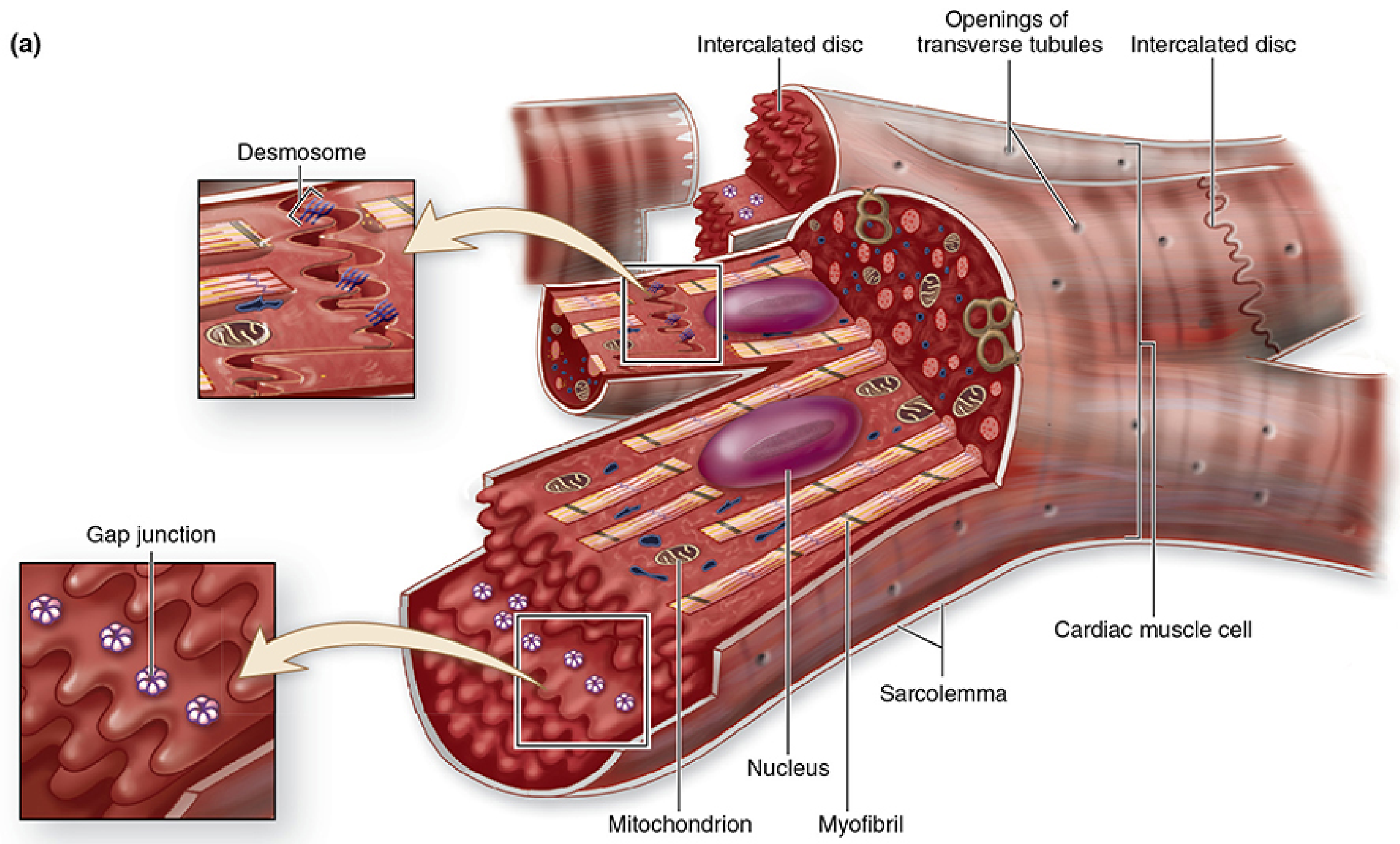
11. Structural Peculiarities of Cardiomyocytes
- Size: 15–30 μm diameter, 85–120 μm long
- Nuclei: Usually one central nucleus (occasionally two); euchromatic (pale-staining)
- Branching: Cells branch and interconnect into a tightly woven, spiraling network
- Myofibrils: Less geometrically regular than skeletal muscle, with more sarcoplasm and mitochondria between them
- Mitochondria: Exceptionally abundant (25–35% of cell volume) → purely oxidative metabolism
- T-tubules: Present but wider than in skeletal muscle; form dyads (one T-tubule + one SR terminal cisterna) rather than triads
- Sarcoplasmic reticulum: Less developed than in skeletal muscle; Ca²⁺ influx from extracellular space (via L-type Ca²⁺ channels) triggers SR release → calcium-induced calcium release (CICR)
- Intercalated discs: Unique step-shaped junctions at the longitudinal ends of cardiomyocytes (see below)
- Lipid droplets: Stored energy for oxidative metabolism
- Atrial myocytes also contain atrial natriuretic peptide (ANP) granules → secretory function
12. Structure of Smooth Muscle
- Shape: Fusiform (spindle-shaped), 5–10 μm wide, 20–500 μm long (varies with organ and physiologic state)
- Nucleus: Single, elongated, central; adopts a corkscrew shape during contraction
- No striations: Thick and thin filaments are not organized into sarcomeres; instead arranged in a lattice-like oblique network anchored to dense bodies (cytoplasmic equivalents of Z discs) and dense plaques (membrane-attached dense bodies)
- Thin filaments: Actin + caldesmon + calponin (regulatory proteins) — no troponin
- Thick filaments: Side-polar myosin II; arranged asymmetrically, allowing greater shortening range than sarcomere-based muscle
- Intermediate filaments: Vimentin and desmin, connecting dense bodies to give structural cohesion
- Caveolae: Membrane invaginations functionally analogous to T-tubules; facilitate Ca²⁺ influx
- Sarcoplasmic reticulum: Less developed; Ca²⁺ comes from both SR and extracellular space
- Mitochondria and glycogen: Present but less prominent than in skeletal muscle
- Organization: Cells arranged in sheets; within each sheet they are oriented at different angles, allowing multidirectional force generation
13. Intercellular Junctions in Muscle
Cardiac Muscle — Intercalated Discs
Step-like structures at the ends of cardiomyocytes containing three junction types:
| Junction | Location in disc | Function |
|---|---|---|
| Fascia adherens | Transverse region | Anchors thin (actin) filaments; mechanical coupling |
| Desmosomes (maculae adherens) | Transverse region | Mechanical adhesion between cells |
| Gap junctions (nexus) | Lateral (longitudinal) region | Low-resistance electrical coupling → synchronous contraction (functional syncytium) |
Smooth Muscle — Junctions
- Gap junctions: Couple adjacent smooth muscle cells electrically and chemically; allow propagation of Ca²⁺ waves and action potentials
- Adherens junctions: Anchor actin filaments to the membrane at dense plaques
- In some smooth muscle (e.g., uterus, GI) gap junctions are sparse at rest but multiply under hormonal stimulation (e.g., oxytocin in labor)
14. Mechanism of Smooth Muscle Contraction
Unlike skeletal muscle, smooth muscle uses a calmodulin–myosin light chain kinase (MLCK) pathway:
- Stimulus (neural, hormonal, stretch) → ↑ cytosolic Ca²⁺ (from SR + extracellular)
- 4 Ca²⁺ bind calmodulin → Ca²⁺–calmodulin complex
- Complex activates MLCK (myosin light chain kinase)
- MLCK phosphorylates regulatory myosin light chain (MLC) on the myosin head
- Phosphorylated myosin binds actin → crossbridge cycling and contraction
- Relaxation: Myosin light chain phosphatase (MLCP) dephosphorylates MLC → crossbridge detachment
- Additional regulation: Latch state — dephosphorylated attached crossbridges can maintain tension at low ATP cost (unique to smooth muscle)
- cAMP and cGMP pathways stimulate MLCP → relaxation (mechanism of nitrates, β-agonists)
15. Regeneration of Muscle Tissues
| Muscle Type | Regenerative Capacity | Mechanism |
|---|---|---|
| Skeletal | Good (limited for large injuries) | Satellite cells (Pax7⁺ stem cells under basal lamina) activate → proliferate → fuse to form new myotubes within the intact basal lamina scaffold |
| Cardiac | Very limited | Adult cardiomyocytes are terminally differentiated; minimal intrinsic turnover (~1%/year); no effective endogenous stem cell pool; damage replaced by fibrous scar |
| Smooth | Good | Smooth muscle cells retain mitotic ability; can proliferate in response to injury; precursors from pericytes and mesenchymal cells also contribute |
Skeletal Muscle Regeneration (Detail)
- Satellite cells are normally quiescent (G₀), activated by injury, growth factors (HGF, FGF, IGF-1)
- Express MyoD, Myf5 (myogenic regulatory factors) upon activation
- Proliferate → some self-renew (maintaining satellite cell pool), others differentiate → fuse with damaged fibers or form new fibers
- Regeneration requires intact basal lamina as scaffolding; large defects replaced by connective tissue (fibrosis)
- Aging and muscular dystrophies deplete or impair satellite cells
Summary Table
| Topic | Skeletal | Cardiac | Smooth |
|---|---|---|---|
| Origin | Somitic mesoderm (myoblasts fuse) | Splanchnic mesoderm (no fusion) | Splanchnic mesoderm / neural crest |
| Cell unit | Multinucleated fiber | Single branched cardiomyocyte | Fusiform cell |
| Functional unit | Motor unit | Electrical syncytium | Electrical syncytium |
| Striations | Yes | Yes | No |
| T-tubule/SR | Triads at A–I junction | Dyads | Caveolae / sparse SR |
| Ca²⁺ trigger | RyR1 (SR release) | CICR (L-type → RyR2) | MLCK via calmodulin |
| Regulatory protein | Troponin–tropomyosin | Troponin–tropomyosin | Calmodulin–MLCK |
| Cell junctions | Neuromuscular junction | Intercalated discs (gap junctions, desmosomes, fascia adherens) | Gap junctions, dense plaques |
| Regeneration | Satellite cells | Very limited (fibrous repair) | Smooth muscle cell mitosis |
*All content from Junqueira's Basic Histology — Text and Atlas, 17e, Chapter 10.*All topics covered. Here's a quick orientation to the full answer above:
What's covered and where:
-
Classification — Three types (skeletal / cardiac / smooth) with key distinguishing features in the comparison table at the top.
-
Embryonic origin — All from mesoderm; skeletal from somitic mesoderm via myoblast fusion; cardiac from splanchnic mesoderm (no fusion); smooth from splanchnic mesoderm or neural crest.
-
Structural & functional units — Motor unit (skeletal), electrical syncytium (cardiac/smooth).
-
Skeletal muscle fiber structures — Organized into three apparatus: cytoskeletal (T-tubules, desmin, costameres), trophic (SR, mitochondria, satellite cells), and contractile (myofibrils, thick/thin filaments, titin, nebulin).
-
Myofibril ultrastructure — Band anatomy table (A, I, H, M, Z).
-
Sarcomere — Defined Z-to-Z with dimensions and filament arrangement; sliding filament basis.
-
Fiber type classification — Types I, IIA, IIB with metabolic and functional properties.
-
Contraction mechanism — Full crossbridge cycle: action potential → T-tubule → DHPR/RyR1 → Ca²⁺ → troponin → power stroke → SERCA reuptake.
-
Skeletal muscle as organ — Epi/peri/endomysium hierarchy, neurovascular supply, motor end plate.
-
Muscle spindles & GTOs — Intrafusal fiber types, afferent innervation (Ia, II, Ib), γ-motor neuron control.
-
Cardiomyocyte peculiarities — Size, central nucleus, dyads, CICR, atrial secretory function.
-
Smooth muscle structure — Dense bodies, caldesmon, side-polar myosin, caveolae.
-
Intercellular junctions — Intercalated disc components (fascia adherens, desmosomes, gap junctions); smooth muscle gap junctions and dense plaques.
-
Smooth muscle contraction — Ca²⁺–calmodulin–MLCK pathway, latch state, cAMP/cGMP relaxation.
-
Regeneration — Satellite cells (skeletal), fibrous repair (cardiac), smooth muscle mitosis.
This is a shared conversation. Sign in to Orris to start your own chat.