
Competitive inhibition and non competitive enzyme inhibition
Reading File
Competitive inhibition involves an inhibitor that competes with the substrate for the active site, raising Km but leaving Vmax unchanged. Non-competitive inhibition involves binding at an allosteric site, reducing enzyme activity regardless of substrate concentration - Vmax decreases but Km is unchanged.
Searching sources...
Finding Sources
Finding Sources
Good - I have strong hits from Lippincott Biochemistry and Harper's. Let me read the relevant sections from both.
Reading File
Reading File
Reading File
Excellent content. Let me now read the noncompetitive inhibition section from Lippincott and fetch the key diagrams.
Reading File
Reading File
Reading File
I have all the content I need. Let me now fetch the key diagrams to include in the answer.
Loading Image
Loading Image
Loading Image
I now have all the content and images needed for a comprehensive answer. Here it is:
Enzyme Inhibition: Competitive vs. Non-competitive
Overview
Enzyme inhibitors are compounds that decrease the velocity of enzyme-catalyzed reactions. The two most important categories are competitive and noncompetitive inhibition, distinguished by where the inhibitor binds and which kinetic parameters it alters.
1. Competitive Inhibition
Mechanism
A competitive inhibitor competes directly with the substrate for the same active site. It is usually a close structural analog of the substrate (hence called a substrate analog). When the inhibitor occupies the active site, the substrate cannot bind, and vice versa.
- The inhibitor (I) binds free enzyme (E) to form an EI complex
- EI is a dead-end complex - it cannot proceed to form product
- At high enough substrate concentrations, the substrate can displace the inhibitor, so inhibition is overcome by excess substrate
Classic example: Malonate inhibits succinate dehydrogenase. Malonate (OOC-CH₂-COO⁻) structurally resembles succinate but lacks the second methylene carbon needed for dehydrogenation, so it binds the active site but cannot be acted upon. - Harper's Illustrated Biochemistry, 32nd Ed, p. 91
Drug example - Statins: Atorvastatin and pravastatin are structural analogs of HMG-CoA (the natural substrate) and competitively inhibit HMG-CoA reductase, the rate-limiting enzyme in cholesterol synthesis. Their Ki values are several orders of magnitude lower than the Km for HMG-CoA, making them exceptionally effective. - Lippincott Illustrated Reviews: Biochemistry, 8th Ed, p. 190
Kinetic Effects
| Parameter | Effect |
|---|---|
| Vmax | Unchanged (inhibition fully overcome at saturating [S]) |
| Km (apparent) | Increased (more substrate needed to reach ½Vmax) |
| Lineweaver-Burk plot | Lines intersect on the y-axis (same y-intercept = same Vmax) |
| Slope | Increases with increasing [I] |
The modified Michaelis-Menten equation becomes:
$$v_o = \frac{V_{max}[S]}{K_m^{apparent} + [S]}$$
where $K_m^{apparent} = K_m\left(1 + \frac{[I]}{K_i}\right)$
The x-axis intercept in the Lineweaver-Burk plot shifts from $-1/K_m$ toward zero as [I] increases (i.e., apparent Km grows). The y-intercept stays fixed at $1/V_{max}$.
Lineweaver-Burk Plot - Competitive Inhibition
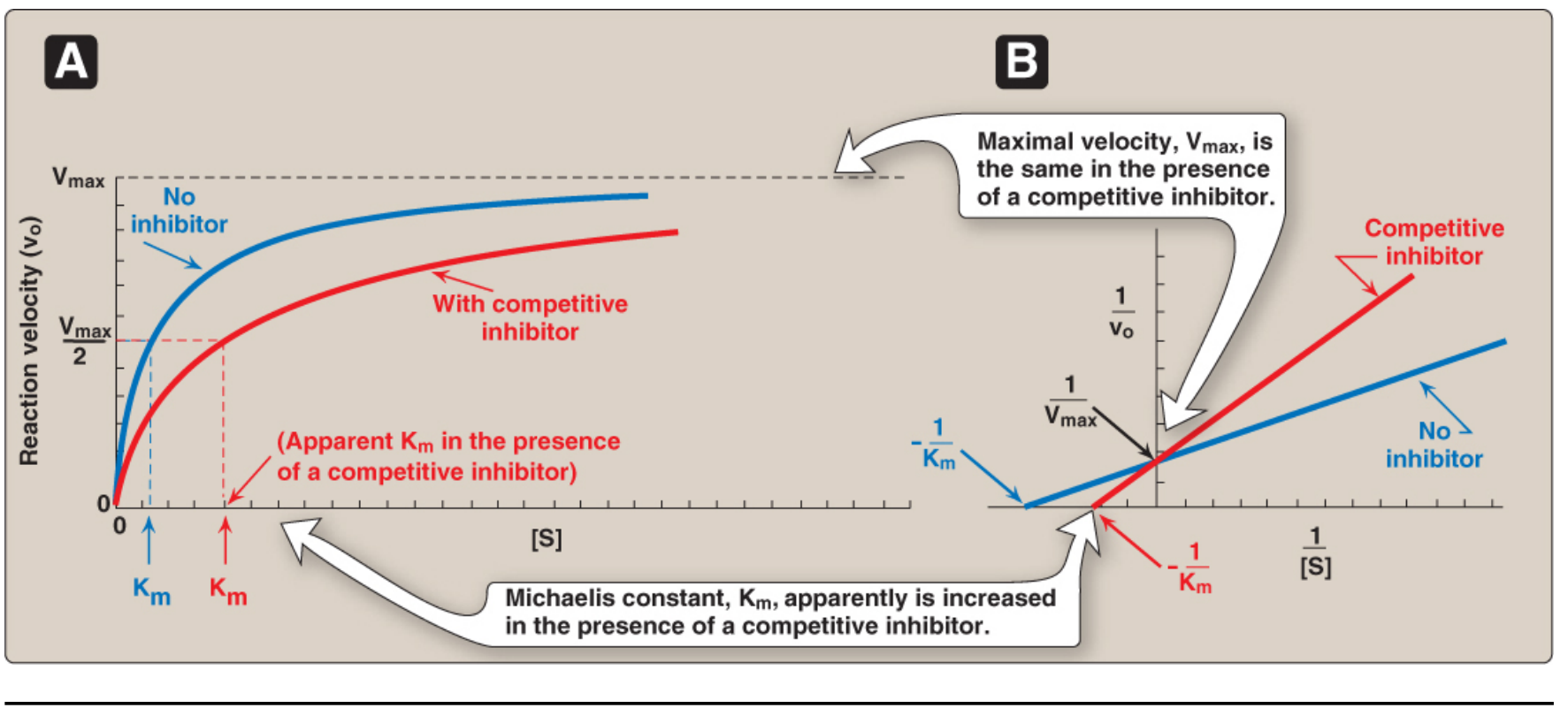
Figure 5.12 from Lippincott Biochemistry, 8th Ed. - Vmax is unchanged; Km is increased. On the double-reciprocal (Lineweaver-Burk) plot (B), lines converge at the y-axis.
2. Non-competitive Inhibition
Mechanism
A noncompetitive inhibitor binds at a site distinct from the active site (an allosteric site). It can bind to either:
- The free enzyme (E) → forms EI complex
- The enzyme-substrate complex (ES) → forms EIS complex
Because the inhibitor does not block substrate binding, adding more substrate does NOT overcome the inhibition. The enzyme can form ES and EIS complexes, but the EIS complex cannot produce product (or does so with reduced efficiency).
Key distinction: Noncompetitive inhibitors generally bear little or no structural resemblance to the substrate, unlike competitive inhibitors. - Harper's Illustrated Biochemistry, 32nd Ed
Drug examples:
- Aspirin irreversibly inhibits cyclooxygenase (COX) at a site that blocks prostaglandin and thromboxane synthesis
- ACE inhibitors (captopril, enalapril, lisinopril) block the conversion of angiotensin I → angiotensin II, lowering blood pressure - Lippincott Biochemistry, 8th Ed, p. 192
Kinetic Effects
| Parameter | Effect |
|---|---|
| Vmax | Decreased (cannot be overcome by excess substrate) |
| Km | Unchanged (substrate binding affinity is unaffected) |
| Lineweaver-Burk plot | Lines intersect on the x-axis (same x-intercept = same Km) |
| Slope | Increases (y-intercept rises) |
The apparent Vmax decreases because the inhibitor effectively reduces the concentration of functional enzyme available to form productive ES complexes.
Lineweaver-Burk Plot - Non-competitive Inhibition
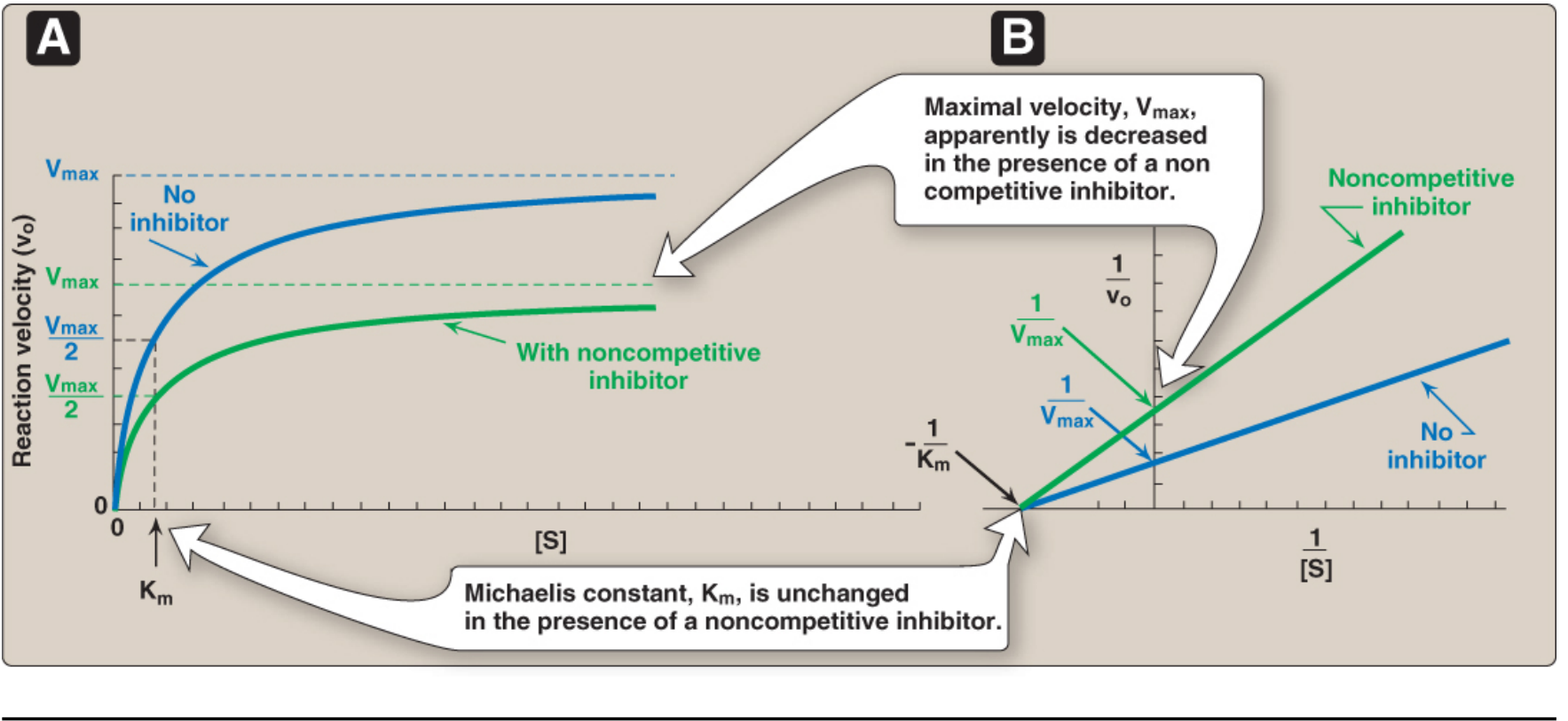
Figure 5.14 from Lippincott Biochemistry, 8th Ed. - Vmax is decreased; Km is unchanged. On the Lineweaver-Burk plot (B), lines converge on the x-axis.
Side-by-Side Comparison
| Feature | Competitive | Non-competitive |
|---|---|---|
| Binding site | Active site (same as substrate) | Allosteric site (distinct from active site) |
| Structural similarity to substrate | Yes (usually substrate analogs) | No (generally unrelated) |
| Overcomed by excess [S]? | Yes | No |
| Effect on Vmax | Unchanged | Decreased |
| Effect on Km | Increased (apparent Km rises) | Unchanged |
| Lineweaver-Burk intersection | On y-axis (same 1/Vmax) | On x-axis (same -1/Km) |
| Binds ES complex? | No | Yes (also free enzyme) |
| Ki formula | $K_m^{app} = K_m(1 + [I]/K_i)$ | $V_{max}^{app} = V_{max}/(1 + [I]/K_i)$ |
| Clinical example | Statins (HMG-CoA reductase) | Aspirin (COX), ACE inhibitors |
Transition State Analogs (Special Competitive Inhibitors)
An important subtype of competitive inhibitor is the transition state analog - a stable molecule that mimics the high-energy transition state of the enzyme-catalyzed reaction. Because enzymes evolved to bind the transition state with maximum affinity, these inhibitors bind far more tightly than the normal substrate, giving them very low Ki values. Many clinically useful drugs (e.g., protease inhibitors for HIV) are designed as transition state analogs. - Lippincott Biochemistry, 8th Ed, p. 189
Reversible vs. Irreversible Inhibition
Both competitive and noncompetitive inhibition described above are reversible - the inhibitor is not covalently bound and can dissociate. Irreversible inhibitors (like aspirin for COX, or organophosphates for acetylcholinesterase) covalently modify the enzyme and permanently reduce activity until new enzyme is synthesized.
Quick Memory Trick
- Competitive: "C" for Competition at active site → Km Changes, Vmax stays
- Non-competitive: Binds elsewhere → Vmax goes down, Km stays (the enzyme still "sees" the substrate normally, it just can't work at full speed)
Sources: Lippincott Illustrated Reviews: Biochemistry, 8th Ed; Harper's Illustrated Biochemistry, 32nd Ed; Basic Medical Biochemistry: A Clinical Approach, 6th Ed
This is a shared conversation. Sign in to Orris to start your own chat.