
Better lubricant than cmc for dry eye
dry eye lubricant artificial tears comparison
best lubricant eye drops better than carboxymethylcellulose dry eye 2024 2025
PMID: 39190794
PMID: 41314967
Lubricants Superior to CMC for Dry Eye
1. Sodium Hyaluronate (Hyaluronic Acid) - Best Overall Step-Up
- A 2024 fluorophotometry RCT directly measured retention: 0.15% HA-HPGuar (hydroxypropyl guar) and 0.2% HA both showed significantly longer ocular surface retention than 0.1% HA, and the HA-HPGuar combination produced superior tear film break-up time vs. HA alone.
- A 2026 multicenter RCT (RESTA trial) found that 0.24% SH + carbomer + triglycerides (Artelac Complete) was noninferior on staining improvement and superior on quality-of-life vs. 0.18% SH alone after 90 days.
2. HA + Hydroxypropyl Guar (HP-Guar) - Best for Tear Film Stability
3. Lipid-Containing / Oil-in-Water Emulsions - Best for Evaporative Dry Eye (MGD)
- A July 2026 RCT comparing lipid-containing vs. non-lipid artificial tears over 3 months found meaningful differences in tear film dynamics in favour of lipid drops.
- Soothe XP (mineral oil-based) - restores lipid layer directly
- Refresh Optive Mega-3 (flaxseed oil emulsion)
- Systane Balance/Complete (propylene glycol + HP-Guar + lipid)
- iVizia (castor oil emulsion)
4. Trehalose-Based Drops - Best for Cellular Protection
5. Carbomer/Polyacrylic Acid Gels - Best for Severe/Nocturnal Dryness
6. Autologous Serum / Platelet-Rich Plasma - Best for Severe Refractory Cases
Quick Selection Guide by Dry Eye Type
| Dry Eye Type | Best Lubricant Step-Up |
|---|---|
| Aqueous deficient (mild-mod) | Sodium hyaluronate 0.1-0.2% |
| Aqueous deficient (moderate) | HA + HP-Guar (Systane Ultra) |
| Evaporative / MGD | Lipid emulsion (Soothe XP, Systane Balance) |
| Mixed / severe | Thealoz Duo, HA+carbomer+TGs (Artelac Complete) |
| Severe refractory | Autologous serum / PRP |
| Nocturnal / at night | Carbomer gel or eye ointment (Lacri-Lube) |
- Preservative-free formulations are strongly preferred for frequent use (>4x/day) - BAK preservatives worsen epithelial toxicity over time
- Higher HA concentration (0.2-0.3%) outperforms lower concentrations (0.1%)
- No single drop is universally superior - matching the drop to the dry eye subtype (aqueous deficient vs. evaporative) gives the best outcomes
Due to increased screen time
screen time digital eye strain dry eye blink rate treatment
best eye drops dry eye screen use digital eye strain evaporative 2024 2025
Dry Eye from Increased Screen Time - Best Lubricants
Why Screen Dry Eye is Different
Best Drops for Screen Users (Ranked)
- Systane Complete PF - nano-droplet technology with propylene glycol + HP-Guar + lipid emulsion; covers aqueous AND evaporative components. Best all-rounder for screen dry eye
- Retaine MGD (castor oil + mineral oil) - specifically formulated for meibomian gland dysfunction; long-lasting without significant blur
- Soothe XP (mineral oil blend) - restores the lipid layer directly; affordable and effective
- Thealoz Duo (0.15% HA + 3% trehalose, PF) - the trehalose component protects corneal cells from desiccation stress during long screen sessions; highly regarded for computer users
- Hyabak 0.15% HA (preservative-free, hypotonic) - good for frequent dosing throughout the day
Screen-Specific Treatment Tips Beyond Drops
| Measure | Evidence |
|---|---|
| 20-20-20 rule - every 20 min, look 20 feet away for 20 sec | Directly restores blink rate and reduces evaporative stress |
| Conscious blinking exercises | More effective than drops at addressing the root cause |
| Screen position at/below eye level | Reduces exposed ocular surface area by ~30% |
| Humidifier / reduce AC draft | Lowers ambient evaporation rate |
| Warm compresses at night | Clears meibomian gland obstruction from incomplete blinks |
| Omega-3 supplementation (1-2g/day) | Improves meibomian gland secretion quality over weeks |
Dosing Approach for Heavy Screen Users
- During the day (every 1-2 hrs): Preservative-free lipid emulsion or HA drop - PF is essential if dosing >4x/day to avoid BAK toxicity
- Before bed: Carbomer gel (Viscotears/GenTeal) or ointment for sustained overnight lubrication
- Avoid: Drops containing BAK (benzalkonium chloride) as a preservative - it worsens the epithelial surface with repeated use
Create a quick reference guide on screen dry eye prevention techniques
What format should the quick reference guide be in?
A clean, modern medical quick reference poster titled "Screen Dry Eye Prevention Guide". Organized into 5 clearly labeled sections with icons: 1. "20-20-20 Rule" - icon of a clock and eye, text: "Every 20 minutes, look 20 feet away for 20 seconds" 2. "Blink Consciously" - icon of a blinking eye, text: "Blink fully & deliberately. Screen use drops blink rate by 60-70%. Set a reminder." 3. "Optimize Your Setup" - icon of a monitor/desk, bullet points: "Screen below eye level (10-15°)", "60-70 cm from face", "Reduce screen glare", "Use night mode / warm display" 4. "Lubricate Smartly" - icon of an eye drop bottle, bullet points: "Use preservative-free lipid drops (Systane Complete PF, Retaine MGD)", "Dose every 1-2 hrs during heavy screen use", "Carbomer gel at bedtime", "Avoid drops with BAK preservative" 5. "Daily Habits" - icon of a checklist, bullet points: "Warm compress 5 min each night", "Omega-3 1-2g/day (fish oil)", "Use a humidifier indoors", "Take a 5-min screen break every hour" Bottom banner: "See an eye care professional if symptoms persist beyond 2 weeks" Color scheme: clean white background, teal/blue medical palette, bold section headers, modern sans-serif font, professional clinical infographic style
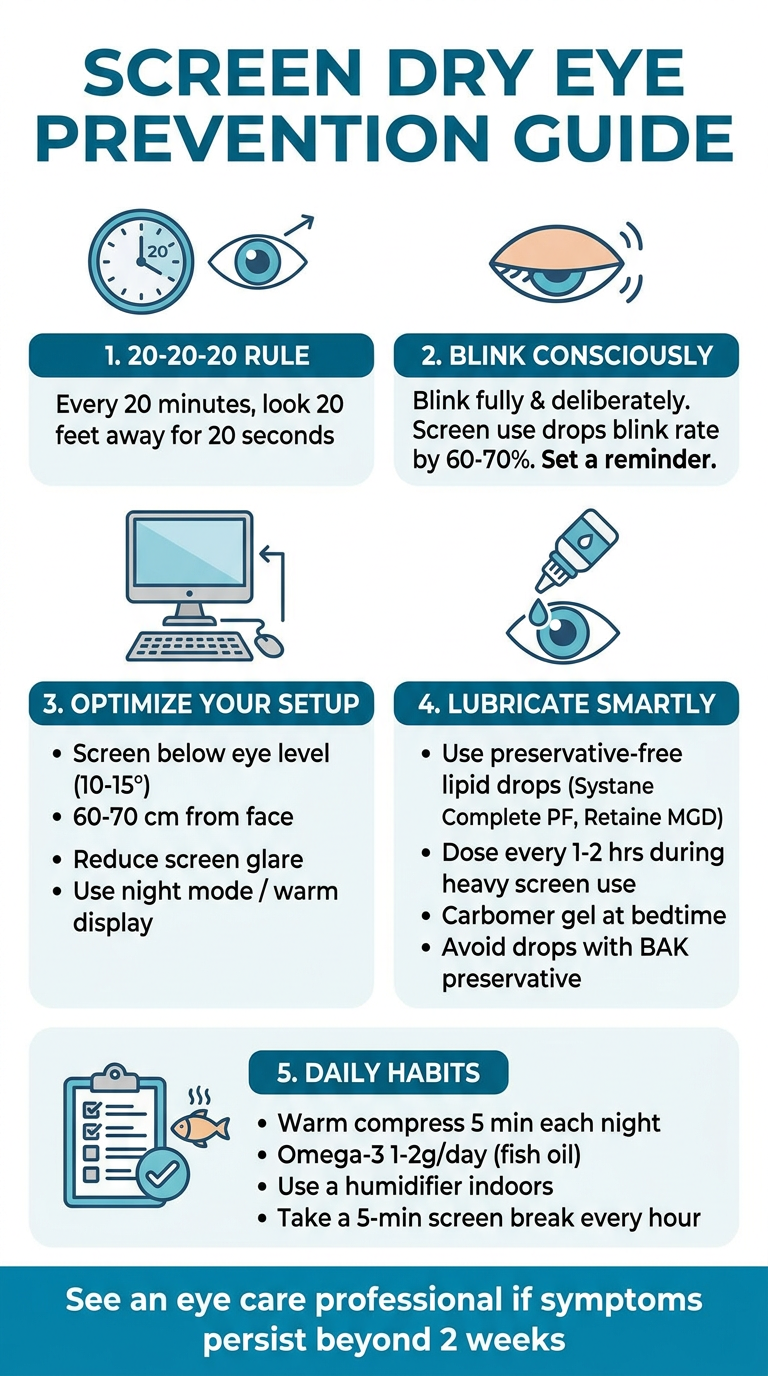
- 20-20-20 Rule - the single most effective behavioral intervention
- Conscious blinking - addresses the root cause (reduced blink rate)
- Screen setup optimization - reduces ocular surface exposure
- Smart lubrication - preservative-free lipid drops during the day, gel at night
- Daily habits - warm compresses, omega-3, humidity