
Explain about chemical agent of strelization of microbiology
Reading File
Now let me search the medical library for chemical sterilization content:
Finding Sources
Finding Sources
Finding Sources
Finding Sources
I found the key textbook sources. Let me now read the detailed content:
Reading File
Reading File
Reading File
Finding Sources
Reading File
Reading File
Reading File
I now have excellent content from the medical library. Let me also fetch the glutaraldehyde diagram for a visual aid:
Loading Image
I now have comprehensive content from authoritative microbiology textbooks. Here is the full explanation:
Chemical Agents of Sterilization in Microbiology
Chemical agents used in sterilization and disinfection are substances that kill or inactivate microorganisms on surfaces, instruments, and occasionally living tissue. Understanding them requires distinguishing between sterilization (complete destruction of ALL living organisms, including spores) and disinfection (destruction of most pathogenic organisms, but resilient forms may survive).
All chemical disinfectants are bound and inactivated to varying degrees by protein and organic matter - they lose considerable activity when applied to dirty surfaces. Sherris & Ryan's Medical Microbiology, 8th Ed.
Classification by Activity Level
| Agent | Activity Level | Spectrum |
|---|---|---|
| Ethylene oxide gas | Sterilizing | All organisms |
| Glutaraldehyde | High-level | All organisms |
| Hydrogen peroxide | High-level | Viruses, vegetative bacteria, fungi |
| Chlorine compounds | High-level | Viruses, vegetative bacteria |
| Alcohols | Intermediate | Vegetative bacteria, fungi, some viruses |
| Iodophors | Intermediate | Broad spectrum |
| Phenolic compounds | Intermediate | Vegetative bacteria |
| Quaternary ammonium compounds | Low-level | Vegetative bacteria, some fungi |
1. Alkylating Agents (True Chemical Sterilants)
Ethylene Oxide (EtO)
- A flammable and potentially explosive gas used to sterilize heat-labile materials (e.g., artificial heart valves, certain plastics, lensed instruments that cannot withstand autoclaving)
- Mechanism: Alkylating agent - it replaces labile hydrogen atoms in DNA, inactivating microorganisms
- Factors affecting efficacy: Concentration of the gas, relative humidity (~30% is optimal), exposure time, and temperature. Effectiveness improves at elevated temperatures and higher concentrations
- Drawback: Requires a prolonged aeration period after use to allow gas to diffuse out of absorbed materials
- Effective spectrum: ALL organisms including spores
Formaldehyde
- Another alkylating agent that can be used as a vapor (without pressure) to decontaminate larger areas such as rooms
- More irritative and allergenic than glutaraldehyde, limiting its routine clinical use
Glutaraldehyde
- A potent high-level disinfectant/sterilant for apparatus that cannot be heat-treated (e.g., endoscopes, respiratory therapy equipment, lensed instruments)
- Mechanism: Polymerizes to form polyglutaraldehyde, which then cross-links with amino acids in microbial proteins and peptidoglycan, alkylating and inactivating them (see diagram below)
- Highly lethal to essentially all microorganisms
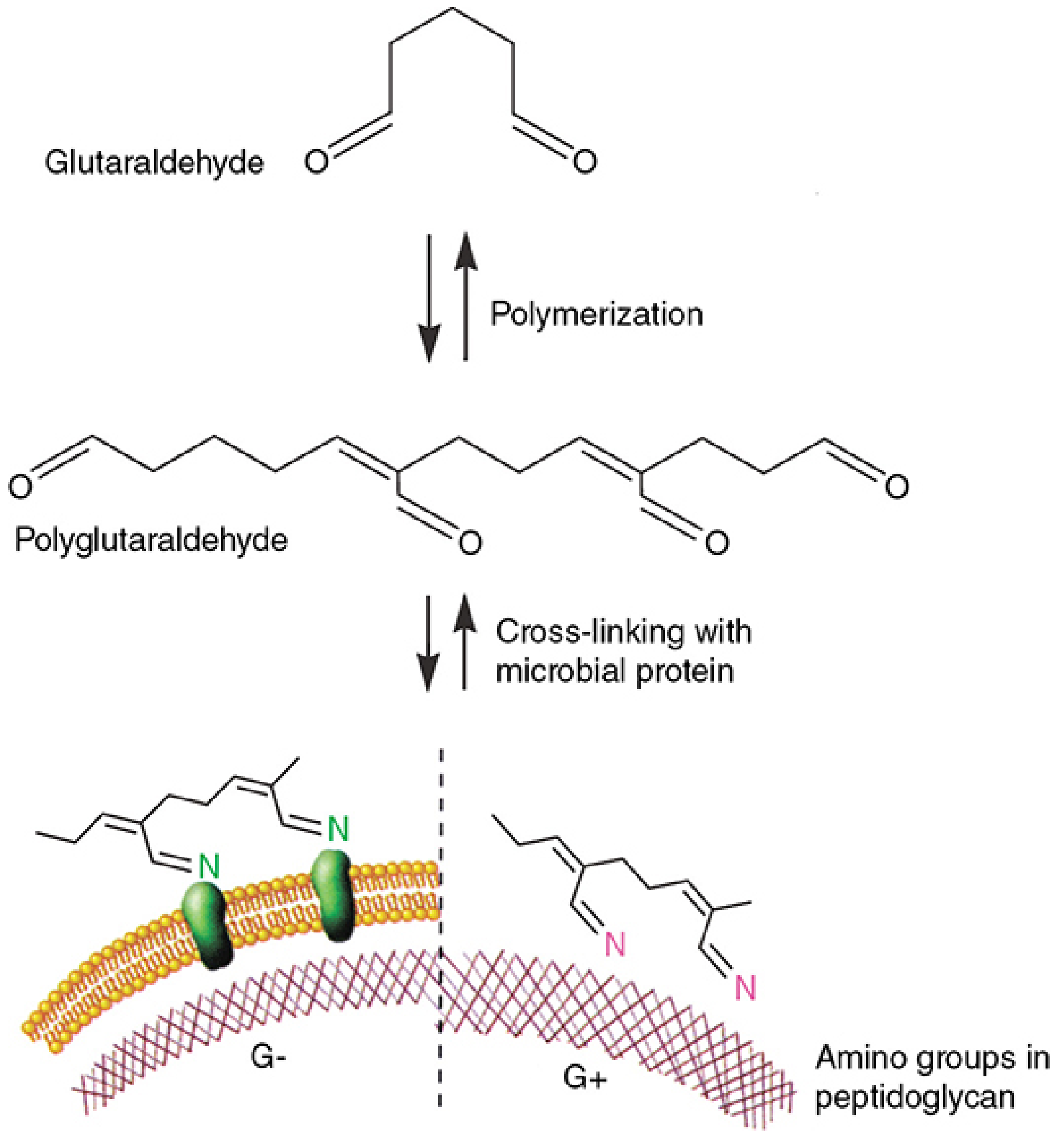
Glutaraldehyde polymerizes, then cross-links with amino groups in proteins (Gram-negative membrane proteins) and peptidoglycan (Gram-positive bacteria) - Sherris & Ryan's Medical Microbiology, 8th Ed., p. 111
2. Halogens
Iodine / Iodophors
- Mechanism: Iodine acts by iodinating or oxidizing essential components of the microbial cell (precipitates proteins and oxidizes essential enzymes)
- Tincture of iodine (iodine in alcohol) has largely been replaced by iodophors - iodine combined with carriers (povidone) or nonionic detergents
- Iodophors (e.g., povidone-iodine / Betadine) gradually release small amounts of free iodine, cause less skin staining and dehydration
- Used widely for pre-surgical skin preparation
Chlorine Compounds
- Mechanism: Strong oxidizing agents. Chlorine exists as hypochlorous acid in aqueous solutions, dissociating to yield free chlorine
- At concentrations of less than 1 part per million, chlorine is lethal within seconds to most vegetative bacteria and inactivates most viruses
- Applied as 5% solution (hypochlorite / bleach) for decontaminating surfaces and glassware contaminated with viruses or spores of pathogenic bacteria
- Used for drinking water purification and swimming pool chlorination
- The agent of choice for decontaminating surfaces contaminated with viruses or bacterial spores
- Examples: elemental chlorine, sodium hypochlorite (bleach), hypochlorite ion
3. Oxidizing Agents
Hydrogen Peroxide (H₂O₂)
- Mechanism: Powerful oxidizing agent that attacks membrane lipids and other cell components
- Useful for disinfecting contact lenses and surfaces not susceptible to its corrosive effect
- High-level disinfectant - active against viruses, vegetative bacteria, and fungi
- Inactivated by organic matter
- Newer formulations containing surfactants act more rapidly
- Peracetic acid (a related oxidant) is also used at high concentrations as a sterilant
4. Alcohols
- Examples: Isopropyl alcohol (70-95%), ethyl alcohol
- Mechanism: Protein denaturants - rapidly kill vegetative bacteria when applied as aqueous solutions in the range of 70%-95%
- 100% alcohol is actually less effective because the lethal process requires water molecules - pure alcohol merely dehydrates organisms
- Spectrum: Active against vegetative bacteria and fungi; inactive against bacterial spores and many non-enveloped viruses
- Isopropyl alcohol (90-95%) is widely used for skin decontamination before procedures such as venipuncture
- Activity level: Intermediate
5. Surface-Active Compounds (Surfactants)
Quaternary Ammonium Compounds ("Quats")
- Examples: Benzalkonium chloride, cetylpyridinium chloride
- Mechanism: Their hydrophobic and lipophilic groups react with the lipid of the bacterial cell membrane, alter membrane surface properties and permeability, leading to loss of essential cell components and death. Also denature proteins
- Bactericidal in the absence of organic matter; highly effective for reducing superficial skin flora
- Inactive against spores and most viruses
- Activity level: Low-level disinfectants
- Used for noncritical instruments and devices (blood pressure cuffs, stethoscopes)
- Note: Their action is neutralized by soaps and anionic detergents
Chlorhexidine
- A cationic agent used as a routine hand and skin disinfectant
- Notable for its ability to bind to the skin and produce a persistent (residual) antibacterial effect
- Activity neutralized by soaps and anionic detergents
6. Phenolic Compounds
- Examples: Phenol (carbolic acid), o-phenylphenol, o-benzyl-p-chlorophenol
- Mechanism: Disrupt lipid-containing cell membranes causing leakage of cellular contents; also potent protein denaturants
- Too toxic to skin and tissues for use as antiseptics (except very brief exposures)
- Valuable for treating inanimate surfaces and rendering contaminated materials safe
- Activity level: Intermediate
Factors Affecting Chemical Sterilization/Disinfection
- Organic matter - proteins and dirt bind and inactivate most chemical agents
- Concentration - higher concentration generally increases killing rate
- Time of exposure - longer contact time increases efficacy
- Temperature - higher temperature enhances chemical activity
- pH - affects the active form of certain agents (e.g., chlorine is more active under slightly acidic conditions)
- Nature of the organism - bacterial spores, mycobacteria, non-enveloped viruses show resistance to many common disinfectants
Summary: Choosing the Right Agent
| Use Case | Recommended Agent |
|---|---|
| Heat-labile surgical equipment | Ethylene oxide gas |
| Endoscopes, lensed instruments | Glutaraldehyde, peracetic acid |
| Pre-surgical skin prep | Iodophors, chlorhexidine |
| Venipuncture site | Isopropyl alcohol |
| Water purification | Chlorine |
| Surface contaminated with viruses/spores | Hypochlorite (bleach) |
| Contact lenses | Hydrogen peroxide |
| Noncritical instruments | Quaternary ammonium compounds |
- Sherris & Ryan's Medical Microbiology, 8th Edition, pp. 100-112
- Medical Microbiology 9e (Murray), p. 898
This is a shared conversation. Sign in to Orris to start your own chat.