
A 21 year old female mbbs student experiences severe knee joint pain in left side of the leg.she sleeps in left lateral position with knee flexed so when she tries to straighten it during sleeping it pain,pain is sharp shooting type and relieve in few minutes after straightening.there is history of leg pain during bending in mother also in left knee
Reading File
Now let me search the medical library in parallel for the relevant conditions.
Finding Sources
Finding Sources
Finding Sources
Searching the Web
knee pain left lateral position flexed knee sharp shooting pain straighten family history diagnosis
Excellent - discoid meniscus is a strong lead. Let me now read the relevant textbook sections and search for more specific information.
Reading File
Reading File
Finding Sources
Finding Sources
Now let me fetch the discoid meniscus images and get more details on hereditary aspects and the Wrisberg-type mechanism.
Loading Image
Loading Image
Finding Sources
Reading File
I now have excellent information to construct a comprehensive clinical analysis. Let me compile the full response.
Clinical Analysis: Most Likely Diagnosis - Discoid Lateral Meniscus (Wrisberg-type / with tear)
Clinical Picture Summary
| Feature | Significance |
|---|---|
| 21-year-old female | Young adult - meniscal anomaly/tear age group |
| Left knee pain | Unilateral |
| Pain with knee flexed in lateral position during sleep | Meniscus is mechanically stressed/subluxated in flexion |
| Sharp, shooting pain on trying to straighten | Meniscus snaps/displaces back - classic "snapping knee" |
| Relieves in minutes after straightening | Meniscus reduces back to position - mechanical symptom, not inflammatory |
| Mother has same left knee pain on bending | Familial/hereditary component - discoid meniscus has a known familial occurrence |
Diagnosis: Discoid Lateral Meniscus (likely Wrisberg-type, possibly with a tear)
What is a Discoid Meniscus?
A discoid meniscus is a congenital anomaly of the knee where the lateral meniscus fails to differentiate into its normal semilunar (crescent) shape and instead forms a thick, disc-shaped (wafer-like) plate of fibrocartilage that covers much of the lateral tibial plateau. It occurs in approximately 3% of the general population and is found bilaterally in 20% of cases.
- Rheumatology (2022, Elsevier), p. 741 - "A discoid meniscus is a congenital anomaly of the knee found in 3% of the population. It typically affects the lateral meniscus and may be found bilaterally in 20% of cases."
Why This Explains Every Symptom
1. Sharp shooting pain in flexion + relief on extension
This is the classic "snapping knee syndrome" - the hallmark of a Wrisberg-type discoid lateral meniscus.
In the Wrisberg variant, the posterior meniscotibial attachment is absent. During knee flexion (as when sleeping on the left side with knee bent), the meniscus is tethered only by the Wrisberg (lateral meniscofemoral) ligament and gets pulled into the intercondylar notch, becoming trapped. On extension/straightening, it snaps back, producing the sudden sharp pain that resolves quickly.
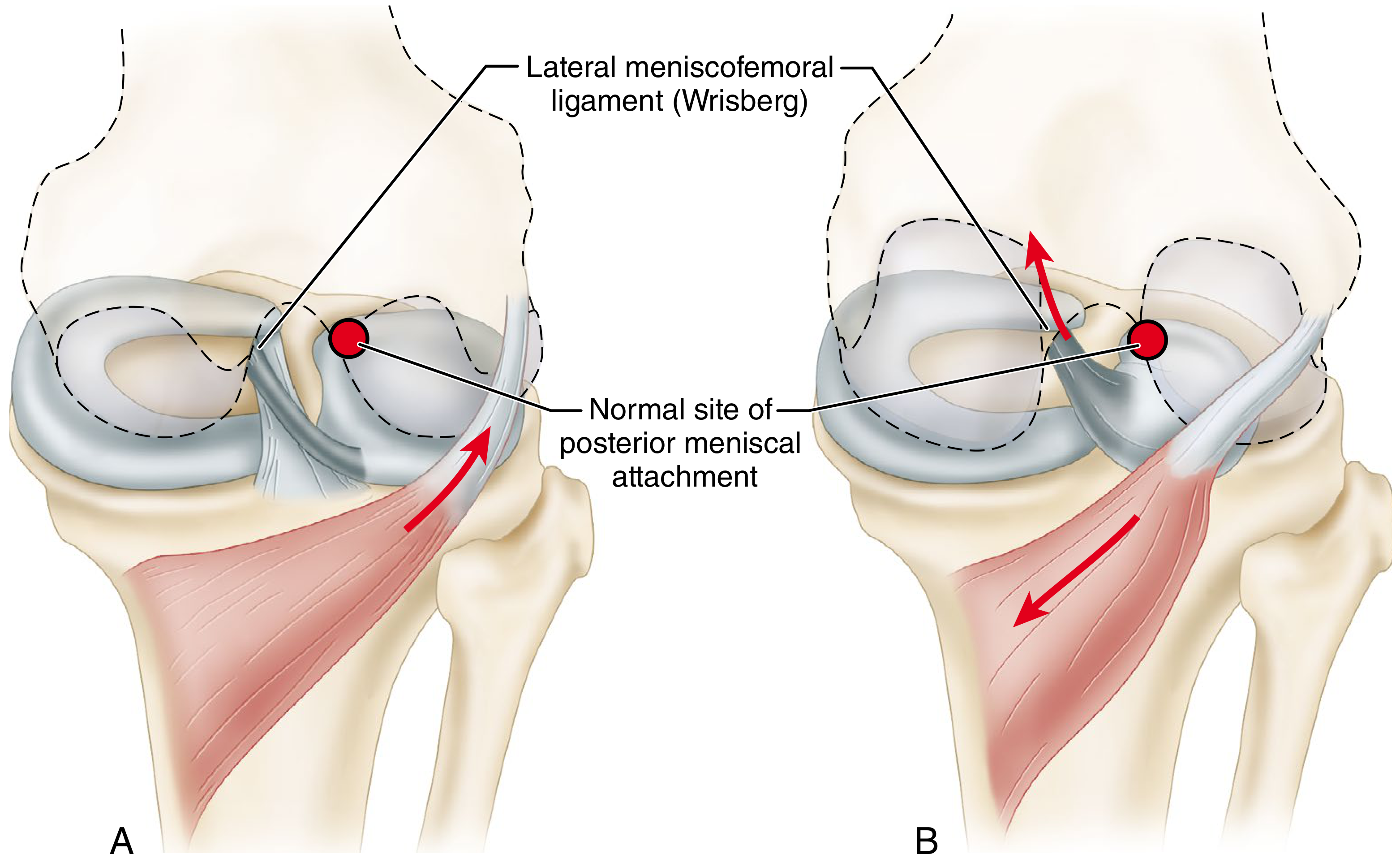
Fig A: Knee in flexion - meniscus subluxated, pulled by Wrisberg ligament. Fig B: With extension, meniscus displaced back into intercondylar notch.
- Campbell's Operative Orthopaedics 15th Ed 2026, p. 2643 - "Abnormal motion of this type of discoid meniscus results in a popping sound during knee flexion and extension ('snapping knee syndrome'). Wrisberg-type discoid menisci often occur at a younger age and are unassociated with trauma."
2. Symptoms during sleep in flexed lateral position
When sleeping on the left lateral side, the left knee is passively maintained in flexion. This continuously stresses the Wrisberg-type meniscus (trapped in the intercondylar notch). Any attempt to passively or actively straighten the knee forces the displaced meniscus to snap back - causing the sharp, shooting pain.
3. Family history (mother has same left knee symptoms on bending)
Discoid meniscus has a well-documented familial and bilateral tendency. The fact that the mother also has left knee pain during bending strongly supports a hereditary/congenital etiology rather than a traumatic or degenerative one. The exact inheritance pattern is not fully defined, but family clustering is recognized in the literature.
Arthroscopic Appearance
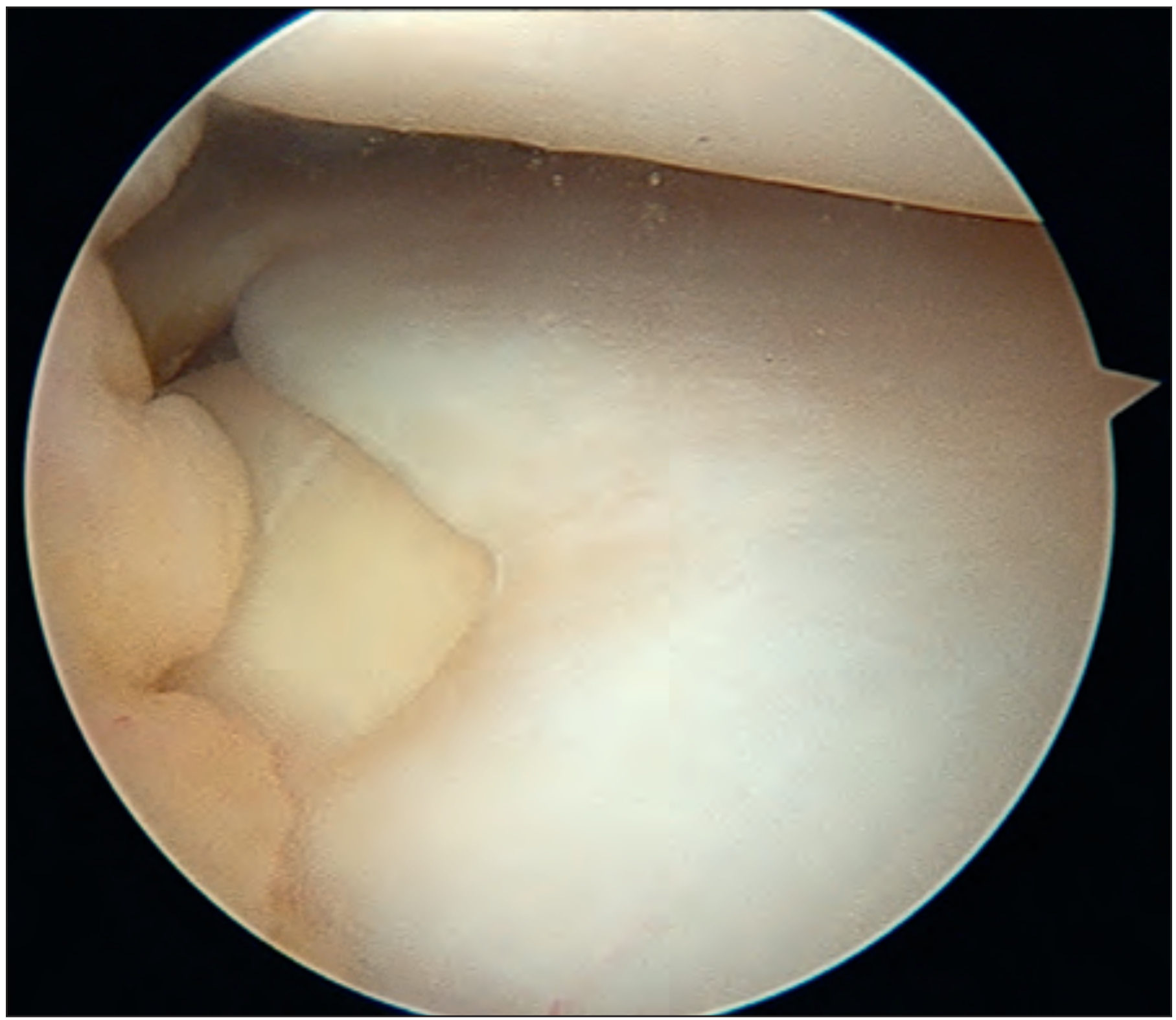
Arthroscopic view showing a white, thick, disc-shaped meniscus covering the lateral tibial plateau - characteristic of discoid meniscus.
Classification (Watanabe Classification)
| Type | Description | Key Feature |
|---|---|---|
| Complete | Covers entire lateral tibial plateau | |
| Incomplete | Partial coverage | |
| Wrisberg variant | Missing posterior meniscotibial attachment | Most symptomatic - snapping knee |
This patient almost certainly has the Wrisberg variant given the snapping/mechanical symptom pattern without trauma history.
Differential Diagnoses to Consider
| Condition | Reason to consider | Reason against |
|---|---|---|
| Lateral meniscus tear | Can cause sharp pain in flexion | No trauma history; age + family history favor congenital |
| IT Band Syndrome | Lateral knee pain | Not position-dependent; no snap/relief pattern |
| Plica syndrome | Young female; knee pain | Doesn't explain relief on straightening |
| Popliteal cyst | Posterior knee pain | Different character; no snapping |
Investigations Recommended
-
MRI knee (left) - Investigation of choice. Confirms discoid meniscus (disk-shaped tissue covering tibial plateau), detects any associated tear. On sagittal MRI, more than 3 consecutive 5-mm slices showing meniscal continuity ("bow-tie sign") = discoid.
-
X-ray knee (AP + lateral) - May show: widening of lateral joint space (up to 11mm), squaring of lateral femoral condyle, cupping of lateral tibial plateau, hypoplastic lateral tibial spine.
-
Screen the right knee too - 20% bilateral occurrence.
Management
| Situation | Treatment |
|---|---|
| Intact discoid meniscus, incidental finding, no symptoms | Observation - no treatment needed |
| Symptomatic snapping (Wrisberg type, intact meniscus) | Arthroscopic meniscal repair (repair the posterior attachment) |
| Discoid meniscus with tear causing pain + snapping | Arthroscopic partial central meniscectomy ("saucerization") - resect central portion, leave 6-8mm stable peripheral rim |
| Complete/incomplete type with tear + intact peripheral | Saucerization |
- Campbell's Operative Orthopaedics 15th Ed 2026, p. 2643 - "Tears of complete or incomplete discoid menisci that cause pain, popping, and snapping within the knee and that show a hypermobile medial segment but intact peripheral attachments are best treated by subtotal meniscectomy or a so-called saucerization of the mobile fragment."
Note: "Preexisting degenerative changes, female gender, and age older than 20 years are associated with unsatisfactory results" after saucerization - so prompt evaluation is important for this 21-year-old.
Summary
This 21-year-old MBBS student most likely has a Wrisberg-type discoid lateral meniscus of the left knee - a congenital anomaly causing "snapping knee syndrome." The mechanism perfectly explains:
- Pain strictly in flexion (meniscus trapped in intercondylar notch)
- Sharp, shooting character (mechanical snap)
- Relief within minutes after straightening (meniscus reduces)
- Family history in mother (congenital/familial etiology)
Next step: MRI of the left knee. Refer to an orthopedic surgeon for arthroscopic evaluation.
This is a shared conversation. Sign in to Orris to start your own chat.