
A bodybuilder came to my clinic and his problem is he feels an uneven pump on the right side then left
Where exactly is the uneven pump felt? · Any associated symptoms besides the uneven pump? · Is he using any performance-enhancing substances?
pectoralis major injury bodybuilder asymmetric
uneven pectoral pump bodybuilder pain right side causes differential diagnosis
pectoralis major rupture weightlifting diagnosis treatment
PMID: 42434169
PMID: 36299934
Bodybuilder with Unilateral (Right > Left) Pectoral Pump + Pain
Understanding the "Pump"
- The right pectoral muscle is working harder, recruiting more fibers, or has better neural drive - OR -
- There is pathological swelling or fluid accumulation on the right side (e.g., hematoma, edema from a partial tear)
Differential Diagnosis
1. Pectoralis Major Partial Tear (Grade 1-2 Strain) - Most Likely
- Mechanism: Eccentric overload during bench press, dumbbell fly, or cable crossovers - particularly when the arm is extended/externally rotated under load
- Pathophysiology: Microtearing of muscle fibers - usually at the myotendinous junction or sternal head - causes local edema and hematoma, which mimics an exaggerated "pump" on that side
- Symptoms: The affected side feels "more pumped" because of inflammation/edema, not just hyperemia; associated with localized pain, especially on contraction or stretch
- Grading:
- Grade 1 (mild): <10% fiber disruption, no strength loss, soreness only
- Grade 2 (moderate): Partial tear, pain with active resistance, possible bruising, asymmetric bulk
- Grade 3 (severe/complete rupture): Sudden pop, ecchymosis, visible defect, retraction - the "pump" may actually be the retracted muscle bunching up
A 2026 case report (PMID: 42434169) describes a 23-year-old powerlifter who developed acute right chest pain, swelling, and pectoralis retraction during heavy bench press, confirmed on MRI as a high-grade intratendinous rupture. A 2022 case (PMID: 36299934) similarly showed a 51-year-old male with sudden-onset right chest pain after bench pressing ~180kg, found to have complete rupture of the sternal head of the PM.
2. Dominant-Side Hypertrophy + Overrecruitment
- Most bodybuilders are right-hand dominant; right pectoral may simply be larger, with more vascular density and more motor unit recruitment
- This produces a consistently more pronounced pump on the right with no associated tissue damage
- Pain would be absent or minimal - if pain is significant, this diagnosis alone is insufficient
3. Costochondritis (Tietze Syndrome)
- Inflammation of the costochondral junctions (usually 2nd-5th ribs)
- Can cause sharp, reproducible chest wall pain that worsens with coughing or deep breathing
- Physical exam: point tenderness at the costo-sternal junction is the hallmark
- Does NOT produce an exaggerated pump, so this may coexist rather than be the sole cause
- According to [Tintinalli's Emergency Medicine]: "Musculoskeletal or chest wall pain is characterized by sharp, highly localized, and positional pain...completely reproducible by light to moderate palpation"
4. Intercostal Muscle Strain
- Strain of the intercostal muscles between ribs on the right side
- Causes localized, pleuritic (breathing-related) chest pain
- Can cause apparent localized swelling but typically doesn't produce an asymmetric pump per se
5. Nerve Entrapment / Long Thoracic Nerve Issue
- Long thoracic nerve palsy causes serratus anterior weakness, leading to scapular winging and altered pectoral mechanics - which can manifest as asymmetric muscle loading, "pump," and pain
- Lateral pectoral nerve irritation could theoretically alter recruitment patterns
- Consider if there is any associated arm weakness, shoulder blade winging, or radicular symptoms
6. Vascular Asymmetry (Subclavian/Axillary)
- Rare but worth considering: right-sided subclavian artery pathology (e.g., thoracic outlet syndrome) can cause asymmetric hyperemia and limb/chest "congestion" during exercise
- Look for diminished radial pulse with provocative maneuvers (Adson's, Wright's test), arm swelling, or effort-related discomfort
7. Musculoskeletal Imbalance + Faulty Technique
- Unilateral pec dominance due to technique errors (e.g., uneven bar path, favoring one arm during pressing) causes asymmetric hypertrophy and pump over time
- Associated chronic overuse pain is common
Key Clinical Assessment Steps
| Step | What to Do |
|---|---|
| History | Onset - sudden vs. gradual? During which exercise? Heard or felt a "pop"? Duration of symptoms? |
| Inspection | Visible asymmetry of pectoral bulk? Ecchymosis or bruising? Skin discoloration? |
| Palpation | Point tenderness at the musculotendinous junction (anterior axillary fold), sternal attachment, or mid-muscle belly? Palpable defect? |
| Strength testing | Adduction and internal rotation of the arm against resistance - pain or weakness? |
| Stretch test | Horizontal abduction of arm (like a pec fly) - does it reproduce pain? |
| Special test | Have him do a pec flex: does the right pec contour look normal or is there retraction/bunching? |
Red Flags Requiring Urgent Imaging (MRI)
- Sudden-onset severe pain during lifting ("pop" or "tear" sensation)
- Visible deformity, retraction, or asymmetric contour at rest
- Significant ecchymosis tracking toward the axilla or arm
- Major strength deficit in adduction/internal rotation
- Palpable gap or defect in the muscle
Management Summary
| Grade | Likely Finding | Management |
|---|---|---|
| Grade 1 (mild strain) | Asymmetric pump, mild tenderness, full strength | RICE, NSAIDs, 2-4 weeks relative rest, gradual return |
| Grade 2 (partial tear) | Moderate tenderness, slight weakness, possible bruising | Conservative x 6-12 weeks; MRI to rule out higher grade; physiotherapy |
| Grade 3 (complete rupture) | Defect palpable, ecchymosis, significant weakness | Surgical repair - early repair (<3 months) gives best outcomes; refer urgently |
| Costochondritis/overuse | Reproducible sternal tenderness, no weakness | NSAIDs, local corticosteroid injection if refractory, activity modification |
Bottom Line
Patients feel discomfort not pain
uneven pectoral pump discomfort not pain bodybuilder causes neuromuscular imbalance
Revised Assessment: Uneven Pectoral Pump + Discomfort (Not Pain)
Most Probable Causes (in order of likelihood)
1. Neuromuscular Imbalance / Dominant Side Overrecruitment - Most Likely
- The right pectoral is simply contributing more motor units during pressing movements than the left
- This means more blood flow, more cellular swelling, and a larger pump on the right side
- The discomfort comes from that side accumulating more metabolic byproducts (lactate, H⁺ ions) and experiencing more mechanical tension per rep
- Often develops from years of favoring the dominant limb, uneven bar path, or always leading with the same arm on cable/dumbbell work
- No structural damage - purely a motor control and training history issue
2. Right Pectoral Hypertrophy (Dominant Side Adaptation)
- If the right pec is simply larger (more muscle cross-section), it holds more blood during a pump
- The discomfort reflects the fascia stretching over a larger muscle mass - the fascial envelope on the more-developed side gets tighter during the pump, causing a pressure-type discomfort
- This is essentially "fascial tightness from pump" - common in hypertrophied muscles
3. Pectoralis Minor Tightness / Overuse (Right Side)
- The pectoralis minor runs from the coracoid process to ribs 3-5 and is commonly overworked in pressing-heavy bodybuilders
- Chronic tightness or low-grade strain of pec minor causes a dull, deep discomfort rather than sharp pain - often described as "pressure" or "tightness" during the pump
- Right-sided pec minor tightness also causes anterior shoulder rounding and impingement, which further alters recruitment patterns
- On exam: tenderness deep to the pec major, inferior to the coracoid process; discomfort reproduced with shoulder hyperextension or horizontal abduction
4. DOMS (Delayed Onset Muscle Soreness) - Asymmetric
- If the right pec worked harder in a recent session, it will accumulate more microtrauma and experience more DOMS
- During the next workout, the more sore (right) side produces more local edema = more visible/felt pump + discomfort
- Self-limiting; resolves with balanced training and adequate recovery
5. Fascial or Myofascial Restriction
- Dense fascial adhesions can develop on one side from repetitive training patterns, old minor injuries, or sleeping position
- Restricted fascia on the right pec creates pressure discomfort during the pump as blood flow increases into a "tight compartment"
- Responds well to massage, foam rolling, and myofascial release
6. Subclinical Grade 1 Strain
- Even without frank pain, a very mild fiber disruption (Grade 1) can present as asymmetric pump + mild discomfort
- No strength loss, no bruising, but localized tenderness may be present on deep palpation
Key Clinical Questions to Ask Him
| Question | What it helps identify |
|---|---|
| When exactly does the discomfort occur? (During workout, peak pump, after?) | Myofascial vs. DOMS vs. active strain |
| Does it happen only during chest training, or other pushing exercises too? | Pec-specific vs. shoulder girdle issue |
| Is the right pec visibly larger than the left at rest? | Dominant-side hypertrophy |
| Does stretching the right pec (arm wide + extended) reproduce the discomfort? | Pec minor tightness, fascial restriction |
| Any change in shoulder position (right shoulder more forward at rest)? | Pec minor tightness with anterior tilt |
| Has he recently increased volume or intensity on chest? | DOMS / overuse |
Physical Exam Focus
- Inspect at rest - Is the right pec visibly larger? Is the right shoulder protracted forward?
- Palpate pec minor - Press deep below the pec major toward the coracoid; tender on the right?
- Palpate pec major belly - Any focal tenderness or nodularity suggesting myofascial trigger points?
- Reproduce the discomfort - Ask him to perform an isometric pec contraction (hands pressed together) and see if it reproduces it
- Shoulder strength symmetry - Quick resistance test of horizontal adduction bilaterally
Management
- Training correction: Switch from barbell to dumbbell pressing - forces each side to work independently and prevents dominant-side overcompensation
- Unilateral work: Add single-arm cable crossovers and single-arm dumbbell press to the weaker (left) side to bring it up
- Pec minor stretching: Doorway stretch with arm at 90°, held 30-60 seconds, 3x/day
- Myofascial release: Deep tissue massage or foam roller on the right pec, targeting trigger points
- Mind-muscle connection cues: Consciously focus on the left pec during sets; use a mirror or touch cue on the lagging side
- Monitor: If discomfort escalates to pain, develops bruising, or he notices a visible defect - re-evaluate with imaging
Bottom Line
Search for recent research on pectoralis imbalance correction in weight training
pectoralis muscle asymmetry correction resistance training
unilateral training muscle imbalance symmetry hypertrophy
pectoralis major minor imbalance correction weight training evidence 2023 2024 2025
bilateral asymmetry strength training chest hypertrophy EMG
pectoralis minor stretching scapular kinematics shoulder posture
https://pmc.ncbi.nlm.nih.gov/articles/PMC11129965
bench press EMG pectoralis activation unilateral dumbbell
limb dominance muscle size asymmetry strength athletes
PMID: 39593406
PMID: 37747901
pectoralis major exercise variation EMG activation systematic review
Recent Research on Pectoralis Imbalance Correction in Weight Training
Note: There is no dedicated literature specifically on "pectoral asymmetry correction in bodybuilders" - the research exists across three overlapping streams: pec activation/EMG studies, pec minor stretching trials, and interlimb asymmetry correction research. Here is what the evidence actually shows.
1. Exercise Selection to Target Specific Pec Regions (EMG Evidence)
| Exercise Variant | Primary Region Activated |
|---|---|
| Flat barbell bench press | Sternocostal (lower/middle sternal head) |
| Incline bench press (30-45°) | Clavicular (upper) pec - more activation vs. flat |
| Decline bench press | Sternal head - more than flat, less clavicular |
| Dumbbell fly | Sternocostal, plus stretch-mediated activation |
| Cable crossover | Sustained tension through full ROM - both heads |
2. Pectoralis Minor Stretching vs. Resistance Training (2024 RCT)
- Stretching group: 15 min/day, 4 days/week
- Training group: 5 × 12 reps, 3 days/week
- Key finding: Both groups showed comparable gains in maximal strength, muscle thickness (hypertrophy), and shoulder ROM
- Stretching alone produced meaningful muscle hypertrophy - likely via mechanical tension on the sarcomeres at long muscle lengths
- Practical implication: For the tight right pec minor causing postural asymmetry, dedicated stretching is as effective as resistance training for improving that side's length and function - it does not need to be either/or
3. Prone Scapular Retraction Does NOT Immediately Lengthen Pec Minor (2024)
- Result: No significant immediate change in PM length (mean increase only 0.24 cm, below the MDC of 0.63 cm)
- Conclusion: "Reciprocal inhibition" from the opposing exercise is not sufficient to change pec minor length acutely
- What this means clinically: Scapular exercises alone will not fix a tight pec minor. The pec minor must be directly stretched at a lengthened position for adequate duration. Scapular retraction work is still valuable for the opposing muscles but should follow - not replace - direct pec minor stretching.
4. Asymmetric Workload Loading to Correct Imbalance (2023)
- Significantly reduced interlimb asymmetry (from 11.88% to 4.47%)
- Large effect size (η² = 0.26)
- Increased nondominant side strength
5. Dominant-Side Asymmetry is Normal in Athletes (2025)
- Some degree of asymmetry is a normal adaptation to habitual loading patterns
- It becomes a clinical problem only when it causes discomfort, functional limitation, or injury risk
- The goal of treatment is reduction of asymmetry, not perfect symmetry
Evidence-Based Correction Protocol (Synthesized)
| Strategy | Evidence Source | Application |
|---|---|---|
| Switch barbell → dumbbell press | EMG meta-analysis 2023 | Forces independent bilateral loading |
| Add unilateral cable/dumbbell work for left pec | Asymmetry correction trial 2023 | Extra 1-2 sets per session on the weaker side |
| 3:1 volume ratio (left:right) until symmetric | PMID 37747901 | Apply for 6-8 weeks then reassess |
| Direct pec minor stretch 15 min/day | PMC11129965 (2024 RCT) | Doorway or cross-body stretch; sustained duration is key |
| Do NOT rely only on scapular retraction to fix pec minor | PMID 39593406 (2024) | Stretch the pec minor directly first, then do scapular work |
| Full ROM training (incline + flat + cables) | EMG review 2023 | Multi-angle stimulation prevents regional imbalances |
Research Gap Worth Noting
Can I use any modalities
dry needling trigger point pectoralis muscle pain treatment
NMES neuromuscular electrical stimulation muscle imbalance asymmetry
physiotherapy modalities for pectoral muscle tightness imbalance ultrasound dry needling TENS foam rolling evidence
dry needling myofascial trigger point chest wall muscle
therapeutic ultrasound muscle recovery soft tissue treatment
Modalities for Pectoral Imbalance / Asymmetric Pump + Discomfort
1. Dry Needling (DN) - High Relevance
- Targets hyperirritable taut bands within the pectoralis, which alter motor activation patterns even in the absence of frank pain
- A published case report on a military athlete with chest wall discomfort unresponsive to standard physio showed that DN to the costochondral region and pectoral musculature resolved symptoms after conventional PT had failed (Council of Chiropractic Acupuncture source)
- Mechanism: local twitch response → relaxation of taut band → restored blood flow → normalization of motor recruitment
- Caution: The pec region is adjacent to the chest wall/pleura. Dry needling here requires an experienced practitioner with anatomical knowledge of needle depth. Always needle at an oblique angle away from the rib cage
2. Therapeutic Ultrasound (US) - Moderate Relevance
- Thermal mode (continuous, 1 MHz): penetrates deeper tissue (3-5 cm), increases collagen extensibility and tissue pliability - useful before stretching the right pec minor
- Non-thermal mode (pulsed): promotes cellular repair, reduces microinflammation in overused muscle
- How to use: Apply 3 MHz (superficial) or 1 MHz (deep/pec minor) over the right pectoralis region for 5-7 min before passive stretching - this combination is more effective than stretching alone
- Evidence from a 2022 military/sports review (PMID: 36694709) supports sustained acoustic medicine (wearable low-intensity US) for soft tissue musculoskeletal conditions
3. TENS (Transcutaneous Electrical Nerve Stimulation) - Low-Moderate Relevance
- High-frequency TENS (conventional, 80-120 Hz): gate control pain relief - reduces the "pump pressure" discomfort sensation
- Addresses muscle chemistry imbalance (lactate, pH) by increasing local blood flow
- More a symptom management tool than a corrective one for imbalance
- Limited direct evidence for pectoral-specific use, but well-established for musculoskeletal discomfort generally
4. Neuromuscular Electrical Stimulation (NMES / EMS) - High Relevance
- NMES applied to the left pec major can:
- Force motor unit recruitment in the underused side
- Build neuromuscular "memory" for that pec to activate earlier and more strongly
- Bridge the gap between dominant and non-dominant side during the retraining phase
- Use at 35-50 Hz (motor threshold) to produce visible contraction in the left pec
- Best combined with a voluntary isometric contraction ("contract while stimulated") for maximum cortical carry-over
- This is essentially biofeedback-assisted re-education of motor recruitment
5. Soft Tissue Mobilization / Myofascial Release (Manual Therapy) - High Relevance
- Instrument-assisted soft tissue mobilization (IASTM / Graston) over the right pectoralis: breaks down adhesions and normalizes fascial gliding
- Direct pec minor manual release: sustained pressure on the pec minor (accessed just below the coracoid process, deep to pec major) for 60-90 seconds
- Cross-friction massage over taut bands in the right pec major
- Evidence base is largely clinical and case-based, but widely accepted in sports physiotherapy
6. Foam Rolling / Percussion Therapy (Self-Administered) - Moderate Relevance
- Foam rolling the right pec major for 60-90 seconds before training
- Percussion/massage gun (Theragun, Hyperice) over the right pec: increases microcirculation and reduces tightness before sets
- Reduces the exaggerated pump on the dominant side by pre-releasing some fascial tension before exercise loading
7. Heat Therapy - Supportive
- Moist heat pad / hot pack over the right pec for 10-15 min before stretching
- Increases collagen extensibility, making subsequent pec minor stretching more effective
- Enhances blood flow and reduces tightness prior to manual therapy or dry needling
Recommended Modality Protocol (Sequenced)
| Order | Modality | Duration | Purpose |
|---|---|---|---|
| 1 | Moist heat (right pec) | 10-15 min | Warm up tissue, improve extensibility |
| 2 | Therapeutic ultrasound (right pec minor, 1 MHz) | 5-7 min | Deep tissue pliability |
| 3 | Manual therapy / IASTM (right pec) | 5-10 min | Release fascial restriction and trigger points |
| 4 | Dry needling (right pec - if MTrPs present) | As needed | Extinguish trigger points, normalize recruitment |
| 5 | Pec minor stretching (right side, sustained) | 15 min total | Lengthen tight tissue while warm |
| 6 | NMES (left pec) | 10-15 min | Re-educate underactive side |
| 7 | TENS (bilateral pec, post-exercise) | 15-20 min | Symptom relief after training |
Key Reminder
Show me electrode placement for pec minor for ems through pic
A clear anatomical diagram showing EMS/NMES electrode placement for the pectoralis minor and pectoralis major muscles on the human chest. The diagram shows a front view of the male torso with the chest muscles visible. Two electrode pad placements are illustrated: one electrode placed just below the clavicle near the coracoid process (upper electrode, targeting pectoralis minor origin area), and one electrode placed on the lateral chest wall near the 3rd-5th ribs (lower electrode, targeting pectoralis minor insertion). A second pair of electrodes is shown for pectoralis major: one on the upper chest (clavicular head) and one on the lower sternal region. Anatomical landmarks labeled include: clavicle, coracoid process, sternum, ribs 3-5, pectoralis major, pectoralis minor (shown as deeper muscle in dashed outline). Electrode pads are shown as rectangular grey pads with + and - polarity labels. Arrows indicate current flow direction. Clean medical illustration style with clear labels and a neutral background.
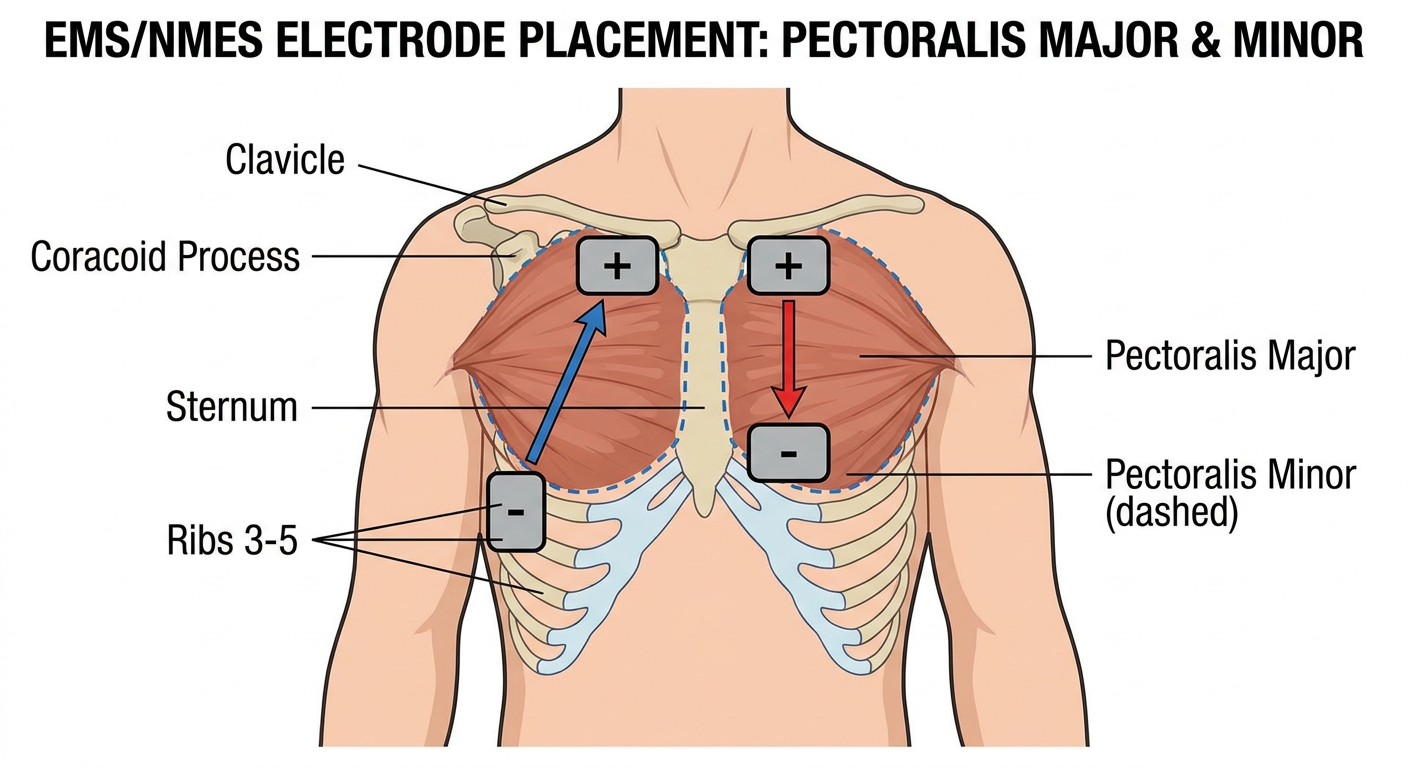
EMS Electrode Placement Guide - Pectoralis Minor (Left Side for Imbalance Correction)
Important Anatomy First
Electrode Placement (2-Pad Setup)
| Electrode | Position | Anatomical Landmark |
|---|---|---|
| Active (+) | Just below the clavicle, 2-3 cm medial to the coracoid process | Upper chest, targeting the pec minor's coracoid attachment |
| Dispersive (-) | Lateral chest wall, over the 3rd-4th intercostal space, anterior axillary line | Targeting pec minor's rib (3-5) insertions |
- Pad orientation: vertical or slightly oblique, aligned along the muscle fiber direction (runs from ribs 3-5 diagonally up to the coracoid)
- Pad size: 5×5 cm or smaller pads preferred for localized stimulation over this small muscle
- Electrode spacing: approximately 8-10 cm apart
Parameters for NMES (Re-education Goal)
| Parameter | Setting |
|---|---|
| Frequency | 35-50 Hz (motor threshold for muscle contraction) |
| Pulse width | 200-300 µs |
| Intensity | Increase until visible/palpable contraction of the anterior chest is felt |
| On/Off cycle | 10 sec on : 20 sec off (to avoid fatigue) |
| Session duration | 10-15 minutes |
| Sessions/week | 3-5x per week |
Key Clinical Notes
- Ask the patient to actively contract their pec (squeeze the arm toward midline) during the "on" phase - this voluntary + electrical co-contraction maximizes cortical re-education
- Since pec minor is deep, you will primarily feel the pec major contracting - this is expected and still drives current to the pec minor
- Avoid placing electrodes directly over the sternum or xiphoid process
- Avoid if the patient has a pacemaker, active inflammation, or open skin in the area
- This placement on the left side targets the underactive pec for asymmetry correction