
Write a short note on Jaipur foot with diagram for Ms orthopedics theory examination gold medal level
Jaipur foot prosthesis diagram
Jaipur foot prosthesis features advantages orthopedics exam
below knee amputation prosthetic foot SACH foot diagram
https://en.wikipedia.org/wiki/Jaipur_foot
A labeled medical diagram showing a lateral cross-sectional view of the Jaipur foot prosthesis, illustrating: the wooden/HDPE keel core, the multi-layered rubber ankle block allowing dorsiflexion-plantarflexion-inversion-eversion movement, the sponge/microcellular rubber filling, the outer skin-colored vulcanized rubber cover shaped like a human foot, and the pylon/shank attachment point at the top. Clean textbook style anatomical diagram with clear pointer labels for each component.
Definition
History
- Developed in 1968 at SMS Medical College, Jaipur, by orthopedic surgeon Prof. P.K. Sethi, in collaboration with sculptor/craftsman Ram Chandra Sharma.
- Popularized worldwide through the Bhagwan Mahaveer Viklang Sahayata Samiti (BMVSS), Jaipur - the largest organization fitting prosthetic limbs free of cost.
- Conceived as a modification of the Western SACH (Solid Ankle Cushion Heel) foot, redesigned to suit barefoot, rural, agrarian lifestyles common in India.
Indications
- Below-knee (transtibial) amputees - most common use.
- Above-knee (transfemoral) amputees, when combined with the Stanford-Jaipur knee joint.
- Ideal for patients from rural/low-resource settings who need to squat, sit cross-legged, walk barefoot on uneven or wet ground, and cannot afford expensive imported prostheses.
- Widely used for landmine and war-injury amputees in low-income countries.
Design and Construction
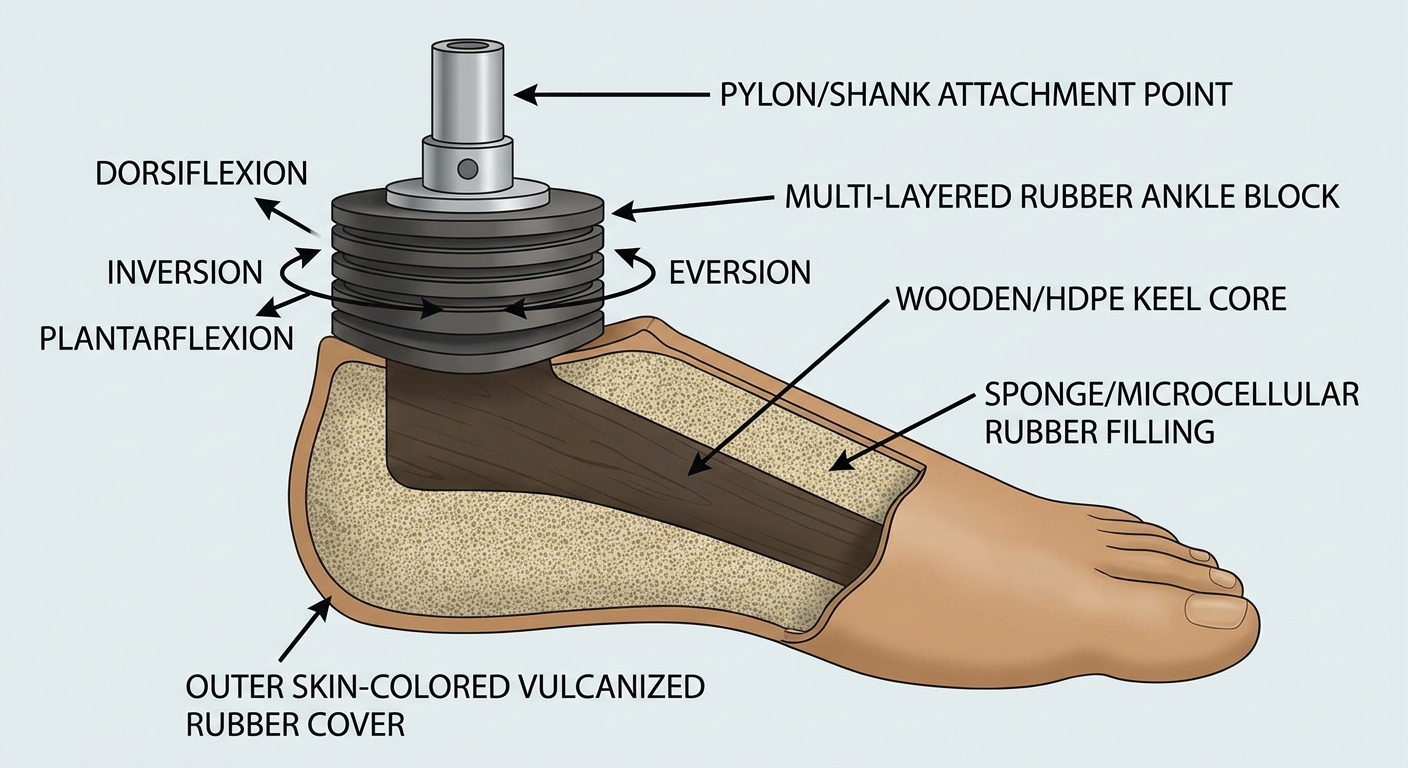
- Keel - a rigid core (originally wood, later aluminum, now usually high-density polyethylene, HDPE) that transmits load from the shank/pylon to the ground and gives structural strength.
- Rubber ankle block - a solid block of soft microcellular rubber (MCR), shorter and more flexible than the SACH foot's wooden keel. This is the key innovation - it allows movement in multiple planes (dorsiflexion, plantarflexion, inversion, eversion, and transverse rotation), unlike the SACH foot which permits none.
- Sponge/rubber cord filling - fills the forefoot and toe region, giving cushioning and a natural foot contour.
- Outer cover - vulcanized, skin-colored rubber shaped and painted to mimic the appearance of a natural foot, including toes, making it cosmetically acceptable and usable without a shoe.
- Attached to the shank/socket via a conventional pylon; the socket itself is made from HDPE, molded directly onto the residual limb (allows same-day fitting).
Mechanism / Functional Advantage
- Squatting and sitting cross-legged
- Climbing trees/ladders, riding a bicycle
- Walking on uneven terrain, wading through water or mud
- Working in agricultural fields
Advantages
- Inexpensive - approximately $30-50 per limb versus thousands of dollars for conventional prostheses.
- Rapid fabrication and fitting - can be manufactured and fitted to the patient in a single day, without highly skilled personnel.
- Waterproof - can be used for wading, bathing, working in wet fields.
- Can be used barefoot - no shoe required; cosmetically resembles a real foot.
- Multiaxial mobility - dorsiflexion, plantarflexion, inversion, eversion, and rotation, unlike the rigid SACH foot.
- Durable and sturdy for rough, rural use.
- Raw materials are locally and cheaply available.
Disadvantages
- Heavier than modern carbon-fiber or SACH prostheses (due to solid rubber components).
- Never patented/standardized - quality and fit vary between manufacturing centers.
- Shorter lifespan (about 2-5 years) compared to costlier energy-storing prosthetic feet.
- Less shock absorption than the SACH foot on hard/urban surfaces (though gait is judged more "natural").
- Not suited for high-performance activity (running, sports) compared to dynamic-response prosthetic feet.
Comparison with SACH Foot
| Feature | Jaipur Foot | SACH Foot |
|---|---|---|
| Ankle | Flexible rubber block (multiaxial) | Rigid, no true ankle motion |
| Keel | Short, flexible keel | Long, rigid wooden keel |
| Movement | Dorsi/plantarflexion, inversion/eversion, rotation | Essentially none |
| Use barefoot | Yes | No (needs shoe) |
| Cost | Very low | Moderate |
| Shock absorption | Lower | Better |
| Suitability | Rural, barefoot, squatting cultures | Urban, shoe-wearing populations |
Recent Modifications
- Stanford-Jaipur knee - a four-bar polycentric knee joint (developed jointly by Stanford University and BMVSS) added for above-knee amputees, mimicking the dynamic center of rotation of a natural knee.
- Newer versions use polyurethane (lighter than rubber) and HDPE sockets/keels for improved durability.
Significance for the Examinee
- Jaipur Foot and the "Jaipur Prosthesis" - Bhargava R, Indian Journal of Orthopaedics, 2019;53(1):5-7.