
Amino acids
Reading File
Amino acids are the building blocks of proteins - there are 20 standard ones, classified as essential (cannot be synthesized by the body) or non-essential. They share a common structure with an amino group, carboxyl group, hydrogen, and a variable R-group attached to an alpha carbon. They differ in properties like polarity, charge, and aromaticity.
Searching sources...
Finding Sources
Searching the Web
amino acids classification structure biochemistry overview
Reading File
Reading File
Finding Sources
Reading File
Reading File
Now let me fetch the classification diagram image to include it visually:
Loading Image
Finding Sources
Finding Sources
Reading File
Reading File
Loading Image
Here is a thorough overview of amino acids, drawn from Basic Medical Biochemistry (6th ed.), Lippincott's Biochemistry (8th ed.), and Ganong's Medical Physiology (26th ed.).
Amino Acids
1. General Structure
Every standard amino acid shares the same backbone: an alpha-carbon bonded to four groups - an amino group (H₃N⁺), a carboxyl group (COO⁻), a hydrogen atom, and a variable R group (side chain).
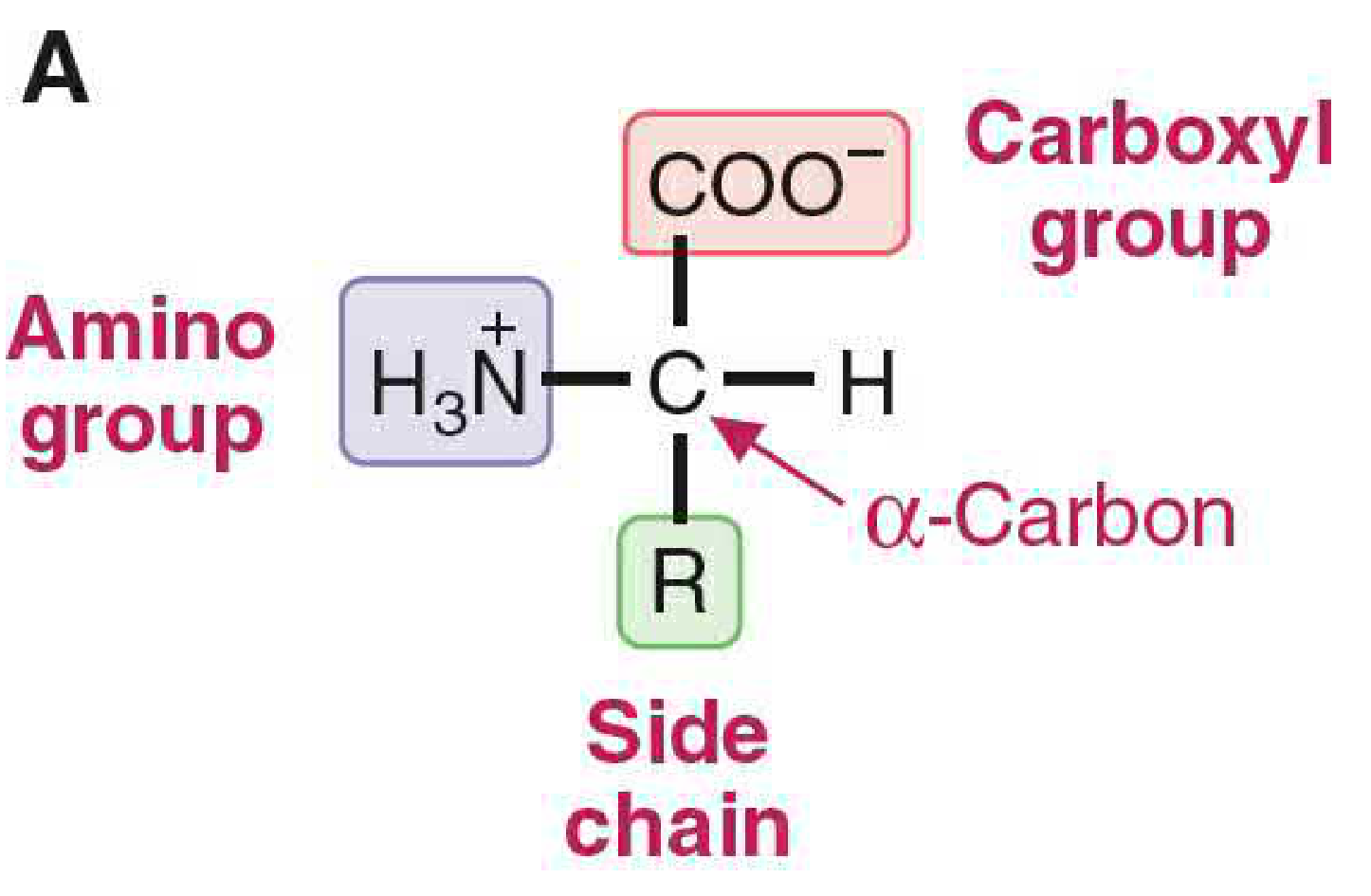
At physiologic pH (~7.4), both the alpha-carboxyl and alpha-amino groups are ionized, forming a zwitterion (dipolar ion). All 20 proteinogenic amino acids are L-isomers - the D form does not appear in human proteins.
Proline is the one exception to the basic structure: its R group is bonded back to the amino nitrogen, forming a rigid cyclic imino acid. This restricts backbone flexibility and is commonly found in turns and loops.
2. Classification by R Group
A. Nonpolar Aliphatic
Hydrophobic side chains cluster in protein interiors, away from water (hydrophobic effect).
| Amino Acid | Symbol | Hydropathy Index |
|---|---|---|
| Glycine | Gly, G | -0.4 |
| Alanine | Ala, A | 1.8 |
| Valine | Val, V | 4.2 |
| Leucine | Leu, L | 3.8 |
| Isoleucine | Ile, I | 4.5 |
| Proline | Pro, P | -1.6 |
| Methionine | Met, M | 1.9 |
B. Aromatic
Phenylalanine (Phe, F), Tyrosine (Tyr, Y), and Tryptophan (Trp, W). Tyrosine and Trp are also polar due to -OH and indole groups, respectively.
C. Polar Uncharged
Serine (Ser, S), Threonine (Thr, T), Asparagine (Asn, N), Glutamine (Gln, Q), Cysteine (Cys, C). These form hydrogen bonds. Cysteine uniquely contains a sulfhydryl (-SH) group and can form disulfide bridges stabilizing protein tertiary structure.
D. Acidic (Negatively Charged at pH 7)
- Aspartate (Asp, D)
- Glutamate (Glu, E)
Their R groups carry a net negative charge, allowing ionic interactions with positively charged molecules.
E. Basic (Positively Charged at pH 7)
- Lysine (Lys, K) - ε-amino group, pKa ~10.5
- Arginine (Arg, R) - guanidinium group, most basic (pKa ~12.5)
- Histidine (His, H) - imidazole ring, pKa ~6.0 (near physiologic pH, making it key in enzyme active sites and hemoglobin buffering)
3. Essential vs. Nonessential
Essential amino acids must come from the diet because humans cannot synthesize them (or cannot synthesize enough). A mnemonic: PVT TIM HaLL - Phenylalanine, Valine, Threonine, Tryptophan, Isoleucine, Methionine, Histidine, Leucine, Lysine.
Arginine and histidine are sometimes called "conditionally essential" - not required to maintain nitrogen balance in adults, but necessary for normal growth (especially in children).
Conditionally essential amino acids become essential under specific stress states - e.g., glutamine and arginine supplementation improves outcomes in trauma, postoperative infections, and immunosuppression.
4. Glucogenic vs. Ketogenic
Based on which metabolic intermediate their carbon skeletons produce during catabolism:
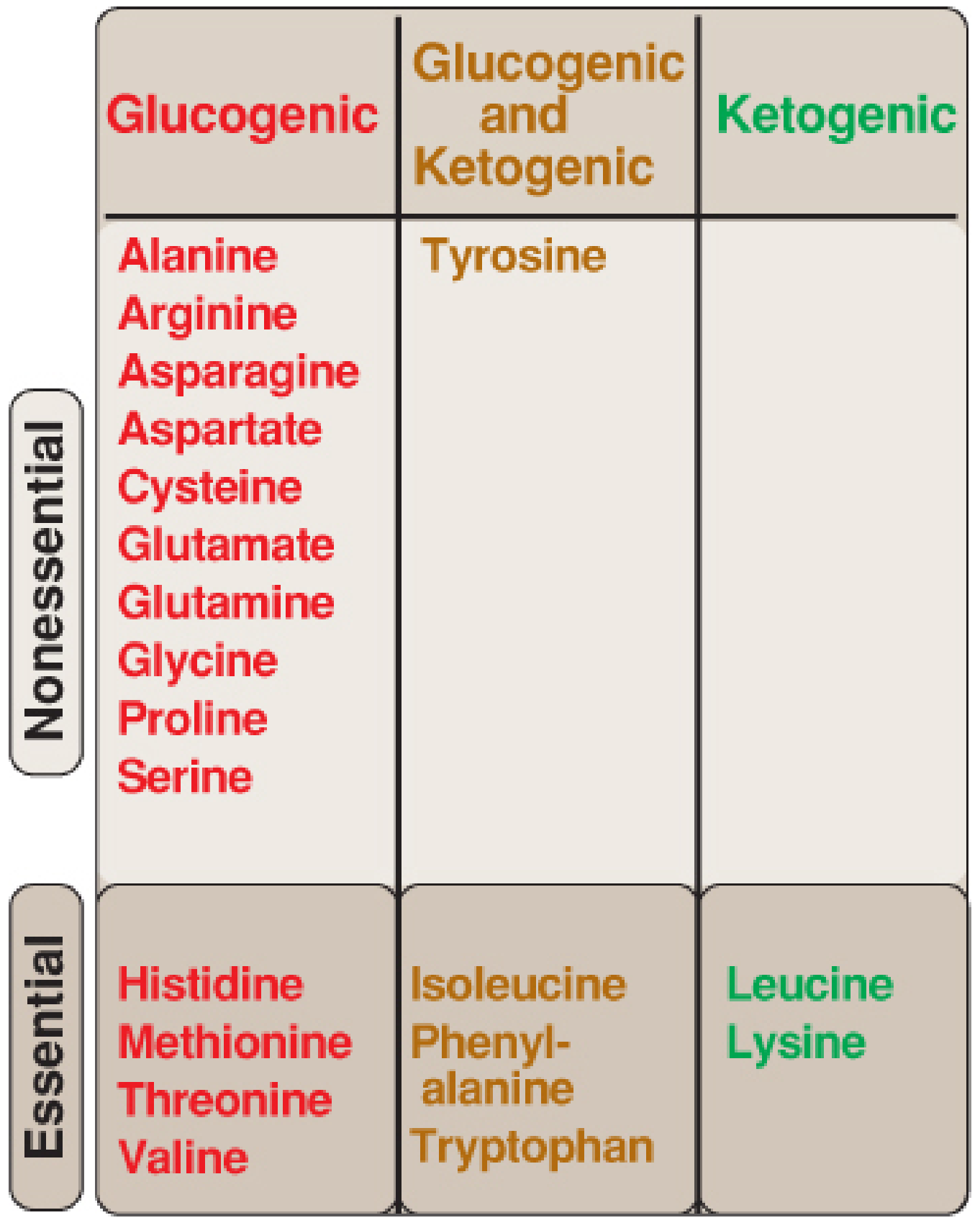
- Glucogenic only: Alanine, Arginine, Asparagine, Aspartate, Cysteine, Glutamate, Glutamine, Glycine, Histidine, Methionine, Proline, Serine, Threonine, Valine - their skeletons enter gluconeogenesis via pyruvate or TCA intermediates.
- Ketogenic only: Leucine and Lysine - the only two that cannot contribute to net glucose synthesis.
- Both glucogenic and ketogenic: Isoleucine, Phenylalanine, Tryptophan, Tyrosine.
5. Functions Beyond Protein Synthesis
Amino acids serve many roles beyond building proteins:
| Amino Acid | Key Role |
|---|---|
| Tryptophan | Precursor to serotonin, melatonin, niacin |
| Phenylalanine/Tyrosine | Precursors to dopamine, epinephrine, norepinephrine, thyroid hormones |
| Glycine | Neurotransmitter; component of heme and purines |
| Glutamate | Major excitatory neurotransmitter in CNS |
| GABA (from Glu) | Major inhibitory neurotransmitter |
| Histidine | Precursor to histamine |
| Arginine | Precursor to nitric oxide (NO) via NO synthase |
| Cysteine | Component of glutathione (antioxidant) |
| Methionine | Universal methyl donor (as SAM) |
| Glutamine | Major nitrogen carrier in blood; fuel for enterocytes |
6. Modified Amino Acids (Posttranslational)
Many proteins contain amino acids modified after synthesis: phosphorylation (Ser, Thr, Tyr), hydroxylation (Pro → hydroxyproline in collagen; Lys → hydroxylysine), carboxylation (Glu → γ-carboxyglutamate in clotting factors), and acetylation. These are not encoded directly but arise through enzyme-catalyzed posttranslational modifications.
Selenocysteine is a rare 21st amino acid where cysteine's sulfur is replaced by selenium, encoded by UGA (normally a stop codon) in specific contexts.
Sources: Basic Medical Biochemistry - A Clinical Approach (6th ed.) | Lippincott Illustrated Reviews: Biochemistry (8th ed.) | Ganong's Review of Medical Physiology (26th ed.)
Create a study guide or reference card on amino acid structure and classification
Asking for Preferences
What format would you like the study guide in?
This is a shared conversation. Sign in to Orris to start your own chat.