
Describe function of phargynx
Reading File
Now let me search the medical library for pharynx function content.
Finding Sources
Finding Sources
Good results. Now let me read the key sections from Gray's Anatomy and Cummings for a thorough description.
Reading File
Reading File
Let me fetch the pharynx diagram and read more content from Scott-Brown's and Gray's for functions.
Loading Image
Reading File
Reading File
I now have enough high-quality information to give a thorough answer. Let me compile the full response.
Functions of the Pharynx
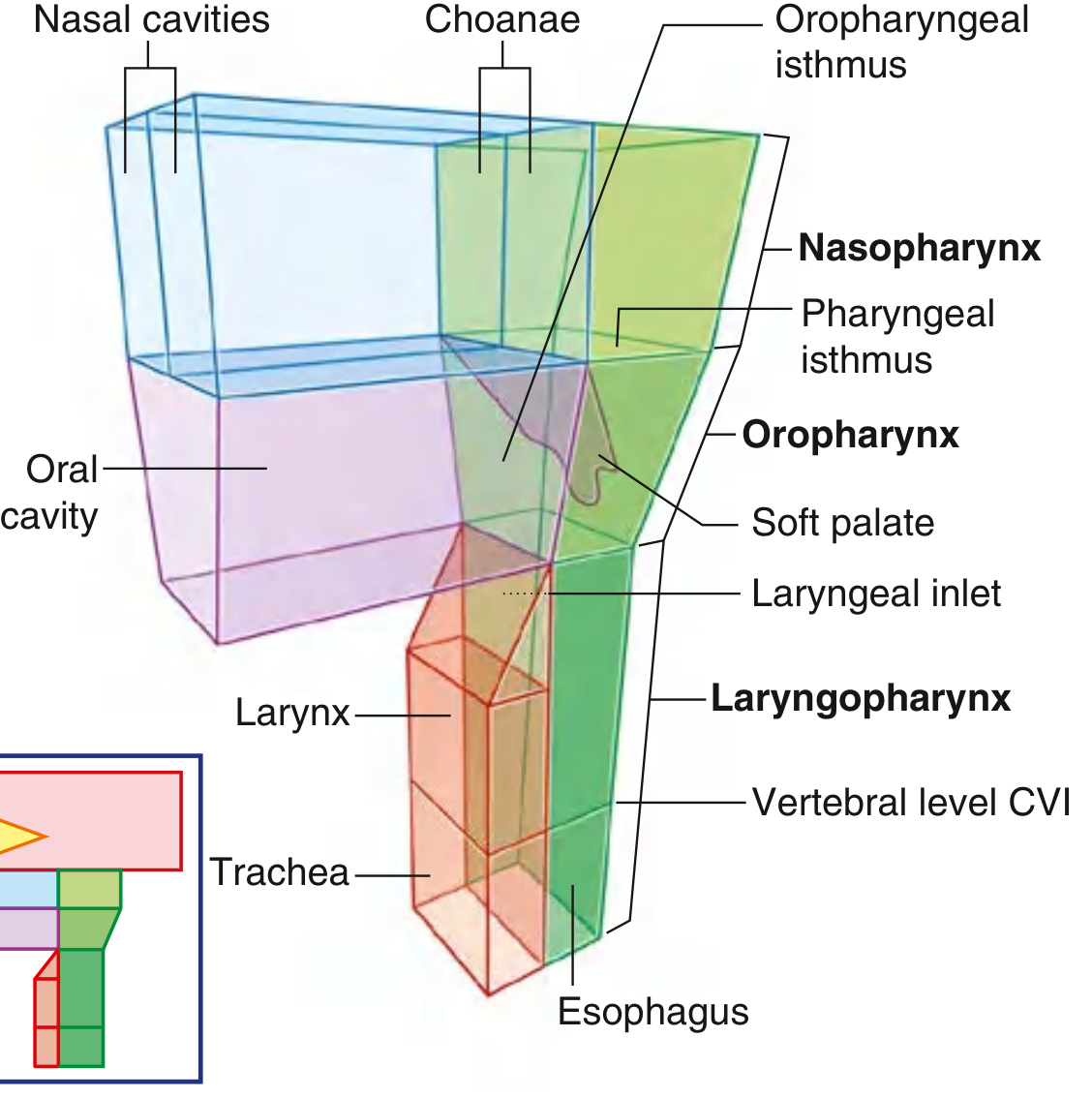
The pharynx is a musculofascial half-cylinder that links the oral and nasal cavities above to the larynx and esophagus below. It extends from the base of the skull to approximately the level of vertebra C6, where it becomes continuous with the esophagus. Its cavity serves as a common pathway for both air and food, and this dual role underpins most of its functions.
1. Deglutition (Swallowing) - Primary Function
The primary function of the pharynx is swallowing. Food prepared in the oral cavity is ejected into the pharynx and rapidly propelled downward around the glottis, through the piriform sinuses, and into the esophagus.
This is accomplished by two groups of muscles:
- Constrictor muscles (superior, middle, inferior): These narrow the pharyngeal cavity sequentially from top to bottom, moving a bolus of food through the pharynx into the esophagus. They are innervated by the vagus nerve (CN X). (- K.J. Lee's Essential Otolaryngology, p. 13623)
- Longitudinal muscles (stylopharyngeus, salpingopharyngeus, palatopharyngeus): These elevate the pharyngeal wall and pull it upward and over the descending food bolus, facilitating its passage into the esophagus. (- Gray's Anatomy for Students)
The pharynx and larynx must work in a coordinated manner during swallowing. If these systems fail to function properly, the airway can be obstructed or pharyngeal contents can be aspirated, leading to lung disease. (- Murray & Nadel's Textbook of Respiratory Medicine)
2. Airway Conduction (Respiration)
The pharynx serves as a conduit for airflow between the nasal/oral cavities and the larynx/trachea below. The nasopharynx receives air from the posterior nasal apertures (choanae), and passes it downward toward the laryngeal inlet. (- Gray's Anatomy for Students)
3. Subdivisions and Their Specific Functions
The pharynx is divided into three regions, each with distinct roles:
| Region | Location | Key Function |
|---|---|---|
| Nasopharynx | Behind nasal cavities, above soft palate | Airway; houses the pharyngotympanic (Eustachian) tube openings; contains pharyngeal tonsils |
| Oropharynx | Behind oral cavity, between soft palate and hyoid | Common air/food passage; contains palatine and lingual tonsils |
| Laryngopharynx (Hypopharynx) | Behind larynx, from hyoid to C6 | Directs food into esophagus via piriform sinuses; food/air separation occurs here |
4. Nasopharyngeal (Eustachian Tube) Regulation
The lateral walls of the nasopharynx contain the openings of the pharyngotympanic (Eustachian) tubes. These tubes equalize pressure between the middle ear and the atmosphere. During swallowing, the salpingopharyngeus muscle opens the tube, allowing pressure equalization - this is why swallowing "pops" the ears during altitude changes. (- Gray's Anatomy for Students)
5. Immune Defense (Lymphoid Tissue - Waldeyer's Ring)
The pharyngeal walls house a collection of lymphoid tissues forming Waldeyer's ring:
- Pharyngeal tonsils (adenoids) - in the nasopharynx
- Palatine tonsils - in the oropharynx
- Lingual tonsils - at the base of the tongue
These structures sample antigens from inhaled and ingested material and form part of the mucosal immune defense system.
6. Nasopharyngeal Separation (Velopharyngeal Closure)
The soft palate acts as a "flutter valve" in relation to the pharynx:
- It elevates to close the pharyngeal isthmus, sealing off the nasopharynx from the oropharynx during swallowing (preventing food/liquid from entering the nasal cavity)
- It depresses to close the oropharyngeal isthmus and seal off the oral cavity
During swallowing, the superior constrictor contracts to form a prominent ridge (Passavant's ridge) that catches the margin of the elevated soft palate, sealing the isthmus closed. (- Gray's Anatomy for Students)
7. Phonation and Speech
The pharynx acts as a resonating chamber that shapes the quality of the voice. Alterations in pharyngeal shape and muscle tone affect speech sounds, particularly vowels. Neuromuscular disorders affecting the pharynx produce hyponasal or hypernasal speech and dysarthria. (- Cummings Otolaryngology)
8. Taste Sensitivity
While taste is primarily a function of the tongue, regions of the pharynx (along with the palate and epiglottis) also possess some taste sensitivity via innervation from the glossopharyngeal nerve (CN IX). CN IX supplies sensation to the pharynx and tonsillar fossa, and taste to the posterior third of the tongue. (- Textbook of Family Medicine 9e; Neuroscience: Exploring the Brain)
Innervation Summary
| Nerve | Role |
|---|---|
| CN IX (Glossopharyngeal) | Sensory to pharynx and tonsillar fossa; taste to posterior tongue |
| CN X (Vagus) | Motor to constrictor muscles; coordinates swallowing |
| CN XI (Accessory) | Contributes via CN X |
Sources: Gray's Anatomy for Students; Cummings Otolaryngology Head and Neck Surgery; K.J. Lee's Essential Otolaryngology; Murray & Nadel's Textbook of Respiratory Medicine; Scott-Brown's Otorhinolaryngology Head & Neck Surgery.
This is a shared conversation. Sign in to Orris to start your own chat.