


IMG-20260724-WA0017.jpg
IMG-20260724-WA0015.jpg
Treatment for this pt
analyse_media
analyse_media
Both images show classic urticaria (hives). Now let me pull treatment details from the medical library.
Reading File
Finding Sources
Finding Sources
Reading File
Reading File
Reading File
Loading Image
Reading File
I now have comprehensive data from Goldman-Cecil Medicine, Fitzpatrick's Dermatology, and Dermatology 2-Volume Set. Here is the full clinical answer:
Diagnosis: Urticaria (Hives)
Image findings: Both photos show classic urticarial wheals - raised, edematous plaques with erythematous borders, central pallor, smooth intact surface, and serpiginous/geographic confluent pattern on the forearm and around the elbow. No vesicles, scaling, or crusting.
Treatment Algorithm
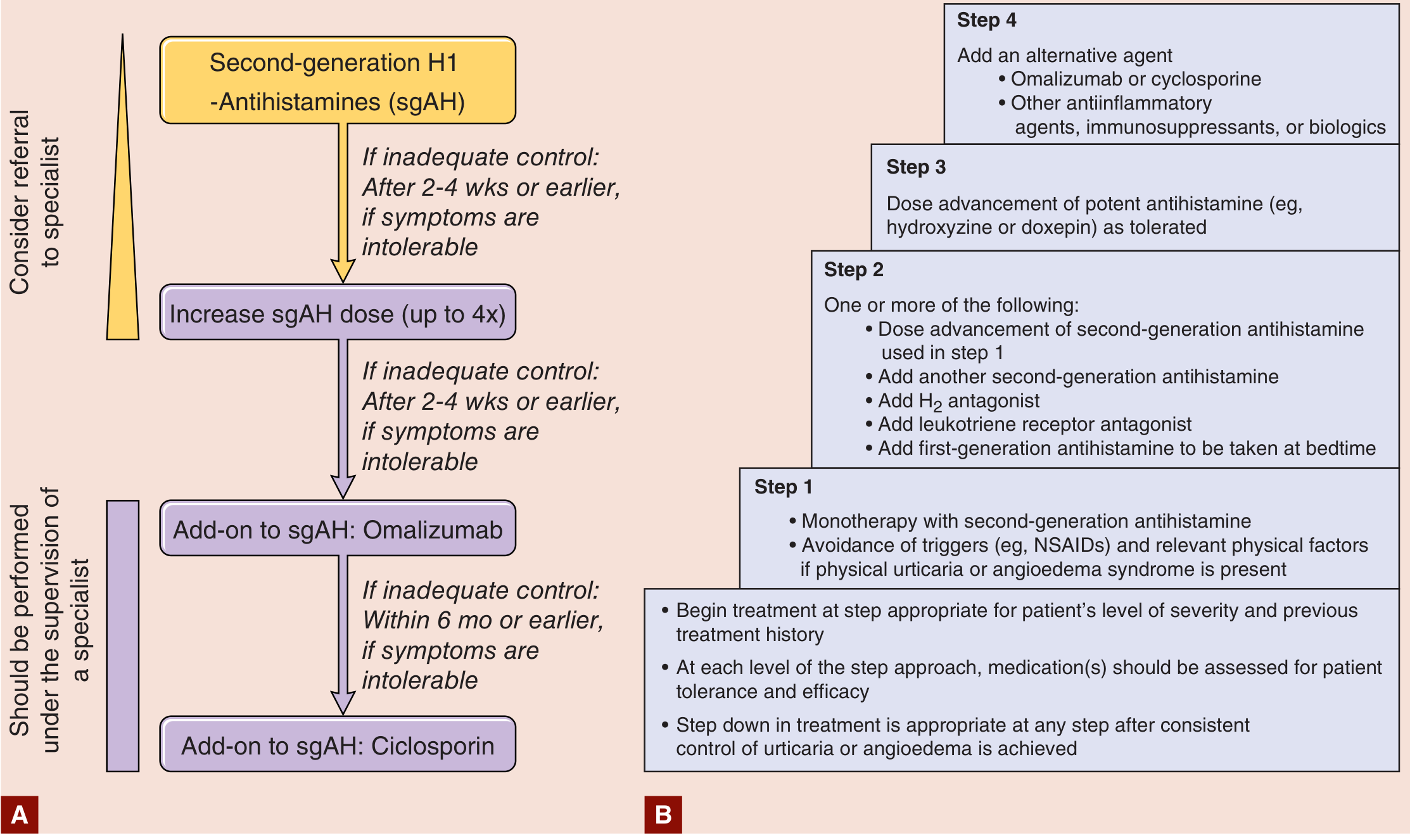
Treatment algorithm for urticaria - EAACI/GALENand AAAAI guidelines (Fitzpatrick's Dermatology)
Step 1 - First line (ALL cases)
Identify and remove the trigger - medications (especially NSAIDs, antibiotics), foods, infections, physical stimuli.
Second-generation (non-sedating) H1 antihistamines - preferred over first-generation due to fewer side effects:
| Drug | Dose | Notes |
|---|---|---|
| Cetirizine | 10 mg/day PO | Preferred; rapid onset |
| Levocetirizine | 2.5-5 mg/day PO | More potent isomer |
| Fexofenadine | 120-180 mg/day PO | Least sedating |
| Loratadine | 10 mg/day PO | Safe in pregnancy |
- Goldman-Cecil Medicine, p. 4904
Step 2 - If inadequate control after 2-4 weeks (or sooner if intolerable)
Dose-advance second-generation antihistamine up to 4x the standard dose, plus any of:
- Add an H2 antagonist (famotidine 20 mg twice daily or cimetidine 400 mg twice daily) - useful since 15% of skin histamine receptors are H2
- Add a leukotriene receptor antagonist - montelukast 10 mg/day
- Add a first-generation antihistamine at bedtime (e.g., hydroxyzine 10-25 mg, diphenhydramine 25-50 mg)
If Severe Acute Urticaria (with or without angioedema)
- Diphenhydramine 25-50 mg PO or 10-50 mg IV/IM q4-6h (max 400 mg/24h)
- Corticosteroids - short course only:
- Prednisone 0.5-1 mg/kg/day (up to 30-50 mg/day) tapered over 1-2 weeks
- OR Triamcinolone 40-60 mg IM single dose
- OR Dexamethasone 4-20 mg IV/IM for severe cases
- Steroids should be used as rescue medication, not long-term, due to rebound and side effects - Dermatology 2-Vol Set, p. 500
Step 3 - Refractory Chronic Urticaria (specialist referral)
- Omalizumab (anti-IgE monoclonal antibody) 150-300 mg SC monthly - strong evidence, well tolerated
- Ciclosporin 3 mg/kg/day for 8-16 weeks (under specialist supervision)
- Other options with weaker evidence: dapsone, hydroxychloroquine, methotrexate, narrow-band UVB, IVIG
If Anaphylaxis (throat/tongue swelling, wheezing, hypotension)
- Epinephrine 0.3-0.5 mg IM (1:1000) thigh - immediately
- IV fluids, oxygen, IV diphenhydramine + IV famotidine, IV methylprednisolone
- This is a medical emergency - Goldman-Cecil, p. 4914-4920
Special Populations
- Pregnancy: Loratadine or cetirizine are preferred (former FDA category B); avoid hydroxyzine near parturition
- Children: Rarely need step 3 therapies; cetirizine or loratadine weight-adjusted
- Breastfeeding: Loratadine and cetirizine are compatible
Practical Points for This Patient
- Check history for recent new drugs, foods, infections (most common triggers)
- Start cetirizine 10 mg daily (or levocetirizine 5 mg)
- If very itchy and disturbing sleep, add hydroxyzine 25 mg at bedtime
- If wheals are large or spreading, short course of prednisolone 20-40 mg/day x 3-5 days provides rapid relief
- If lesions persist > 6 weeks - classify as chronic urticaria and investigate for underlying cause (thyroid antibodies, ANA, CBC, LFT)
- Avoid NSAIDs and aspirin (can trigger or worsen urticaria)
Note: If the patient develops facial/throat swelling, difficulty breathing, or dizziness, treat as anaphylaxis and refer immediately to emergency care.
Yes itching increase
With increasing itch, this patient needs more aggressive antihistamine coverage plus a short steroid burst.
Immediate management for worsening urticaria with increased pruritus:
Oral Regimen (preferred if no airway symptoms)
| Drug | Dose | Timing |
|---|---|---|
| Levocetirizine 5 mg (or Cetirizine 10 mg) | 1 tab | Morning |
| Hydroxyzine 25 mg | 1 tab | Night (sedating - helps sleep) |
| Prednisolone 20-40 mg | Once daily | Morning with food × 3-5 days then taper |
The steroid burst rapidly suppresses the allergic response. Do NOT use long-term.
Add-on for Breakthrough Itch
- Montelukast 10 mg once at night - leukotriene blocker, works synergistically with antihistamine
- Calamine lotion topically for immediate itch relief (cooling effect)
- Cold compress on wheals - reduces histamine release locally
If Still Not Controlled (48-72 hrs)
- Escalate to Chlorphenamine 4 mg q6h (sedating first-gen H1) as bridging
- Or Dexamethasone 4-8 mg IM/IV single dose if very severe
Key Advice to Patient
- Avoid scratching - breaks skin, risks secondary infection
- Wear loose, cotton clothing
- Avoid heat, tight clothing, hot showers - all worsen histamine release
- Identify and stop any new drug, food, or supplement started recently
- Return immediately if lips/tongue/throat swell or breathing difficulty
Red Flag - Refer to Emergency If:
- Throat/tongue swelling (angioedema)
- Hoarse voice or stridor
- Difficulty breathing or swallowing
- Dizziness/drop in BP → anaphylaxis protocol with epinephrine 0.3 mg IM
They don't have any medicine access more than Cetirizine and one Cetirizine taken now what
With only Cetirizine available and one dose already taken, here's what to do right now:
What They've Done ✓
- Cetirizine 10 mg taken - good. It will start working within 1-2 hours. Peak effect at 4-6 hours.
Right Now - Non-Drug Measures (Do Immediately)
These actually work and can reduce itch significantly:
-
Cold compress / ice pack wrapped in cloth - apply directly on wheals for 10-15 mins. Cold constricts blood vessels and suppresses histamine release. Repeat every 30 mins.
-
Cold water rinse - run cool/cold water over the arm for 5-10 minutes
-
Do NOT scratch - scratching releases more histamine → more itch → more wheals (vicious cycle)
-
Remove tight clothing/sleeves - pressure on skin worsens urticaria
-
Stay in a cool room / use a fan - heat worsens itching significantly
-
Avoid hot food, spicy food, alcohol right now - all trigger histamine release
Next Cetirizine Dose
- If itching is still bad after 24 hours, take the next Cetirizine 10 mg
- Do NOT double dose at once
Get These ASAP (basic pharmacy items)
In order of priority:
- Prednisolone 20-40 mg (very cheap, widely available) - most effective for acute flare
- Chlorphenamine / Pheniramine tablets - cheap, available everywhere
- Calamine lotion - topical, immediate cooling relief
Go to Emergency NOW if any of these appear:
- 🚨 Swelling of lips, tongue, or throat
- 🚨 Difficulty breathing or swallowing
- 🚨 Dizziness or feeling faint
- 🚨 Wheals spreading rapidly over whole body
Otherwise - cold compress + wait for Cetirizine to kick in is the safest approach right now.
Can I give levocetrizine now
Yes, you can give Levocetirizine now - but with one important consideration:
Is It Safe After Cetirizine?
Technically yes, but timing matters.
- Levocetirizine is the active R-enantiomer of Cetirizine
- They work on the same H1 receptors
- Giving both close together = additive H1 blockade but also additive side effects (sedation, dizziness)
Practical Decision:
| Time since Cetirizine | Action |
|---|---|
| < 2 hours ago | ⚠️ Wait - Cetirizine hasn't peaked yet (peak = 1-2 hrs). Give it time to work first. |
| 2-4 hours ago, itch still bad | ✅ Can give Levocetirizine 5 mg cautiously |
| > 6 hours ago | ✅ Safe to give Levocetirizine 5 mg as next dose |
If You Give It Now
- Use Levocetirizine 5 mg only (standard dose - don't exceed)
- Watch for drowsiness - patient should not drive
- Monitor for itch relief over next 1-2 hours
Bottom Line
If the itch is increasing and distressing and it's been at least 1-2 hours since Cetirizine - go ahead with Levocetirizine 5 mg. The combination is used in practice for refractory acute urticaria.
Tomorrow, choose one of them as the regular daily antihistamine - don't continue both long-term.
Now she don't have any itching but now it's on another two place of body
This is classic urticaria behavior - wheals migrate. This is actually a good sign in one way but also means she needs proper treatment.
Why Is This Happening?
Urticarial wheals characteristically:
- Appear, disappear, and move to new sites within hours
- Old wheals resolve as new ones form elsewhere
- Each wheal typically lasts < 24 hours at one spot
- This migratory pattern = confirms urticaria diagnosis
The itch stopping = antihistamine is working on histamine ✓
New sites appearing = ongoing allergic trigger still active ⚠️
What This Means Clinically
The antihistamine is controlling symptoms but not stopping the underlying trigger. The allergic process is still running.
Action Right Now
She needs Prednisolone/Corticosteroid urgently to stop the spreading:
- Without steroids, wheals will keep migrating and potentially worsen over next few hours
- Antihistamine alone may not be enough if lesions keep spreading
Immediate Steps
- ✅ Good - itch is controlled, stay calm
- 🌡️ Cold compress on new sites immediately
- 💊 Get Prednisolone 20-40 mg as soon as possible tonight
- 📋 Document trigger - what did she eat/take/touch in last 2-4 hours?
🚨 Watch Closely for Next 2 Hours:
| Sign | Action |
|---|---|
| Spreads to face/lips | Go to ER now |
| Any throat tightness | Emergency - call ambulance |
| Difficulty breathing | Epinephrine + Emergency |
| Just new skin wheals | Monitor, cold compress, get steroids |
Tonight's Plan
If only skin involvement (no face, no throat):
- Continue monitoring every 30 mins
- Get Prednisolone first thing tomorrow morning if not available tonight
- Next Levocetirizine 5 mg tomorrow morning
If wheals keep spreading rapidly tonight → go to emergency, IV antihistamine + IV steroid is needed.
This is a shared conversation. Sign in to Orris to start your own chat.