
Na k pump samjhao aur batao water ka kya physiology
Na-K pump (Sodium-Potassium ATPase) ek active transport mechanism hai jo har cell mein hota hai - 3 Na+ bahar nikalta hai aur 2 K+ andar leta hai, ATP use karke. Water physiology osmosis pe based hai - water hamesha low osmolarity se high osmolarity ki taraf move karta hai.
Searching sources...
Reading File
Finding Sources
Finding Sources
Finding Sources
Finding Sources
Finding Sources
Finding Sources
Reading File
Finding Sources
Reading File
Reading File
Reading File
Ab mere paas Guyton & Hall aur Brenner & Rector se excellent content hai. Images bhi fetch karte hain aur complete answer deta hoon.
Loading Image
Loading Image
Ab dono topics ka detailed, easy Hinglish explanation deta hoon:
⚡ Na⁺-K⁺ ATPase Pump (Sodium-Potassium Pump)
Kya hai ye pump?
Na⁺-K⁺ ATPase pump ek primary active transporter hai jo har cell ki plasma membrane mein hota hai. Ye pump ATP ki energy use karke sodium aur potassium ko unke concentration gradient ke khilaf move karta hai.
Simple Rule yaad rakhein:
"3 Na⁺ bahar, 2 K⁺ andar" - aur 1 ATP kharch hoti hai
Structure (Brenner & Rector's The Kidney se)
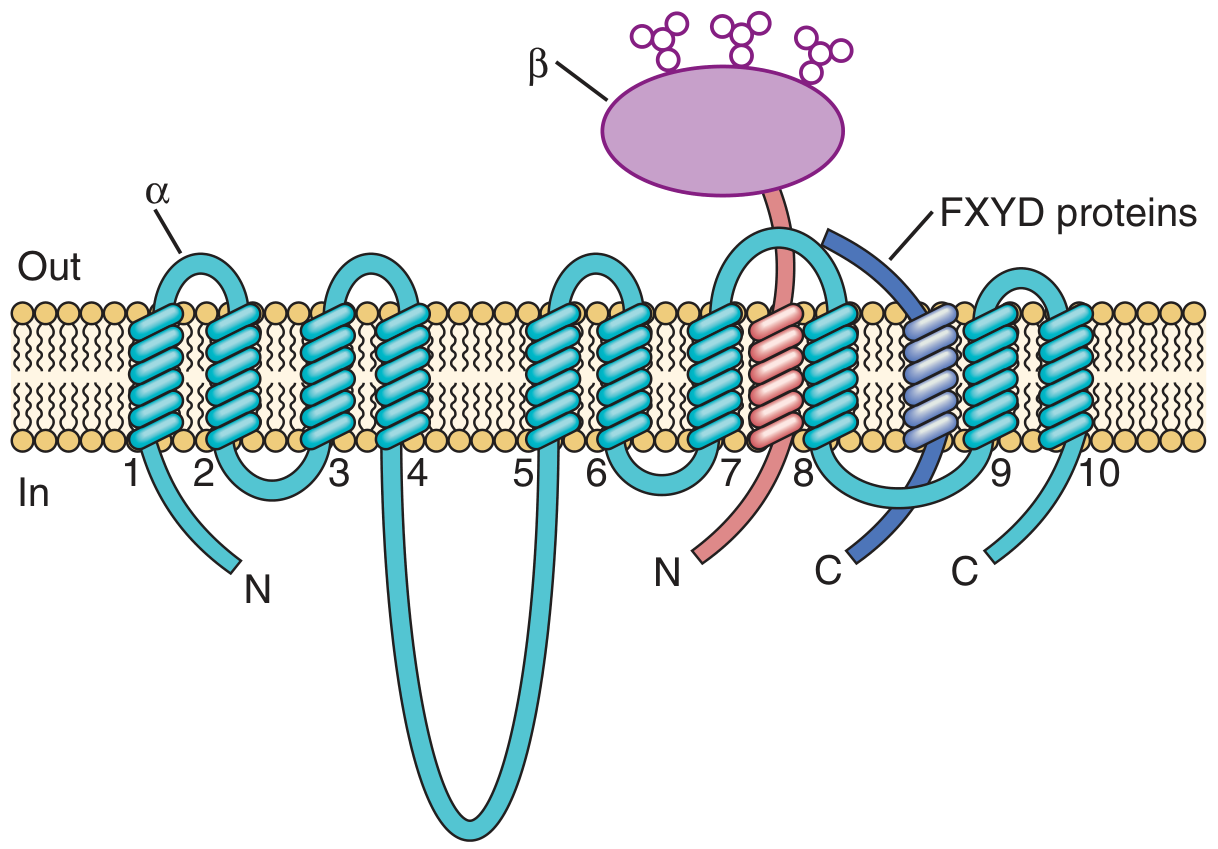
Pump teen subunits se bana hota hai:
| Subunit | Kaam |
|---|---|
| α (alpha) - catalytic | ATP hydrolyze karta hai, Na⁺ aur K⁺ transport karta hai, 10 transmembrane segments hain |
| β (beta) | Pump ko plasma membrane tak pahunchane mein help karta hai (maturation) |
| FXYD proteins | Pump ki kinetics ko tissue-specific tarike se modulate karte hain |
Kidney mein mainly α1β1 heterodimer hota hai.
Mechanism - Step by Step
CELL KE ANDAR                    CELL KE BAHAR
[HIGH Na⁺]  ←←←←← 3 Na⁺ ←←←←← [LOW Na⁺]
[LOW K⁺]    →→→→→ 2 K⁺  →→→→→ [HIGH K⁺]
                     ↑
                  ATP → ADP + Pi
                  (Energy milti hai)
Step 1: Pump ke cytoplasmic side par 3 Na⁺ ions bind hote hain
Step 2: ATP hydrolysis hoti hai → pump phosphorylated hota hai
Step 3: Pump conformation change karta hai → 3 Na⁺ bahar nikal jaate hain
Step 4: Bahar se 2 K⁺ ions bind hote hain
Step 5: Dephosphorylation → pump original shape mein aata hai
Step 6: 2 K⁺ andar release ho jaate hain
Electrochemical Effects
Is pump ki wajah se:
- Cell ke andar: Low Na⁺, High K⁺, net negative charge (-70 mV resting membrane potential)
- Cell ke bahar: High Na⁺, Low K⁺
Ye gradient bahut important hai kyunki:
- Action potentials (nerve, muscle) isi gradient pe depend karte hain
- Secondary active transport (glucose, amino acid absorption) Na⁺ gradient use karta hai
- Cell volume regulate hoti hai
Pump-Leak Balance (Guyton & Hall se)
Steady state mein:
Jo Na⁺ pump bahar nikalta hai, utna hi Na⁺ channels se back-leak karke andar aata hai. Goldman voltage equation se membrane potential calculate hoti hai (Na, K, Cl permeabilities consider karke).
Agar pump fail ho jaye? (Robbins Pathology se)
- Na⁺ cell mein accumulate hota hai → osmotic water entry → cell swelling
- K⁺ bahar nikal jaata hai
- Ye cell injury ka early sign hai (jaise ischemia mein hota hai)
Kidney mein Na-K pump ka role
- Renal tubular cells ki basolateral membrane mein exclusively hota hai
- Na⁺ ko interstitium mein pump karke low intracellular Na⁺ maintain karta hai
- Isse luminal side par Na⁺ ke liye driving force banta hai (secondary active transport)
- Aldosterone is pump ko stimulate karta hai → more Na⁺ reabsorption, more K⁺ secretion
💧 Water Physiology
Total Body Water (TBW)
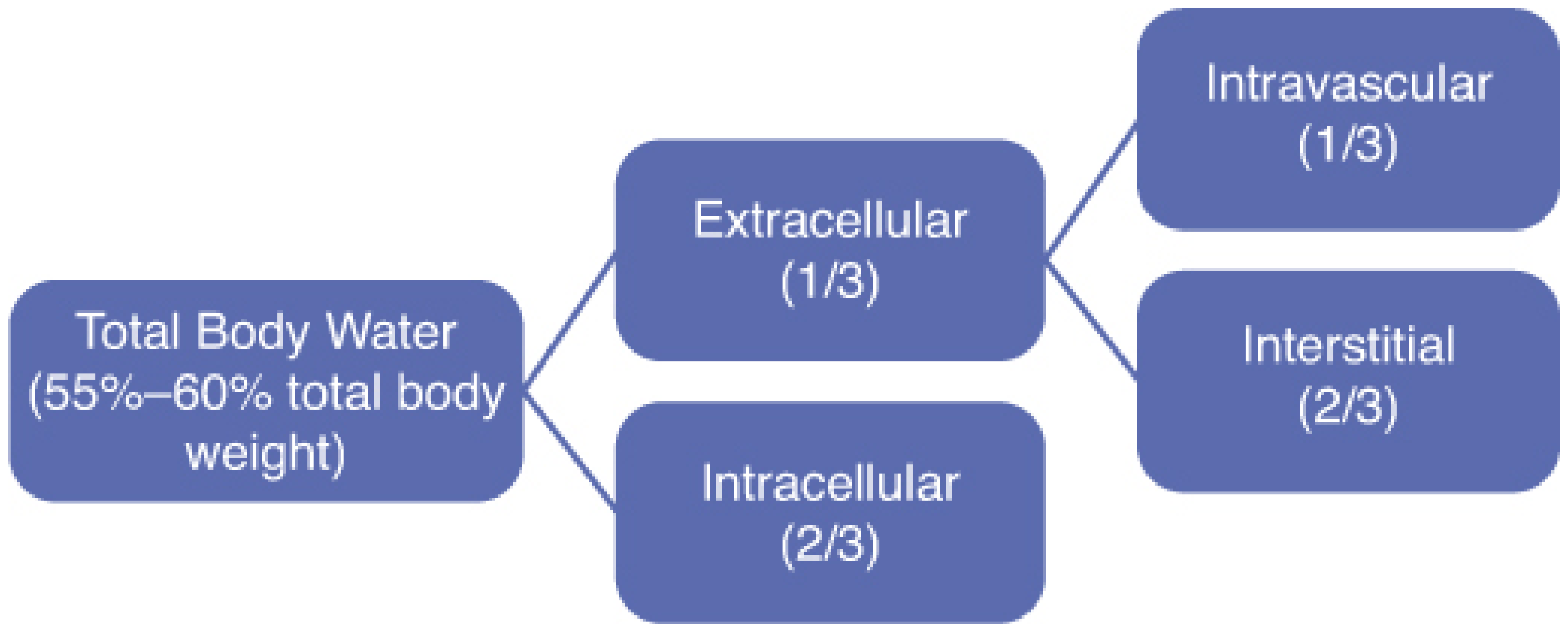
| Compartment | % of Body Weight | % of TBW |
|---|---|---|
| Total Body Water | 55-60% (male), 50-55% (female) | 100% |
| Intracellular Fluid (ICF) | ~40% | 2/3 |
| Extracellular Fluid (ECF) | ~20% | 1/3 |
| - Interstitial fluid | ~15% | ECF ka 2/3 |
| - Plasma (Intravascular) | ~5% | ECF ka 1/3 |
60-40-20 Rule yaad rakhein: TBW = 60%, ICF = 40%, ECF = 20% of body weight
Osmosis - Water Movement ka Principle
Cell membrane water ke liye highly permeable hai (aquaporins ke zariye) lekin most solutes ke liye impermeable.
Rule:
Water HAMESHA low osmolarity se HIGH osmolarity ki taraf move karta hai
Example (Guyton & Hall se):
- Agar ECF mein NaCl add ho → ECF osmolarity badh gayi
- Water cells se bahar nikal ke ECF mein aata hai → dono sides equal ho jaayein
- Agar NaCl ECF se remove ho → Water cells mein jaata hai
Osmolarity kya hai?
| Term | Definition |
|---|---|
| Osmolality | Osmoles per kg water |
| Osmolarity | Osmoles per liter solution |
Body mein practically dono almost same hain (~300 mOsm/L).
Normal body fluid osmolarity = ~300 mOsm/L (plasma, interstitial, intracellular - teeno equal)
Composition breakdown:
- ECF/Plasma: 80% osmolarity Na⁺ aur Cl⁻ se
- ICF: Almost half K⁺ se, baaki other intracellular substances
Normal Saline (0.9% NaCl) calculation:
- 9g NaCl / liter
- MW of NaCl = 58.5 g/mol
- Molarity = 9/58.5 = 0.154 mol/L
- NaCl → 2 ions (Na⁺ + Cl⁻)
- Osmolarity = 0.154 × 2 × 0.93 (osmotic coefficient) = ~286 mOsm/L ✓ (Isotonic!)
Water aur Na-K Pump ka Connection
Na-K pump aur water physiology deeply linked hain:
Na-K Pump → Na⁺ bahar → ECF osmolarity badha
                       ↓
              Water cells se bahar aata hai (osmosis)
                       ↓
              Cell volume maintain hoti hai
Agar Na-K pump band ho:
→ Na⁺ cells mein accumulate → osmotic pressure badhti hai → water cells mein → cellular edema
Water Regulation Summary
| Factor | Effect |
|---|---|
| ADH (Vasopressin) | Aquaporin-2 channels insert karta hai collecting duct mein → water reabsorption badha |
| Aldosterone | Na⁺ retain → osmotically water bhi retain |
| Atrial Natriuretic Peptide (ANP) | Na⁺ excretion badha → water bhi lose hoti hai |
| Osmoreceptors (hypothalamus) | Serum osmolarity >295 → thirst + ADH release |
Sources: Guyton and Hall Textbook of Medical Physiology | Brenner and Rector's The Kidney | Fischer's Mastery of Surgery
Matalb jiss side na udhar water
Bilkul sahi pakda! Ye ek golden rule hai physiology mein:
💧 "Jahan Na⁺ jaaye, wahan Water jaata hai"
Kyun?
Kyunki Na⁺ ek osmotically active solute hai - ye paani ko apni taraf "kheenchta" hai.
Na⁺ move kiya  →  Osmolarity us side badh gayi
                          ↓
              Water osmosis se us side aata hai
                          ↓
              Dono sides ka osmolarity phir equal ho jaata hai
Real Examples:
1. Kidney Tubule mein
Na-K pump Na⁺ ko cell se basolateral side (interstitium) mein pump karta hai
→ Interstitium osmolarity badh jaati hai
→ Water bhi tubule se osmosis se reabsorb ho jaata hai
→ Urine concentrate hota hai
2. Aldosterone
Aldosterone Na⁺ reabsorption badhata hai
→ Water automatically follow karta hai
→ Blood volume badh jaata hai → BP badh jaata hai
3. Diarrhea/Vomiting
Na⁺ bahar nikal jaata hai stool/vomit se
→ Water bhi saath nikal jaata hai
→ Dehydration ho jaati hai
4. Diuretics (Furosemide)
Na⁺ reabsorption block karo
→ Na⁺ urine mein jaata hai
→ Water bhi urine mein jaata hai
→ Edema/hypertension treat hota hai
Ek aur Important Point:
Water KABHI actively transport nahi hota - ye hamesha passively osmosis se follow karta hai Na⁺ ko.
Isliye doctors kehte hain:
- "Na manages water"
- Hyponatremia (low Na⁺) = cells mein water chali jaati hai = cerebral edema risk
- Hypernatremia (high Na⁺) = cells se water nikal jaata hai = cell shrinkage
Short mein: Na⁺ = Boss, Water = Follower 🎯
This is a shared conversation. Sign in to Orris to start your own chat.