
Frozen shoulder history and examination orthopaedics
Reading File
Now let me search for frozen shoulder content in the library simultaneously across headings and paragraphs:
Finding Sources
Finding Sources
Searching the Web
frozen shoulder adhesive capsulitis history examination orthopaedics clinical features
Good — I have strong hits in Miller's Review of Orthopaedics and other texts. Let me read all the relevant sections in parallel:
Reading File
Reading File
Reading File
Reading File
Now let me search for more detailed clinical examination findings and the three stages, plus look for any orthopaedic examination-focused content:
Finding Sources
Finding Sources
Searching Images
frozen shoulder adhesive capsulitis examination range of motion
Let me read the Tintinalli's section on stages and also look for more examination detail:
Reading File
Reading File
Loading Image
I now have comprehensive content from multiple authoritative orthopaedic textbooks. Let me compile a thorough answer.
Frozen Shoulder (Adhesive Capsulitis) — History & Examination
Definition
Frozen shoulder (adhesive capsulitis) is characterized by pain and restricted glenohumeral joint motion — both active and passive — due to inflammation and fibrosis of the joint capsule, particularly the coracohumeral ligament (CHL) and the rotator interval capsule. Histologically, there is a dense matrix of type III collagen containing fibroblasts and myofibroblasts, resembling findings in Dupuytren disease.
— Miller's Review of Orthopaedics, 9th Ed.
Epidemiology / Risk Factors
| Factor | Detail |
|---|---|
| Age | 40–70 years; rare before age 40 |
| Sex | More common in females |
| Side | Nondominant side more frequently affected |
| Associations | Diabetes mellitus, thyroid disease (disproportionately affected) |
| Secondary causes | Prolonged immobilization, post-mastectomy, Colles fracture, post-breast/chest surgery, stroke |
| Psychiatric | Depression and anxiety adversely affect symptoms and function |
Pathophysiology & Stages
The condition passes through four stages (not necessarily linear):
| Stage | Name | Timing | Key Features |
|---|---|---|---|
| 1 | Acute / Painful | 0–3 months | Acute synovial inflammation; pain limits movement |
| 2 | Freezing | 3–9 months | Capsular thickening and scarring; chronic pain; decreased ROM |
| 3 | Frozen | 9–15 months | Less pain but dense fibrotic capsule; maximum ROM restriction |
| 4 | Thawing | >15 months | Progressive ROM improvement; significant pain reduction |
Resolution typically occurs within 1–3 years, though many patients are left with residual limitation.
— Tintinalli's Emergency Medicine; Goldman-Cecil Medicine
History
Key points to elicit:
- Onset — insidious, gradual onset of diffuse shoulder pain (weeks to months). Sometimes rapid progression.
- Character of pain — diffuse, aching, poorly localized; radiates down the upper arm over the deltoid area.
- Night pain — characteristically worse at night, interfering with sleep; also worse at rest in early stages.
- Stiffness — progressive restriction of all shoulder movements. The patient notices difficulty with activities of daily living (e.g., reaching behind the back to fasten a bra, combing hair, reaching overhead).
- Dominant / non-dominant — clarify which arm is affected (nondominant more common).
- Precipitating factors — prior shoulder injury, immobilization, recent surgery, sling use.
- Relevant medical history — diabetes (ask about glucose control/HbA1c), thyroid disorders, autoimmune conditions, pulmonary history.
- Psychosocial — depression/anxiety (relevant to prognosis).
- Previous treatment — physiotherapy, injections, NSAIDs, and their response.
Examination
Inspection
- Muscle wasting (deltoid, supraspinatus, infraspinatus) — from disuse
- No gross deformity; shoulder contour usually normal
- Observe scapular compensatory movement during attempted arm elevation
Palpation
- Diffuse tenderness around the shoulder joint
- No specific point tenderness (unlike rotator cuff tendinopathy, where supraspinatus insertion is tender)
Range of Motion — THE KEY FINDING
The hallmark of frozen shoulder is globally restricted ROM — equally in active and passive testing (active = passive, because restriction is mechanical/capsular, not muscular):
| Movement | Finding |
|---|---|
| External rotation | Most restricted first — classic early finding (capsular pattern) |
| Abduction | Significantly limited |
| Internal rotation | Restricted (patient cannot reach mid-thoracic level behind the back) |
| Forward flexion | Restricted — typically <100° in full frozen stage |
"Diagnosis is clinical — typically an insidious onset of pain followed by selective loss of external rotation; in later stages, global ROM loss occurs; classically, active ROM and passive ROM are equivalent." — Miller's Review of Orthopaedics, 9th Ed.
Important: On passive external rotation testing, a mechanical restriction / hard end-feel (capsular end-feel) is felt — not a pain-limited end-feel.
Special Tests / Functional Assessment
- Apley scratch test — limited internal rotation; patient cannot reach dorsal midline on affected side
- External rotation (arms at sides) — compare bilateral ER; restriction is pathognomonic in early disease
- Impingement tests (Hawkins-Kennedy, Neer) — difficult to perform and interpret due to global ROM restriction
- Cervical spine exam — must be performed to exclude cervical radiculopathy as a cause of shoulder pain/stiffness
Neurovascular
- Normal sensation and power in myotomal distribution (rules out cervical pathology, brachial plexopathy)
- Normal distal pulses
Clinical Photograph — ROM Restriction
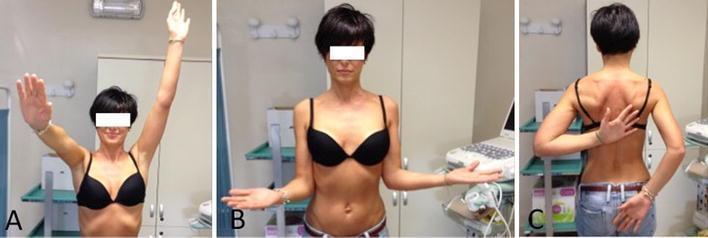
Panels A–C: Asymmetric ROM in frozen shoulder — restricted elevation (A), bilateral external rotation assessment (B), and the Apley scratch test showing significant internal rotation deficit on the affected side (C).
Investigations
| Investigation | Findings |
|---|---|
| Plain radiograph (X-ray) | Usually normal — but mandatory to exclude glenohumeral OA and locked posterior dislocation (which also cause ER loss) |
| Arthrography | Loss of the normal axillary recess — confirms capsular contracture; decreased joint volume |
| MRI | Thickening of GHJ capsule at axillary pouch, thickening of CHL, obliteration of subcoracoid fat triangle, rotator interval synovitis — none pathognomonic |
| Ultrasound | Increased vascular flow, thickening of rotator cuff structures — supportive |
"Two other causes of selective loss of external rotation are glenohumeral osteoarthritis and a locked posterior shoulder dislocation — for this reason, radiographs must be obtained before a diagnosis of frozen shoulder is made." — Miller's Review of Orthopaedics, 9th Ed.
Differential Diagnosis
- Glenohumeral osteoarthritis — bony crepitus, X-ray changes
- Locked posterior dislocation — history of seizure/trauma, X-ray abnormal
- Rotator cuff tear — passive ROM preserved, active restricted; positive lag signs
- Calcific tendinitis — acute severe pain, calcification on X-ray
- Cervical radiculopathy — dermatomal/myotomal distribution, neck movements reproduce pain
- Shoulder impingement — ROM less globally restricted; positive Hawkins-Kennedy/Neer
Key Diagnostic Criterion
Adhesive capsulitis is a clinical diagnosis based on history and examination, and by excluding other causes of shoulder pain and stiffness. There are no pathognomonic imaging findings.
Sources: Miller's Review of Orthopaedics 9th Edition; Goldman-Cecil Medicine; Harrison's Principles of Internal Medicine 22E; Tintinalli's Emergency Medicine; Rosen's Emergency Medicine
This is a shared conversation. Sign in to Orris to start your own chat.