
MEDICOLEGAL IMPORTANCE OF AGE FROM FMT GAUTAM BISWAS AND KS N REDDY
Reading File
Now let me search both FMT textbooks simultaneously for the medicolegal importance of age topic.
Finding Sources
Finding Sources
I found it in KSN Reddy's book (36th edition). Let me also search for Gautam Biswas's FMT and read the relevant section from Reddy.
Finding Sources
Reading File
Good content found. Let me read the rest of the section and also search for Gautam Biswas's book specifically.
Reading File
Finding Sources
Now let me search for Gautam Biswas's book properly.
Finding Sources
Gautam Biswas's FMT book is not in the library, but KSN Reddy's 36th edition (2026) is present - which is the primary reference. I now have all the content from the section. Let me compile the comprehensive answer.
Here is the complete topic from KSN Reddy's "The Essentials of Forensic Medicine and Toxicology" (36th Edition, 2026) - the authoritative FMT reference (Gautam Biswas's textbook covers largely the same points):
MEDICOLEGAL IMPORTANCE OF AGE
Age estimation is a key function of the forensic expert because age determines legal rights, responsibilities, and punishments under Indian law. The following are the recognized medicolegal contexts:
1. Criminal Responsibility
Under the Bharatiya Nyaya Sanhita (BNS) (formerly IPC):
| Age Group | Legal Position |
|---|---|
| Under 7 years | No criminal liability - any act is not an offence [Sec. 20 BNS / S. 82 IPC] |
| 7-12 years | Conditional liability - child may be held responsible if proven to have "sufficient maturity of understanding" [Sec. 21 BNS / S. 83 IPC]; maturity is presumed unless disproved by the defence |
| Under 12 years | Cannot give valid consent to suffer any harm done in good faith for their benefit [Sec. 27 BNS / S. 89 IPC] |
| 18 years and above | Can give valid consent to suffer harm from an act not intended to cause death or grievous hurt [Sec. 25 BNS / S. 87 IPC] |
- Under the Railway Act, a child (no specific age prescribed) may be held responsible for wrecking a train or endangering commuters.
- Persons with XYY chromosomal pattern are of aggressive and criminal nature.
2. Judicial Punishment (Juvenile Justice)
Under the Juvenile Justice (Care and Protection of Children) Act, 2000 and its 2015 Amendment:
- A "juvenile" means a person (boy or girl) who has not completed 18 years of age.
- A "juvenile in conflict with law" is one who has not completed 18 years on the date of commission of the offence.
- Juvenile Justice Boards exercise powers over such juveniles - they may warn, order community service, release on probation, impose a fine, or send to a reformatory/special home until the juvenile becomes a major.
- No juvenile shall be sentenced to death or life imprisonment, nor committed to prison.
- Juveniles aged 16-18 years who commit heinous offences (e.g., rape, murder - punishable with 7+ years imprisonment) will be tried as adults, but no death penalty or life term (2015 Amendment).
3. Rape
- Sexual intercourse by a man with his own wife or with any girl under 18 years, even with her consent, constitutes rape [Sec. 63 BNS].
4. Kidnapping
Under Section 137 BNS (Sections 359-369 IPC):
| Age Threshold | Offence |
|---|---|
| Child under 10 years | Kidnapping with intent to dishonestly take movable property |
| Boy under 16 years / Girl under 18 years | Kidnapping from lawful guardianship |
| Any person (minor) | Kidnapping for ransom or murder |
| Child used for begging [Sec. 139 BNS / S. 363-A IPC] | Any age |
| Girl under 18 years | Procurement for prostitution [Sec. 96 BNS / S. 366-A IPC] |
| Female under 21 years | Import into India for illicit intercourse [Sec. 140 BNS / S. 366-B IPC] |
| Inducing a woman to compel marriage | S. 366 IPC |
5. Employment
- A child below 14 years cannot be employed for any type of work.
- A person completing 15 years (adolescent) is allowed to work in a factory as an adult, provided a fitness certificate is issued by a certifying surgeon.
6. Attainment of Majority
Under the Indian Majority Act, 1875 (Sec. 3):
- Majority is attained on completion of 18 years.
- However, if a person is under the guardianship of a Court of Wards or a court-appointed guardian, majority is attained on completion of 21 years.
7. Evidence (Competence to Testify)
Under Section 124 BNS (S. 118 IEA):
- All persons are competent to testify unless prevented by tender years, extreme old age, or disease of body or mind from understanding questions or giving rational answers.
8. Marriage Contract
Under the Child Marriage Restraint Act, 1978:
- A female under 18 years and a male under 21 years cannot contract marriage.
9. Infanticide
- The charge of infanticide cannot be supported if the infant is proved to be under 7 months of intrauterine life (i.e., it was not viable/capable of being born alive).
10. Criminal Abortion
- A woman who has passed the child-bearing age (post-menopause) cannot be charged with procuring criminal abortion.
11. Identification
- An approximate age is important in any chain of identity data - for example, when a few days old child is alleged to be a specific newborn child.
12. Impotence and Sterility
- A boy is sterile (though not impotent) before puberty.
- Women become sterile after menopause.
- Age is therefore relevant in cases involving these conditions.
13. Custody of Minors
Under Section 6(a) of the Hindu Minority and Guardianship Act, 1956:
- A minor who has not completed 5 years of age shall ordinarily be in the custody of the mother.
Quick Summary Table
| Point | Age | Legal Provision |
|---|---|---|
| No criminal liability | < 7 yrs | Sec. 20 BNS / S. 82 IPC |
| Conditional criminal liability | 7-12 yrs | Sec. 21 BNS / S. 83 IPC |
| Consent to harm | > 18 yrs | Sec. 25 BNS / S. 87 IPC |
| Juvenile (JJ Act) | < 18 yrs | JJ Act 2000/2015 |
| Rape (even with consent) | < 18 yrs | Sec. 63 BNS |
| Kidnapping from guardianship | Boy < 16 / Girl < 18 | Sec. 137 BNS |
| Child labour prohibited | < 14 yrs | Child Labour Act |
| Factory work (adolescent) | ≥ 15 yrs | Factories Act |
| Attainment of majority | 18 yrs (or 21 if under court guardianship) | Indian Majority Act |
| Marriage minimum | Female ≥ 18 / Male ≥ 21 | Child Marriage Restraint Act |
| Custody with mother | < 5 yrs | Hindu Minority & Guardianship Act |
| Infanticide charge not valid | < 7 months intrauterine life | - |
Source: The Essentials of Forensic Medicine and Toxicology, KSN Reddy, 36th Edition (2026), p. 92 - with BNS references updated from IPC.
Note on Gautam Biswas: The "Review of Forensic Medicine and Toxicology" by Gautam Biswas covers the same medicolegal points on age. That textbook is not available in the library database, but the content above from KSN Reddy is the standard reference and is consistent with Biswas. The key difference is that Reddy's 36th edition has been updated with the new BNS 2023 sections replacing the old IPC sections, which is important for current exam purposes.
Short note on Gustafson's technique of age estimation
Gustafson's method (1950) estimates age from teeth by scoring 6 dental changes on a 0-3 scale, summing the scores, and applying a regression formula. The six criteria are: attrition, periodontosis, secondary dentine, cementum apposition, root resorption, and root transparency. Let me get the full textbook detail now.
Searching sources...
Finding Sources
Finding Sources
Finding Sources
Excellent - found it in both KSN Reddy and Forensic Anthropology. Let me read both sections in parallel.
Reading File
Reading File
Reading File
Reading File
Reading File
Loading Image
I now have all the content needed for a thorough answer, including the diagram. Here is the complete short note:
Gustafson's Method of Age Estimation from Teeth
Introduced by: Gösta Gustafson, a Swedish stomatologist, in 1950.
Principle: This is an objective, quantitative method used to estimate age from teeth in deceased individuals (adults). It is based on the fact that teeth undergo a series of progressive, age-related structural changes. Gustafson identified six such changes and assigned numerical scores to each, which are then summed and applied to a regression formula.
The Six Criteria (Mnemonic: APSRTC)
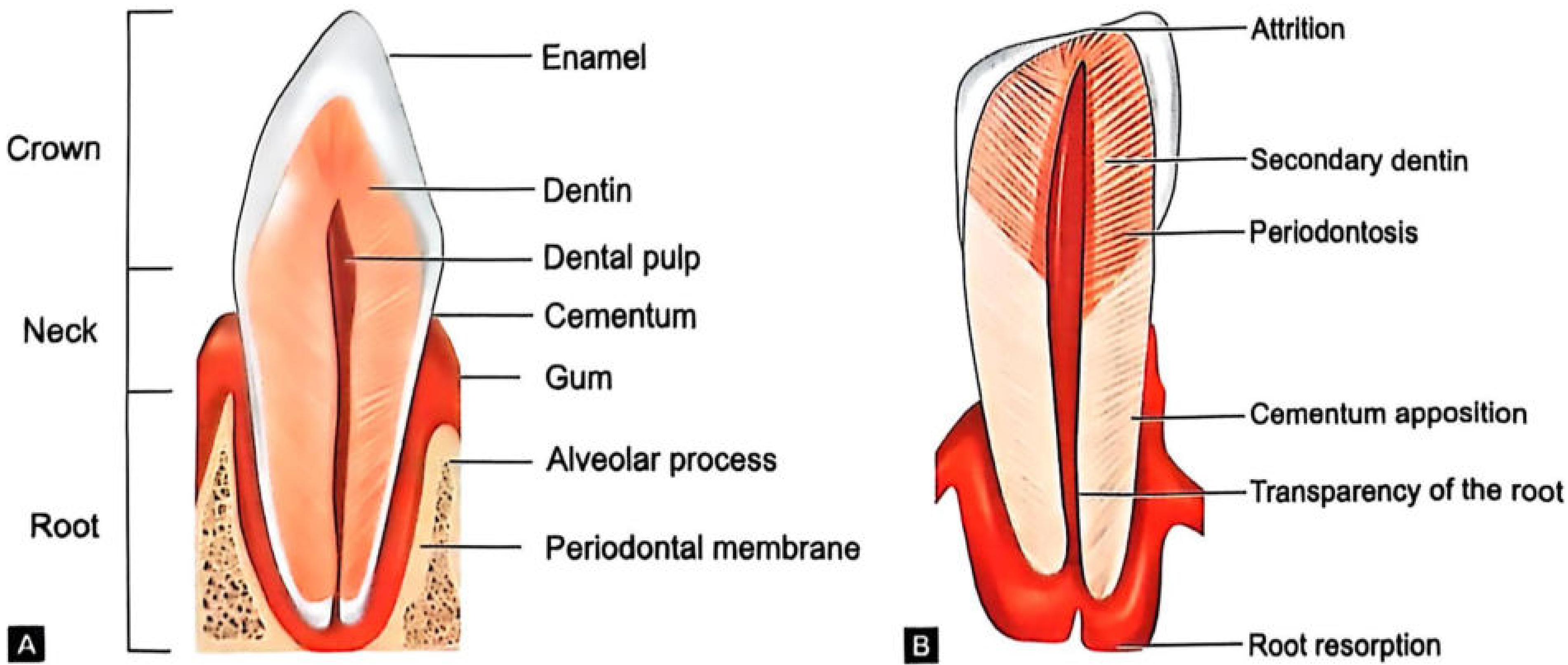
| Letter | Criterion | Description |
|---|---|---|
| A | Attrition | Wear and tear from mastication destroys the occlusal surface progressively - first enamel, then dentine, then pulp is exposed in old age. Depends on hardness of enamel and functional use. |
| P | Periodontosis | Regression/recession of gums and periodontal tissues with advancing age, gradually exposing the necks and roots of teeth - teeth become loose and fall off. Poor oral hygiene accelerates this. |
| S | Secondary dentine | New dentine deposited from the walls within the pulp cavity, progressively decreasing its size. Starts at the pulp chamber and extends down to the apex, eventually filling it completely. Caused partly by ageing, partly by caries and periodontosis. |
| R | Root resorption | Absorption of cementum and dentine showing characteristically sharp grooves. Starts at the apex and extends upwards. Usually occurs in late age; may be due to a pathological process. |
| T | Transparency of the root | The dentinal tubules, initially wide, become filled with mineral with age, making the dentine translucent. NOT seen until about 30 years of age. Occurs from below upward in the lower jaw and from above downward in the upper jaw. It is the most reliable of all criteria. |
| C | Cementum apposition | Cementum increases in thickness over time, particularly near the end of the root, due to changes in tooth position. |
Scoring System
Each of the six criteria is assigned a score of 0 to 3:
| Score | Degree of Change |
|---|---|
| 0 | No change |
| 1 | Beginning of change |
| 2 | Obvious change |
| 3 | Maximum change in dental tissues |
The total score (0 to 18) is calculated by adding all six scores.
Procedure
- Before extracting the tooth, degree of periodontosis is estimated clinically.
- The extracted tooth is ground down on glass slabs from both sides:
- Grinding to ~1 mm - allows estimation of transparency.
- Further grinding to ~0.25 mm - allows microscopic examination of other features.
- All six criteria are scored and the total is calculated.
- Age is estimated by:
- Applying the regression formula: Age = (Total score × 4.56) + 11.43 (Gustafson's original equation), or
- Directly reading from the regression line graph.
- The result is corrected for standard deviation.
Accuracy and Limitations
- Error margin: ±4 to 7 years.
- Error increases above 50 years of age.
- Anterior teeth are more suitable than posterior teeth; reliability decreases from incisors to premolars. Third molars are quite unsuitable.
- These changes are absent at 15 years of age - the method is not applicable for young individuals.
- Correlation between dental microstructure and age: r = 0.98 (very strong).
- Disadvantages:
- Destructive method (requires grinding of tooth).
- Requires thorough knowledge of dental histology.
- Poor oral health produces higher age estimates than actual age (overestimates age).
- Johanson's modification of Gustafson's method is considered more accurate.
Related Methods (for comparison)
- Boyde's method - counts daily cross striations in enamel from the neonatal line; used to estimate age in days in dead infants.
- Stack's method - uses weight and height of erupting teeth; applicable to both deciduous and permanent teeth in the erupting phase.
Source: The Essentials of Forensic Medicine and Toxicology, KSN Reddy, 36th Edition (2026), p. 82-83; Forensic Anthropology - A Comprehensive Introduction, 2nd Ed.
This is a shared conversation. Sign in to Orris to start your own chat.