
Cardiack monitar btana in deatila mey
Reading File
Finding Sources
Finding Sources
Searching PubMed
cardiac monitoring
Searching the Web
American Heart Association cardiac monitoring standards ECG monitoring hospital 2024
Finding Sources
Finding Sources
Cardiac monitor kya hota hai?
Cardiac monitor ek device hai jo dil ki electrical activity aur heart rate ko continuously ya fixed period tak record karta hai. Iska main purpose heart rhythm ki problem, jaise fast heartbeat, slow heartbeat, irregular rhythm, ya ischemia ke signs ko pakadna hota hai.
Hospital me ise aksar telemetry monitor ya bedside monitor kehte hain. Ghar par lagne wale monitors me Holter monitor, event monitor aur smart wearable ECG devices shamil hain.
Cardiac monitor kya-kya dekhta hai?
Monitor screen par aam tor par ye values hoti hain:
| Parameter | Meaning | Normal adult range, approx. |
|---|---|---|
| HR / Pulse | Heart rate, beats per minute | 60-100/min at rest |
| ECG rhythm | Dil ki electrical rhythm | Regular sinus rhythm |
| SpO₂ | Blood oxygen saturation | Usually 95-100% |
| BP / NIBP | Blood pressure, intermittent cuff reading | Person-specific |
| RR | Respiratory rate | 12-20/min |
| ST segment | ECG ka portion, ischemia/infarction concern me observed | Clinical interpretation needed |
Sirf monitor ka alarm ya single number diagnosis nahi hota. Patient ke symptoms, blood pressure, ECG strip, examination, medicines aur lab tests ko saath me dekha jata hai.
ECG monitor kaise kaam karta hai?
Chest par sticky pads, jinhe electrodes kehte hain, lagte hain. In electrodes se wires monitor se connect hoti hain. Ye electrodes heart ki electrical signals ko detect karte hain aur screen par ECG waveform banate hain.
ECG waveform ke main parts:
- P wave: atria ki electrical activation
- QRS complex: ventricles ki activation
- T wave: ventricles ki recovery phase
- R-R interval: do heartbeats ke beech ka interval, jisse heart rate aur rhythm judge kiya jata hai
Monitor commonly 3-lead ya 5-lead ECG use karta hai. Ye continuous rhythm monitoring ke liye useful hai, lekin suspected heart attack me diagnosis ke liye usually proper 12-lead ECG ki zarurat hoti hai.
Cardiac monitoring ke prakar
1. Bedside cardiac monitor / ICU monitor
Patient ke bed ke paas hota hai. Continuous ECG, oxygen saturation, respiratory rate aur kabhi invasive blood pressure bhi show karta hai.
Kahan use hota hai?
- ICU/CCU
- Emergency department
- Operation theatre
- Post-operative recovery
- Unstable heart rhythm ya critical illness
2. Telemetry monitor
Patient hospital ward me chal-phir sakta hai, aur uska ECG wireless signal central monitoring station par jata hai.
Useful for:
- Chest pain observation
- Suspected arrhythmia
- Heart attack ke baad
- Electrolyte imbalance
- Antiarrhythmic drugs ke dauran
- Selected heart failure or cardiac patients
3. Holter monitor
Ye ek portable continuous ECG device hai, jo aksar 24-48 hours ke liye pehna jata hai. Kabhi longer duration bhi ho sakta hai.
Useful when:
- Palpitations roz ya frequently aate hon
- Chakkar ya fainting episodes aate hon
- Intermittent irregular heartbeat suspected ho
- Antiarrhythmic treatment assess karna ho
Holter monitoring arrhythmias, antiarrhythmic therapy aur ischemic episodes ke frequency/severity ka assessment kar sakta hai. Morgan and Mikhail's Clinical Anesthesiology, 7e, p. 2159.
4. Event monitor / external loop recorder
Agar symptoms har din nahi, balki kabhi-kabhi aate hain, to 2-4 weeks ya longer duration ka event monitor use ho sakta hai. Patient symptom ke samay button press karta hai, ya device automatic abnormal rhythm record karta hai.
5. Implantable loop recorder
Chhota device skin ke neeche chest area me insert hota hai aur months to years tak rhythm record kar sakta hai.
Kab consider hota hai?
- Repeated unexplained fainting
- Bahut infrequent palpitations
- Cryptogenic stroke ke baad hidden atrial fibrillation dhoondhne ke liye
6. Smartwatch / wearable ECG
Kuch watches irregular rhythm ya single-lead ECG detect kar sakti hain. Ye screening aur symptom-time tracing ke liye helpful ho sakti hain, par doctor ki ECG interpretation ko replace nahi karti. Recent systematic review me consumer ECG wearables ki utility ke saath signal quality, algorithm errors aur clinical confirmation ki need highlight hui hai (PMID: 39240746).
Cardiac monitor kab lagaya jata hai?
Doctor cardiac monitoring suggest kar sakte hain agar:
- Dil ki dhadkan bahut tez, bahut slow ya irregular lage
- Palpitations ho, yani chest me fluttering, pounding ya skipped beats ka sensation
- Chakkar, near-fainting ya fainting ho
- Chest pain ya suspected heart attack ho
- Saans phool rahi ho, especially cardiac disease ke background me
- Atrial fibrillation, SVT, ventricular tachycardia, heart block etc. suspect ho
- Pacemaker/ICD function assess karna ho
- Potassium, magnesium jaise electrolytes abnormal hon
- Aisi medicines di ja rahi hon jo QT interval ya rhythm affect kar sakti hain
Palpitations ke assessment ka main objective dangerous arrhythmia ko rule out karna hota hai. Palpitations ke saath fainting, lightheadedness, chest pain, breathlessness, existing coronary artery disease, ya structural heart disease concern badhate hain. Harrison’s Principles of Internal Medicine, 22e, “Palpitations” section.
Monitor ke common alarms ka matlab
High HR alarm
Heart rate set limit se upar hai. Causes ho sakte hain:
- Fever, pain, anxiety
- Dehydration
- Exercise/movement
- SVT, atrial fibrillation, atrial flutter
- Ventricular tachycardia
- Monitor artifact
Low HR alarm
Heart rate set limit se neeche hai. Causes:
- Sleep, athletic conditioning
- Beta blockers or some medicines
- Heart block
- Sinus bradycardia
- Electrode issue / signal loss
Irregular rhythm alarm
May indicate:
- Atrial fibrillation
- Premature atrial contractions
- PVCs
- Other arrhythmias
- Motion artifact
Asystole / lead-off alarm
Screen par flat line har baar cardiac arrest nahi hoti. Pehle patient ko dekha jata hai:
- Patient responsive hai?
- Pulse present hai?
- Electrodes/wires connected hain?
- ECG tracing real hai ya artifact?
“Treat the patient, not only the monitor.”
Monitor artifacts kya hote hain?
Kabhi monitor abnormal-looking rhythm dikhata hai par actual heart rhythm normal ho sakta hai. Isse artifact kehte hain.
Common reasons:
- Patient movement, shivering, coughing
- Loose or dry electrodes
- Sweating
- Wires disconnected
- Electrical interference
- Poor skin contact
Isliye alarming rhythm dekhne par staff ECG strip, patient pulse, symptoms aur blood pressure verify karta hai.
Monitor lagate waqt basic care
- Skin clean aur dry rakhen.
- Electrodes ko recommended interval par replace karen, especially sweating ya loose pad me.
- Wires ko pull na hone dein.
- Monitor ko bathing ke time wet na hone dein unless device specifically waterproof ho.
- Holter/event monitor ke dauran symptom diary rakhen: time, symptom, activity, medicines. Isse recorded rhythm ko symptoms se match karna aasaan hota hai.
- Monitor lagne ke baad chest pain, breathlessness, dizziness, fainting, ya severe palpitations ho to turant staff ko batayen.
Kab emergency help leni chahiye?
Agar inme se koi symptom ho, urgent emergency evaluation len:
- Chest pressure/pain jo 5 minutes se zyada rahe, ya sweating/nausea ke saath ho
- Fainting or near-fainting
- Severe breathlessness
- New confusion, weakness, blue lips
- Very fast or irregular heartbeat ke saath dizziness/chest pain
- Monitor alarm ke saath patient unresponsive ho
Hospital ECG monitoring standards ka purpose timely arrhythmia detection hai, lekin continuous telemetry har patient ke liye necessary nahi hoti. Appropriate selection unnecessary alarms aur over-monitoring ko reduce kar sakta hai, as reflected in the AHA telemetry practice standards.
Aap “cardiac monitor” se hospital bedside monitor, Holter monitor, ya ECG screen ke readings me se kis ke baare me padh rahe hain?
Image key sath btayo
Reading File
Searching Images
labeled 5 lead cardiac telemetry monitor ECG electrode placement chest diagram
Searching Images
normal ECG P wave QRS complex T wave labeled diagram
Searching Images
Holter monitor patient wearing ambulatory ECG recorder image
Searching PubMed
ambulatory electrocardiography monitoring
Searching the Web
cardiac telemetry 5 lead ECG electrode placement monitor labeled diagram
Cardiac monitor with image
1. 5-lead cardiac monitor: electrodes kahan lagte hain?
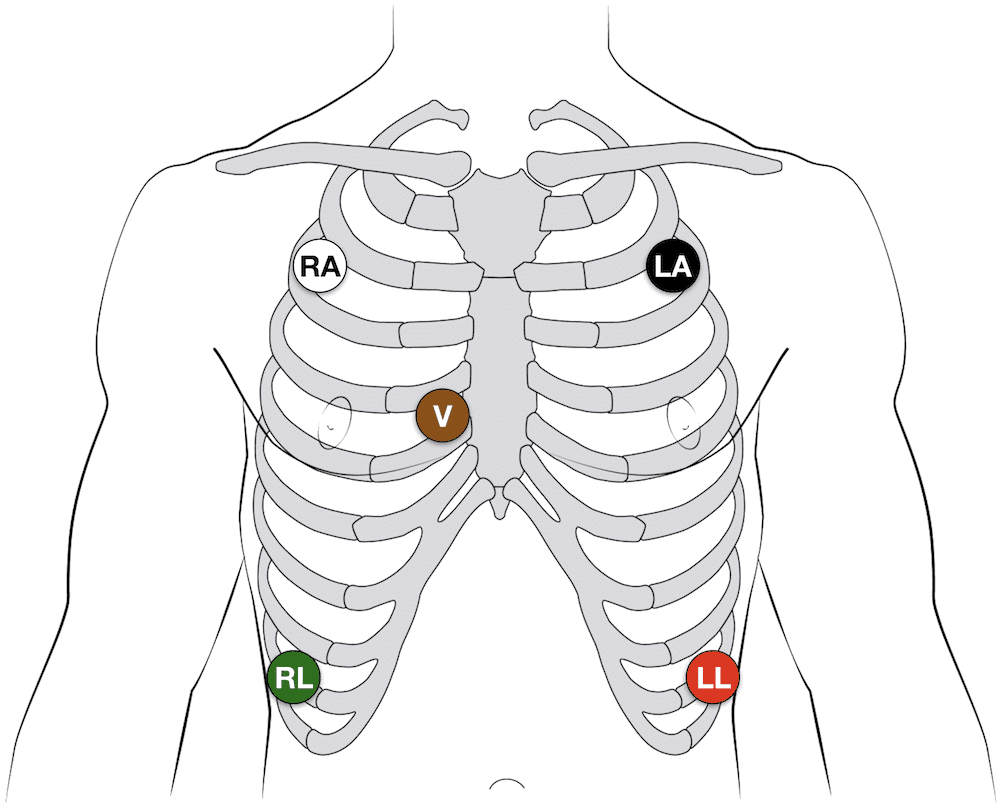
Is monitor me 5 sticky electrodes chest/body par lagte hain. Ye wires se monitor ya telemetry box se connect hote hain. Monitor phir screen par ECG rhythm aur heart rate dikhata hai.
| Electrode | Usual position | Kaam |
|---|---|---|
| RA - Right arm | Right clavicle ke neeche, upper right chest | ECG signal |
| LA - Left arm | Left clavicle ke neeche, upper left chest | ECG signal |
| RL - Right leg | Right lower chest/abdomen, rib cage ke neeche | Reference/ground electrode |
| LL - Left leg | Left lower chest/abdomen, rib cage ke neeche | ECG signal |
| V / Chest lead | Usually chest par, monitoring protocol ke hisab se | Chest view, rhythm/ST observation me help |
Important: Wire colors brand, country aur AHA/IEC standard ke hisab se alag ho sakte hain. Isliye color yaad karke electrode na lagayen. Lead label, local hospital protocol aur trained staff ki instruction follow karein. 5-lead placement guidance me RA, LA, RL, LL aur chest lead ka overview diya gaya hai.
2. Monitor screen par kya dikhai deta hai?
Aksar screen par ye parameters hote hain:
ECG waveform:   _/¯\____/¯\____/¯\_
HR:             78 /min
SpO₂:           98%
BP:             122/76 mmHg
RR:             16 /min
- ECG waveform: dil ki electrical activity
- HR: heart rate, beats per minute
- SpO₂: oxygen saturation
- BP/NIBP: blood pressure, cuff se measured
- RR: respiratory rate
3. ECG wave ko simple way me samjhein
             R
            /\
 P         /  \                 T
/\        /    \               /\
  \______/      \_____________/  \____
       Q          S

P wave  = upper chambers, atria, ki activation
QRS     = lower chambers, ventricles, ki activation
T wave  = ventricles ki recovery
- P wave: atria contract karne se pehle ki electrical activity
- QRS complex: ventricles ki main activation, usually sabse sharp wave
- T wave: ventricles ki recovery phase
- Do R waves ke beech ka distance rhythm aur heart rate estimate karne me help karta hai.
4. Monitor par common alarms
| Alarm | Possible meaning | Pehla step |
|---|---|---|
| High HR | Heart rate zyada | Patient ke symptoms aur pulse check |
| Low HR | Heart rate kam | Patient stable hai ya nahi check |
| Irregular rhythm | AF, ectopic beats, artifact, etc. | ECG strip/patient assess |
| Lead off | Pad ya wire loose/disconnected | Electrodes aur wires check |
| Asystole alarm | Flat tracing, but often lead disconnect/artifact bhi ho sakta hai | Patient responsiveness/pulse immediately check |
Sabse important rule
Pehle patient ko dekho, phir monitor ko.
Agar screen par abnormal rhythm aaye lekin patient baat kar raha ho aur pulse normal ho, pehle electrode/wire disconnect ya movement artifact ko check kiya jata hai.
Agar screen par abnormal rhythm aaye lekin patient baat kar raha ho aur pulse normal ho, pehle electrode/wire disconnect ya movement artifact ko check kiya jata hai.
5. Holter monitor ka image-style concept
Holter monitor me small recorder belt/pouch me hota hai aur chest par electrodes lage hote hain. Yeh 24-48 hours, kabhi zyada time, continuously ECG record karta hai.
 Chest electrodes  ── wires ──>  [Portable Holter recorder]
                                      |
                               ECG data stored
Ye un logon me useful hota hai jinko palpitations, chakkar, fainting ya irregular heartbeat kabhi-kabhi hoti hai, jab normal clinic ECG me rhythm capture nahi hoti. Morgan and Mikhail's Clinical Anesthesiology, 7e, p. 2159.
Chest pain, fainting, severe breathlessness, ya fast/irregular heartbeat ke saath dizziness ho to monitor par depend na karein, urgent medical help lein.
Okey INC syllabus hi tumhare pass?
Reading File
Searching the Web
site:indiannursingcouncil.org Indian Nursing Council syllabus BSc Nursing GNM official curriculum PDF
Haan, main Indian Nursing Council (INC) ke official syllabus ke hisaab se nursing topics padhane me help kar sakta hoon, especially B.Sc. Nursing, GNM, ANM aur Post Basic B.Sc. Nursing.
Aapka cardiac monitor wala topic Medical-Surgical Nursing ke syllabus ke according, nursing procedure + theory + viva points + images ke saath karwa sakta hoon.
INC ka revised B.Sc. Nursing programme competency-based hai aur 4 years, including internship, ka hai. Official INC B.Sc. Nursing curriculum available hai.
Bas batayein:
- Course: B.Sc Nursing / GNM / ANM?
- Year/Semester: 1st, 2nd, 3rd, 4th?
- Topic: cardiac monitor, ECG, cardiac diseases, procedures, etc.
Main notes ko simple Hindi-English me, exam-oriented format me banaunga.
This is a shared conversation. Sign in to Orris to start your own chat.