
Classification of malnutrition and describe the effect of malnutrition 10+10
I'll read the medical library skill first, then search for comprehensive information on malnutrition classification and effects.
Reading File
Now I'll run parallel searches for both classification and effects of malnutrition:
Finding Sources
Finding Sources
Finding Sources
Finding Sources
Excellent finds. Now I'll read the most relevant sections in parallel:
Reading File
Reading File
Great content. Now reading more from both sources - the Sleisenger classification section and Robbins pathology effects section:
Reading File
Reading File
Excellent detailed content. Let me read a bit more from Robbins to capture the effects/consequences section:
Reading File
Reading File
I now have comprehensive content. Let me also fetch the malnutrition image from Robbins and read about effects on specific body systems:
Loading Image
Reading File
I now have all the material needed for a comprehensive 10+10 answer. Let me compile the full response:
Classification of Malnutrition (10 marks)
Definition
Malnutrition implies a sustained imbalance between nutrient availability and nutrient requirements, resulting in altered intermediary metabolism, organ function, and body composition. "Sustained" is key - short-term imbalances are usually corrected by homeostatic mechanisms and nutrient reserves.
Customarily, the term refers to inadequacy in protein, calories, or both - more precisely called Protein-Energy Malnutrition (PEM) or Protein-Caloric Malnutrition. - Sleisenger & Fordtran's GI and Liver Disease
I. By Etiology: Primary vs. Secondary
| Type | Mechanism |
|---|---|
| Primary (Dietary) Malnutrition | Inadequate intake of protein, calories, or both; or protein of poor quality lacking essential amino acids |
| Secondary (Conditional) Malnutrition | Dietary intake adequate; malnutrition results from malabsorption, impaired use/storage, excess losses, or increased metabolic requirements |
Causes of secondary malnutrition fall into three overlapping categories:
- Gastrointestinal diseases (malabsorption syndromes, IBD, short bowel)
- Chronic wasting diseases (advanced cancer, disseminated TB, AIDS - cachexia)
- Acute critical illness (burns, sepsis - up to 80% rise in resting energy expenditure)
Other recognized causes: poverty, ignorance of nutritional needs, chronic excess alcohol use, self-imposed dietary restriction (anorexia nervosa, bulimia), drug therapies, total parenteral nutrition (TPN) complications.
- Robbins & Kumar Basic Pathology
II. WHO Classification: Severe Acute Malnutrition (SAM)
The WHO defines SAM as:
- Weight-to-height ratio ≥3 standard deviations below the median growth standard, OR
- Visible severe wasting, OR
- Presence of nutritional edema
SAM affects ~50 million children worldwide; ~45% of deaths in children under 5 in low-resource countries are attributable to undernutrition.
III. Waterlow Classification (Children)
The Waterlow classification uses two anthropometric indices:
| Indicator | Term | Meaning |
|---|---|---|
| Weight for Height inadequacy | Wasting | Acute malnutrition (current) |
| Height for Age inadequacy | Stunting | Chronic malnutrition (past) |
This gives four grades (none, mild, moderate, severe) for each dimension.
IV. Clinical Syndromes of PEM in Children
There are three major clinical syndromes:
1. Marasmus ("Nutritional Atrophy")
- Severe caloric deficiency (both protein and energy severely lacking)
- Somatic protein compartment (skeletal muscle) depleted predominantly
- Serum albumin normal or near-normal (visceral compartment spared)
- Features: profound growth retardation, gross emaciation, loss of subcutaneous fat, "matchstick" limbs with head appearing too large
- Low leptin stimulates the hypothalamic-pituitary-adrenal axis, causing high cortisol contributing to lipolysis
- Concurrent infections common due to T-cell mediated immune deficiency
2. Kwashiorkor ("Displaced Child")
- Protein deprivation relatively greater than caloric reduction; typically in children weaned onto a carbohydrate-only diet
- Visceral protein compartment (liver) depleted predominantly
- Hypoalbuminemia leads to generalized/dependent edema - hallmark feature
- Weight 60-80% of normal, but true weight loss is masked by fluid retention
- Features:
- Peripheral and periorbital edema, ascites
- Protuberant abdomen (weak abdominal muscles + intestinal distension + hepatomegaly)
- Fatty liver (reduced synthesis of carrier protein of lipoproteins)
- Skin lesions: alternating zones of hyperpigmentation, desquamation, and hypopigmentation
- Hair changes: depigmentation, straightening, fine texture, easy pluckability
- Apathy, listlessness, irritability when held
- Serum albumin reduced (distinguishes from marasmus)
3. Nutritional Dwarfism (Stunting)
- Chronic inadequate nutrition causing impaired linear growth
- Weight for age reduced but weight for height may be near-normal
- Both somatic and visceral compartments affected, but less acutely
Note: These three syndromes overlap considerably in clinical practice. Marasmic-kwashiorkor is a mixed form with features of both.
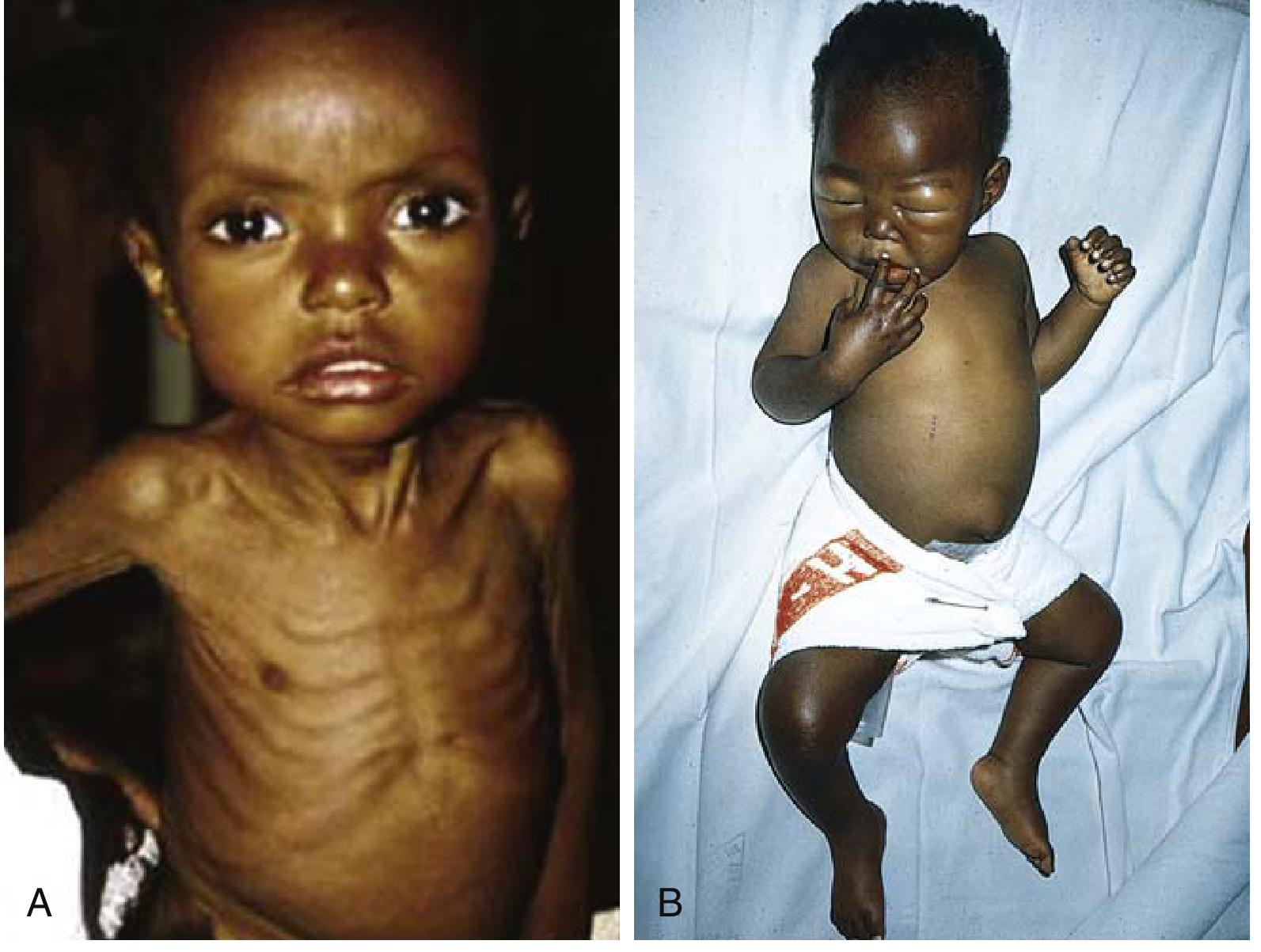
V. Adult Malnutrition Classification
In adults, undernutrition causes wasting rather than stunting (since linear growth is complete). Pure kwashiorkor and marasmus can occur, but in high-income societies, adult PEM is more often secondary, occurring in hospitalized patients with overlapping features. Categorized as:
- Mild PEM: <5% unintentional weight loss over 6 months
- Moderate PEM: 5-10% weight loss
- Severe PEM: >10% weight loss
Effects of Malnutrition (10 marks)
PEM adversely affects almost every organ system, although the brain is usually spared. Most adverse effects are reversible with nutritional restitution. - Sleisenger & Fordtran's
1. Gastrointestinal Tract
- Villus atrophy with marked blunting of intestinal villi
- Loss of brush border hydrolases (disaccharidases, peptidases)
- Reduced gastric, pancreatic, and biliary secretions (volume and enzyme concentration)
- Malabsorption of carbohydrates, fats, fat-soluble and water-soluble vitamins
- Steatorrhea proportional to severity of PEM - creates a vicious cycle of further nutrient loss
- Bacterial overgrowth in upper small intestine
- Intestinal hypomotility and gas distension causing abdominal protuberance
2. Cardiovascular System
- Reduced myocardial mass (myofibrillar atrophy)
- Myocardial edema, patchy necrosis, chronic inflammatory cell infiltration
- Decreased stroke volume, cardiac output, and maximal work capacity
- Bradycardia and hypotension
- Cardiac failure can occur under conditions of increased metabolic demand
3. Immune System
The immune system is the most vulnerable organ system in PEM:
- Impaired T-lymphocyte function (cell-mediated immunity most affected)
- Blunted polymorphonuclear leukocyte (PMN) function
- Reduced complement activity
- Variable impairment of B-lymphocyte antibody production
- Total lymphocyte count and delayed skin hypersensitivity are used diagnostically as markers of malnutrition
- Increased susceptibility to infections, which in turn worsen malnutrition (vicious cycle)
4. Liver
- Fatty liver (hepatic steatosis) in kwashiorkor - due to reduced synthesis of apolipoprotein, impairing VLDL export of fat from hepatocytes
- Hepatomegaly
- In severe/chronic malnutrition, impaired hepatic protein synthesis reduces albumin, coagulation factors, transport proteins
5. Skeletal Muscle and Somatic Protein
- Massive protein catabolism - urinary urea nitrogen losses rise to 2.5x basal levels at maximal stress
- Daily loss of up to 0.5 kg lean mass in severe illness
- AA efflux from skeletal muscle increases 2-6 fold in critically ill
- Progressive muscle wasting and weakness
6. Bone and Growth (Children)
- Stunted linear growth - impaired skeletal development
- Bone marrow suppression leads to anemia, leukopenia, lymphocytopenia
- Delayed epiphyseal closure and bone age
- In adults: osteopenia and increased fracture risk
7. Endocrine and Metabolic Effects
- Elevated cortisol (stress response) - promotes protein catabolism and lipolysis
- Low insulin, low IGF-1 - impairs anabolism
- Low leptin - further stimulates HPA axis
- Cytokine-mediated hypermetabolism: TNF-α, IL-1β, IL-6, IFN-γ all increase AA release from muscle, elevate acute-phase proteins, cause fever and anorexia
- Altered glucose homeostasis (hypoglycemia in severe SAM)
8. Skin and Appendages (especially Kwashiorkor)
- Flaky paint dermatosis - alternating zones of hyperpigmentation, desquamation, and hypopigmentation
- Hair changes: depigmentation ("flag sign" - alternating bands), straightening, fine texture, easy pluckability
- Poor wound healing
- Pressure ulcers
9. Neurological and Psychological Effects
- Apathy, listlessness, irritability (especially kwashiorkor)
- Impaired cognitive development and intellectual function in children
- Vitamin B deficiencies (thiamine, B12, folate) can cause peripheral neuropathy, Wernicke-Korsakoff syndrome
- Brain is relatively spared in direct protein-energy effects but indirect deficiencies cause damage
10. Renal and Other Effects
- Reduced glomerular filtration rate and tubular function
- Impaired wound healing and increased surgical risk
- Delayed recovery from illness
- Increased perioperative morbidity and mortality
- Secondary infections become the leading direct cause of death in malnourished children
Summary Table
| System | Effect of Malnutrition |
|---|---|
| GI Tract | Villus atrophy, malabsorption, bacterial overgrowth |
| Heart | Myocardial atrophy, low output, bradycardia |
| Immune | Immunodeficiency, infection susceptibility |
| Liver | Fatty change, reduced protein synthesis |
| Muscle | Wasting, weakness, amino acid efflux |
| Bone/Growth | Stunting, osteopenia, marrow suppression |
| Endocrine | High cortisol, low IGF-1, cytokine storm |
| Skin/Hair | Dermatosis, depigmentation, poor wound healing |
| Neuro/Psych | Apathy, impaired cognition, neuropathy |
| Kidney | Reduced GFR, tubular impairment |
Sources: Sleisenger & Fordtran's Gastrointestinal and Liver Disease; Robbins & Kumar Basic Pathology (10th ed.)
This is a shared conversation. Sign in to Orris to start your own chat.