
Norma lateralis
Reading File
Finding Sources
Searching Images
norma lateralis skull lateral view
Finding Sources
Finding Sources
Finding Sources
Finding Sources
Finding Sources
Finding Sources
Finding Sources
Loading Image
Finding Sources
Loading Image
Norma Lateralis
Norma lateralis is the lateral (side) view of the skull — the aspect seen when the skull is viewed from the side.
Bones Visible in Norma Lateralis
The lateral aspect of the skull is formed by contributions from eight bones:
| Bone | Region |
|---|---|
| Frontal bone | Anterosuperior, forms forehead |
| Parietal bone | Superior cranial vault |
| Occipital bone | Posterior |
| Temporal bone | Lateral cranial base, forms the external acoustic meatus |
| Sphenoid bone (greater wing) | Anteroinferior cranial wall |
| Zygomatic bone | Forms the cheekbone and zygomatic arch (with temporal) |
| Maxilla | Anterior face below orbit |
| Mandible | Lower jaw |
Key Anatomical Features
Sutures
- Coronal suture — between frontal and parietal bones (runs vertically)
- Sagittal suture — visible at the top (between parietal bones, seen end-on)
- Lambdoid suture — between parietal and occipital bones posteriorly
- Squamous suture — between temporal and parietal bones (arc-shaped)
- Parietomastoid suture — between parietal and mastoid part of temporal bone
Pterion
The pterion is a clinically crucial H-shaped junction where four bones meet:
- Frontal, parietal, temporal, and sphenoid (greater wing)
- Located approximately 4 cm above the midpoint of the zygomatic arch and 3.5 cm behind the frontozygomatic suture
- It is the thinnest part of the skull
- The middle meningeal artery (anterior branch) runs in a groove on the inner surface directly beneath it
- A blow to the pterion can rupture this artery → extradural (epidural) haematoma
Temporal Fossa
- Boundaries:
- Superior & posterior: Superior and inferior temporal lines
- Anterior: Frontal and zygomatic bones
- Inferior: Zygomatic arch (roof of infratemporal fossa below)
- Medial floor: Pterion
- Contents: Temporalis muscle and its fascia, deep temporal nerves and vessels
Zygomatic Arch
- Formed by the zygomatic process of the temporal bone + temporal process of the zygomatic bone
- The masseter muscle originates from its lower border and medial surface
External Acoustic Meatus (EAM)
- Opening in the temporal bone, visible as a round foramen
- Mastoid process is posterior to it; styloid process inferior
Mastoid Process
- Posterior projection of the temporal bone
- Contains mastoid air cells communicating with the middle ear
Orbital Region
- The lateral orbital margin is formed by the zygomatic bone
- The frontozygomatic suture is visible at the lateral angle of the orbit
Mandibular Features (visible in norma lateralis)
- Coronoid process (anterior) — for temporalis attachment
- Condylar process (posterior) — forms the temporomandibular joint
- Mandibular notch between them
- Mental foramen on the body of the mandible (below 2nd premolar)
Temporal Lines
Two curved ridges on the parietal and frontal bones:
- Superior temporal line — attachment of temporal fascia
- Inferior temporal line — origin of temporalis muscle
Clinical Significance
| Structure | Clinical Point |
|---|---|
| Pterion | Thinnest skull point; underlies middle meningeal artery → extradural haemorrhage |
| Temporal fossa | Houses temporalis; route of spread for deep head/neck infections |
| Mastoid process | Landmark for mastoidectomy; contains facial nerve canal |
| Mental foramen | Landmark for inferior alveolar nerve block |
| Zygomatic arch | May fracture inward, impinging on coronoid process → trismus |
| Infratemporal fossa (just below the arch) | Contains pterygoid muscles, mandibular nerve (V3), maxillary artery |
Visual Reference
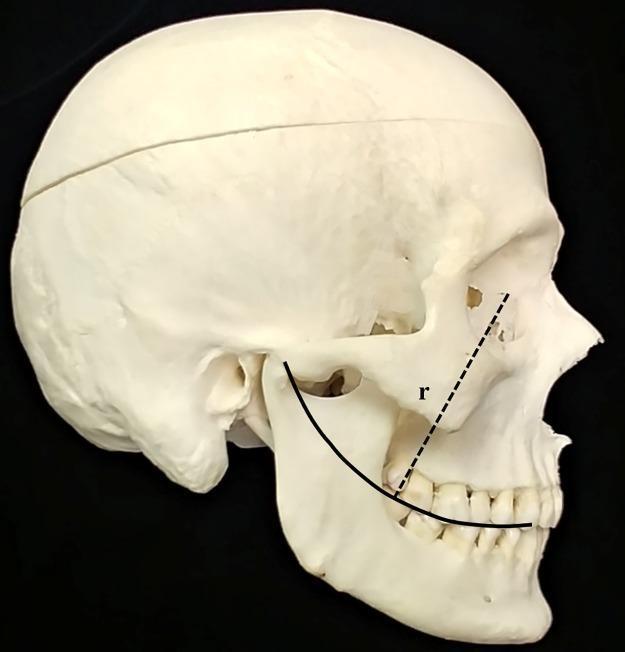
Lateral view of the human skull showing the calvaria, zygomatic arch, and mandible. The dashed line (r) marks the radius of the Curve of Spee from the orbital region to the mandibular occlusal plane.
Summary of Normas (Aspects of the Skull)
| Term | Meaning |
|---|---|
| Norma lateralis | Lateral / side view |
| Norma frontalis | Anterior / front view |
| Norma occipitalis | Posterior view |
| Norma verticalis | Superior / top view |
| Norma basalis | Inferior / base view |
Mandible
Finding Sources
Searching Images
mandible anatomy parts labeled diagram
Reading File
Loading Image
Loading Image
Reading File
Finding Sources
Finding Sources
Reading File
Finding Sources
Now I have comprehensive information from Gray's Anatomy for Students. Let me compile the full answer.
Mandible
The mandible is the bone of the lower jaw — the only movable bone of the skull (excluding the ossicles). It is a single U-shaped bone formed by the fusion of two halves at the mandibular symphysis (visible as a midline vertical ridge anteriorly).
Parts of the Mandible
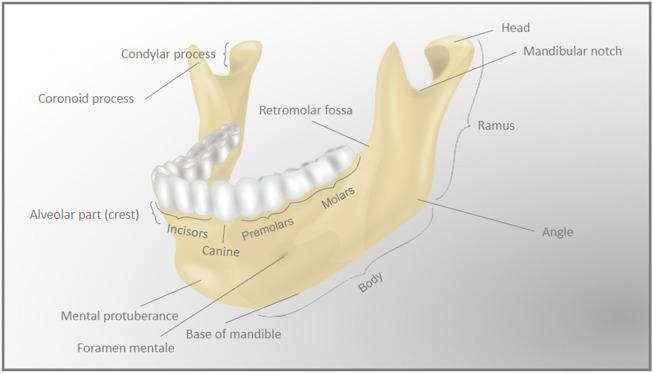
The mandible has two main parts: the body and the ramus (one on each side). They meet at the angle of the mandible.
1. Body
A horizontal, horseshoe-shaped structure with two surfaces and two borders:
External (Outer) Surface:
- Mental protuberance — midline bony prominence forming the chin
- Mental tubercles — slight elevations on either side of the mental protuberance
- Mental foramen — oval opening midway between the upper and lower borders of the body, usually below the 2nd premolar; transmits the mental nerve and vessels (terminal branch of inferior alveolar nerve)
- Oblique line — ridge running from the anterior border of the ramus onto the external surface of the body; attachment for muscles depressing the lower lip
Internal (Medial) Surface:
- Mental spines (genial spines) — two pairs of small spines posterosuperior to the symphysis
- Superior mental spines → origin of genioglossus (tongue muscle)
- Inferior mental spines → origin of geniohyoid muscle
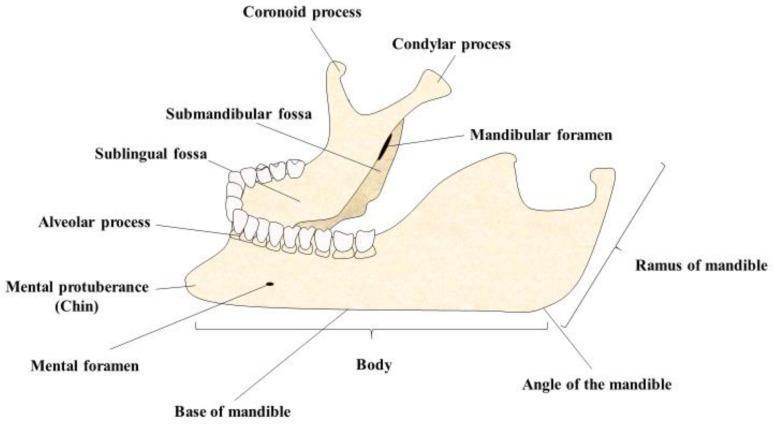
- Mylohyoid line — an oblique ridge running posterosuperiorly from below the mental spines to just below the last molar; attachment for the mylohyoid muscle (floor of mouth)
- Sublingual fossa — shallow depression above the anterior ⅓ of mylohyoid line → lodges the sublingual gland
- Submandibular fossa — depression below the posterior ⅔ of mylohyoid line → lodges the submandibular gland
- Digastric fossa — at the base near midline → attachment of anterior belly of digastric
Borders:
- Superior (alveolar) border — bears the alveolar arch (tooth sockets for the 16 lower teeth); resorbed when teeth are lost
- Inferior border (base) — thick and rounded; the body of the mandible measured here
2. Ramus
A flat quadrangular plate projecting superiorly on each side.
Outer (Lateral) Surface:
- Roughened in the lower part for attachment of the masseter muscle
Inner (Medial) Surface:
- Mandibular foramen — large opening, the superior entrance to the mandibular canal; transmits the inferior alveolar nerve and vessels
- Lingula — a triangular bony tongue immediately anterosuperior to the mandibular foramen; attachment for the sphenomandibular ligament
- Mylohyoid groove — runs anteroinferiorly from the mandibular foramen; carries the nerve to mylohyoid
- Roughened posteroinferior area for medial pterygoid muscle attachment
Superior Border — bears two processes:
| Process | Shape | Function |
|---|---|---|
| Coronoid process (anterior) | Triangular | Attachment for temporalis muscle |
| Condylar process (posterior) | Has head + neck | Forms the temporomandibular joint (TMJ) with temporal bone |
The two processes are separated by the mandibular notch (sigmoid notch), through which the masseteric nerve and vessels pass.
The neck of the condyle has a shallow pterygoid fovea anteriorly — attachment of the lateral pterygoid muscle.
Retromolar triangle/fossa — small triangular depression posterosuperior to the last molar; attachment point of the pterygomandibular raphe
Key Foramina and Canals
| Foramen/Canal | Location | Contents |
|---|---|---|
| Mandibular foramen | Medial surface of ramus | Inferior alveolar nerve + vessels (entering) |
| Mandibular canal | Runs through the body | Inferior alveolar nerve + vessels |
| Mental foramen | External surface of body, below 2nd premolar | Mental nerve + vessels (exiting) |
Muscle Attachments Summary
| Muscle | Attachment on Mandible |
|---|---|
| Temporalis | Coronoid process + anterior ramus |
| Masseter | Lateral ramus and angle |
| Medial pterygoid | Medial ramus and angle |
| Lateral pterygoid | Pterygoid fovea of condylar neck |
| Genioglossus | Superior mental spines |
| Geniohyoid | Inferior mental spines |
| Mylohyoid | Mylohyoid line |
| Digastric (ant. belly) | Digastric fossa |
| Buccinator | Lateral alveolar margin (pterygo-mandibular raphe) |
Temporomandibular Joint (TMJ)
Formed between the head of the mandible and the articular fossa + articular tubercle of the temporal bone. Unique features:
- Articular surfaces covered by fibrocartilage (not hyaline cartilage)
- Divided by a fibrous articular disc into two compartments:
- Lower compartment → hinge movement (depression/elevation)
- Upper compartment → translatory movement (protrusion/retraction)
- Opening the mouth involves both depression and protrusion simultaneously
Ligaments of TMJ
- Lateral (temporomandibular) ligament — main ligament, thickening of joint capsule
- Sphenomandibular ligament — from spine of sphenoid to lingula
- Stylomandibular ligament — from styloid process to angle of mandible
Ossification
The mandible is the only bone in the face that ossifies in membrane (intramembranous ossification) around Meckel's cartilage (the cartilage of the 1st pharyngeal arch). Meckel's cartilage is NOT the template for the mandible but acts as a scaffold.
Diagrams
Lateral & oblique view:
Medial view showing internal features:
Clinical Relevance
| Point | Significance |
|---|---|
| Mental foramen | Below 2nd premolar; mental nerve block performed here; avoid during implants |
| Lingula | Landmark for inferior alveolar nerve block in dentistry |
| Mandibular foramen | Target for inferior alveolar (mandibular) nerve block |
| Condylar fracture | Most common mandible fracture site; can occur from blow to chin (indirect) |
| Angle fracture | Weak point due to 3rd molar; favoured fracture site |
| Parasymphysis | Common fracture site in RTA/falls |
| Trismus | Restricted mouth opening; caused by fracture, masseteric spasm, or TMJ dysfunction |
| Mandibular dislocation | Forward dislocation of condyle out of fossa; condyle rides over articular eminence |
— Gray's Anatomy for Students, pp. 993, 1230
This is a shared conversation. Sign in to Orris to start your own chat.