
With appropriate diagram explain the physiology of regulation of stress.
Reading File
Searching sources...
Finding Sources
Finding Sources
Finding Sources
Finding Sources
Reading File
Finding Sources
I found great sources and a diagram. Let me now fetch the key content and image simultaneously.
Loading Image
Reading File
Reading File
Reading File
Finding Sources
Reading File
Reading File
Now I have all the content needed to write a thorough, well-cited answer. Let me compose it.
Physiology of Regulation of Stress
The Diagram
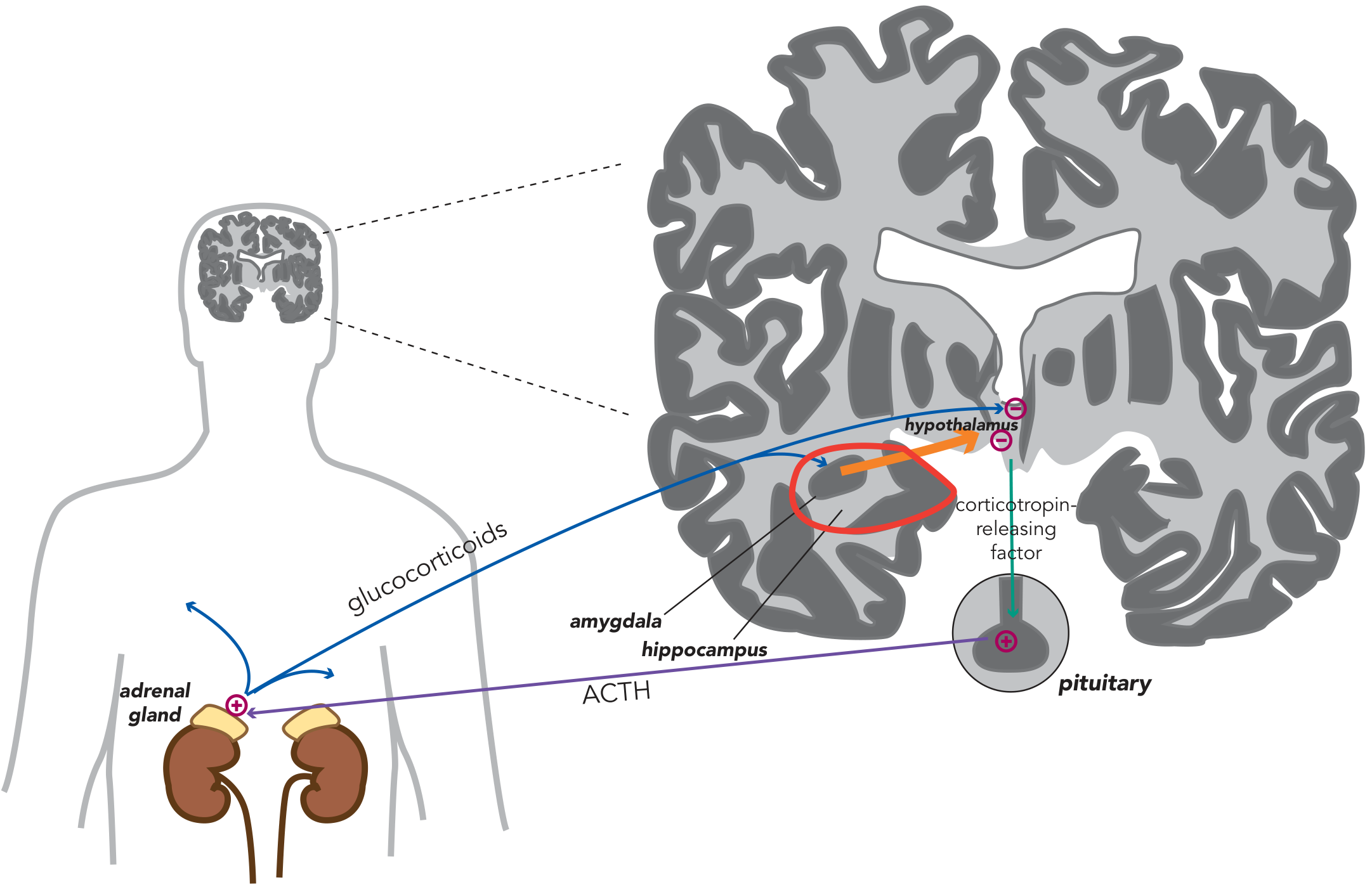
Figure: The Hypothalamic-Pituitary-Adrenal (HPA) Axis in the Normal Stress Response. The amygdala and hippocampus provide modulatory input to the hypothalamus. CRF (corticotropin-releasing factor) travels to the pituitary, stimulating ACTH release, which triggers glucocorticoid secretion from the adrenal gland. Glucocorticoids feed back negatively to terminate the response. (Source: Stahl's Essential Psychopharmacology)
Overview
The stress response is a coordinated physiological reaction that prepares the body to deal with perceived threats. It operates through two major axes:
- The Hypothalamic-Pituitary-Adrenal (HPA) axis - the hormonal arm
- The Sympatho-Adrenomedullary (SAM) axis - the fast neural/catecholamine arm
1. Perception and CNS Integration
When a stressor (physical - e.g., hemorrhage, infection, or psychological) is perceived, the cerebral cortex processes the signal and activates the hypothalamus. The amygdala amplifies the response (especially for fear/threat stimuli), while the hippocampus normally suppresses HPA axis activation via inhibitory input to the hypothalamus.
"The reaction of the body to stress is integrated in the brain through the hypothalamus. Signals are transmitted downward from the hypothalamus through the brainstem, into the spinal cord and then to organs."
- DiMaio's Forensic Pathology
2. The Fast Arm: Sympatho-Adrenomedullary (SAM) Axis
This is the immediate response - acting within seconds.
Pathway:
Stressor → Cortex → Hypothalamus → Brainstem → Spinal cord → Sympathetic ganglia → Target organs + Adrenal medulla
- The hypothalamus triggers widespread sympathetic discharge
- Sympathetic nerve terminals release norepinephrine (NE) at end organs
- The adrenal medulla (a modified sympathetic ganglion) releases both epinephrine (E) and norepinephrine (NE) into the bloodstream
Effects of catecholamines:
- Increased heart rate and cardiac output
- Vasoconstriction in skin/gut; vasodilation in skeletal muscle
- Bronchodilation
- Pupil dilation
- Mobilization of glucose (glycogenolysis)
- Heightened alertness - the classic "fight-or-flight" response
NE and E act via adrenoceptors (alpha and beta subtypes) on cell membranes. The balance between release and reuptake/enzymatic degradation controls the degree of sympathetic excitation. (DiMaio's Forensic Pathology, p. 449)
3. The Sustained Arm: HPA Axis
This is the slower, sustained response - acting over minutes to hours.
Step-by-Step Cascade
STRESSOR
    ↓
Cerebral Cortex / Limbic System
    ↓
Hypothalamus (Paraventricular Nucleus)
    ↓  [releases CRH + AVP]
Anterior Pituitary (Corticotrophs)
    ↓  [releases ACTH]
Adrenal Cortex (Zona Fasciculata)
    ↓  [synthesizes and secretes CORTISOL]
Target Tissues (liver, muscle, immune cells, brain)
    ↓
Negative Feedback ← inhibits hypothalamus AND pituitary
CRH (Corticotropin-Releasing Hormone)
- Released by small neurons in the paraventricular nucleus (PVN) of the hypothalamus
- A 41-amino-acid neuropeptide stored in secretory vesicles at the median eminence
- Travels via the hypothalamo-hypophyseal portal venous plexus to the anterior pituitary
- Binds CRH-R1 (a Gαs-coupled GPCR) on corticotroph cells → activates adenylyl cyclase → raises cAMP → activates PKA → opens L-type Ca²⁺ channels → exocytosis of pre-formed ACTH
"The stress response therefore involves the cerebral cortex, specialized neuroendocrine tissue in the hypothalamus, as well as two glands, the pituitary and the adrenal cortex."
- Medical Physiology (Boron & Boulpaep)
AVP (Arginine Vasopressin)
The paraventricular nucleus also produces AVP, which is a potent co-secretagogue for ACTH. AVP becomes particularly important in stresses involving dehydration or trauma. The stress response is mediated ~75% via CRH and ~25% via vasopressin - though CRH and AVP can be released independently, allowing selective activation of the vasopressin-containing neuron subset.
ACTH
- Released from anterior pituitary corticotrophs
- Acts directly on zona fasciculata cells of the adrenal cortex
- Stimulates synthesis and secretion of cortisol from cholesterol
- Has a shorter plasma half-life than cortisol, so its pulsatile secretion appears amplified
Cortisol - The Principal Stress Hormone
Cortisol exerts widespread effects in proportion to the severity of the stressor:
| Target | Effect |
|---|---|
| Liver | Gluconeogenesis - raises blood glucose |
| Muscle | Protein catabolism; amino acid mobilization |
| Adipose tissue | Lipolysis |
| Immune system | Anti-inflammatory; suppresses cytokine production |
| Cardiovascular | Maintains vascular tone and responsiveness to catecholamines |
| Brain | Mood, cognition, feedback suppression of HPA axis |
| Bone | Decreased osteoblast activity (problematic in chronic stress) |
4. Negative Feedback - Termination of the Stress Response
The HPA axis is tightly regulated by multi-level negative feedback:
- Short-loop feedback: ACTH inhibits CRH release from the hypothalamus
- Long-loop feedback: Cortisol inhibits:
- CRH synthesis/release from the hypothalamus
- Pituitary corticotroph sensitivity to CRH (directly reducing ACTH release)
- Hippocampal feedback: The hippocampus contains numerous glucocorticoid receptors - when activated by rising cortisol, it suppresses CRH release from the hypothalamus, helping terminate the response
"Within this CRH-ACTH-cortisol axis, feedback can occur at several levels. Cortisol inhibits the production of CRH by the hypothalamus as well as the sensitivity of the pituitary to a standard dose of CRH."
- Medical Physiology (Boron & Boulpaep)
In severe acute stress, this negative feedback is overridden - high cortisol levels that would normally shut down the axis are insufficient to suppress ACTH secretion, allowing a sustained response.
5. Circadian Modulation
Superimposed on the stress-driven response is a circadian rhythm of CRH and ACTH secretion. ACTH (and consequently cortisol) secretory activity is greatest in the early morning and lowest in the late afternoon/evening. This daily rhythm is input to the corticotrophs via hypothalamic nuclei through both CRH and AVP. Additionally, CRH is released in pulses, producing pulsatile ACTH secretion. In chronic stress, these normal circadian rhythms can be disrupted. (Medical Physiology, p. 1501)
6. Limbic Modulation - Amygdala and Hippocampus
| Structure | Role in Stress |
|---|---|
| Amygdala | Amplifies the stress signal - drives HPA axis activation, especially for emotional/fear stimuli |
| Hippocampus | Suppresses HPA axis activation via inhibitory input to the hypothalamus; contains high glucocorticoid receptor density for negative feedback |
In chronic stress, excessive glucocorticoid exposure can cause hippocampal neuronal atrophy, reducing its inhibitory input to the hypothalamus - resulting in a vicious cycle of HPA axis overactivity, as seen in depression.
7. Summary Diagram (Conceptual)
         STRESSOR (physical / psychological / biochemical)
                           ↓
         ┌─────────────────────────────────────┐
         │     CEREBRAL CORTEX / AMYGDALA      │
         └─────────────────────────────────────┘
                           ↓ activates
         ┌─────────────────────────────────────┐
         │   HYPOTHALAMUS (paraventricular      │◄── Hippocampus (inhibits)
         │   nucleus) → CRH + AVP              │◄── Cortisol (negative feedback)
         └─────────────────────────────────────┘
           ↓ (portal venous system)        ↓ (spinal cord)
   ┌──────────────────┐          ┌────────────────────────┐
   │ ANTERIOR PITUITARY│          │   SYMPATHETIC NERVOUS  │
   │ → ACTH           │          │   SYSTEM               │
   └──────────────────┘          └────────────────────────┘
           ↓ (blood)                       ↓
   ┌──────────────────┐          ┌────────────────────────┐
   │ ADRENAL CORTEX   │          │ ADRENAL MEDULLA +       │
   │ → CORTISOL       │          │ SYMPATHETIC TERMINALS  │
   └──────────────────┘          │ → EPINEPHRINE + NE     │
           ↓                     └────────────────────────┘
   Metabolic / immune /                    ↓
   cardiovascular effects        Fight-or-flight effects
           ↓
   NEGATIVE FEEDBACK → ↓CRH, ↓ACTH (terminates response)
Key Points Summary
- Two axes: SAM (fast, catecholamines) and HPA (slow, cortisol)
- CRH from hypothalamic PVN is the master stress hormone trigger
- ACTH bridges the pituitary and adrenal cortex
- Cortisol is the effector hormone with wide metabolic, immune, and cardiovascular actions
- Negative feedback at hypothalamic and pituitary levels normally terminates the response
- Amygdala activates, hippocampus inhibits the HPA axis
- Circadian and pulsatile patterns are superimposed on the stress response
- In chronic stress, feedback fails, leading to sustained hypercortisolemia and hippocampal atrophy
Sources: Medical Physiology (Boron & Boulpaep); Stahl's Essential Psychopharmacology; Schwartz's Principles of Surgery, 11e; DiMaio's Forensic Pathology, 3e; Kaplan & Sadock's Comprehensive Textbook of Psychiatry
This is a shared conversation. Sign in to Orris to start your own chat.