
Acute respiratory distress syndrome
Reading File
Finding Sources
Searching PubMed
"acute respiratory distress syndrome"[MeSH Terms] AND management
Reading File
Reading File
Searching PubMed
"ARDS" AND "mechanical ventilation"
Finding Sources
Reading File
Finding Sources
Finding Sources
Reading File
Finding Sources
Reading File
Reading File
Finding Sources
Loading Image
Reading File
Loading Image
I now have rich content from multiple authoritative textbooks. Let me compile the comprehensive answer.
Acute Respiratory Distress Syndrome (ARDS)
Definition - Berlin Criteria (2012)
ARDS is defined as a syndrome with ALL four of the following criteria (Berlin Definition, JAMA 2012):
- Onset within 1 week of a known clinical insult or new/worsening respiratory symptoms
- Bilateral radiographic opacities - not fully explained by pleural effusions, atelectasis, or nodules
- Respiratory failure not fully explained by cardiac failure or fluid overload (requires objective assessment, e.g., echocardiography, if no risk factor is present)
- Hypoxemia with PaO2/FiO2 ≤ 300 mmHg on PEEP or CPAP ≥ 5 cm H2O
Severity Classification
| Severity | PaO2/FiO2 | Approximate Mortality |
|---|---|---|
| Mild | 201-300 | ~27% |
| Moderate | 101-200 | ~32% |
| Severe | ≤100 | ~45% |
Note: The older term "Acute Lung Injury" (ALI) for PaO2/FiO2 ≤ 300 but > 200 is now obsolete - these cases are reclassified as mild ARDS.
- Fishman's Pulmonary Diseases and Disorders, p. 2480
- Sabiston Textbook of Surgery, p. 940
Etiology / Risk Factors
Direct (pulmonary) lung injury:
- Pneumonia (most common)
- Gastric aspiration
- Pulmonary contusion
- Inhalation injury, near-drowning
Indirect (extrapulmonary) lung injury:
-
Sepsis (most common indirect cause)
-
Major trauma / multiple transfusions (TRALI)
-
Severe pancreatitis
-
Burns
-
Shock / hypoperfusion
-
Drug overdose
-
Fishman's Pulmonary Diseases and Disorders, p. 2480
Pathophysiology
Three Phases of Diffuse Alveolar Damage (DAD)
1. Exudative phase (Days 1-7)
- Widespread alveolar and interstitial edema, inflammation, hemorrhage
- Destruction of type I alveolar epithelial cells
- Hyaline membrane formation (precipitated plasma proteins + fibrin + necrotic debris) - the histologic hallmark of DAD
- Marked increase in pulmonary dead space fraction
- Minute ventilation typically doubles (~12 L/min)
2. Proliferative phase (Days 5-14)
- Reabsorption of edema fluid
- Fibrin deposition in alveoli and interstitium
- Proliferation of type II pneumocytes (cuboidal epithelium)
- Fibroblast infiltration; air-blood barrier thickening
- Disruption of pulmonary vascular bed
3. Fibrotic phase (not all patients)
-
Linked to prolonged mechanical ventilation
-
Irreversible architectural remodeling
-
Fishman's Pulmonary Diseases and Disorders, pp. 2479-2480
Key Mediators
- Neutrophil sequestration in alveolar/interstitial spaces - central to injury
- TNF-α, IL-6, IL-8 - proinflammatory cytokines driving neutrophil activation
- Phospholipase A2 - enzymatic degradation of surfactant, promoting alveolar collapse
- Reactive oxygen species (ROS)
- von Willebrand factor (VWF) antigen - elevated in ARDS edema fluid, correlates with poor outcomes
- Angiopoietin-2 - elevated levels in sepsis predict development of ALI
The alveolar epithelium is often more severely damaged than the vascular endothelium. Increased alveolar-capillary permeability leads to protein-rich edema flooding the airspaces.
Clinical Features
- Acute onset of severe dyspnea and hypoxemia refractory to supplemental O2
- Tachypnea, tachycardia, cyanosis
- Diffuse bilateral crackles on auscultation
- CXR/CT: bilateral diffuse opacities ("whiteout"), often heterogeneous on CT (not truly diffuse)
- Reduced lung compliance (stiff lungs)
- Increased work of breathing
- The CT appearance shows a mix of consolidation, atelectasis, and relatively normal alveoli in a heterogeneous distribution - the "baby lung" concept (only the open alveoli receive tidal volume, greatly amplifying volutrauma risk)
Diagnosis
- Clinical: Berlin criteria above
- ABG: severe hypoxemia, often hypocapnia initially; metabolic acidosis may supervene
- CXR: bilateral infiltrates not explained by cardiomegaly or pleural effusion alone
- CT chest: more sensitive; shows heterogeneous infiltrates (gravity-dependent dense consolidation, non-dependent aeration)
- Echocardiography / BNP: to exclude cardiogenic pulmonary edema (the "non-cardiogenic" hallmark of ARDS)
- BAL: if needed to identify infectious etiology; reveals neutrophilia, elevated protein, inflammatory mediators
Management
1. Lung-Protective Mechanical Ventilation (cornerstone of therapy)
The ARDSNet ARMA trial demonstrated a 10% absolute mortality reduction (40% → 30%) with low tidal volume ventilation vs. traditional large tidal volumes.
ARDSNet Protocol (ARDS Network Algorithm):
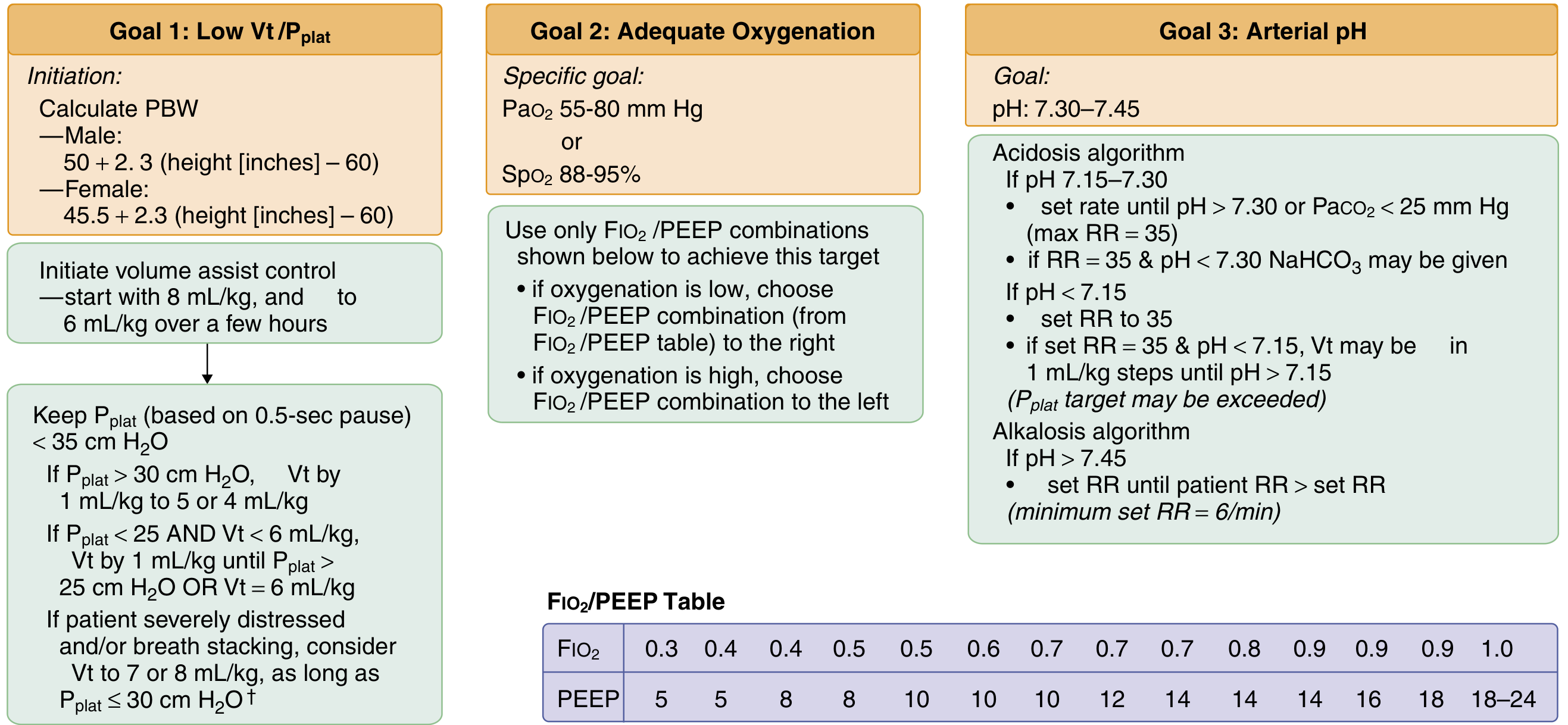
Key ventilator goals:
| Parameter | Target |
|---|---|
| Mode | Volume assist-control |
| Tidal Volume | 6 mL/kg predicted body weight (PBW); start at 8, reduce to 6 |
| Plateau pressure (Pplat) | ≤ 30 cm H2O |
| PaO2 | 55-80 mmHg |
| SpO2 | 88-95% |
| pH | 7.30-7.45 |
| PEEP | Titrated by FiO2/PEEP table |
Predicted body weight (PBW):
- Male: 50 + 2.3 × (height in inches - 60)
- Female: 45.5 + 2.3 × (height in inches - 60)
Permissive hypercapnia is accepted to allow low tidal volumes - CO2 rises but this is tolerated as long as pH ≥ 7.15-7.20.
FiO2/PEEP table (titrate together):
| FiO2 | 0.3 | 0.4 | 0.4 | 0.5 | 0.5 | 0.6 | 0.7 | 0.7 | 0.7 | 0.8 | 0.9 | 0.9 | 0.9 | 1.0 |
|---|---|---|---|---|---|---|---|---|---|---|---|---|---|---|
| PEEP | 5 | 5 | 8 | 8 | 10 | 10 | 10 | 12 | 14 | 14 | 14 | 16 | 18 | 18-24 |
Rationale for volutrauma avoidance: On CT, ARDS lungs show heterogeneous aeration. Tidal volumes of 10-15 mL/kg are preferentially distributed to the small fraction of open alveoli ("baby lung"), causing dangerous overexpansion. Low Vt limits both volutrauma (overdistension) and atelectrauma (repetitive alveolar opening/closing).
- Fishman's Pulmonary Diseases and Disorders, pp. 2499-2500
- Goldman-Cecil Medicine, p. 1066-1067
2. Prone Positioning
-
One of the few interventions with proven mortality benefit in an RCT (PROSEVA trial, 2013)
-
Indicated for moderate-severe ARDS (PaO2/FiO2 < 150)
-
Should be initiated early in the course of ARDS
-
Mechanism: redistributes lung perfusion toward better-ventilated dependent regions, recruits dorsal lung units, reduces ventral overinflation
-
Requires experienced nursing staff; prone sessions typically 16+ hours/day
-
Requires caution given risk of accidental extubation, line displacement
-
Sabiston Textbook of Surgery, p. 940
A 2024 network meta-analysis in Intensive Care Med confirmed that prone positioning reduces mortality in severely hypoxemic ARDS and remains the standard recommendation before escalating to VV-ECMO. (PMID 38842731)
3. PEEP Optimization
- PEEP recruits collapsed alveoli, reduces intrapulmonary shunt, and allows FiO2 reduction (limiting O2 toxicity)
- Titrated by FiO2/PEEP tables (ARDSNet), or increasingly guided by driving pressure or electrical impedance tomography (EIT)
- A 2024 systematic review (PMID 38512400) showed EIT-guided PEEP titration improves oxygenation and reduces driving pressure vs. ARDSNet tables
4. Sedation and Neuromuscular Blockade
- Deep sedation ensures ventilator synchrony and prevents patient-driven lung injury
- Neuromuscular blockade (NMB) with cisatracurium: early use (first 48h) in moderate-severe ARDS was evaluated in the ACURASYS and ROSE trials with conflicting results; not routinely recommended for all patients currently, but may be used for ventilator dyssynchrony or severe hypoxemia
5. Fluid Management
- Conservative fluid strategy (FACTT trial): achieving negative fluid balance reduces duration of mechanical ventilation and ICU stay without increasing renal failure
- Target dry intravascular volume once hemodynamic stability is achieved
- Diuresis helps reduce extrapulmonary edema
6. Adjunct Therapies (rescue, no proven mortality benefit)
| Intervention | Evidence |
|---|---|
| Inhaled nitric oxide (iNO) | Improves oxygenation transiently; no mortality benefit |
| Inhaled epoprostenol | Similar to iNO; improves oxygenation; no mortality benefit |
| Corticosteroids | Controversial; may reduce inflammation and fibroproliferation; no clear survival benefit in meta-analyses; sometimes used in fibroproliferative phase or COVID-ARDS (dexamethasone has survival benefit specifically in COVID-19) |
| High-frequency oscillatory ventilation (HFOV) | No mortality benefit; may be harmful in some patients |
| Inverse ratio ventilation | No proven mortality benefit |
- Sabiston Textbook of Surgery, p. 940
7. Extracorporeal Membrane Oxygenation (VV-ECMO)
- Reserved for refractory ARDS failing all conventional measures
- CESAR trial: reduced mortality for patients referred to ECMO centers
- EOLIA trial (2018): no statistically significant benefit (but stopped early; crossover complicated interpretation)
- 2024 network meta-analysis (PMID 38842731): VV-ECMO may reduce mortality in severe ARDS compared to supine ventilation; prone positioning should be tried first
- Should only be performed in high-volume, experienced centers
8. Treatment of Underlying Cause
- Antibiotics for sepsis/pneumonia
- Source control for abdominal sepsis
- Transfusion protocols for TRALI
- No therapy directly reverses diffuse alveolar damage - supportive ventilation buys time for spontaneous lung repair
Prognosis and Outcomes
- Overall mortality: 30-45% depending on severity and etiology
- Survivors frequently have impaired quality of life, with persistent pulmonary function deficits, neuromuscular weakness, and cognitive impairment (post-intensive care syndrome)
- Recovery: most survivors show gradual lung function improvement over 6-12 months; fibrotic phase (in a minority) may leave permanent restriction
Recent Evidence (2024-2025)
- [PMID 38842731] - Network meta-analysis (Intensive Care Med, Jul 2024): Prone positioning and VV-ECMO both reduce mortality vs. supine ventilation in severe ARDS; prone should be tried before ECMO
- [PMID 38512400] - Systematic review (Intensive Care Med, May 2024): EIT-guided PEEP titration outperforms ARDSNet table-based titration for oxygenation and driving pressure outcomes
- [PMID 41270941] - Systematic review (Respir Med, Dec 2025): Mechanical power (the energy per unit time transferred by ventilator to lung) is associated with ventilator-induced lung injury; monitoring mechanical power is an emerging metric alongside driving pressure
Sources: Fishman's Pulmonary Diseases and Disorders | Goldman-Cecil Medicine | Sabiston Textbook of Surgery | Murray & Nadel's Textbook of Respiratory Medicine | Miller's Anesthesia | Rosen's Emergency Medicine | Barash's Clinical Anesthesia
This is a shared conversation. Sign in to Orris to start your own chat.