
Difference between SIMV Vs APRV for My MD Anaesthesiology exam notes
Reading File
Now let me search the medical library for SIMV and APRV content in parallel.
Finding Sources
Finding Sources
Finding Sources
Excellent results. Now let me read the most relevant sections from Morgan & Mikhail (the top anaesthesiology textbook), Murray & Nadel (respiratory medicine), and Roberts & Hedges in parallel.
Reading File
Reading File
Reading File
Now let me read the APRV section from Roberts & Hedges and Murray & Nadel, and also the SIMV/APRV weaning section from Morgan & Mikhail:
Reading File
Reading File
Reading File
Now let me fetch the APRV waveform image and read the weaning section from Morgan & Mikhail, and also check Sabiston for additional comparison points:
Loading Image
Loading Image
Reading File
I now have comprehensive information from multiple authoritative anaesthesiology textbooks. Let me compile the complete exam notes.
SIMV vs APRV: Comparison for MD Anaesthesiology Exam Notes
1. SIMV - Synchronized Intermittent Mandatory Ventilation
Definition
A ventilator mode that delivers a preset number of mandatory breaths (volume- or pressure-targeted) synchronized to the patient's own inspiratory effort. Between mandatory breaths, the patient can breathe spontaneously without ventilator assistance (unless Pressure Support is added).
Breath Sequence Classification
- PC-IMV or VC-IMV (Intermittent Mandatory Ventilation)
- The mandatory breath is "synchronized" = timed to coincide with the beginning of a spontaneous effort to avoid breath stacking
How It Works
- Clinician sets: Rate (RR), Tidal Volume (VT) or Pressure, FiO2, PEEP
- Ventilator delivers the set number of mandatory breaths per minute
- If patient's RR > set rate: additional breaths above the set rate are unsupported spontaneous breaths (patient does all the work)
- If patient is paralyzed: SIMV and AC look identical - both deliver at the set rate
- SIMV + PSV: Pressure support is typically added to assist spontaneous breaths and reduce work of breathing imposed by the ET tube and circuit resistance
Key Settings
| Parameter | Typical Value |
|---|---|
| Set RR | 10-14 breaths/min (full support) → reduced during weaning |
| VT | 6-8 mL/kg IBW |
| PEEP | 5 cm H2O (adjust per ABG/SpO2) |
| FiO2 | Titrate to SpO2 ≥94% |
| PSV (add-on) | 5-10 cm H2O for spontaneous breaths |
Work of Breathing (Key Exam Point)
- Mandatory breaths: ventilator does the work
- Spontaneous breaths between mandatories: patient does ALL the work, including overcoming ET tube resistance
- This unequal work distribution is SIMV's major disadvantage
- PSV must be added to reduce this burden
Weaning with SIMV (Morgan & Mikhail)
- Progressively decrease RR by 1-2 breaths/min
- Check ABG after min. 15-30 min at each setting
- Criteria to continue decreasing: PaCO2 <45-50 mmHg, RR <30 breaths/min
- When IMV rate reaches 2-4 breaths/min with acceptable oxygenation: discontinue ventilation
- If PSV is co-used: reduce to 5-8 cm H2O before extubation
Disadvantages (Exam High-Yield)
- Delays liberation from mechanical ventilation vs T-piece trials or PSV-alone weaning (Murray & Nadel, Roberts & Hedges)
- High work of breathing during spontaneous breaths
- Patient-ventilator dyssynchrony if rate set too high (masks effort) or too low (insufficient backup)
- If rate is set too low (e.g., 4 breaths/min) and patient is weak - backup may be insufficient
2. APRV - Airway Pressure Release Ventilation
Definition
A time-cycled, pressure-targeted mode that maintains a prolonged high CPAP level (P-high) during which the patient breathes spontaneously, with brief, intermittent pressure releases (P-low) to eliminate CO2. Also known as bilevel ventilation, biphasic airway pressure, or (when paralyzed) inverse ratio ventilation.
Breath Sequence Classification
- PC-IMV variant / CPAP-based mode
- Modification of pressure-targeted SIMV that allows unrestricted spontaneous breathing at ALL phases of the cycle (including T-low)
How It Works
The four key parameters:
| Parameter | Description | Typical Value |
|---|---|---|
| P-high | High CPAP level - maintains alveolar recruitment; oxygenation phase | 20-35 cm H2O |
| T-high | Time at P-high (patient breathes spontaneously here) | 4-6 seconds |
| P-low | Low CPAP/release pressure - CO2 clearance phase | 0-5 cm H2O |
| T-low | Duration of release/exhalation phase | 0.2-0.8 s (restrictive); 0.8-1.5 s (obstructive) |
- Releases occur 10-12 times/min (starting point)
- T-low is set to allow only 50-75% of exhalation to complete (flow termination criterion), creating auto-PEEP
- Patient can breathe in AND out at any point during T-high
The "Floating Valve" Concept
A demand valve responds to patient effort regardless of where the patient is in the cycle - this is what makes APRV fundamentally different from cyclic ventilation. There is no traditional set inspiratory or expiratory time per breath.
Oxygenation vs Ventilation in APRV (Exam High-Yield)
| Goal | Mechanism | Parameter to Adjust |
|---|---|---|
| Oxygenation | Long T-high maintains high mean airway pressure, recruits alveoli | ↑ P-high, ↑ T-high, ↑ FiO2 |
| Ventilation (CO2 clearance) | Pressure drop from P-high to P-low + elastic recoil drives large expiratory flow | ↑ Number of releases (↓ T-high), adjust T-low |
APRV Waveform
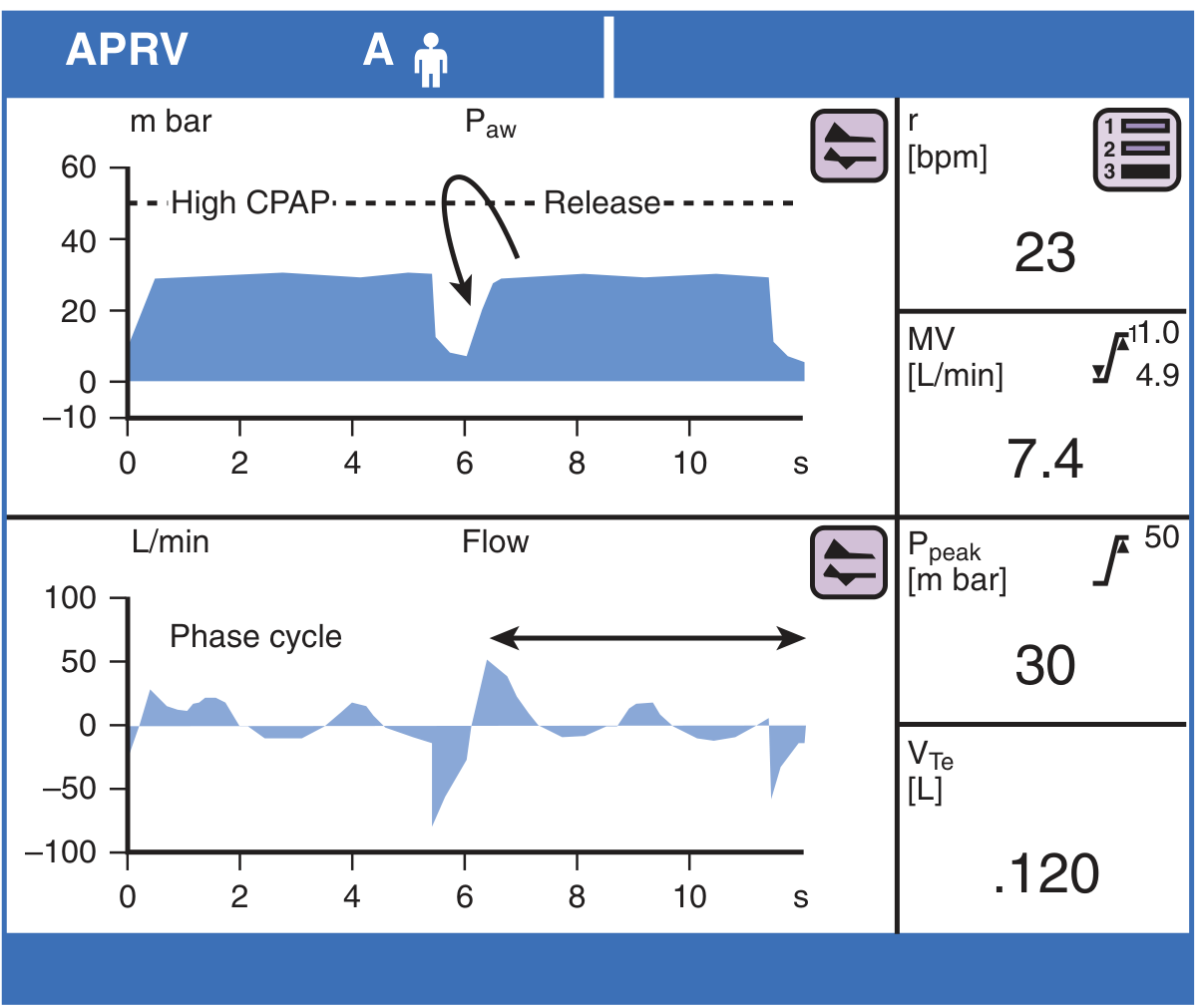
The pressure-time trace shows prolonged P-high phase with brief drops to P-low. The flow-time trace shows spontaneous breathing efforts (small positive/negative deflections) during T-high, and a large negative deflection (high expiratory flow) during the release. Small exhalations during T-high (50-200 mL) should not be counted as full breaths.
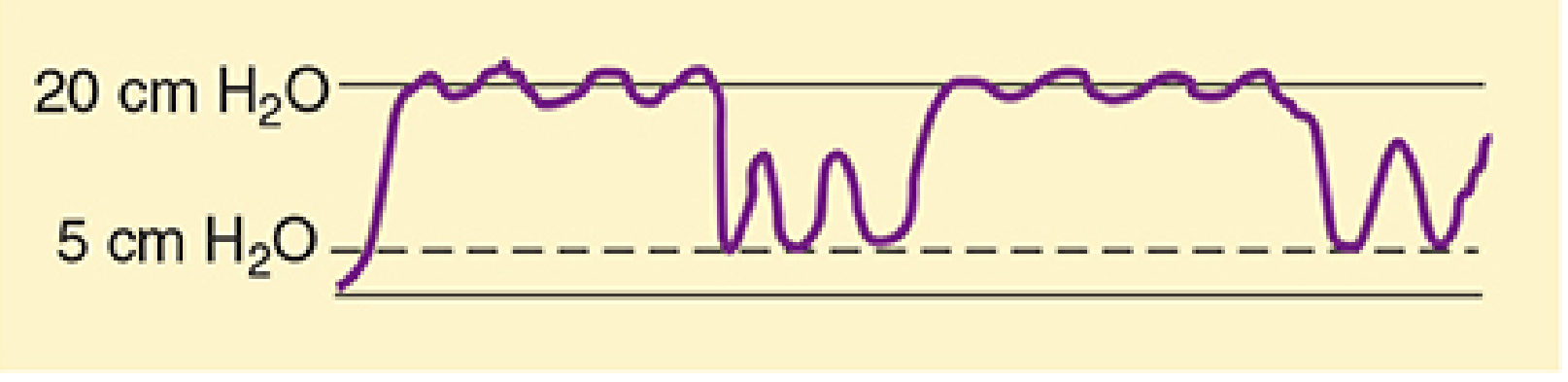
Classic APRV trace: patient breathes spontaneously at P-high (~20 cm H2O), with periodic drops to P-low (~5 cm H2O). Spontaneous breaths visible at both P-high and P-low levels.
Advantages of APRV
- Maintains spontaneous breathing → better V/Q matching, diaphragm recruitment, hemodynamic preservation
- Less sedation/NMB required compared to IRV or CMV (no chemical paralysis needed)
- Higher mean airway pressure without proportionally higher peak pressure → better recruitment
- Reduces barotrauma risk compared to PC-IRV
- Less circulatory depression than other high-PEEP modes
- Open-lung strategy - ideal for ARDS with poor compliance
- Avoids need for paralysis (unlike IRV) - patient comfort maintained
Indications
- ARDS (early, diffuse) - especially when traditional LPV is failing
- ALI with refractory hypoxemia
- Post-op respiratory failure
- Alternative to PC-IRV when paralysis is undesirable
3. SIMV vs APRV: Direct Comparison Table
| Feature | SIMV | APRV |
|---|---|---|
| Mode type | Volume or pressure-targeted IMV | Pressure-targeted, time-cycled |
| Primary pressure level | Variable (set by VT or Pinsp) | High CPAP (P-high): 20-35 cm H2O |
| Time distribution | Equal I:E ratio (e.g., 1:2) | Majority time at P-high (4-6s high : 0.2-1.5s low) |
| I:E ratio | Normal (1:2 or 1:3) | Effectively INVERSE (I:E >>1, like IRV) |
| Spontaneous breathing | Between mandatory breaths only (unsupported unless PSV added) | During ALL phases - at P-high AND P-low |
| CO2 clearance | Via mandatory + spontaneous breaths | Via pressure release (T-low) + elastic recoil |
| Oxygenation mechanism | FiO2 + PEEP | High mean Paw via prolonged P-high |
| Sedation requirement | Moderate | Low (minimal sedation, no paralysis needed) |
| NMB required? | No | No (key advantage over IRV) |
| Work of breathing | High during unsupported spontaneous breaths | Distributed, supported throughout cycle |
| Weaning | Step-down RR by 1-2/min | Lengthen T-high, reduce P-high gradually |
| Liberation from MV | Delays liberation (evidence-based) | Potentially fewer ventilator days (single-center data) |
| Primary use | General MV support, weaning | ARDS, refractory hypoxemia, open-lung strategy |
| Mean airway pressure | Lower | Higher (lung recruitment) |
| Peak airway pressure | Can be high (VC mode) | Limited by P-high setting |
| Barotrauma risk | Higher in VC mode | Lower than IRV, comparable to lung-protective CMV |
| Hemodynamic effects | Less depression than APRV (lower mean Paw) | More circulatory depression (higher mean Paw) - monitor RV |
| Settings | RR, VT (or Pinsp), PEEP, FiO2, (+PSV) | P-high, P-low, T-high, T-low, FiO2 |
| Breath sequence | PC-IMV or VC-IMV | PC-IMV (CPAP-based variant) |
4. Key Exam Mnemonics & High-Yield Points
APRV = "CPAP with a release valve"
- P-high = Platform for oxygenation
- T-high = Time to recruit (long)
- P-low = Pressure drops for CO2 clearance
- T-low = Tiny window (short - to preserve auto-PEEP)
SIMV Key Facts
- "S" = Synchronized - breath timed to patient's effort (prevents stacking)
- High RR SIMV ≈ full support; Low RR SIMV ≈ near spontaneous breathing
- Always add PSV to unsupported breaths
- SIMV delays weaning compared to T-piece or PSV trials (Esteban et al.)
APRV Key Facts
- Inverse ratio without paralysis = APRV's signature
- Mean Paw > PEEP (auto-PEEP from short T-low)
- Terminate T-low when expiratory flow reaches 50-75% of peak (prevents derecruitment)
- APRV = PC-IRV when patient is paralyzed (functionally identical)
5. Clinical Decision: When to Choose Which?
| Scenario | Preferred Mode |
|---|---|
| Standard post-op ventilation | SIMV+PSV or AC |
| Weaning from MV | PSV > T-piece > SIMV (SIMV slowest) |
| ARDS with refractory hypoxemia | APRV (open-lung) |
| Patient requiring heavy sedation or NMB | Avoid APRV (defeats its purpose) |
| Obstructive lung disease (COPD/asthma) | Avoid APRV (air trapping risk, T-low adjustment needed) |
| Head injury (need tight CO2 control) | Avoid APRV (CO2 control less precise) |
| Spontaneously breathing ARDS patient | APRV preferred |
Sources:
- Morgan and Mikhail's Clinical Anesthesiology, 7e, Chapters 58 (Mechanical Ventilation, Weaning with SIMV, APRV)
- Roberts and Hedges' Clinical Procedures in Emergency Medicine, Chapter 8 (SIMV, APRV)
- Murray & Nadel's Textbook of Respiratory Medicine, Chapter 135 (Modes of Ventilation, APRV)
- Current Surgical Therapy, 14e (SIMV, APRV)
- Sabiston Textbook of Surgery (SIMV, APRV/Bilevel)
This is a shared conversation. Sign in to Orris to start your own chat.