
Compare the difference between intrinsic pathway and extrinsic pathway of blood coagulation for five marks. Give me the proper difference and it should be of exam oriented. Make a table and describe it.
Reading File
Now let me search the medical library for coagulation pathway content.
Finding Sources
Finding Sources
Good results. Let me now read the most relevant sections from multiple textbooks simultaneously.
Reading File
Reading File
Reading File
Excellent content gathered. Let me also fetch the coagulation cascade diagram and get Harper's content.
Loading Image
Reading File
I now have rich, authoritative content from multiple textbooks. Let me compose the comprehensive, exam-oriented answer.
Intrinsic vs. Extrinsic Pathway of Blood Coagulation
(Source: Harper's Illustrated Biochemistry 32e, Basic Medical Biochemistry 6e, Medical Physiology, Miller's Anesthesia 10e)
Coagulation Cascade Diagram
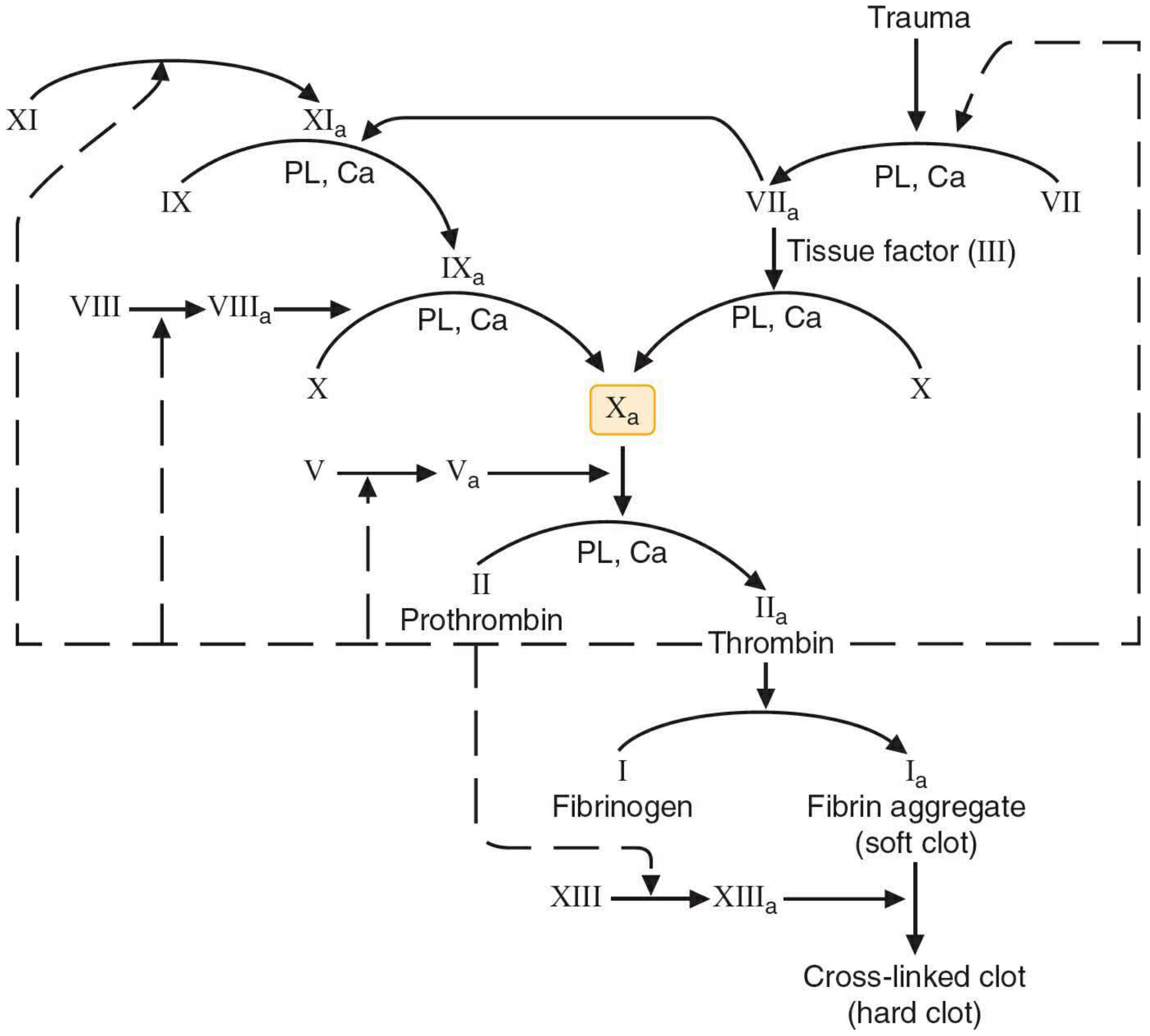
Comparison Table: Intrinsic vs. Extrinsic Pathway
| Feature | Intrinsic Pathway (Contact Activation Pathway) | Extrinsic Pathway (Tissue Factor Pathway) |
|---|---|---|
| Trigger / Initiating stimulus | Activation by negatively charged surfaces (collagen, glass, dextran sulfate, kaolin) in contact with blood | Exposure of blood to Tissue Factor (TF / Factor III) released from damaged subendothelial tissues |
| Components involved | Factors XII, XI, IX, VIII, prekallikrein (PK), high-molecular-weight kininogen (HMWK), Ca²⁺, platelet phospholipids | Factors VII, X, Tissue Factor (III), Ca²⁺, phospholipids |
| Key initiating factor | Factor XII (Hageman factor) - activated by contact with negatively charged surface | Factor VII (Proconvertin) - activated upon binding to Tissue Factor after vascular injury |
| Speed of reaction | Slower - involves more steps and multiple factors | Faster - fewer steps; rapid initiation of hemostasis |
| Role in physiology | Primarily an amplification system - propagates and sustains thrombin generation initiated by the extrinsic pathway | Represents the initiation phase of plasma-mediated hemostasis; principal pathway in vivo |
| In vitro test | aPTT (Activated Partial Thromboplastin Time) - prolonged when intrinsic factors are deficient | PT (Prothrombin Time) - prolonged when extrinsic factors (especially Factor VII) are deficient |
| Sequence of activation | XII → XIIa → XI → XIa → IX → IXa → (with VIIIa, Ca²⁺, PL) → Xa | VII + TF → VIIa/TF complex → (with Ca²⁺, PL) → Xa |
| Vitamin K-dependent factors | Factors IX (also II and X in common pathway) | Factors VII (also II, IX, X - vitamin K dependent) |
| Associated disorders | Deficiency of Factor VIII → Hemophilia A; Factor IX → Hemophilia B; Factor XI → Hemophilia C | Factor VII deficiency → prolonged PT; tissue factor pathway defects are rare |
| Inhibitors | Contact pathway inhibited by C1-inhibitor, antithrombin III | TFPI (Tissue Factor Pathway Inhibitor) is the key inhibitor; limits the extrinsic pathway |
| Location of reaction | On the phospholipid membrane of activated platelets | At the site of tissue injury on subendothelial tissue factor (membrane-bound) |
Convergence: The Common Pathway
Both pathways converge at Factor X activation (Factor Xa). From here:
- Xa + Va + Ca²⁺ + phospholipid form the Prothrombinase complex
- Prothrombinase converts Prothrombin (Factor II) → Thrombin (Factor IIa)
- Thrombin cleaves Fibrinogen (Factor I) → Fibrin monomers → polymerize into a soft clot
- Factor XIIIa (activated by thrombin) cross-links fibrin strands into an insoluble hard clot
Key Points to Remember for Exams
- "Intrinsic = all components in blood" - no external tissue factor required; activated by internal contact with abnormal surfaces.
- "Extrinsic = external trigger" - tissue factor (extrinsic to blood) is needed.
- TFPI is the physiologic brake on the extrinsic pathway - this is why the intrinsic pathway is essential for sustaining coagulation.
- Both pathways are not truly independent - the TF/VIIa complex of the extrinsic pathway also activates Factor IX of the intrinsic pathway, creating cross-talk.
- Lab correlation: aPTT tests intrinsic; PT/INR tests extrinsic. A patient with prolonged aPTT but normal PT has an intrinsic pathway defect (e.g., Hemophilia A or B).
Sources: Harper's Illustrated Biochemistry 32e, p. 1417-1421 | Basic Medical Biochemistry 6e, p. 1557 | Medical Physiology (Boron & Boulpaep), p. 643 | Miller's Anesthesia 10e, p. 6715-6717
This is a shared conversation. Sign in to Orris to start your own chat.