
Defecation and defecation reflexes to get full marks in first year mbbs university exam
Reading File
Now let me search the medical library for defecation and defecation reflexes content.
Finding Sources
Finding Sources
Found the primary sources. Let me read the Guyton defecation section and the Ganong section in parallel.
Reading File
Reading File
Excellent content retrieved. Let me read the continuation of the Guyton defecation section and also get the Ganong defecation reflex details.
Reading File
Reading File
Let me fetch the key diagram from Guyton and also get the Ganong defecation section with the sphincter pressure details.
Loading Image
Reading File
I now have comprehensive material from both Guyton and Ganong. Let me compose the full exam-ready answer.
Defecation and Defecation Reflexes
Sources: Guyton & Hall Textbook of Medical Physiology (14th ed.) and Ganong's Review of Medical Physiology (26th ed.)
1. Definition
Defecation is the process by which feces are expelled from the rectum through the anus. It involves coordinated activity of smooth muscle, skeletal muscle, and both intrinsic (enteric) and extrinsic (spinal) neural pathways.
2. Anatomy Relevant to Defecation
| Structure | Type | Control |
|---|---|---|
| Internal anal sphincter | Smooth muscle (thickening of circular layer) | Involuntary; autonomic (sympathetic - excitatory; parasympathetic - inhibitory) |
| External anal sphincter | Striated (skeletal) muscle | Voluntary + subconscious; pudendal nerve (somatic) |
| Puborectalis muscle | Skeletal muscle | Maintains anorectal angle (~90-100°); inhibits defecation |
Key point: The rectum is normally empty of feces. A weak functional sphincter at the sigmoid-rectal junction (~20 cm from anus) + a sharp angulation keeps it empty until mass movements push feces in.
3. Filling of the Rectum - The Trigger
Mass movements (mass action contractions) in the colon:
- Occur ~3 times/day (most commonly after meals)
- A large segment of colon contracts as a unit, propelling feces from the transverse colon down into the rectum
- Triggered by gastrocolic reflex and duodenocolic reflex (distension of stomach/duodenum after meals)
- The urge to defecate first appears when rectal pressure rises to about 18 mm Hg (Ganong)
4. Defecation Reflexes
There are two reflexes that work together:
A. Intrinsic (Myenteric) Defecation Reflex
- Stimulus: Feces distend the rectal wall
- Arc: Afferent signals via myenteric plexus → peristaltic waves travel down through the descending colon, sigmoid, and rectum toward the anus → internal anal sphincter relaxes (via inhibitory signals from myenteric plexus)
- Limitation: By itself this reflex is relatively weak and insufficient to cause effective defecation
B. Parasympathetic (Spinal) Defecation Reflex - The Amplifier
- Stimulus: Rectal distension stimulates nerve endings
- Arc:
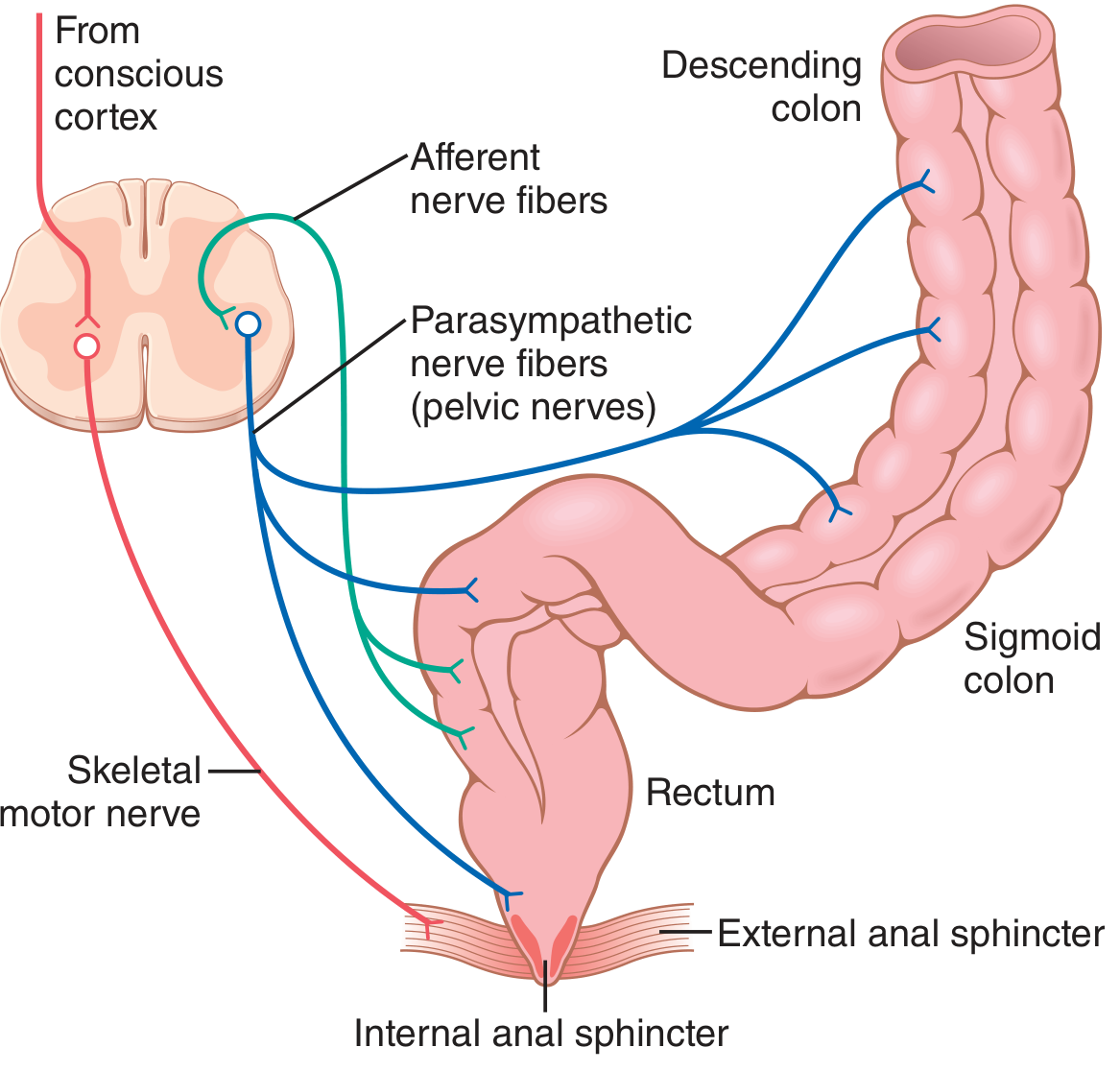
- Afferent signals travel via pelvic nerves → sacral spinal cord (S2-S4)
- Efferent parasympathetic signals return via pelvic nerves → descending colon, sigmoid, rectum, anus
- Effect: Greatly intensifies peristaltic waves + relaxes the internal anal sphincter
- This reflex greatly amplifies the intrinsic myenteric reflex, making defecation effective
The diagram below shows the afferent and efferent pathways of the parasympathetic defecation reflex (Guyton Fig. 64.6):
5. Sequence of Events During Defecation
- Feces enter rectum via mass movements → rectal wall is distended
- Intrinsic + parasympathetic defecation reflexes are triggered
- Peristaltic waves sweep down the colon and rectum
- Internal anal sphincter relaxes (via myenteric inhibitory signals)
- If the person voluntarily relaxes the external anal sphincter → defecation occurs
- Simultaneously:
- Deep breath is taken
- Glottis closes (Valsalva)
- Abdominal muscles contract → raises intra-abdominal pressure
- Pelvic floor relaxes and descends 1-3 cm
- Anorectal angle straightens (puborectalis relaxes)
- These forces push fecal contents out
When rectal pressure reaches 55 mm Hg, both internal AND external sphincters relax reflexively, causing automatic expulsion - this is why evacuation can occur even after spinal cord injury.
6. Voluntary Control
- The external anal sphincter is under voluntary control (pudendal nerve, somatic)
- When it is socially inconvenient, a person can voluntarily constrict the external sphincter to postpone defecation
- This causes the rectal wall to accommodate to the increased pressure and the urge temporarily subsides
- If natural reflexes are repeatedly suppressed, constipation results
- When convenient, defecation can be voluntarily initiated by:
- Taking a deep breath → diaphragm moves down
- Contracting abdominal muscles → increases intra-abdominal pressure → forces more feces into rectum → triggers the reflex again (though less effective than naturally arising reflexes)
7. Gastrocolic Reflex
- Distension of the stomach by food initiates contractions of the rectum and the desire to defecate
- This is a vagovagal reflex (possibly amplified by gastrin acting on the colon)
- Explains why defecation after meals is common, especially in children
8. Effects of Spinal Cord Transection
| Level of Injury | Effect |
|---|---|
| Above sacral segments | Parasympathetic reflex arc is intact but disconnected from higher control → automatic, involuntary defecation at inconvenient times |
| At sacral/conus medullaris | Parasympathetic reflex lost; only weak intrinsic myenteric reflex remains; digital stimulation may not be effective |
| Newborns | No voluntary cortical control → automatic emptying at inconvenient times |
9. Hirschsprung Disease (Clinical Correlation)
- Absence of ganglion cells (aganglionosis) in a segment of colon → no myenteric plexus → no intrinsic reflex in that segment → the aganglionic segment remains tonically contracted → megacolon proximal to it
- Treatment: surgical resection of aganglionic segment
10. Summary Table for Quick Revision
| Feature | Intrinsic Reflex | Parasympathetic Reflex |
|---|---|---|
| Mediated by | Myenteric (enteric) plexus | Sacral spinal cord (S2-S4) via pelvic nerves |
| Strength | Weak alone | Strong amplifier |
| Arc | Local (rectal wall) | Spinal cord relay |
| Effect on IAS | Relaxation | Relaxation (greatly enhanced) |
| Effect on peristalsis | Initiates | Greatly intensifies |
Key Points to Score Full Marks
- Two types of defecation reflexes must be named and distinguished
- Intrinsic = myenteric plexus; Parasympathetic = sacral spinal cord (S2-S4) via pelvic nerves
- Intrinsic reflex is weak alone - always needs the spinal reflex to be effective
- Internal sphincter = smooth, involuntary; External sphincter = skeletal, voluntary (pudendal nerve)
- Role of Valsalva maneuver components (deep breath + glottis closure + abdominal contraction)
- Voluntary inhibition/facilitation via the external sphincter
- Gastrocolic reflex = defecation urge after meals
- Rectal pressure thresholds: urge at ~18 mm Hg, reflex expulsion at ~55 mm Hg (Ganong)
- Consequences of spinal cord injury on defecation
- Clinical relevance: Hirschsprung disease, constipation
Guyton & Hall Textbook of Medical Physiology, 14th ed., Ch. 64, p. 796 | Ganong's Review of Medical Physiology, 26th ed., Ch. 27, p. 505
Gastric emptying to get full marks in physiology university exams
Finding Sources
Finding Sources
Good - found sections in Guyton (via Boron Medical Physiology), Costanzo, and Ganong. Let me read all three primary physiology sources in parallel.
Reading File
Reading File
Finding Sources
Good content. Now let me read more of the Boron Medical Physiology section on feedback mechanisms and also get Guyton's specific gastric emptying section.
Reading File
Finding Sources
Let me now get Guyton's dedicated gastric emptying section and the Ganong section on gastric motility/emptying.
Finding Sources
Finding Sources
Excellent - found the exact Guyton sections. Let me read them all now.
Reading File
Reading File
Excellent content. Let me read the continuation with hormonal feedback and the summary section, plus fetch the key diagram.
Reading File
Loading Image
I now have comprehensive, high-quality content from Guyton, Costanzo, and Boron. Let me also quickly fetch the propulsion/grinding/retropulsion diagram.
Loading Image
I now have all the content needed for a comprehensive, exam-ready answer. Let me compose it.
Gastric Emptying - Complete Notes for University Physiology Exam
Sources: Guyton & Hall Textbook of Medical Physiology (14th ed.), Costanzo Physiology (7th ed.), Boron & Boulpaep Medical Physiology
1. Definition
Gastric emptying is the process by which the stomach delivers its contents (chyme) into the duodenum at a controlled rate that matches the small intestine's capacity to digest and absorb nutrients.
After a meal, the stomach contains about 1.5 L of food + gastric secretions, all of which empties over approximately 3 hours.
2. Basic Electrical Rhythm (BER) of the Stomach
- The stomach has a pacemaker in the upper body (corpus) that generates slow waves (BER) at 3 waves/minute
- These slow waves do NOT themselves cause contraction - they set the maximum frequency at which contractions can occur
- When action potentials (spike potentials) are superimposed on these waves, smooth muscle contracts
- The strength of contraction depends on the degree of hormonal/neural stimulation
3. Mechanical Basis of Gastric Emptying
The Pyloric Pump
Most of the time (~80%), gastric contractions are weak mixing waves. However, for about 20% of the time while food is in the stomach, contractions become intense:
- Strong peristaltic ringlike constrictions begin in the mid-stomach and sweep toward the antrum
- These generate 50-70 cm H₂O pressure (about 6x stronger than mixing waves)
- Each wave forces a few mL of chyme through the pylorus into the duodenum
- This repeated pumping action is called the "Pyloric Pump"
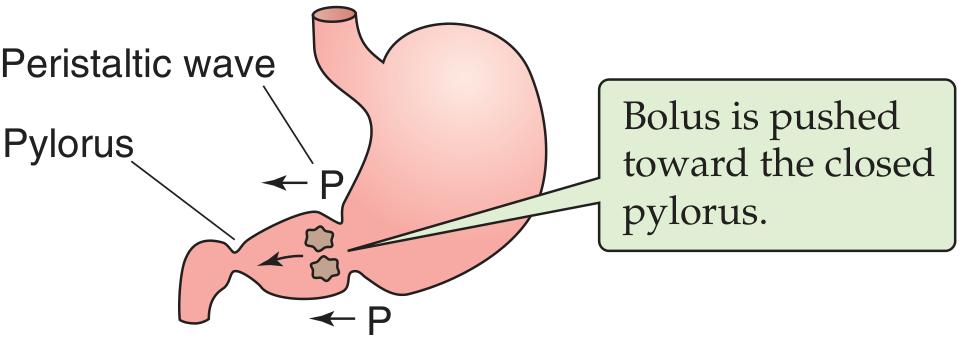
Three Key Mechanical Steps (Boron)
| Step | What Happens |
|---|---|
| Propulsion | Peristaltic wave pushes chyme toward the closed pylorus |
| Grinding | Antrum churns trapped material, breaking solids into smaller particles |
| Retropulsion | Pylorus closes just before the wave arrives; most material is squirted back into the body - further pulverizing solids |
These three steps repeat until particles are <2 mm (or <1 mm³ per Costanzo), after which they can pass through the pylorus.
Larger indigestible particles (>2 mm) are retained until the Migrating Motor Complex (MMC) during the inter-digestive (fasting) period sweeps them through.
4. Role of the Pylorus
- Pyloric sphincter = thickening of circular smooth muscle at the stomach outlet (50-100% thicker than elsewhere in the antrum)
- Remains slightly tonically contracted at rest
- Open enough to let fluids and very fine particles pass freely
- Constriction increases under inhibitory duodenal signals (see below)
- Constriction decreases under gastric distension signals
5. Rate of Gastric Emptying: Comparison by Meal Type
The graph below (Boron Medical Physiology) shows emptying rates for different meal types:
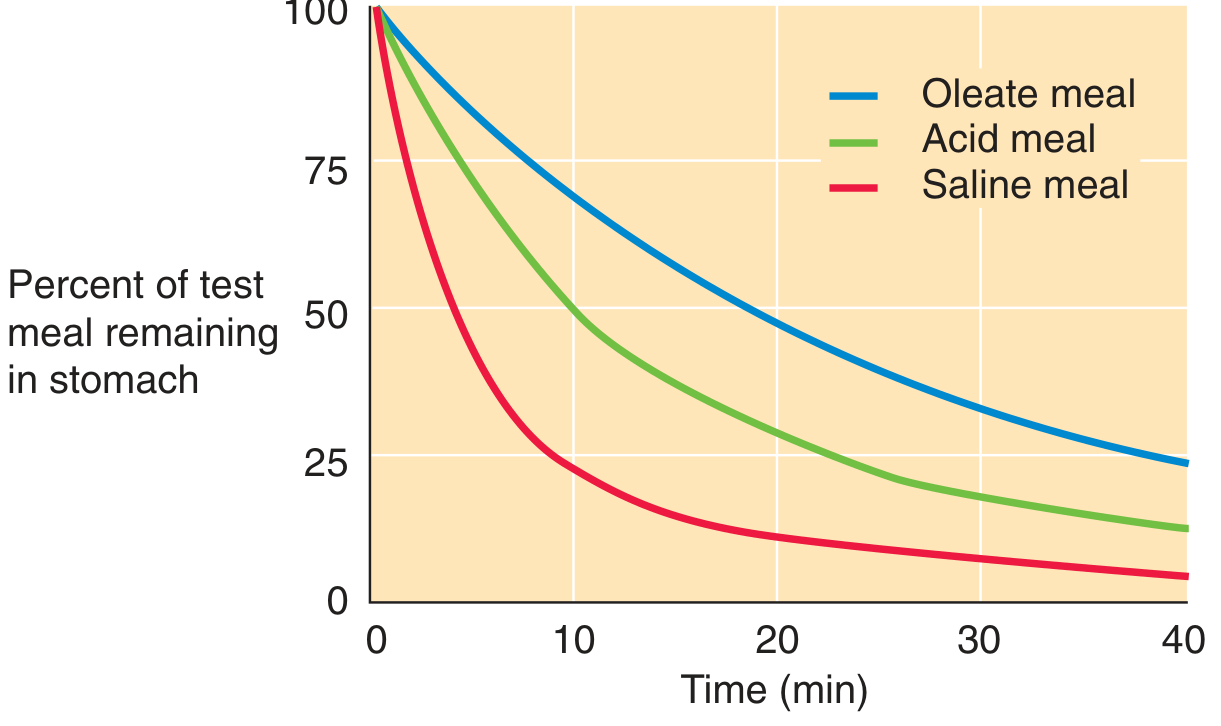
Order of emptying speed (fastest to slowest):
Liquids > Isotonic > Carbohydrates > Proteins > Fats
- Liquids empty fastest (simple fluids leave within 20-30 min)
- Fats empty slowest (up to 4-6 hours for a fatty meal)
- Isotonic solutions empty faster than hypotonic OR hypertonic solutions
- A mixed solid meal typically empties over ~3-4 hours
6. Regulation of Gastric Emptying
Regulation is achieved by two categories of signals - from the stomach itself (promoting) and from the duodenum (inhibitory). The duodenum provides far more potent control.
A. Gastric Factors That PROMOTE Emptying
1. Gastric Distension / Volume
- Increased food volume stretches the stomach wall
- This activates local myenteric reflexes that:
- Increase activity of the pyloric pump
- Relax the pyloric sphincter
- Note: It is wall stretch, NOT increased intragastric pressure, that drives this (receptive relaxation keeps pressure low)
2. Gastrin
- Released by G cells of the gastric antrum in response to protein digestion products + vagal stimulation
- Has a mild stimulatory effect on gastric motility
- Acts as a positive feedback to keep the stomach working on a protein meal
B. Duodenal Factors That INHIBIT Emptying
This is the most important and exam-relevant part. Duodenal inhibition slows emptying to match the rate at which the small intestine can process chyme.
i. Enterogastric Nervous Reflexes (Enterogastric Reflex)
When chyme enters the duodenum, sensory receptors in the duodenal wall detect its properties and send inhibitory signals back to the stomach via three pathways:
| Pathway | Route |
|---|---|
| 1. Enteric (local) | Duodenum → enteric nervous system (myenteric plexus) → stomach |
| 2. Sympathetic | Duodenum → prevertebral sympathetic ganglia → inhibitory sympathetic fibers → stomach |
| 3. Vagovagal | Duodenum → vagus afferents → brainstem → inhibit vagal excitatory signals to stomach |
Effects: Inhibit the pyloric pump + increase tone of pyloric sphincter.
Triggers for the enterogastric reflex:
- Duodenal distension (too much volume)
- Duodenal acidity (pH < 3.5-4 triggers within 30 seconds)
- Osmolality (hypo- OR hypertonic chyme)
- Protein breakdown products (peptides/amino acids)
- Irritation of duodenal mucosa
- Fatty acids / fat digestion products
ii. Hormonal Feedback (Enterogastrones)
Hormones released from duodenal/jejunal mucosa travel via blood to inhibit gastric motility:
| Hormone | Released by | Stimulus | Effect on stomach |
|---|---|---|---|
| CCK (Cholecystokinin) | I cells (duodenum, jejunum, ileum) | Fatty acids + amino acids in chyme | Most potent inhibitor - inhibits pyloric pump + constricts pyloric sphincter |
| Secretin | S cells (duodenum) | Acid (H⁺) in duodenum | Weak inhibition of gastric motility; mainly inhibits gastric acid secretion + stimulates pancreatic HCO₃⁻ |
| GIP (Gastric Inhibitory Peptide / Glucose-dependent Insulinotropic Peptide) | K cells (duodenum) | Fat + carbohydrates | Weak general inhibition of GI motility; main action = stimulates insulin secretion |
| GLP-1 (Glucagon-like Peptide-1) | L cells (ileum, colon; also duodenum) | Carbohydrate digestion products | Slows gastric emptying; reduces food intake; basis of GLP-1 agonist drugs (e.g. semaglutide) |
7. Summary: Control of Gastric Emptying (Guyton's Summary)
The stomach is controlled only moderately by its own filling. The dominant control is inhibitory feedback from the duodenum - both neural (enterogastric reflex) and hormonal (CCK and others).
Gastric emptying is slowed when:
- Too much chyme is already in the small intestine
- Chyme is too acidic (pH < 3.5)
- Chyme contains unprocessed protein or fat
- Chyme is hypotonic or hypertonic
- Duodenal mucosa is irritated
8. Inter-digestive Motility: The MMC
During fasting (between meals), the stomach undergoes Migrating Motor Complexes (MMC):
- Occur every 90 minutes, mediated by motilin (hormone from duodenum)
- Sweep the stomach and small intestine clean of residue
- Called the "housekeeper of the gut"
- Absent during eating (eating interrupts the MMC)
9. Clinical Correlations
| Condition | Mechanism | Key Feature |
|---|---|---|
| Gastroparesis | Delayed gastric emptying (often diabetic neuropathy) | Nausea, vomiting, early satiety; gold standard test = radionuclide gastric emptying scintigraphy |
| Dumping syndrome | Rapid gastric emptying (after gastrectomy) | Early: osmotic fluid shift into gut → hypotension; Late: reactive hypoglycemia |
| Peptic ulcer (pyloric stenosis) | Obstruction at pylorus | Projectile vomiting, succussion splash |
| GLP-1 agonists (semaglutide, liraglutide) | Slow gastric emptying via GLP-1 receptors | Weight loss, reduced appetite |
| Hyperglycemia | High blood glucose directly inhibits gastric motility | Slows emptying of solids |
10. Quick Revision Table
| Feature | Detail |
|---|---|
| BER frequency of stomach | 3/min (pacemaker in corpus) |
| BER frequency of duodenum | 12/min |
| Normal gastric emptying time | ~3 hours for a mixed meal |
| Pyloric pump pressure | 50-70 cm H₂O |
| Particle size to exit pylorus | < 2 mm (< 1 mm³ per Costanzo) |
| Fastest emptying | Liquids (isotonic saline) |
| Slowest emptying | Fats |
| Most potent inhibitory hormone | CCK (from I cells; stimulus = fat + protein) |
| Inter-digestive contractions | MMC; every 90 min; motilin-driven |
| Enterogastric reflex - 3 pathways | Enteric, sympathetic, vagovagal |
Key Points to Score Full Marks
- Define gastric emptying and state approximate time (3 hours for a mixed meal)
- Explain the pyloric pump - intense antral peristalsis, 50-70 cm H₂O, 20% of the time
- Describe propulsion, grinding, retropulsion - particles must be <2 mm
- State the order of emptying: liquids > carbs > proteins > fats
- List both categories of regulation - gastric (promoting) and duodenal (inhibitory)
- Detail the enterogastric reflex and its 5 triggers and 3 neural pathways
- Name all 4 inhibitory hormones: CCK, secretin, GIP, GLP-1 - their cells, stimuli, effects
- Describe the MMC during fasting - motilin, every 90 minutes
- Clinical: gastroparesis, dumping syndrome, GLP-1 agonists
Guyton & Hall Textbook of Medical Physiology, 14th ed., Ch. 63-64 | Costanzo Physiology, 7th ed., Ch. 8 | Boron & Boulpaep Medical Physiology, Ch. 42
This is a shared conversation. Sign in to Orris to start your own chat.