
What is rapidly progressive renal failure and what will be the differential diagnosis
Reading File
Now let me search the medical library for rapidly progressive renal failure and its differential diagnosis.
Finding Sources
Finding Sources
Excellent sources found. Let me read from the best ones in parallel.
Reading File
Reading File
Reading File
Excellent. Now let me get the detailed differential diagnosis table and more from the Comprehensive Clinical Nephrology and also look for the image.
Reading File
Loading Image
Finding Sources
Now let me get more details from the Comprehensive Clinical Nephrology on the RPGN section and also get clinical features from the Tietz textbook:
Reading File
Reading File
I now have rich, comprehensive material from multiple authoritative nephrology textbooks. Let me also do a quick PubMed search for recent evidence and fetch the crescent GN image.
Searching PubMed
"rapidly progressive glomerulonephritis" AND "diagnosis"
Loading Image
I now have comprehensive material from multiple authoritative textbooks. Here is a thorough answer:
Rapidly Progressive Renal Failure (RPRF / RPGN)
Definition
Rapidly progressive glomerulonephritis (RPGN) - also referred to as rapidly progressive renal failure - is a clinical syndrome characterized by acute deterioration of kidney function occurring over days to a few weeks, with features of the nephritic syndrome (hematuria, red cell casts, proteinuria, oliguria, azotemia). Without treatment, it typically leads to end-stage kidney disease (ESKD).
- Comprehensive Clinical Nephrology, 7th Ed., p. 243
- Robbins & Kumar Basic Pathology, p. 489
Pathogenesis - Three Immunological Forms
The glomerular injury is immunologically mediated in most cases. Three major subtypes exist, distinguished by immunofluorescence (IF) and serology:
Type I - Anti-GBM Antibody Disease (Linear IF)
- Circulating anti-glomerular basement membrane (anti-GBM) antibodies bind to type IV collagen in the GBM
- IF shows linear deposits of IgG and C3 along the GBM
- When anti-GBM antibodies also attack pulmonary alveolar capillary BM causing pulmonary hemorrhage + renal failure = Goodpasture syndrome
Type II - Immune Complex-Mediated (Granular IF)
- Granular deposits of immunoglobulin and/or complement in the GBM and mesangium
- Seen in: postinfectious GN, SLE, IgA nephropathy, Henoch-Schonlein purpura (IgA vasculitis), mixed cryoglobulinemia
- Shows proliferative GN within the tuft plus crescent formation
Type III - Pauci-Immune (No IF Deposits)
- No detectable anti-GBM antibodies or immune complex deposition
- ~80% of cases are associated with ANCA (antineutrophil cytoplasmic antibodies)
- C-ANCA (anti-PR3) - associated with Granulomatosis with Polyangiitis (GPA/Wegener's)
- P-ANCA (anti-MPO) - associated with Microscopic Polyangiitis (MPA)
- The remaining ~20% are idiopathic pauci-immune
Histopathology
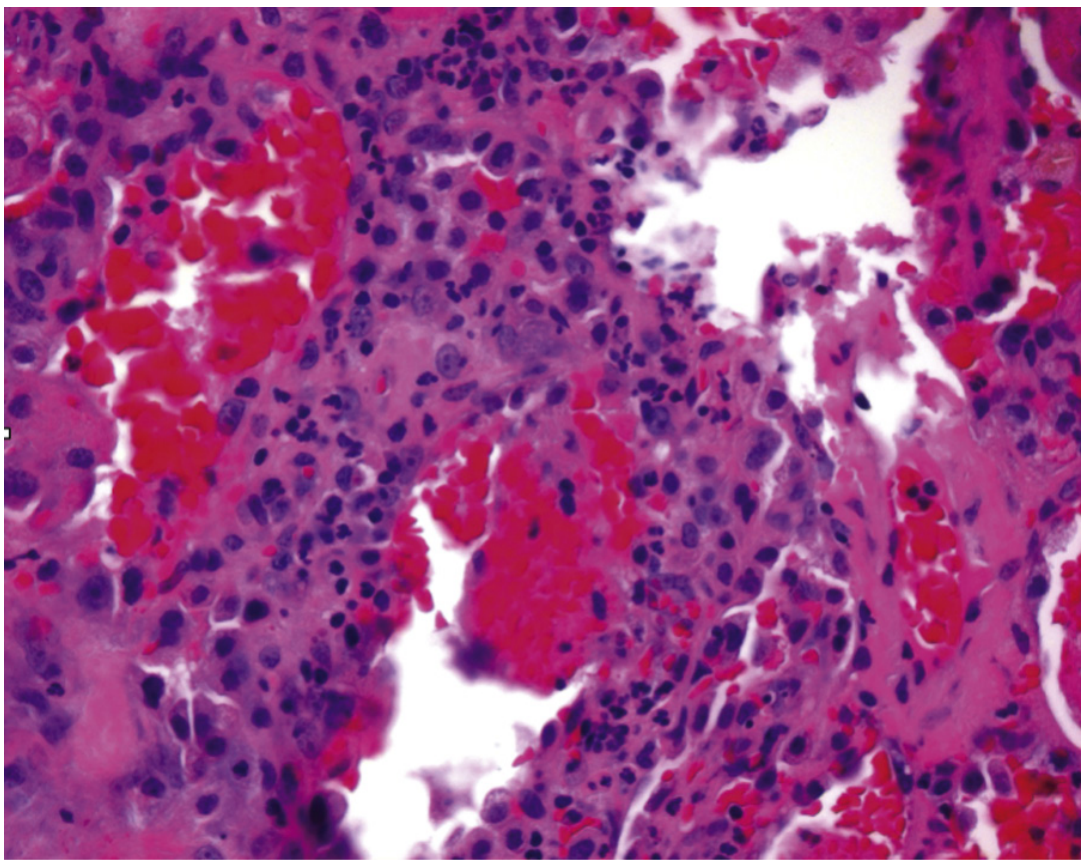
The hallmark is crescentic glomerulonephritis:
- Cellular crescents form within Bowman's space, composed of proliferating parietal epithelial cells and migrating monocytes/macrophages
- The crescentic shape compresses the glomerular tuft and obstructs the proximal tubule, severely compromising nephron function
- Associated segmental necrosis and breaks in the GBM are common (especially in vasculitis)
- Fibrin deposition in Bowman's space
- Over time, cellular crescents undergo fibrosis leading to progressive glomerulosclerosis
Clinical Presentation
| Feature | Detail |
|---|---|
| Onset | Days to weeks |
| Urine | Hematuria (dysmorphic RBCs), red cell casts, proteinuria (>500 mg/day, sometimes nephrotic range) |
| Renal | Rising creatinine, oliguria, azotemia (uraemic emergency) |
| Systemic prodrome | Malaise, weight loss, breathlessness, upper respiratory tract symptoms (months before) |
| Skin | Nailfold infarcts, palpable purpura on legs |
| Pulmonary | In severe cases: pulmonary hemorrhage (diffuse alveolar hemorrhage, DAH) = pulmonary-renal syndrome |
Key diagnostic point: Urine microscopy must be performed on a fresh sample - red cell casts and dysmorphic RBCs degenerate within 30-60 minutes.
- Murray & Nadel's Textbook of Respiratory Medicine
Differential Diagnosis
The differential for rapidly progressive renal failure is organized by mechanism:
1. Anti-GBM (Goodpasture) Disease
- Goodpasture syndrome: pulmonary hemorrhage + RPGN
- Serologies: anti-GBM antibody positive (occasionally ANCA co-positive)
- IF: linear IgG along GBM
2. ANCA-Associated Vasculitis (Pauci-Immune)
| Condition | ANCA Type | Distinguishing Features |
|---|---|---|
| Granulomatosis with Polyangiitis (GPA) | Mostly C-ANCA / PR3 | Upper + lower respiratory tract: sinusitis, nasal crusting, saddle nose, pulmonary nodules/cavities |
| Microscopic Polyangiitis (MPA) | Mostly P-ANCA / MPO | Multisystem involvement, pulmonary capillaritis |
| Pauci-immune crescentic GN (renal-limited vasculitis) | MPO or PR3 ANCA | Kidney involvement only, no systemic vasculitis |
3. Immune Complex-Mediated GN
| Condition | Key Features | Serology |
|---|---|---|
| Systemic Lupus Erythematosus (SLE) | Malar rash, arthritis, serositis, multisystem | ANA, anti-dsDNA, low C3/C4 |
| Poststreptococcal GN | Recent pharyngitis or impetigo (2-3 wks prior) | ASO titer, streptozyme Ab; low C3 |
| IgA Nephropathy | Episodic gross hematuria, often follows respiratory/GI infection | Serum IgA elevated (30%); C3 normal |
| IgA Vasculitis (Henoch-Schonlein Purpura) | Palpable purpura, abdominal pain, arthritis | C3 & C4 normal |
| Infective Endocarditis | Cardiac murmur, fever, bacteremia | Blood cultures, low C3, C4 normal |
| Essential Mixed Cryoglobulinemia | Purpura, arthralgia, neuropathy, often HCV | Cryoglobulins, low C4 |
| Membranoproliferative GN (MPGN) | Nephritic + nephrotic overlap | Low C3 |
4. Other Causes of AKI Mimicking RPGN
While not true RPGN, these can cause rapidly declining renal function:
- Accelerated (malignant) hypertension complicating underlying GN
- Renal vein thrombosis
- Acute tubular necrosis (ATN) - no nephritic sediment
- Thrombotic microangiopathy (TMA) - HUS, TTP: schistocytes, thrombocytopenia, ADAMTS13 deficiency in TTP
- Acute interstitial nephritis (AIN) - drug reaction: eosinophiluria, eosinophilia, skin rash
Serologic Work-Up Summary
| Test | Disease Identified |
|---|---|
| Anti-GBM antibody | Goodpasture/anti-GBM disease |
| C-ANCA / PR3-ANCA | GPA |
| P-ANCA / MPO-ANCA | MPA, pauci-immune GN |
| ANA, anti-dsDNA, low C3/C4 | SLE |
| ASO titer, streptozyme | Post-streptococcal GN |
| Serum IgA | IgA nephropathy |
| Blood cultures | Endocarditis-associated GN |
| Cryoglobulins, HCV serology | Cryoglobulinemic GN |
| Serum complement (C3/C4) | Distinguishes immune complex from pauci-immune |
Key Diagnostic Approach
- History and examination - look for systemic features (respiratory, skin, joints)
- Urinalysis with microscopy (fresh sample) - nephritic sediment confirms glomerular origin
- Serology panel as above - guides the likely cause
- Renal biopsy - essential for histologic confirmation; light microscopy, immunofluorescence, and electron microscopy together define the type
- Imaging - chest X-ray/CT for pulmonary involvement
Recent Evidence
- A 2024 systematic review on anti-GBM disease (Kuang H et al., Autoimmun Rev, PMID 38493958) provides updated epidemiology and outcome data
- The 2022 EULAR recommendations for ANCA-associated vasculitis (updated 2024, Ann Rheum Dis, PMID 36927642) are the current guideline standard for pauci-immune RPGN management
- A 2025 pediatric systematic review (Meena J et al., Pediatr Nephrol, PMID 39278987) shows that in children, post-infectious GN and immune complex diseases predominate over ANCA-associated disease
Sources:
- Comprehensive Clinical Nephrology, 7th Edition (Feehally et al.), Ch. 16
- Robbins & Kumar Basic Pathology (2023)
- Brenner and Rector's The Kidney, 2-Volume Set
- Tietz Textbook of Laboratory Medicine, 7th Ed.
- Murray & Nadel's Textbook of Respiratory Medicine
This is a shared conversation. Sign in to Orris to start your own chat.