
Describe Branches Of Brachial Artery With Their Course And Area Of Supply. 5 marks
Reading File
Finding Sources
Finding Sources
The best sources are Gray's Anatomy for Students and the THIEME Atlas. Let me read both simultaneously.
Reading File
Reading File
Reading File
Now let me fetch the anatomical diagram of the brachial artery branches:
Loading Image
Loading Image
I now have all the information needed for a comprehensive answer. Let me also quickly read the remaining Gray's content about the collateral branches:
Reading File
I now have comprehensive information. Let me also fetch the branch diagram:
Loading Image
Excellent! I now have everything needed for a complete, well-illustrated answer.
Branches of the Brachial Artery — Course and Area of Supply
Introduction
The brachial artery is the major artery of the arm. It begins as a continuation of the axillary artery at the lower border of teres major and terminates in the cubital fossa (just distal to the elbow joint) by dividing into the radial and ulnar arteries. It travels down the anterior compartment of the arm, initially on the medial side, then moves laterally to lie midway between the two epicondyles. It is accompanied by the median nerve throughout.
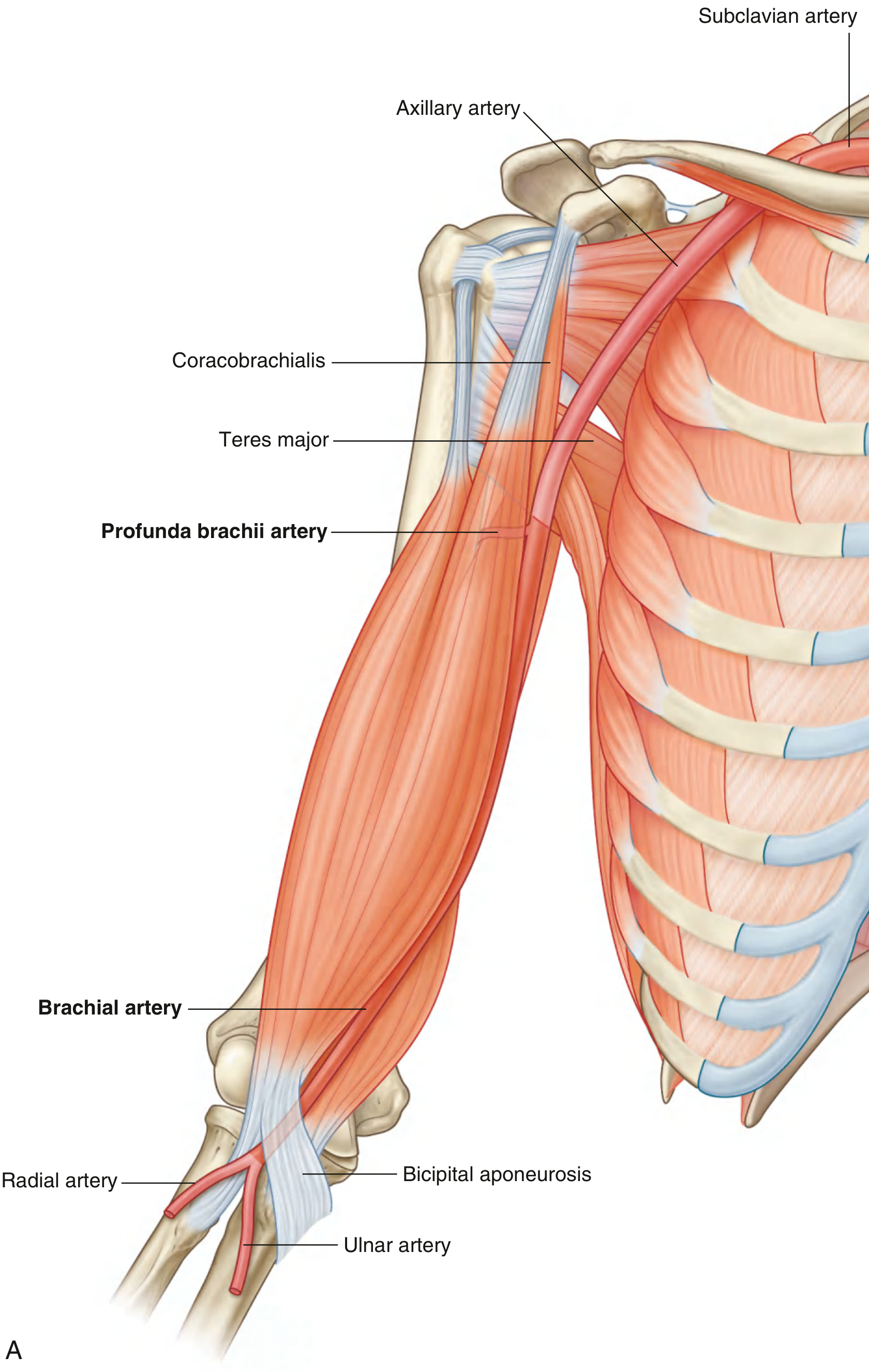
Branches of the Brachial Artery
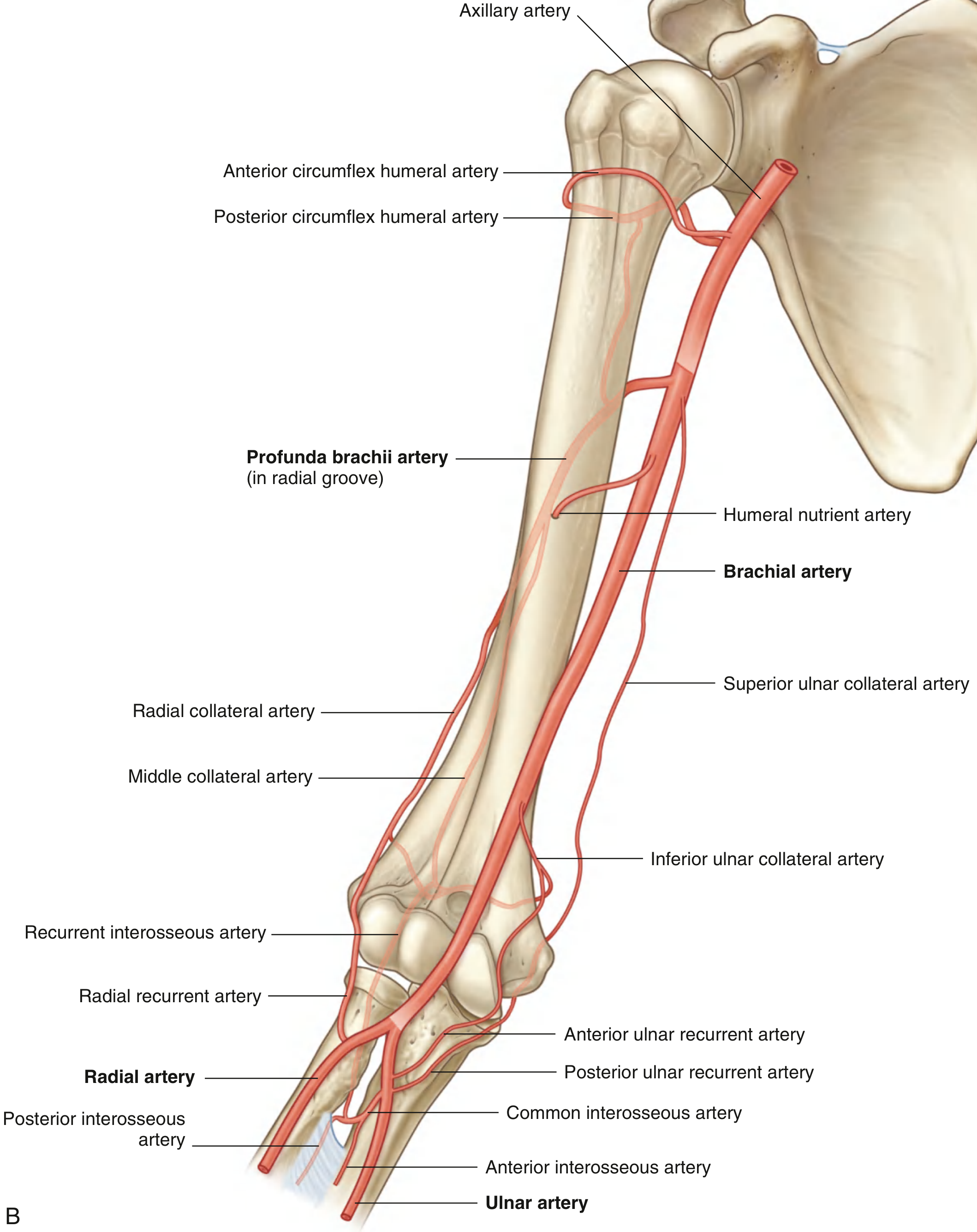
1. Profunda Brachii Artery (Deep Artery of the Arm)
Largest branch of the brachial artery; arises from its posteromedial aspect near the top of the arm.
Course:
- Winds posteriorly with the radial nerve through the triangular interval (bounded by the shaft of humerus, inferior margin of teres major, and lateral head of triceps).
- Passes through the radial (spiral) groove on the posterior surface of the humerus, deep to the lateral head of triceps.
- Terminates as two collateral vessels: the radial collateral artery and the middle collateral artery.
Area of supply:
- Posterior compartment of arm — all three heads of triceps brachii
- Anastomoses with the posterior circumflex humeral artery proximally
- Contributes to the periarticular anastomosis around the elbow (radial collateral → anastomoses with radial recurrent; middle collateral → anastomoses with recurrent interosseous)
2. Superior Ulnar Collateral Artery
Course:
- Arises from the brachial artery at about mid-arm level.
- Accompanies the ulnar nerve, pierces the medial intermuscular septum to enter the posterior compartment.
- Descends behind the medial epicondyle to anastomose with the posterior ulnar recurrent artery and the inferior ulnar collateral artery.
Area of supply:
- Medial arm muscles; contributes to the medial side of the periarticular anastomosis around the elbow.
3. Inferior Ulnar Collateral Artery (Supratrochlear Artery)
Course:
- Arises approximately 5 cm above the medial epicondyle.
- Passes medially between the median nerve and the brachialis muscle.
- Divides into anterior and posterior branches around the medial epicondyle.
- Anastomoses with the anterior ulnar recurrent artery anteriorly and with the superior ulnar collateral posteriorly.
Area of supply:
- Lower part of the brachialis; contributes to the periarticular anastomosis around the elbow joint.
4. Nutrient Artery to the Humerus
Course:
- A small branch arising from the brachial artery in the middle of the arm.
- Enters the nutrient foramen on the anteromedial surface of the humeral shaft.
Area of supply:
- Supplies the medullary cavity and cortical bone of the humerus.
5. Muscular Branches
Multiple small unnamed branches arise along the course of the brachial artery.
Area of supply:
- Coracobrachialis, biceps brachii, and brachialis muscles (anterior compartment).
6. Terminal Branches — Radial and Ulnar Arteries
Course:
- The brachial artery bifurcates at the level of the neck of the radius (in the cubital fossa), just deep to the bicipital aponeurosis.
- The radial artery runs laterally to supply the forearm, wrist, and hand (deep palmar arch).
- The ulnar artery runs medially; gives off the common interosseous artery and supplies the forearm and hand (superficial palmar arch).
Area of supply:
- Together, the terminal branches supply the entire forearm, wrist, and hand.
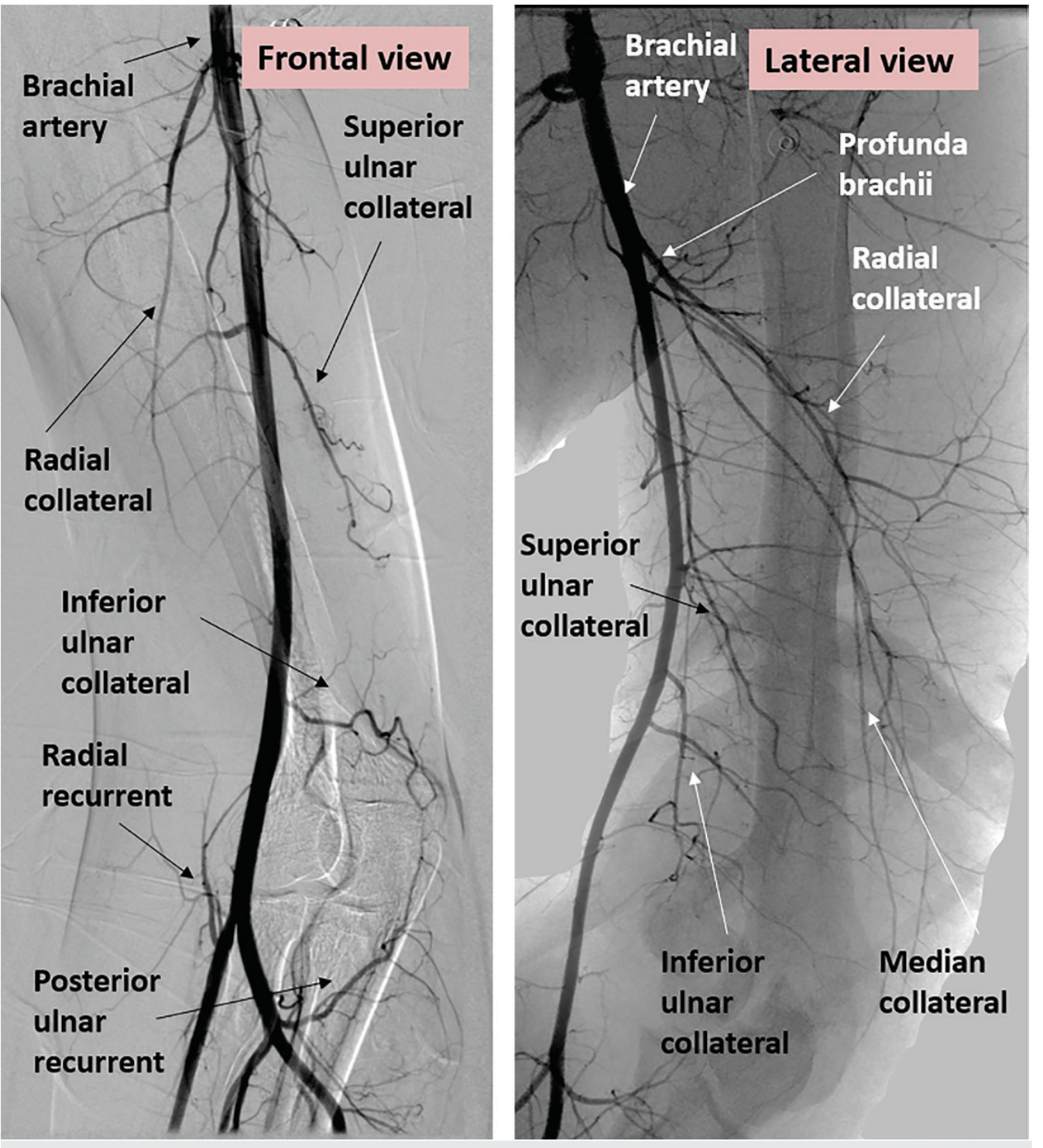
Angiographic Correlation
Summary Table
| Branch | Origin | Course | Area of Supply |
|---|---|---|---|
| Profunda brachii | Upper brachial artery (posteromedial) | Triangular interval → radial groove with radial nerve | Posterior arm (triceps), elbow anastomosis |
| Superior ulnar collateral | Mid-brachial artery | With ulnar nerve → behind medial epicondyle | Medial arm, elbow anastomosis |
| Inferior ulnar collateral | ~5 cm above medial epicondyle | Around medial epicondyle | Lower arm, elbow anastomosis |
| Nutrient artery to humerus | Mid-brachial artery | Nutrient foramen of humerus | Humeral cortex and medulla |
| Muscular branches | Along entire course | Direct to anterior compartment muscles | Coracobrachialis, biceps, brachialis |
| Radial artery (terminal) | Cubital fossa | Lateral forearm → wrist | Forearm, wrist, hand (deep arch) |
| Ulnar artery (terminal) | Cubital fossa | Medial forearm → hand | Forearm, wrist, hand (superficial arch) |
Key clinical point: The brachial artery is the site of blood pressure auscultation (Korotkoff sounds) in the cubital fossa, and is compressible against the humerus in the proximal arm. Injury or iatrogenic damage (e.g., supracondylar fractures in children) can compromise blood flow to the entire forearm and hand.
— Gray's Anatomy for Students; Imaging Anatomy: Bones, Joints, Vessels and Nerves; THIEME Atlas of General Anatomy and Musculoskeletal System
This is a shared conversation. Sign in to Orris to start your own chat.