
Peng block
The Peng block is a regional anesthesia technique. Let me look this up in the medical library for detailed information.
Searching sources...
Reading File
Finding Sources
Finding Sources
Searching the Web
PENG block pericapsular nerve group hip anesthesia technique
Good, I have hits in both Miller's Anesthesia and Morgan & Mikhail. Let me read those sections now.
Reading File
Reading File
Searching PubMed
"PENG block" OR "pericapsular nerve group" hip analgesia
Now let me read the Miller's dedicated PENG block section and fetch the ultrasound image.
Reading File
Loading Image
I now have comprehensive information from Miller's Anesthesia (10e), Morgan & Mikhail (7e), web sources, and recent PubMed meta-analyses. Here is a complete overview:
PENG Block (Pericapsular Nerve Group Block)
Overview
The PENG block is a fascial plane block for hip analgesia first described by Giron-Arango et al. in 2018 (named in part after Dr. Philip Peng). It deposits local anesthetic in the plane between the psoas muscle/tendon and the superior pubic ramus, blocking the articular (sensory) branches of the femoral, accessory obturator, and obturator nerves that innervate the anterior hip joint capsule - Morgan & Mikhail's Clinical Anesthesiology, 7e, p. 1940.
Its key advantage over femoral nerve or fascia iliaca blocks is motor-sparing analgesia - it targets only the sensory articular branches, not the main motor trunks, allowing early mobilization.
Anatomy Targeted
The hip capsule is innervated by articular branches from three nerves:
| Nerve | Contribution |
|---|---|
| Femoral nerve (FN) | Articular branches to the anterior capsule |
| Accessory obturator nerve (AON) | Variable; crosses the iliopubic eminence |
| Obturator nerve (ON) | Articular branches to the inferomedial capsule |
The injection target is the fascial plane between the psoas muscle and the superior pubic ramus / iliopubic eminence, just lateral to the psoas tendon. This is where the articular branches travel before entering the capsule - Miller's Anesthesia, 10e, p. 11122.
Technique (Ultrasound-Guided)
Patient position: Supine, with slight external rotation of the hip.
Probe placement: Linear high-frequency probe placed along the inguinal ligament, oriented in the same direction as the inguinal crease, between the pubic ramus and the ASIS. This gives a view of:
- Anterior inferior iliac spine (ASIS) - lateral landmark
- Iliopubic eminence - floor
- Psoas muscle and tendon
- Femoral artery and femoral nerve (medially - must be kept in view and avoided)
Needle: 22-gauge, inserted in-plane, lateral to medial, until the tip contacts the pubic ramus, lateral to the psoas tendon.
Injection: After negative aspiration and confirming the tip is not intramuscular, inject ropivacaine 0.2% or 0.5% at 3 mg/kg, up to 20 mL. If injection is difficult, slight needle retraction is needed. - Miller's Anesthesia, 10e
The local anesthetic spreads in the plane beneath the iliacus muscle, bathing the articular branches.
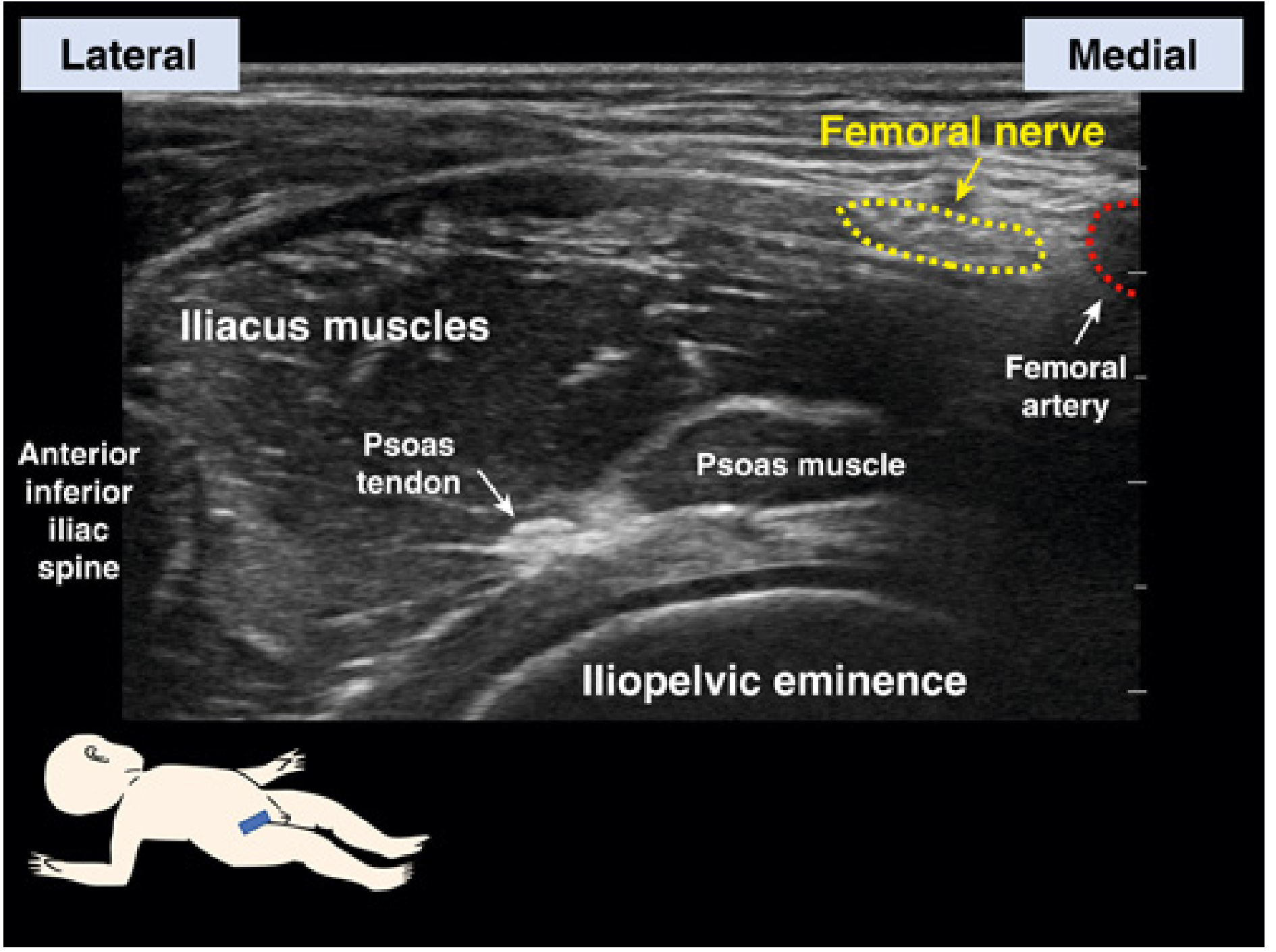
FIG. 74.49 from Miller's Anesthesia 10e - Ultrasound image for PENG block. Needle inserted in-plane from lateral to medial until reaching the pubic ramus lateral to the psoas tendon.
Indications
- Hip fractures (femoral neck, intertrochanteric, acetabular) - pre- and postoperative
- Total hip arthroplasty (THA) - anterior and posterior approach
- Hip arthroscopy
- Emergency department pain management for hip/pelvic fractures (opioid-sparing)
- Chronic hip pain (extended use via denervation)
Advantages Over Other Hip Blocks
| Block | Motor Block? | Notes |
|---|---|---|
| Femoral nerve block | Yes (quadriceps) | Delays mobilization |
| Fascia iliaca block | Yes (quadriceps) | Larger volume, less targeted |
| Lumbar plexus block | Yes | Deep, higher risk |
| PENG block | No | Purely sensory articular branches |
The PENG block avoids quadriceps weakness, which is a major advantage for early mobilization protocols - Barash Clinical Anesthesia, 9e. In elderly patients with atrophied muscles, bony landmarks for the PENG can actually be easier to identify than soft-tissue landmarks for FN or FICB.
Evidence Base
A 2024 systematic review and meta-analysis (PMID 39514540) confirmed that the PENG block reduces opioid consumption and pain scores after hip surgery across RCTs. A 2025 network meta-analysis in the British Journal of Anaesthesia (PMID 40483183) further compared regional anesthesia modalities for THA, placing PENG among top options. A 2026 meta-analysis (PMID 40833559) compared PENG to local infiltration analgesia (LIA) in THA, supporting its efficacy.
Clinical reports note 40-60% reduction in pain scores vs. systemic opioids, with the block typically having a learning curve of approximately 25 cases.
Limitations & Considerations
- Posterior hip capsule is not covered - may need supplementation (e.g., periarticular infiltration or quadratus lumborum block) for posterior THA approaches
- Learning curve - approximately 25 procedures for proficiency
- Does not reliably cover the lateral thigh skin (lateral femoral cutaneous nerve not blocked)
- Can be combined with FICB or QL block for broader coverage
- Can be performed as a continuous catheter technique for extended analgesia
Sources: Miller's Anesthesia 10e, p. 11122 | Morgan & Mikhail's Clinical Anesthesiology 7e, p. 1940 | Barash Clinical Anesthesia 9e | Giron-Arango et al. 2018 | PubMed meta-analyses 2024-2026
This is a shared conversation. Sign in to Orris to start your own chat.