attachment
attachment

What is treatment for this

analyse_media
Reading File
Searching the Web

great toe distal phalanx intra-articular fracture treatment referral guidelines

Searching PubMed

toe phalanx fracture treatment

Finding Sources
The report describes an oblique intra-articular fracture at the base of the distal phalanx of the left great toe. Alignment is reported as normal, which is reassuring, but because it extends into the joint, it should be assessed by an orthopedic doctor or foot-and-ankle specialist within a few days, sooner if pain or deformity is significant.
Typical treatment if it is nondisplaced and stable
  • Walking boot or short-leg cast with toe protection for about 2-3 weeks. Avoid running, jumping, football, or impact activity.
  • Then a rigid/hard-soled shoe and sometimes buddy-taping as advised for another 2-3 weeks.
  • Walk only as pain allows. Elevate the foot and use ice wrapped in cloth for 15-20 minutes at a time during the first 48 hours.
  • Pain relief: paracetamol/acetaminophen if safe for you. Ibuprofen can help if you have no kidney disease, stomach ulcer/bleeding, blood-thinner use, or other reason a clinician has told you to avoid it.
  • A repeat X-ray is often done at around 1 week for a fracture involving the joint, to ensure it has not shifted.
  • Gentle toe range-of-motion exercises are usually started around 4 weeks, only when cleared and pain is improving.
This type of great-toe fracture commonly takes about 4-6 weeks to unite. The AAFP guidance on great-toe fractures recommends a walking boot or cast initially, then a rigid-sole shoe; it also advises referral for displaced joint fractures or if more than 25% of the joint surface is involved.
Surgery may be needed if the joint fragment is displaced, the fracture involves a substantial part of the joint surface, there is rotation/deformity, the toe cannot be kept aligned, or it is open. The report does not state displacement or the percentage of joint involved, so an orthopedic review is the right next step.
Go to urgent care today if the toe becomes pale/blue/cold/numb, there is an open wound or nail-bed injury, rapidly worsening swelling/pain, fever, or you cannot bear weight at all.

Oblique intra-articular fracture at the base of the distal phalanx of the left great toe means what and explain with images

Reading File
Searching the Web

great toe distal phalanx intra-articular fracture anatomy explanation reputable patient information

Searching Images

anatomy diagram great toe distal phalanx interphalangeal joint fracture x-ray

Searching PubMed

hallux phalanx fractures

Finding Sources
Generating Image

A clear patient-education medical diagram of the left great toe viewed from above. Label the proximal phalanx, distal phalanx, interphalangeal joint, and nail. Show a diagonal fracture line at the base of the distal phalanx extending into the interphalangeal joint, with an enlarged inset explaining oblique and intra-articular. Include arrows and simple labels.
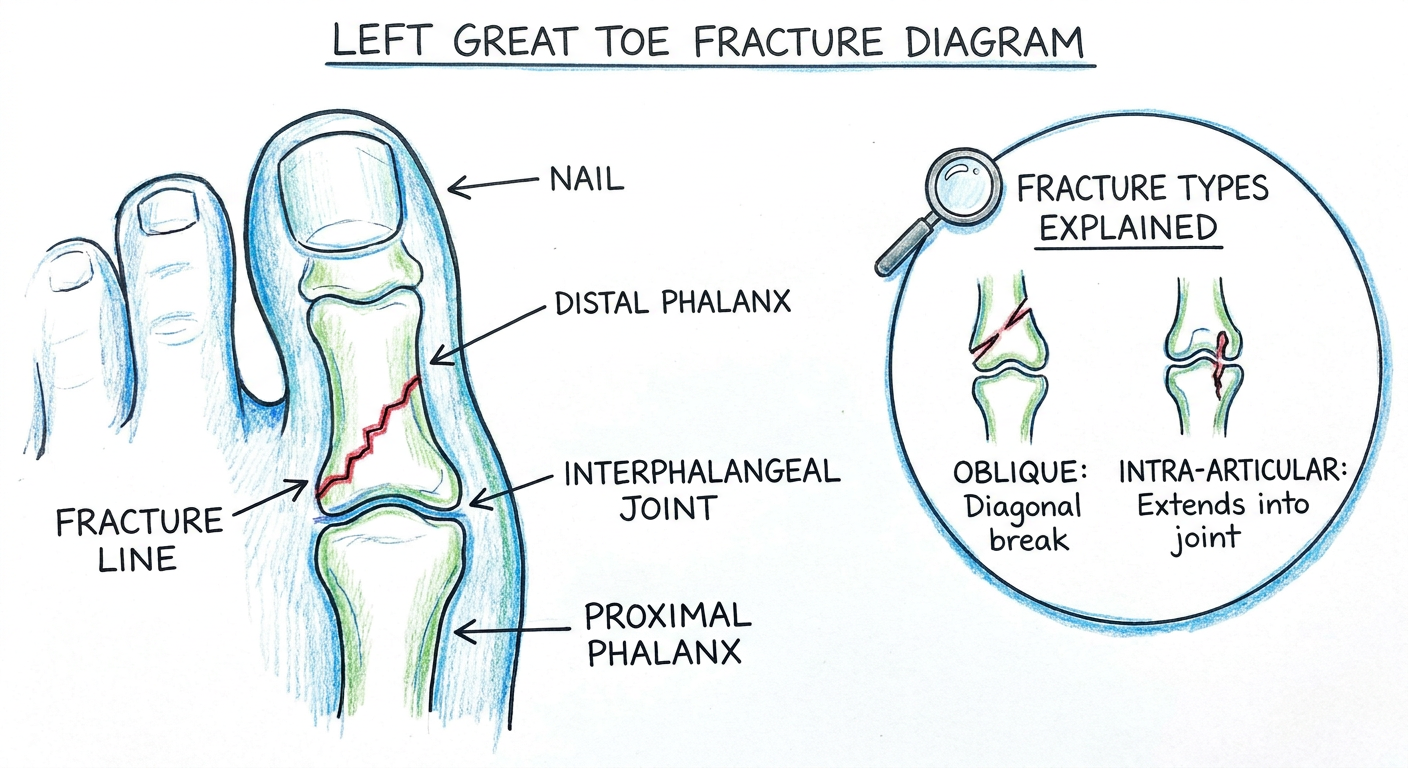
It means there is a diagonal crack in the bone of your big toe, close to the toe joint.
Diagram showing your injury: diagonal fracture at the base of the distal phalanx extending into the interphalangeal joint

Breaking down the report

Report termPlain meaning
Left great toeYour left big toe
Distal phalanxThe small bone at the tip of the big toe, under the nail
Base of distal phalanxThe end of that tip bone nearest the middle of the toe
Oblique fractureThe crack runs diagonally, rather than straight across
Intra-articularThe crack reaches the smooth joint surface where the tip bone meets the next toe bone, called the interphalangeal joint

Simple location diagram

     nail / toe tip
          ↓
  ┌─────────────────────┐
  │   Distal phalanx    │
  │       /             │  ← diagonal (oblique) fracture
  │      /              │
  └─────/───────────────┘
        ↑
   Interphalangeal joint
        ↑
  Proximal phalanx
  (the bone closer to foot)
The word intra-articular matters because the break enters the joint. If the fragment heals unevenly or moves, it can leave a step in the joint surface and later cause stiffness, pain with push-off while walking, or arthritis.
Your report also states “alignment appears normal.” That generally suggests the pieces are not obviously out of position on the X-ray, which is a favorable sign. However, the report does not say:
  • how much of the joint surface is involved
  • whether there is a tiny displacement not obvious in the wording
  • whether the fracture remains stable when you walk
That is why a clinician, preferably orthopedics, should review the actual X-ray. Great-toe fractures receive more attention than other toe fractures because the big toe is important for weight-bearing and balance. The AAFP foot-fracture review advises repeat X-ray at about one week when the fracture involves a joint, and referral for displaced intra-articular fractures or nondisplaced fractures involving more than 25% of the joint.
Until reviewed: protect it in the prescribed boot or rigid-sole footwear, avoid running and impact activity, elevate/ice for swelling, and do not force the toe to bend. Seek urgent care if the toe becomes numb, cold, blue/pale, severely deformed, has an open wound, or pain/swelling rapidly worsens.
This is a shared conversation. Sign in to Orris to start your own chat.