
Hey Ares, there is one problem. I need you to find a solution to it or refer some case laws or something and help me with it. You can use the web search for it. So basically the thing is that one of my friend, he has taken admission into Sumandeep College as a resident, medical resident, and in Gujarat, and it is a private college, and they have basically asked him for a And uh he applied through NMC laws after giving NEET PG exam. Now there are uh there is a situation where he has to drop out in the first year itself, and now they are asking for uh second year and third year fees for this PG program. So whose liability is this and do we have to pay this amount or we are not liable for this? Refer the case laws and judgment of Supreme Court or whatever.
Supreme Court judgment medical PG student dropout bond fee recovery private medical college India
NMC regulations PG medical student bond fee refund dropout Gujarat private college 2023 2024
https://www.livelaw.in/top-stories/shocking-that-private-med…
Supreme Court "remaining fee" OR "future fees" medical PG student dropout private college cannot recover NEET PG
https://api.sci.gov.in/supremecourt/2020/17117/17117_2020_2_…
P.A. Inamdar case Supreme Court private medical college fee regulation cannot charge future year fees student leaves
Can Sumandeep College Recover 2nd & 3rd Year Fees from a 1st-Year PG Dropout?
1. The Core Legal Position — Private Colleges Cannot Collect More Than One Year's Fee at a Time
"No private medical educational institution shall collect a fee amounting to more than one year's fee from a student in an academic year. Collection of more than one year's fee in an academic year shall be construed as collecting of capitation fee and shall be liable to be proceeded against."
2. Private Colleges Cannot Impose Bonds — Supreme Court Slammed This Practice
"Private medical colleges cannot ask their students to execute bonds of compulsory service after completion of education because these colleges charge huge amounts of money from students for course fees and do not offer any subsidy like government medical colleges."
3. NMC Post-Graduate Medical Education Regulations 2023 (PGMER-2023)
- The fee structure for a student admitted through common counselling is governed by the Fee Regulatory Committee of the state (in Gujarat, this is the AFRC — Admission and Fee Regulatory Committee).
- Fees are fixed annually and cannot be front-loaded or recovered in bulk for future years.
- Sumandeep Vidyapeeth (a deemed university) is governed by the Gujarat AFRC and NMC rules; the fees it charges must be those approved by the regulator, not inflated penalties.
4. The "Seat Vacancy" Argument — Does Not Apply to Private Colleges
- Charge full commercial fees
- Receive no government subsidy
- Already profit from the student's admitted year
5. What the College CAN Legitimately Do
| Legitimate claim | Status |
|---|---|
| Retain fees already paid for Year 1 | Likely valid (fees for services rendered) |
| Retain security deposit / caution deposit | May be valid per admission terms |
| Withhold degree/certificate until dues cleared | Only if there are actual outstanding dues, not future fees |
| Demand 2nd & 3rd year fee as "bond penalty" | Not legally valid for a private college |
| Demand service bond penalty | Not valid — SC ruled private colleges can't do this |
6. What Your Friend Should Do — Practical Steps
- Do not sign any acknowledgment or undertaking agreeing to pay the future fees.
- Write a formal notice to the college citing:
- 2025 INSC 518 (State of Kerala v. KMCT Medical College)
- RD Gardi Medical College v. Anshul Jain (SC, Nov 2022)
- P.A. Inamdar v. State of Maharashtra, (2005) 6 SCC 537
- NMC PGMER-2023, which bars collection of more than one year's fee at a time
- File a complaint with Gujarat AFRC (Admission & Fee Regulatory Committee) against illegal fee collection — Gujarat's AFRC has statutory power to penalise colleges for this.
- Approach the NMC — file a grievance at the NMC portal (www.nmc.org.in) for regulatory violation.
- File a writ petition in Gujarat High Court if the college withholds original documents. Courts have consistently ordered colleges to return documents on this ground.
- Consumer Forum — education services fall under consumer protection law. A complaint can be filed before the State Consumer Disputes Redressal Commission seeking return of documents and quashing of unlawful fee demand.
7. Key Case Laws at a Glance
| Case | Court | Principle |
|---|---|---|
| P.A. Inamdar v. State of Maharashtra, (2005) 6 SCC 537 | Supreme Court (7-judge bench) | Private colleges free to fix fees but no capitation, no profiteering |
| R.D. Gardi Medical College v. Dr. Anshul Jain (2022) | Supreme Court (CJI Chandrachud bench) | Private colleges cannot impose service bonds; refund ordered with 8% interest |
| State of Kerala v. KMCT Medical College, 2025 INSC 518 | Supreme Court (2025) | No college can collect more than one year's fee in an academic year; excess = capitation fee |
| In re: NEET-PG counselling fee disclosure, SC Bench of Justices Pardiwala & Mahadevan (May 2025) | Supreme Court | Mandated pre-counselling fee disclosure; penalties for seat-blocking |
give me urls for this all as well and summarise the whole information along with urls / references and give me a poster for this
RD Gardi Medical College v Anshul Jain Supreme Court 2022 livelaw judgment URL
P.A. Inamdar v State of Maharashtra 2005 6 SCC 537 Supreme Court judgment URL
A clean, professional legal advisory poster titled "Know Your Rights: PG Medical Student Dropout & Fee Recovery". The poster has a dark navy blue background with white and gold text. It includes these sections clearly laid out: 1) "Private College CANNOT Recover Future Year Fees" with a red X symbol, 2) Key Supreme Court rulings listed as bullet points (R.D. Gardi Medical College v. Anshul Jain 2022, P.A. Inamdar v. State of Maharashtra 2005, KMCT Medical College 2025 INSC 518), 3) "What College CAN Do" vs "What College CANNOT Do" in a two-column comparison box, 4) "Steps to Take" with numbered action steps including: Send Legal Notice, File complaint with Gujarat AFRC, Approach NMC Portal, File Writ in Gujarat High Court, 5) A footer saying "NMC PGMER-2023: No college can collect more than 1 year fee at a time". Use legal scale/gavel icons, Indian flag colors as accents, and a clean modern infographic style with clear section dividers.
Summary: Can Sumandeep College Recover 2nd & 3rd Year Fees?
Poster
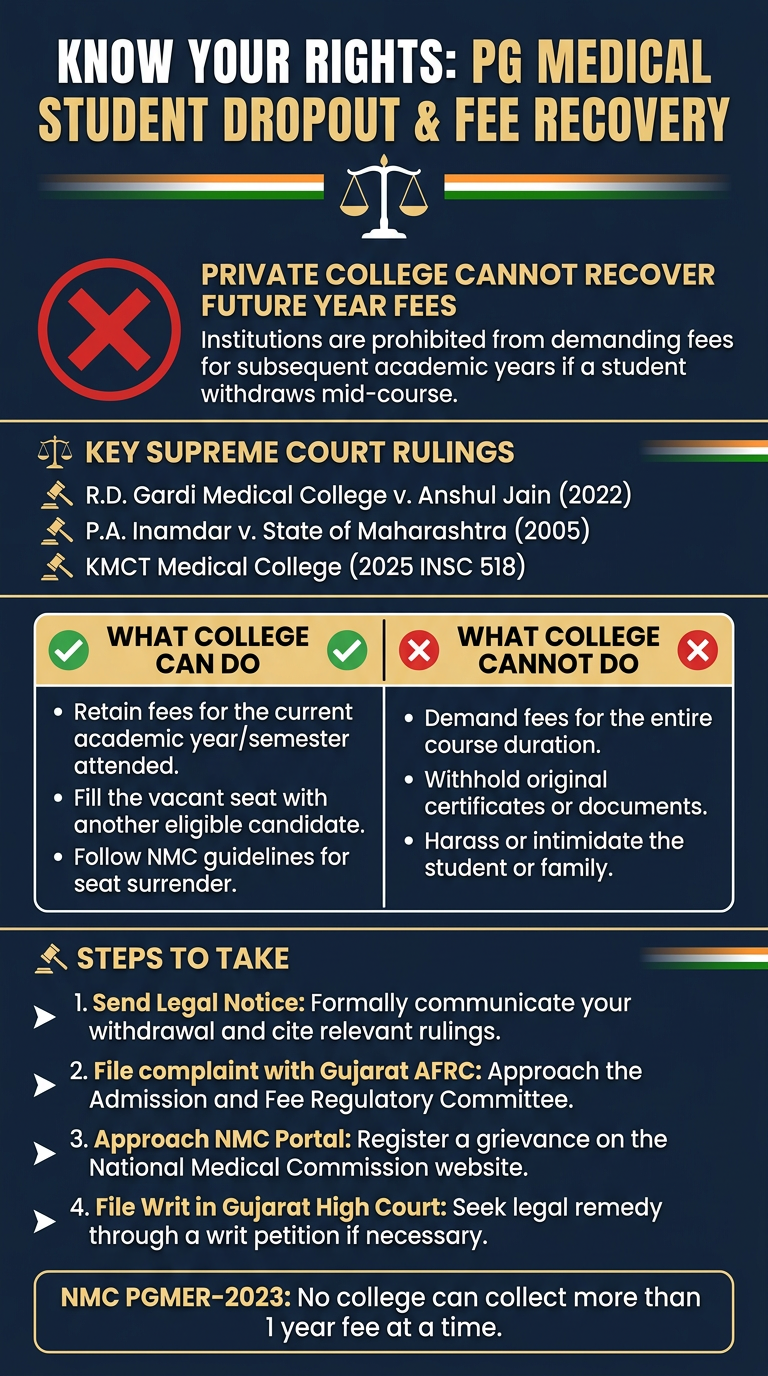
Key Legal Principles & Case Laws with URLs
1. Private Colleges Cannot Collect More Than 1 Year's Fee at a Time
"No private medical educational institution shall collect a fee amounting to more than one year's fee in an academic year. Collection of more than one year's fee shall be construed as capitation fee."
2. Private Colleges Cannot Force Bonds or Penalty Fees from PG Students
"Private medical colleges cannot ask students to execute bonds… they charge huge fees and offer no subsidy like government colleges." Court ordered refund of ₹5 lakh with 8% annual interest.
3. Fee Structure Must Be Reasonable — No Profiteering Allowed
"Every institution is free to devise its own fee structure subject to the limitation that there can be no profiteering and no capitation fee can be charged directly or indirectly."
4. NMC Regulation — PGMER 2023
5. Government Seat Bond — Different Rules Apply
What the College CAN vs. CANNOT Do
| ✅ College CAN | ❌ College CANNOT |
|---|---|
| Retain Year 1 fees already paid | Demand Year 2 & 3 fees as penalty |
| Retain security/caution deposit | Impose a service bond |
| Hold documents for actual outstanding dues | Withhold documents for future/unpaid years |
| Report vacancy to counselling authority | Bar student from future NEET-PG |
Action Plan for Your Friend
- Do not sign any undertaking agreeing to pay future fees
- Send a legal notice to the college citing the above cases
- File complaint with Gujarat AFRC — the statutory fee regulator
- Lodge grievance on NMC portal → nmc.org.in
- File Writ Petition in Gujarat High Court if documents are withheld — courts grant urgent relief in days
- Consumer forum complaint — education is a service under Consumer Protection Act 2019